
The popular advice is simple: lift weights to lose weight. The more accurate advice is narrower. Strength exercise for weight loss usually isn't a fast way to make the scale drop, but it can help you lose fat while preserving lean tissue, improve function, and make a calorie-deficit plan more sustainable.
Resistance exercise means repeated muscular effort against resistance, including body weight, bands, machines, or free weights. In obesity care, its role is to improve strength and function and protect lean mass during weight loss. It doesn't replace nutrition, aerobic activity, sleep, or individualized medical care. Adults considering physician-led weight-loss care should view strength training as one part of a broader plan, not as a test of willpower.
Table of Contents
- Why Strength Exercise Belongs in a Weight Loss Plan
- The Five Foundation Movement Patterns to Learn First
- A Beginner Blueprint for Two Weekly Sessions
- Pairing Strength Training With Cardio and a Calorie Deficit
- Form Cues and Safety Signals Every New Lifter Should Know
- Progressing Safely With a Six Week Composite Example
- When to Bring Strength Training Into Physician Led Care
Why Strength Exercise Belongs in a Weight Loss Plan
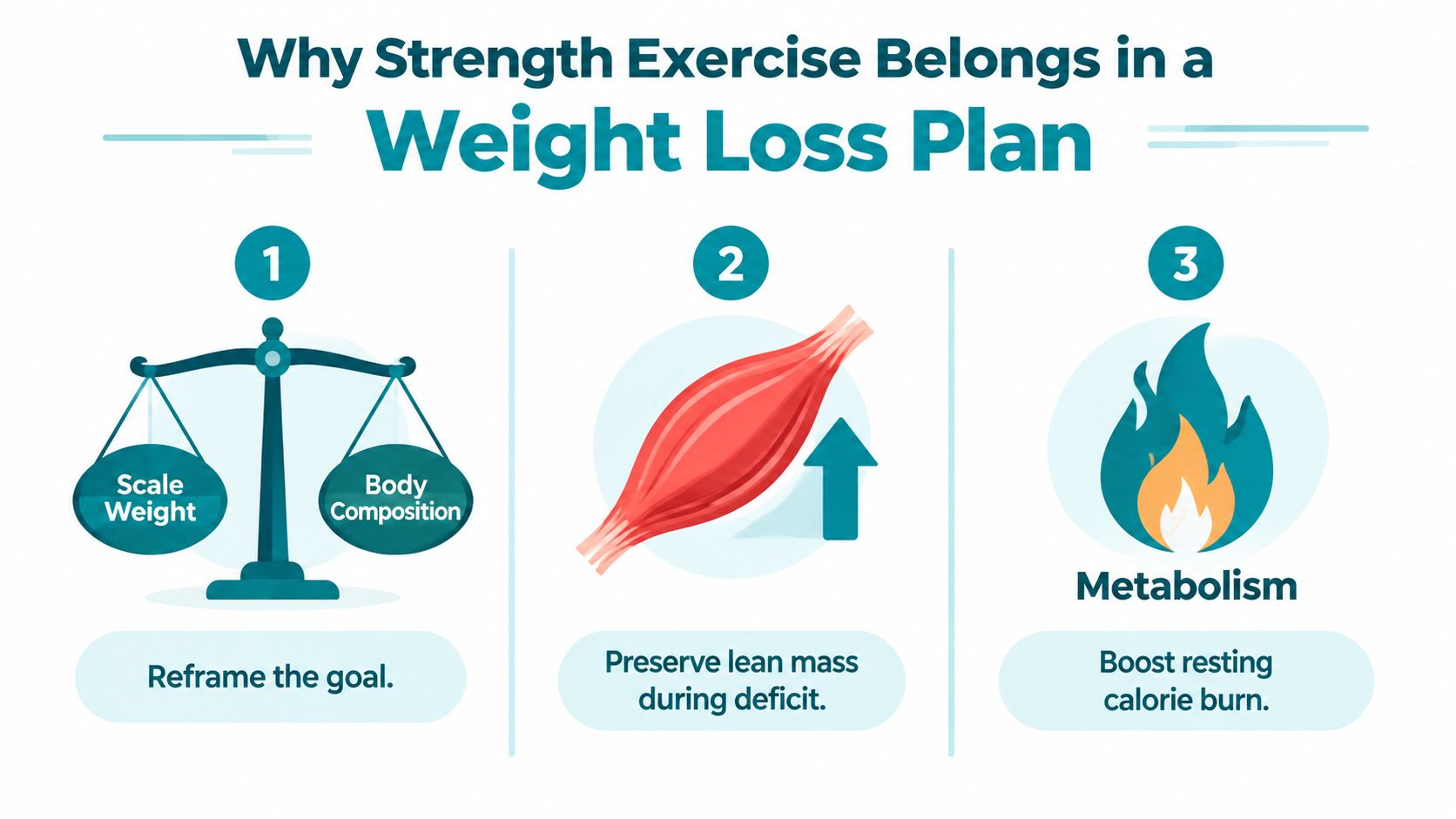
A lower number on the scale is only one outcome of weight loss. Strength exercise for weight loss is better understood as a body-composition tool: during a calorie deficit, the aim is usually less body fat with as much useful lean tissue as possible. Preserved muscle supports movement, balance, daily function, and continued participation in physical activity.
A 2022 systematic review and meta-analysis found that resistance training combined with caloric restriction reduced body-fat percentage by an average of 3.8 percentage points and whole-body fat mass by 5.3 kg compared with groups without intervention. It also found that adding resistance exercise to diet generally did not produce a large additional reduction in total body weight compared with diet alone. That distinction matters. Body composition may improve even when scale weight changes modestly. Read the systematic review and meta-analysis for the full evidence.
What the scale misses
Scale weight includes more than fat. Fluid shifts, food volume, glycogen, and preserved or gained lean tissue can all change short-term readings. Continue tracking weight if it helps, but also monitor waist trend, clothing fit, functional capacity, exercise performance, symptoms, and adherence.
The 2025 resistance-training meta-analysis reached a similar practical conclusion. It found no meaningful overall between-group change in body mass, with a mean difference of -0.32 kg, while resistance exercise preserved fat-free mass, increased fat loss, and improved strength. Review the 2025 analysis for its methods and findings.
Practical rule: Judge the program by more than pounds. Preserving lean mass can represent meaningful progress even when scale loss is modest.
Strength training can also help maintain the physical capacity needed for walking, cycling, and other aerobic activity. The CDC Physical Activity Guidelines for Americans recommend muscle-strengthening activity for all major muscle groups at least 2 days per week. For adults trying to lose more than 5% of body weight or maintain weight after losing it, the CDC guideline states that more than 300 minutes per week of moderate-intensity activity may be needed.
Adults considering physician-led weight-loss care should treat training dose, nutrition, recovery, symptoms, and medical supervision as connected decisions. A clinician may need to adjust activity when pain, fatigue, medication effects, or another health concern changes the risk-benefit balance.
For more detail on gradually increasing resistance work, review these progression strategies for lean muscle. Lifting alone does not guarantee rapid scale loss. Paired with an appropriate calorie deficit, it can improve the quality of weight loss and help preserve the capacity to stay active.
The Five Foundation Movement Patterns to Learn First
A beginner doesn't need a complicated exercise menu. A useful starting point is a small set of movements that addresses the major muscle groups and resembles ordinary tasks such as standing, reaching, pulling, carrying, and climbing stairs. The options below are examples, not a personal prescription.
| Pattern | Beginner exercise | Key cues | Primary muscles and function |
|---|---|---|---|
| Squat | Sit-to-stand from a chair | Keep the whole foot grounded. Let the knees track in line with the toes. | Thighs, hips, and trunk. Helps with standing and sitting. |
| Hinge | Wall-supported hip hinge | Push the hips backward. Keep the spine comfortable and steady. | Glutes and hamstrings. Supports lifting from the floor. |
| Push | Wall or incline push-up | Keep the body aligned. Move the chest toward the support under control. | Chest, shoulders, and arms. Helps with pushing tasks. |
| Pull | Seated band row | Draw the elbows back without shrugging. Pause briefly with the ribs relaxed. | Upper back and arms. Supports pulling and posture. |
| Carry | Light farmer carry | Walk with a tall torso. Keep the load close and steps controlled. | Grip, trunk, shoulders, and hips. Builds carrying capacity. |
The squat pattern doesn't require a barbell. A chair provides feedback and can make depth easier to control. The hinge is different from squatting because the hips travel backward while the trunk inclines as one unit. That distinction matters when learning to pick up a laundry basket or grocery bag.
For readers curious about how the squat, bench press, and deadlift are taught in a strength-sport setting, this beginner overview of squat bench deadlift for beginners offers useful context. You don't need to train like a powerlifter to benefit from foundational resistance work.
Keep the patterns balanced
The push and pull patterns should coexist. So should lower-body work and trunk control. Rotating variations can reduce repetitive stress and lets a person choose a tolerable version when a shoulder, knee, hip, or back feels limited.
A program can use machines, bands, dumbbells, or body weight. The equipment matters less than controlled movement, appropriate effort, and gradual progression. If an exercise causes sharp pain, changes how you move, or aggravates symptoms after the session, it needs to be adjusted or replaced.
A Beginner Blueprint for Two Weekly Sessions
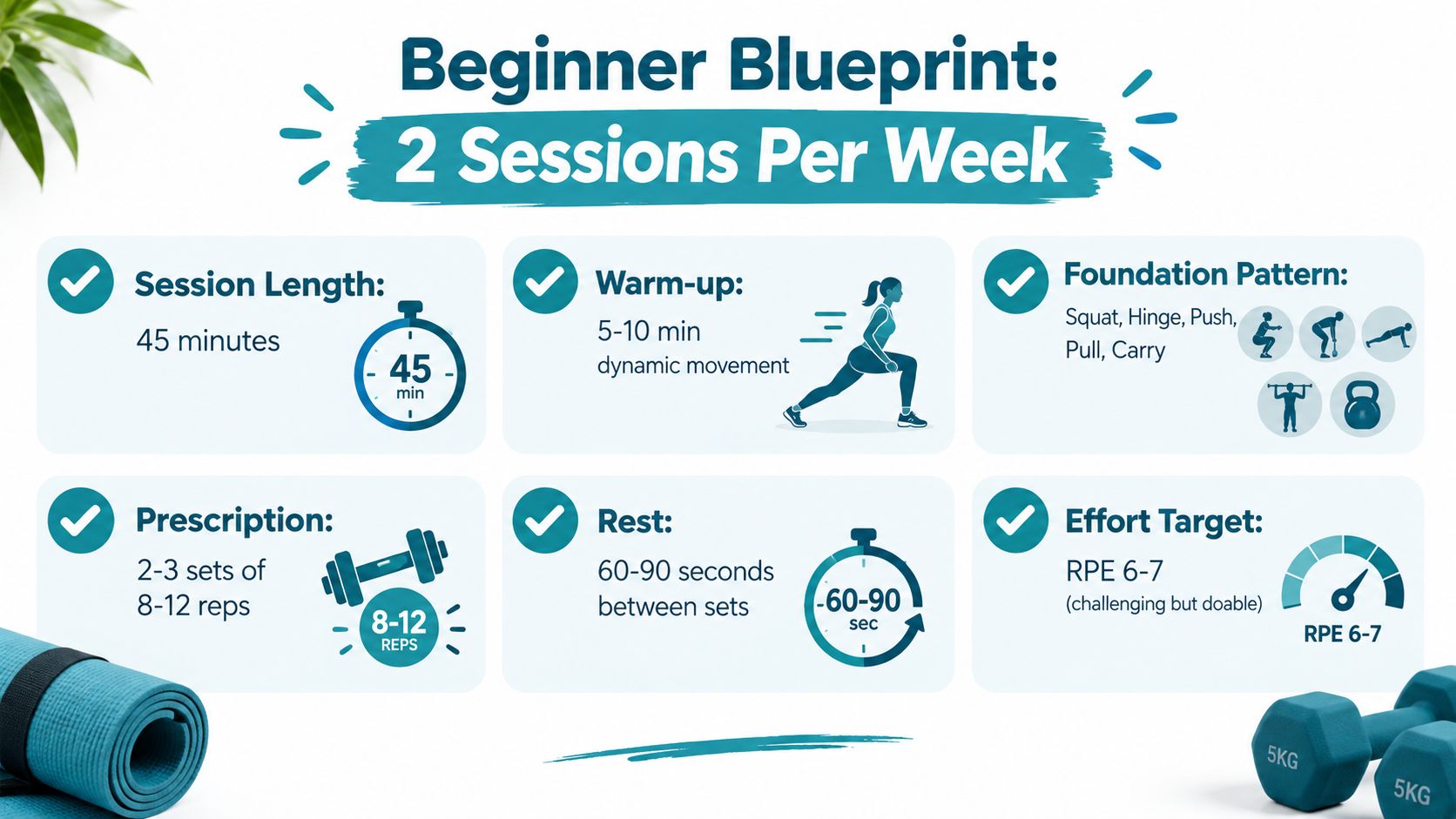
A workable example for a busy adult is two nonconsecutive full-body sessions each week, with each session lasting about 20 to 30 minutes when organized as a circuit. The exact duration can be longer or shorter depending on warm-up needs, rest, equipment, and experience. This is a framework to discuss with a qualified professional, not an individualized prescription.
Begin with several minutes of easy movement. Shoulder circles, gentle marching, body-weight sit-to-stands, and unloaded hinges can prepare the joints and help reveal whether a pattern feels comfortable that day. Then select one movement from each foundation pattern.
A worked example
The content owner's requested example uses one set of roughly 8 to 12 controlled repetitions, at a light-to-moderate effort that leaves 2 to 3 good repetitions in reserve. As technique and recovery permit, a person can progress toward 2 to 3 sets. Rest may be about 60 to 90 seconds, but longer recovery is reasonable when breathing, balance, or form hasn't returned.
A simple session could include:
- Squat pattern: Sit-to-stand or a supported squat.
- Hinge pattern: Wall hinge or a light dumbbell Romanian deadlift.
- Push pattern: Wall push-up or incline push-up.
- Pull pattern: Band row or supported machine row.
- Carry or core pattern: Farmer carry, suitcase carry, or a controlled trunk exercise.
- Calf or step pattern: Supported calf raise or a low step-up, if comfortable.
The perceived effort target is often described as RPE 6 to 7, meaning challenging but still controlled. Beginners don't need to chase a maximum load. They need repeatable practice with stable alignment, a comfortable range of motion, and recovery that allows the next session to happen.
If equipment is limited, dumbbells can replace machines, bands can replace many cable exercises, and body-weight variations can replace both. Knee, hip, shoulder, balance, cardiovascular, pregnancy, or recent-surgery considerations may require a lower starting point or a different movement.
For nutrition planning that supports a broader weight-management approach, the practice's nutrition guidance is a relevant place to start. A strength routine works better when the overall plan accounts for food intake, recovery, schedule, and medical factors.
A short demonstration can also make unfamiliar movements easier to understand:
Pairing Strength Training With Cardio and a Calorie Deficit
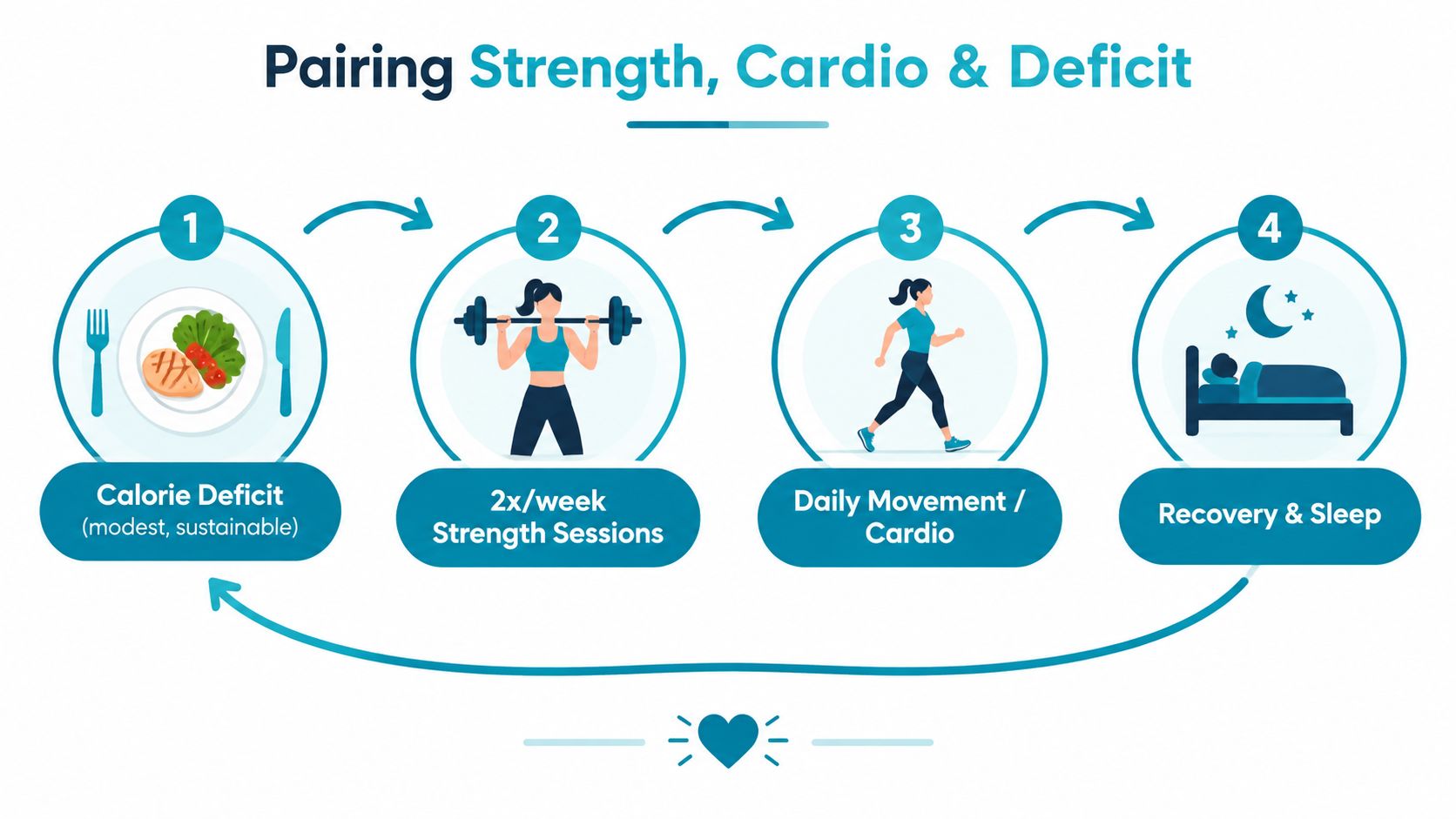
Strength training and cardio support different parts of weight management. Resistance exercise gives muscles a reason to retain lean tissue, while aerobic activity supports cardiorespiratory fitness and adds repeatable movement. The goal is not to make every session exhausting. A workable plan protects recovery well enough to continue.
Nutrition usually creates the calorie deficit. Strength training helps preserve body composition during that deficit, while walking or other aerobic activity can increase daily movement without requiring maximal effort. As noted earlier, the CDC guideline supports combining physical activity with nutrition changes rather than treating exercise as a substitute for dietary planning.
A flexible weekly arrangement
A sample schedule can separate demanding sessions and leave room for recovery:
| Day | Primary focus | Practical option |
|---|---|---|
| Monday | Full-body strength | Complete the planned movement patterns |
| Tuesday | Aerobic movement | Walking, cycling, or another tolerable activity |
| Wednesday | Recovery or easy movement | Gentle walking and mobility |
| Thursday | Full-body strength | Repeat with manageable variations |
| Friday | Aerobic movement | Comfortable steady activity |
| Saturday | Optional daily movement | Keep intensity easy if recovery is incomplete |
| Sunday | Recovery | Rest or light activity based on symptoms |
Strength and cardio can also occur on the same day. If both are demanding, place strength first when preserving lifting quality is the priority, or separate the sessions by several hours. An easy walk after strength training is less likely to interfere with recovery than hard intervals. Alternating days may suit adults who feel unusually fatigued, have joint symptoms, or are adjusting to reduced food intake.
A crowded day still has options. One set of each planned movement followed by a short walk may be more sustainable than waiting for a perfect hour. Sleep, hydration, and adequate protein intake affect recovery, particularly when appetite or food intake changes during structured treatment.
Readers comparing training schedules may find this discussion helpful for find the right cardio and strength mix. For nutrition planning, a calorie-deficit framework can clarify how food intake, activity, and recovery fit together. Adults with medication changes, pregnancy, recent surgery, or a relevant medical condition should coordinate exercise and nutrition adjustments with their clinician.
Form Cues and Safety Signals Every New Lifter Should Know
Good form isn't a performance aesthetic. It's a way to keep the intended muscles working and reduce unnecessary stress while learning a new task. Use a stable stance, keep joints aligned with the direction of movement, and choose a range of motion you can control.
For the five foundation patterns, the cues are straightforward:
- Squat: Keep the feet stable and let the knees follow the toes.
- Hinge: Move from the hips and avoid forcing the spine into a rigid or exaggerated position.
- Push: Keep the ribs and pelvis controlled rather than letting the back sag.
- Pull: Move the elbows without shrugging the shoulders toward the ears.
- Carry: Walk slowly enough to maintain a tall, steady torso.
Exhale during the harder phase instead of holding your breath for a prolonged period. Stop a set when form changes, balance deteriorates, or pain becomes sharp. A qualified coach can help when technique, physical limitations, or medical conditions make self-guided learning uncertain.
| Body signal | Normal effort, keep going or adjust | Red flag, stop and seek guidance |
|---|---|---|
| Muscle sensation | Working effort, warmth, and ordinary fatigue | Sudden sharp pain, tearing sensation, or acute joint pain |
| Breathing | Breathing harder but recovering with rest | Severe shortness of breath, chest pressure, or faintness |
| Balance | Stable movement with minor adjustment | New loss of coordination or a fall |
| Next-day response | Mild muscle soreness that settles | Marked swelling, worsening pain, or inability to use a joint normally |
| Technique | Controlled repetitions with a manageable range | Form changes despite reducing speed or resistance |
Make the environment predictable
Wear shoes that provide a stable base. Clear the floor, use a surface that isn't slippery, keep water nearby, and have a phone accessible if you're exercising alone. People with blood-pressure concerns can review the practice's blood-pressure care information before beginning a new program.
Normal effort shouldn't be confused with danger, and motivation doesn't override symptoms. Chest pain, faintness, severe shortness of breath, new neurologic symptoms, or an acute joint injury require stopping and appropriate medical evaluation.
Progressing Safely With a Six Week Composite Example
Progression doesn't mean adding weight every session. It means giving the body a manageable reason to adapt while keeping movement quality intact. A useful beginner strategy is rep first, load second. Increase repetitions within the planned range, then make a small load change only when the current version remains controlled.
The example below is a hypothetical composite, not an Empire patient case or a clinical benchmark. It uses functional observations such as chair stands, wall or incline push-ups at a consistent height, a comfortable loaded carry, and pain-free row repetitions. The same tests can be repeated after six weeks, alongside symptoms, form, recovery, waist and weight trends, and adherence.
| Week | Sets x reps | Effort, RPE | Load change | Focus |
|---|---|---|---|---|
| 1 | 1 x 8 | 6 | No change | Learn positions and identify tolerable variations |
| 2 | 1 x 9 to 10 | 6 | No change | Add repetitions only when form stays consistent |
| 3 | 1 x 10 to 12 | 6 to 7 | No change | Practice the upper end of the range |
| 4 | 2 x 8 | 6 | Small change only if technique is solid | Spread work across sets |
| 5 | 2 x 9 to 10 | 6 to 7 | Hold the same load | Build repeatability and recovery |
| 6 | 2 x 10 to 12 | 7 | Consider a small change after review | Recheck standardized functional measures |
This table isn't a reason to force progression. Repeat a week if pain, fatigue, or form worsens. Change only one variable at a time, such as repetitions, load, sets, or range of motion. A third weekly session may be considered only when two sessions are well tolerated and recovery is reliable, preferably with professional input for people managing medical limitations.
The scale may stay flat while clothing fit, waist trend, or functional performance improves. That is a reason to review the complete record, not automatically to abandon the program.
When to Bring Strength Training Into Physician Led Care
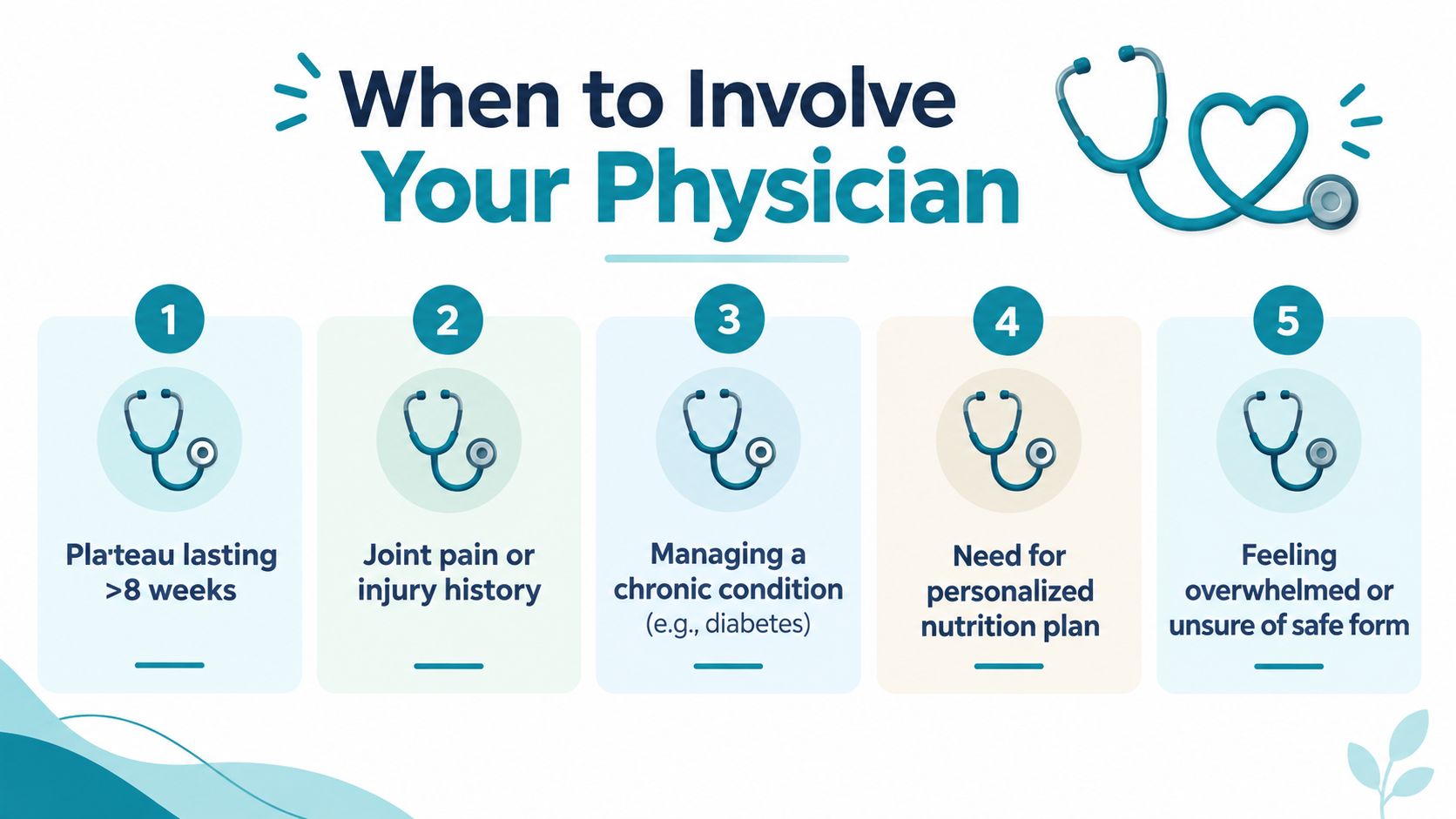
Strength training can support weight management, but it should not be treated as a stand-alone solution for every adult. Physician-led care adds screening, medication review, practical adjustments, and follow-up when joint pain, chronic disease, limited exercise tolerance, or stalled progress affects the plan.
Discuss the program with a qualified physician if you have:
- Weight and metabolic risk: A BMI at or above 30, a waist circumference above 40 inches in men or 35 inches in women, prediabetes, type 2 diabetes, dyslipidemia, or hypertension.
- Sleep and cardiovascular context: Sleep apnea or a family history of early cardiovascular disease.
- Movement limitations: Joint pain, a prior injury, balance concerns, or symptoms that make ordinary exercise difficult.
- Life-stage considerations: Pregnancy, recent surgery, or a major change in health status.
- Progress concerns: A weight-loss plateau lasting beyond 8 to 12 weeks despite consistent training and nutrition.
These are reasons to seek evaluation, not diagnoses. BMI screens risk but does not describe overall health, and waist circumference must be measured accurately and interpreted in context.
What medical follow-up can add
A clinician may review medical history, medications, sleep, nutrition, symptoms, and relevant laboratory testing. Body-composition testing, including DEXA when appropriate, may clarify whether a program is changing fat mass and fat-free mass. The best monitoring method depends on the person and the clinical question.
This review is particularly relevant for adults using or considering anti-obesity medication. A 2026 review found that resistance training may improve the composition of weight lost by supporting fat-mass reduction while preserving or increasing fat-free mass. A 2025 pilot randomized trial of a home-based resistance program during weight loss found no meaningful change in BMI, body mass, fat mass, or fat-free mass. The practical point is clear: the instruction to “do strength training” is incomplete. Dose, supervision, progression, pain, appetite changes, recovery, and follow-up all influence the result. Review the emerging evidence on resistance training during obesity treatment.
Physician-led weight-management care can connect nutrition, activity, medication when clinically appropriate, and follow-up while keeping decisions individualized. The plan can then change when health status, treatment, recovery, or goals change.
Empire Medical Wellness provides private-pay, physician-led obesity medicine that may include medical and metabolic assessment, individualized weight-management planning, medication review, and ongoing monitoring when clinically appropriate. Strength exercise is one part of that broader process, not a substitute for medical evaluation.
Byline: Empire Medical Wellness Editorial Team
Published: September 10, 2026
Updated: September 10, 2026
This article is educational and isn't personal medical advice.