
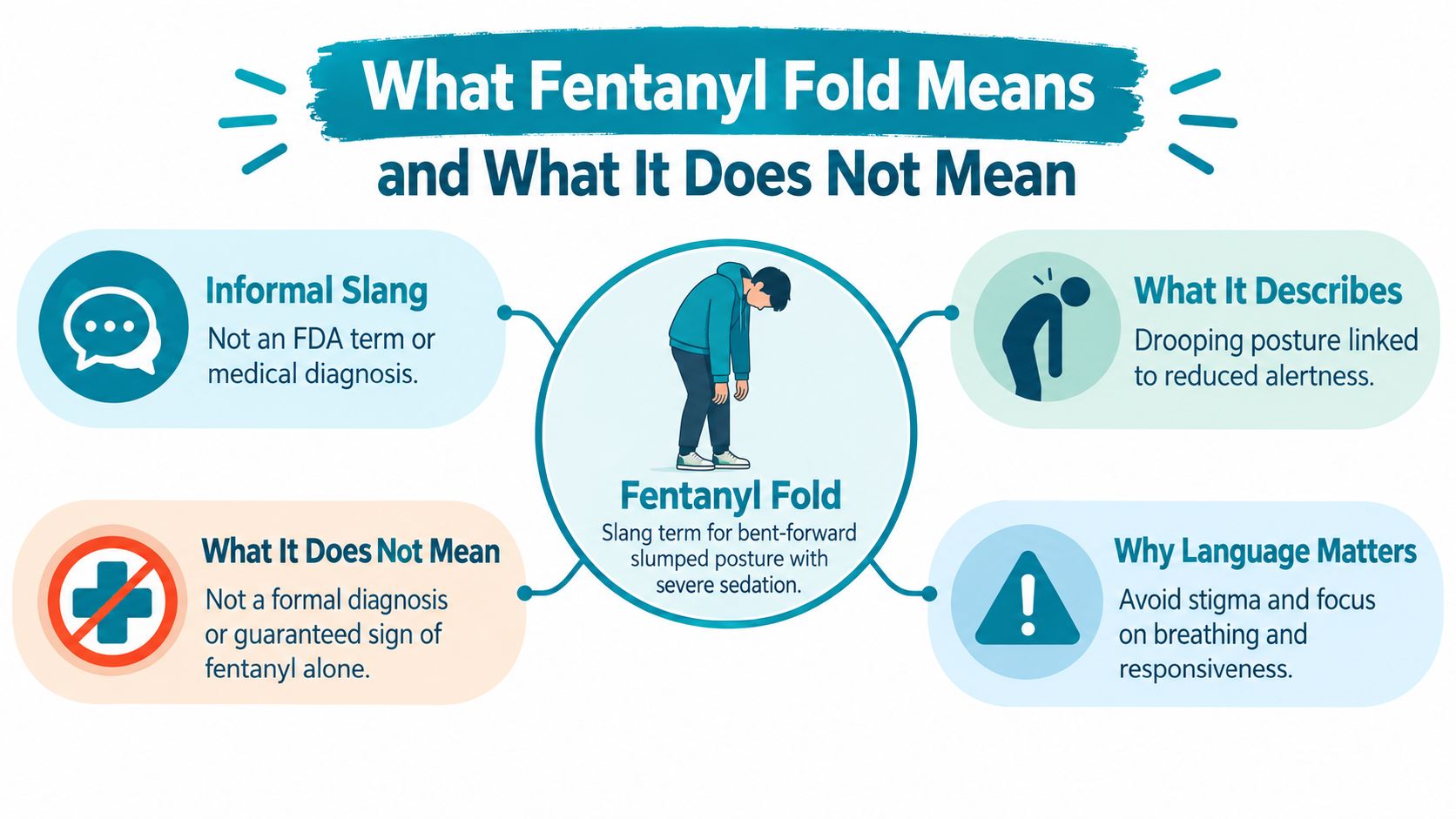
The fentanyl fold is informal slang for a bent-forward or slumped posture linked to severe opioid sedation, not a medical diagnosis. A posture alone can't confirm fentanyl exposure or prove that an overdose is occurring.
The most popular advice about this term is also the least reliable: identifying the posture isn't enough. The safer question is whether the person is responsive and breathing normally. Someone who appears folded over, whether standing, seated, or slumped, may be experiencing severe intoxication, an opioid overdose, another drug effect, or a different medical emergency.
This guide separates street language from medical facts. It explains what the posture may indicate, how to recognize danger, what bystanders should do, and why prescription fentanyl patch disposal is a completely different use of the word “fold.” It's educational information, not personal medical advice.
Table of Contents
- What Fentanyl Fold Means and What It Does Not Mean
- Why the Term Became Common in the Fentanyl Era
- How Severe Opioid Sedation Can Produce a Folded Posture
- Recognizing Possible Overdose and Responding Right Away
- Fentanyl Patch Folding Is Different From Street Slang
- A Labeled Hypothetical Shows Home Patch Safety in Practice
- When to Seek Confidential Care and How Empire Can Help
What Fentanyl Fold Means and What It Does Not Mean
Fentanyl fold is an informal street and media description for a person bent sharply forward at the waist, sometimes with the head drooping toward the chest. The person may look rigid, slumped, minimally responsive, or unable to maintain an upright stance. Coverage often links this appearance with severe opioid sedation, which means the brain and body are slowed by an opioid.
The phrase isn't an FDA term, and it isn't a formal medical diagnosis. It also doesn't identify the exact substance involved. The same posture could occur with severe opioid sedation, use of other central nervous system depressants, a combination of substances, exhaustion, illness, or another cause of impaired consciousness.
What the posture can and cannot tell you
Appearance can prompt concern, but it can't establish:
- The drug involved: A folded posture doesn't prove fentanyl was taken.
- The amount taken: The position can't reveal dose, potency, or timing.
- The medical state: It doesn't distinguish severe intoxication from a life-threatening overdose.
- The person's intent: A visual sign says nothing about why or how exposure occurred.
Practical rule: Treat the posture as a high-risk warning sign, then check responsiveness and breathing. Don't treat it as a diagnosis.
The terminology became more visible in the 2020s as illicit fentanyl spread through counterfeit pills and adulterated street drugs. That visibility has helped some people recognize possible danger, but mocking or labeling a person can delay care. Nonjudgmental language keeps attention on the immediate safety problem.
For readers seeking confidential information about substance-related concerns, the fentanyl education and care page can provide a relevant starting point. Emergency symptoms still require emergency services, not an outpatient appointment.
Why the Term Became Common in the Fentanyl Era
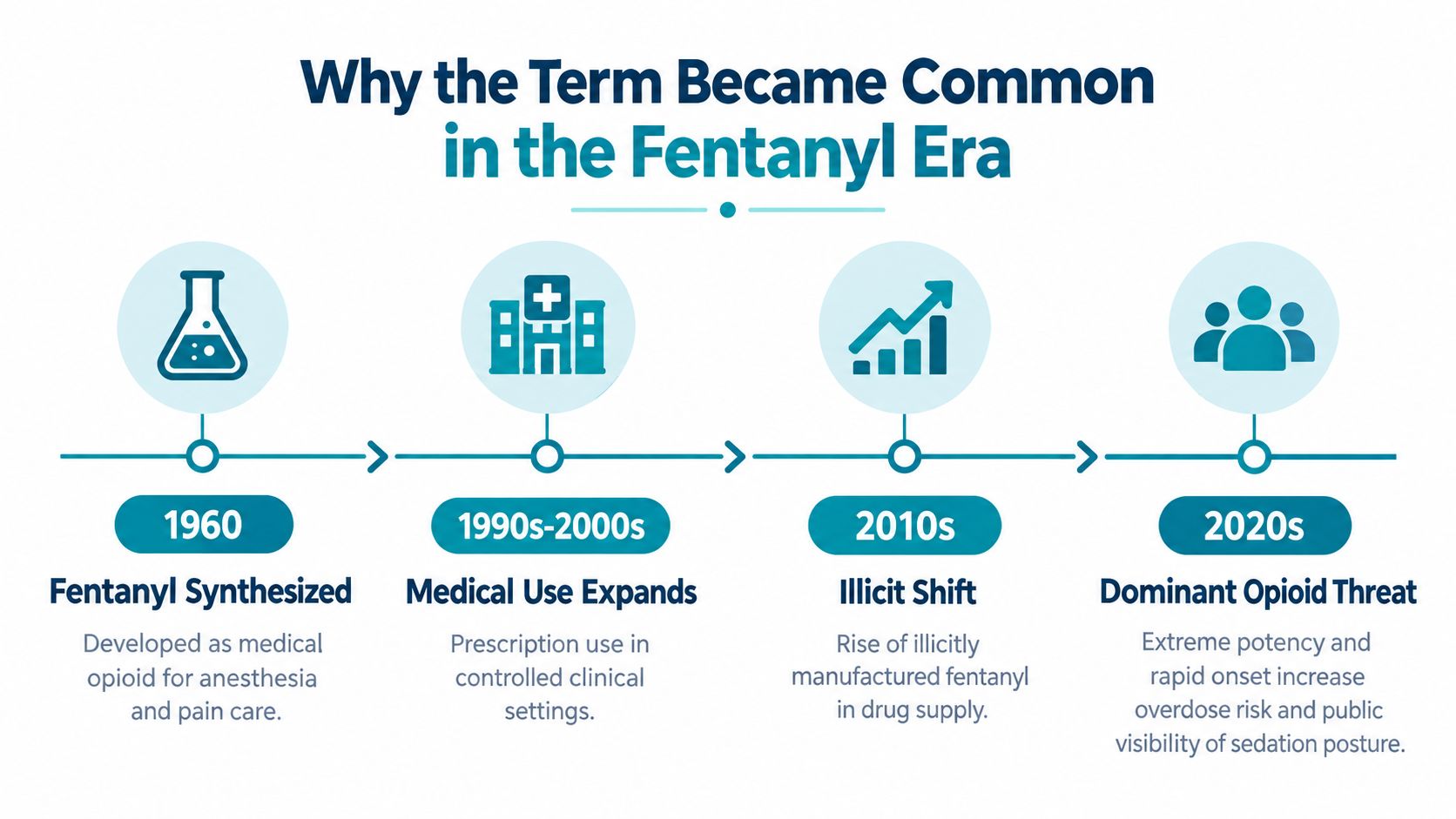
The phrase fentanyl fold became visible because fentanyl became more visible, not because a bent posture can identify a drug. Historical medical literature records fentanyl's synthesis in 1960, laying the foundation for a potent synthetic opioid later used in medical care. Over the following decades, fentanyl also appeared widely in illicit drug markets, especially during the 2010s and 2020s. The historical PubMed record on fentanyl provides context for its development and medical history.
Illicit fentanyl has been found in counterfeit pills and adulterated street drugs. A person may therefore encounter an opioid without knowing it. Reports have described visible sedation developing within 2 to 3 minutes after ingestion, although timing varies with the substance, route, amount, tolerance, and other factors.
Why mortality data changed the conversation
In the United States, deaths involving synthetic opioids other than methadone rose from 3,105 in 2013 to 72,776 in 2023, a more than 23-fold increase over roughly a decade, according to the fentanyl statistics overview. A change of that scale helped public-health workers, journalists, families, and clinicians describe severe opioid sedation using memorable visual language.
Fentanyl is also reported in more than 70% of opioid overdose deaths in the United States in the provided clinical background. The CDC overview of fentanyl describes fentanyl as a powerful synthetic opioid related to morphine and heroin and involved in many U.S. overdose deaths.
These facts explain public concern. They do not make posture a diagnosis. A person may appear folded without fentanyl, while someone overdosing may show no folded posture. Responsiveness and breathing determine the urgency of the response.
The term can also arise after suspected stimulant exposure, such as cocaine. That situation still requires assessment rather than assumption, since an illicit supply may contain unexpected substances. Information about cocaine-related medical concerns cannot replace emergency evaluation when someone is difficult to wake or breathing abnormally.
How Severe Opioid Sedation Can Produce a Folded Posture
A folded posture is an effect, not a diagnosis. Severe opioid-induced central nervous system depression can affect alertness, muscle control, and breathing at the same time. The brain and spinal cord slow down. Muscle tone may weaken. The brain's drive to breathe may also fall.
Central nervous system depression means the nervous system is working more slowly than usual. A person may remain partly upright because some muscle activity continues, yet be too sedated to straighten up, protect their balance, or respond to nearby people. The body may bend at the waist, the head may droop, or the person may appear rigid or half-standing.
Posture alone cannot identify fentanyl or any other substance. Alcohol, sedative medicines, and other drugs can worsen sedation. A stroke, seizure, low blood sugar, or another medical problem can also alter posture and awareness. The appearance gives context, not a confirmed cause.
Why breathing changes the level of concern
Fentanyl is a potent opioid that can cause respiratory depression. This means breathing becomes too slow, shallow, irregular, or stops. Experimental research has found rapid effects on ventilation in animal models, as described in this peer-reviewed physiology study.
A person who is bent forward may still be breathing, but that does not show that breathing is safe. Sedation can worsen, especially when other depressants are involved. A posture that looks stable can hide poor oxygen exchange or a fading level of consciousness.
A still-standing person can be medically unstable. Upright posture does not guarantee adequate breathing or consciousness.
Use the posture as a prompt to assess the person, not as a label. Look for a response to a loud voice and gentle stimulation. Observe whether the chest rises normally. If the person is difficult to wake or breathing abnormally, get emergency help without waiting to identify the drug.

The same principle applies to other sedating substances. Information about barbiturate overdose risks can explain why impaired consciousness needs prompt medical attention, regardless of posture or the suspected drug.
Recognizing Possible Overdose and Responding Right Away
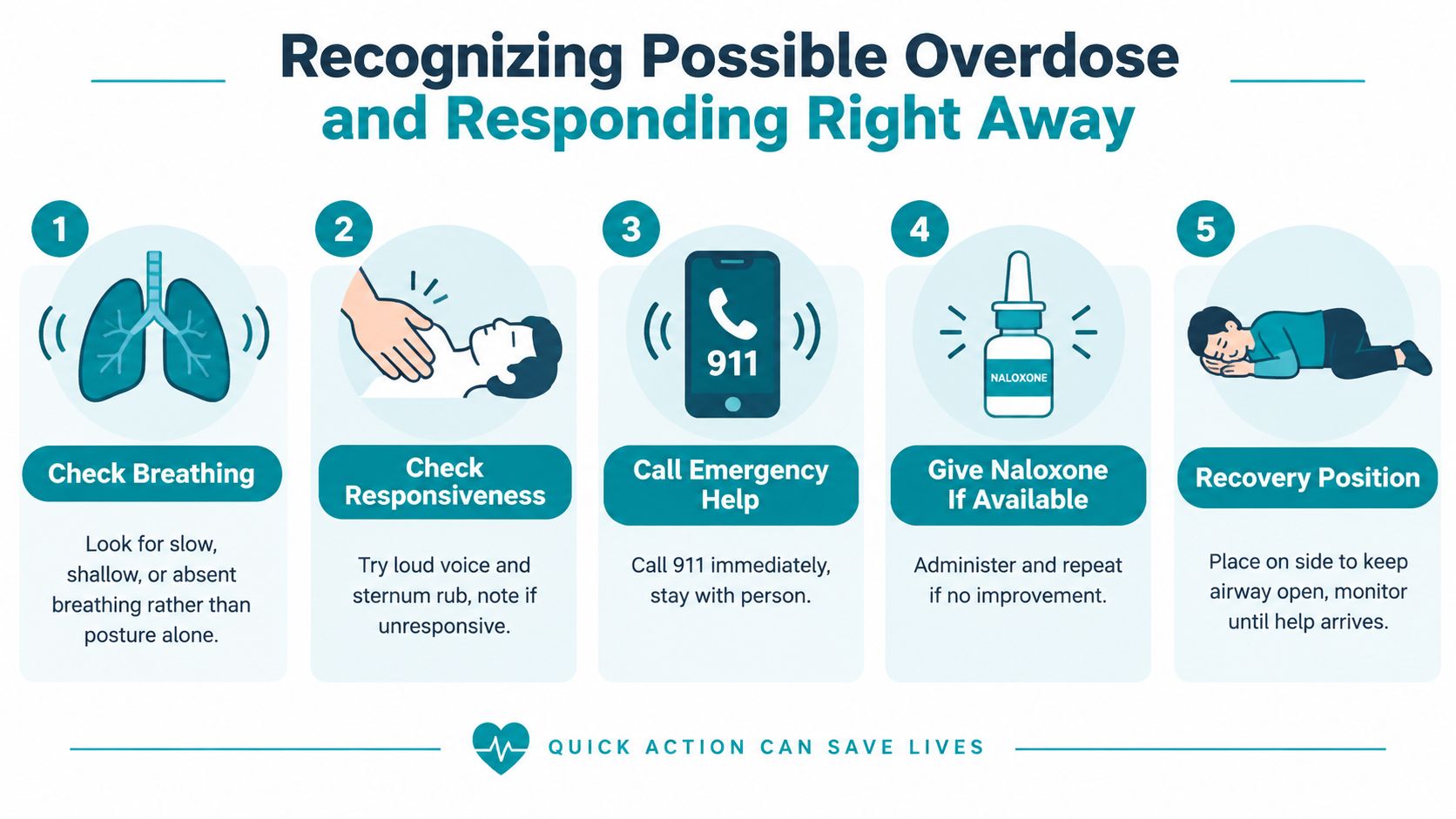
When someone appears folded over, the first priority is responsiveness and breathing, not identifying the drug. Look for slow, shallow, absent, or abnormal breathing. Check whether the person responds to a loud voice or gentle stimulation. Blue, gray, or pale lips or skin can signal inadequate oxygen, but color can be difficult to assess in some lighting and skin tones.
Call 911 immediately when the person is unresponsive, breathing slowly or abnormally, or not breathing. If naloxone is available, give it according to the product label. Naloxone reverses opioid effects, but it doesn't treat every possible cause of unconsciousness, so emergency evaluation remains necessary.
A field checklist for bystanders
- Make the scene safe. Avoid contact with unknown powders, liquids, needles, or patches. Ask others to help while you call.
- Check responsiveness. Use a loud voice and gentle physical stimulation. Don't delay emergency care while trying to identify the substance.
- Look at breathing. Observe the chest and listen for normal breathing. Gasping, very slow breathing, or no breathing is an emergency.
- Call 911. Give the location and describe the person's responsiveness and breathing.
- Give naloxone if available. Follow the package directions. If there's no improvement, repeat it as directed while waiting for responders.
- Protect the airway. If the person is breathing, place them on their side when possible and continue monitoring. Don't leave them alone.
Repeat naloxone may be needed when there's no improvement, particularly when fentanyl or more than one substance may be involved. Don't assume that a person is safe because they briefly wake up. Opioid effects can return, and naloxone doesn't remove the need for professional assessment.
The naloxone information page offers additional educational context. For an emergency, call 911 first or have another person call while you provide assistance.
Folded Posture Field Triage Checklist
| Observation | What It May Suggest | Immediate Action |
|---|---|---|
| Person is bent forward but responds normally | Possible intoxication, fatigue, pain, or another condition | Stay alert, ask whether they need help, and reassess if their condition changes |
| Person responds slowly or can't stay awake | Severe sedation or impaired consciousness | Call 911 if responsiveness is poor or worsening |
| Breathing is slow, shallow, irregular, or absent | Possible opioid overdose or another life-threatening emergency | Call 911 and give naloxone as labeled if available |
| Lips or skin look blue, gray, or unusually pale | Possible oxygen problem | Call 911 immediately and monitor breathing |
| No improvement after naloxone | Ongoing opioid effect or another cause of unconsciousness | Continue emergency response, repeat naloxone as directed, and stay with the person |
Fentanyl Patch Folding Is Different From Street Slang
The word folding has a separate meaning for some prescription transdermal fentanyl patches. It doesn't describe a person's posture. It refers to a disposal step that may appear in the current FDA Medication Guide for a specific product.
For a used prescription patch, follow the exact instructions for that brand and formulation. When the label directs folding, bring the adhesive sides together immediately so the sticky, drug-containing surface is enclosed. Then use the disposal method identified by the label and local rules, such as an FDA take-back option or flush-list instruction where applicable.
Product-specific patch safety
Never improvise with a fentanyl patch. The following checklist is a safety reminder, not a substitute for the current product label:
- Keep it secured: Store unused and used patches away from children and pets.
- Don't cut it: Cutting can damage the patch and release medication.
- Don't heat it: Heat can increase drug release and create a serious exposure risk.
- Don't reuse it: A used patch may still contain fentanyl.
- Don't tape or reapply a loose patch: Follow the product's instructions for a detached patch.
- Verify the exact label: Disposal directions can vary by product and must be checked against the current FDA Medication Guide.
The FDA's fentanyl transdermal system Medication Guide should be treated as the controlling source for product-specific instructions. Internet discussions about the fentanyl fold don't provide safe patch-handling guidance.
This distinction also matters when a reader sees a link about another kind of patch. Information about a nicotine patch doesn't replace instructions for a fentanyl product. Don't generalize disposal advice across medications.
A Labeled Hypothetical Shows Home Patch Safety in Practice
Hypothetical example, not an Empire patient case: A caregiver finds a partially detached used fentanyl patch within reach of a child or pet. The caregiver shouldn't reapply it, cut it, tape it to another person, or leave it on a counter while deciding what to do.
First, prevent further contact and follow the exact exposure and disposal instructions for that product. If there may have been contact or ingestion, call Poison Control at 1-800-222-1222 for exposure questions. If anyone has breathing problems or is unresponsive, call 911 immediately. Naloxone may be needed when opioid overdose is suspected.
A home patch-safety checklist
- Separate people and pets from the patch. Don't touch the sticky medication surface unnecessarily.
- Read the current Medication Guide. Use the instructions for that exact brand and formulation.
- Enclose the patch when directed. If the label says to fold it, bring adhesive sides together as instructed.
- Use the labeled disposal route. Don't rely on a generic internet recommendation.
- Report possible exposure promptly. Poison Control can help with exposure-specific questions.
- Escalate breathing symptoms. Call 911 for breathing problems, severe sedation, or unresponsiveness.
- Don't casually store a loose used patch. Keep it away from children and animals until disposal is complete.
A partially detached patch is a medication-safety issue, not an example of the street term. The two meanings share a word but require different responses. One describes an informal posture. The other concerns handling a potent prescription medication under FDA labeling.
When to Seek Confidential Care and How Empire Can Help
A single posture can't diagnose opioid use disorder, fentanyl exposure, or any other condition. Recurrent episodes of severe sedation, concern about an unpredictable drug supply, or difficulty controlling substance use deserves a confidential medical conversation.
Emergency care comes first when someone is unresponsive or breathing abnormally. For non-emergency concerns, outpatient addiction medicine can include medical assessment, evidence-based treatment when clinically appropriate, monitoring, recovery planning, and coordination with outside clinicians or treatment programs when useful and authorized.
Empire Medical Wellness is a private-pay, physician-led outpatient practice. Dr. Chhatpar provides direct care in addiction medicine, with a focus on thoughtful evaluation and individualized next steps. The practice doesn't provide emergency response, detoxification, inpatient, residential, partial-hospitalization, or intensive-outpatient services.
For patch exposures, contact Poison Control at 1-800-222-1222. For suspected overdose, call 911, give naloxone as labeled if available, and stay with the person until emergency responders arrive.
If you're concerned about recurrent sedation, fentanyl exposure, or substance use, Empire Medical Wellness offers confidential outpatient physician-led addiction medicine assessment, monitoring, and recovery planning. Visit the practice site to learn whether this type of care fits your non-emergency needs and to request an appointment.
Byline: Empire Medical Wellness Editorial Team
Published: September 10, 2026
Updated: September 10, 2026
Sources
- CDC overview of fentanyl
- FDA fentanyl transdermal system Medication Guide
- PubMed historical fentanyl record
- Peer-reviewed study of fentanyl and ventilatory depression
This article is educational and isn't personal medical advice.