
A calorie deficit means eating fewer calories than your body uses, and clinical weight-loss programs often begin with a 500–750 kcal/day deficit rather than the largest possible restriction. NIDDK also describes 1–2 pounds per week and 5%–10% of current body weight within six months as practical weight-management benchmarks for many adults, but neither target is a personal guarantee.
What if the number on a calorie app looks precise, but your hunger, energy, activity, medications, and real-world weight trend tell a different story? A calorie deficit is an educational estimate, not a diagnosis or a safe-use guarantee. The useful question isn't how to eat less. It's how to estimate energy needs transparently, preserve nutrition and function, verify what happens over time, and recognize when physician input is warranted.
Table of Contents
- What a Calorie Deficit Means in Plain Language
- How Energy Balance and Metabolism Work
- Safe Deficit Ranges and What Guidelines Recommend
- Estimating and Verifying Your Deficit in Practice
- Metabolic Adaptation and Why Plateaus Happen
- Common Pitfalls and Special Considerations
- When to Bring It to a Physician and Next Steps
What a Calorie Deficit Means in Plain Language
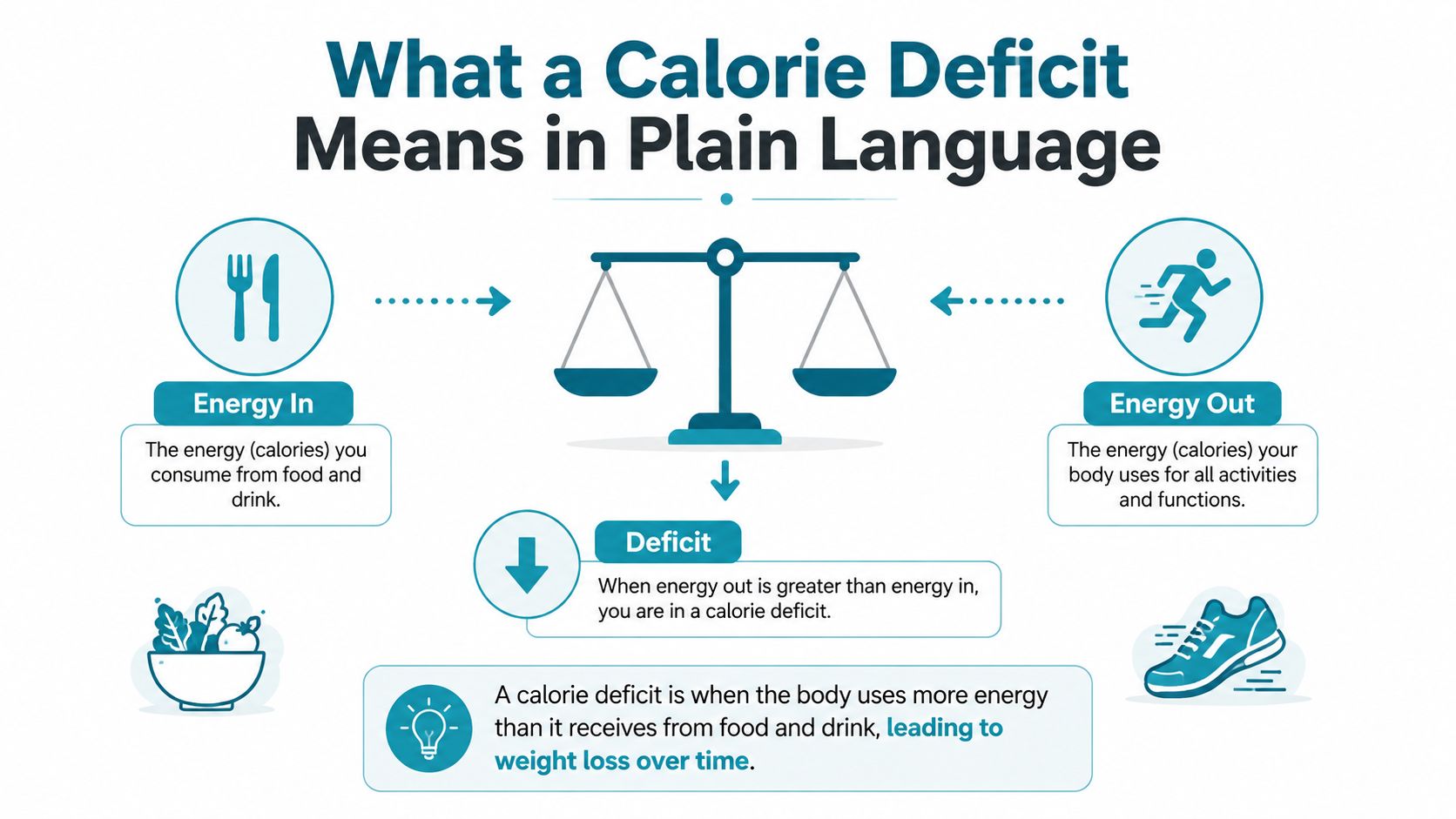
A calorie deficit occurs when your body uses more energy than it receives from food and beverages. To cover the difference, the body draws on stored energy, and body weight generally declines over time.
The calculation has two sides:
- Energy in includes meals, snacks, calorie-containing drinks, oils, sauces, condiments, and small tastes that are easy to overlook.
- Energy out includes the energy required for basic body functions, digestion, planned exercise, and ordinary movement such as walking, standing, and household tasks.
A deficit isn't a moral score. It doesn't measure discipline or character. It describes an energy relationship that changes as body weight, activity, appetite, health, and treatment change.
Clinical guidance commonly discusses a daily deficit of about 500–750 calories for weight-loss programs, although the appropriate starting point depends on the person's circumstances. A 500-calorie difference may feel manageable for one adult and disruptive for another. The same target can also produce different results because calorie intake and expenditure are estimates, not laboratory measurements.
The practical aim
The purpose isn't to create the biggest deficit you can tolerate for a short period. A sound plan should support adequate nutrition, daily functioning, physical activity, sleep, mood, and long-term maintenance.
NIDDK materials use the teaching rule that losing one pound in a week would require a 500-calorie daily deficit for seven days, based on the traditional idea that about 3,500 calories equals one pound. That rule is useful for teaching basic arithmetic, but body weight doesn't respond as a fixed linear equation indefinitely. The body becomes lighter, energy expenditure changes, water shifts, and tracking errors affect the observed result. NIDDK's structured education manual provides the teaching rule, while the research literature supports a more dynamic interpretation.
The rest of a responsible discussion therefore needs more than a target number. You need to understand basal metabolic rate, total daily energy expenditure, the limits of equations, guideline-aligned ranges, and the process of checking a two-to-four-week trend. Symptoms such as dizziness, weakness, persistent fatigue, or compulsive restriction can matter as much as the scale.
How Energy Balance and Metabolism Work
How can two people with similar measurements need different calorie targets? Energy balance helps explain why. The body manages energy through several overlapping demands, much like a household paying for fixed services, daily errands, and food preparation. Total daily energy expenditure, or TDEE, is the combined estimate of those demands.
Basal metabolic rate, or BMR, is the energy used for essential functions at rest. TDEE includes BMR, planned physical activity, ordinary movement, and the thermic effect of food, meaning the energy required to digest and process nutrients. These categories are useful for organizing an estimate, although each one can vary.
| Component | What it includes | How estimates are used |
|---|---|---|
| Basal metabolic rate | Essential functions at rest | Provides a starting estimate, not a calorie prescription |
| Physical activity | Planned exercise and training | Adjusts the estimate for structured movement |
| Daily movement | Walking, standing, chores, and other activity | Helps explain differences in energy needs |
| Thermic effect of food | Energy used to digest and process food | Adds another variable to the total estimate |
A transparent equation
A commonly used BMR estimate is the Mifflin–St Jeor equation:
- For men:
10 × weight in kilograms + 6.25 × height in centimeters − 5 × age + 5 - For women:
10 × weight in kilograms + 6.25 × height in centimeters − 5 × age − 161
The calculation uses body weight, height, age, and sex, then an activity adjustment estimates TDEE. Subtracting a proposed deficit creates a starting target. It does not directly measure metabolism or guarantee a particular rate of weight change.
Apps can produce different results because they use different equations, activity categories, food databases, and user inputs. Exercise calories may be overestimated, while portions, beverages, cooking oils, and weekend intake may be under-recorded. Treat an app's result as a hypothesis to test against observed trends, rather than as a biological fact.
The NIDDK Body Weight Planner models calorie intake and physical activity for a specific goal weight and time period, including maintenance planning. It can make the assumptions behind an estimate easier to see, but it does not replace clinical judgment or measure an individual's metabolism.
For broader nutrition context, adults can review Empire Medical Wellness nutrition information. Pair any calculator with observations of hunger, energy, training, adherence, and health status. A two-to-four-week trend can show whether an estimate fits real life, while symptoms or major changes in health may warrant medical input.
Safe Deficit Ranges and What Guidelines Recommend
What makes a calorie deficit reasonable? It must fit estimated maintenance needs, nutritional requirements, medical history, treatment plans, and the person's ability to sustain it. A generic chart cannot account for pregnancy, eating-disorder risk, medication effects, unstable illness, or a major change in activity.
Clinical programs often begin with a 500–750 kcal/day deficit when the estimate and health context support it. NIDDK guidance discusses 1–2 pounds per week and a longer-term goal of 5%–10% of current body weight within six months for many adults. These figures are reference points, not guarantees. NIDDK's adult obesity treatment guidance emphasizes realistic goals and individualized care.
| Approximate daily deficit or intake | Typical use | Important limitations |
|---|---|---|
| 500–750 kcal/day deficit | A commonly used clinical starting range when estimated maintenance and health status support it | The estimate may become less effective as body weight and expenditure change |
| Individualized intake ceiling | A target built from estimated TDEE, food preferences, activity, nutrition needs, and observed response | It isn't a fixed biological threshold and must be checked against real-world trends |
| 1,000–1,500 kcal/day intake | Low-calorie diets that may be used in selected clinical weight-loss programs | NIDDK advises adults not to eat below 1,200 calories per day, and larger restrictions shouldn't be self-imposed |
The table separates a deficit from total daily intake. A 500-calorie deficit means eating 500 calories below estimated maintenance. It does not mean eating 500 calories, nor does it reveal the person's maintenance level.
A review of obesity guidelines describes low-calorie diets commonly within the 1,000–1,500 kcal/day range, with 500–750 kcal/day deficits often used in clinical programs. The guideline review also reported that, in a 14-week study of 54 adults with overweight or obesity, participants averaging more than a 500 kcal/day deficit lost nearly four times as much weight as those below that threshold. The finding supports consistent adherence, not an extreme cut.
NIDDK's practical guidance says eating less than 1,200 calories per day isn't advised, and gives example daily targets of 1,200, 1,500, 1,800, or 2,000 calories depending on current weight. Lower intake is not automatically better. Severe restriction can increase hunger and fatigue, create nutrient shortfalls, raise medication-related concerns, and make adherence harder. Adults considering physician-led weight management can review Empire's weight-loss information while discussing individual safety with a qualified clinician.
Estimating and Verifying Your Deficit in Practice
Could an estimated calorie target be wrong even when an app presents it confidently? Yes. A deficit is a working estimate, not a promise. A clinician or qualified professional may use the Mifflin–St Jeor equation to estimate BMR, adjust for activity to approximate TDEE, and then choose a modest deficit. Dynamic planning tools can model how energy needs may change over time, but they still depend on the information entered and cannot predict an individual response with certainty.
A hypothetical example
Consider a hypothetical 42-year-old woman whose fitness app suggests a 1,500-calorie daily target. The estimate may miss medications, weekend activity, portion sizes, snacks, or changes in routine. It also cannot determine whether the target produces excessive hunger or fatigue.
A two-to-four-week observation period can provide a clearer signal than isolated scale readings. Record:
- Weight trend, measured under reasonably consistent conditions
- Food and beverage intake, including oils, sauces, alcohol, and snacks
- Hunger and energy, especially during work and exercise
- Activity and training, without treating exercise calories as guaranteed extra food
- Adherence, including incomplete logging and difficult days
- Waist measurement, if appropriate and not distressing
Compare the overall trend with the expected direction. Water, sodium, digestive contents, and menstrual-cycle changes can hide short-term changes. A faster-than-intended decline, persistent symptoms, or marked fatigue calls for plan review rather than a larger restriction. When the trend does not match the estimate, first check portions, beverages, cooking oils, activity assumptions, medications, and logging completeness.
Resting metabolic rate testing can clarify the difference between an equation-based estimate and a measured value. This Telomyx RMR testing insight also illustrates why testing has limits. No measurement guarantees a particular rate of weight change.
| Assumption | Observed result to review |
|---|---|
| App-estimated maintenance | Weight trend over two to four weeks |
| Logged food intake is complete | Portions, beverages, oils, snacks, and weekends |
| Activity estimate reflects actual movement | Training, steps, fatigue, and routine changes |
| Planned deficit is tolerable | Hunger, energy, strength, mood, and adherence |
| Target remains valid | Recalculation after meaningful weight change |
A persistent mismatch merits clinical review, not automatic severe restriction. A structured balanced meal approach for weight loss can help organize food choices, but it is not an individualized prescription. Empire Medical Wellness's weight-loss information may offer general context while a qualified clinician evaluates medical history, medications, symptoms, and safety.
Metabolic Adaptation and Why Plateaus Happen
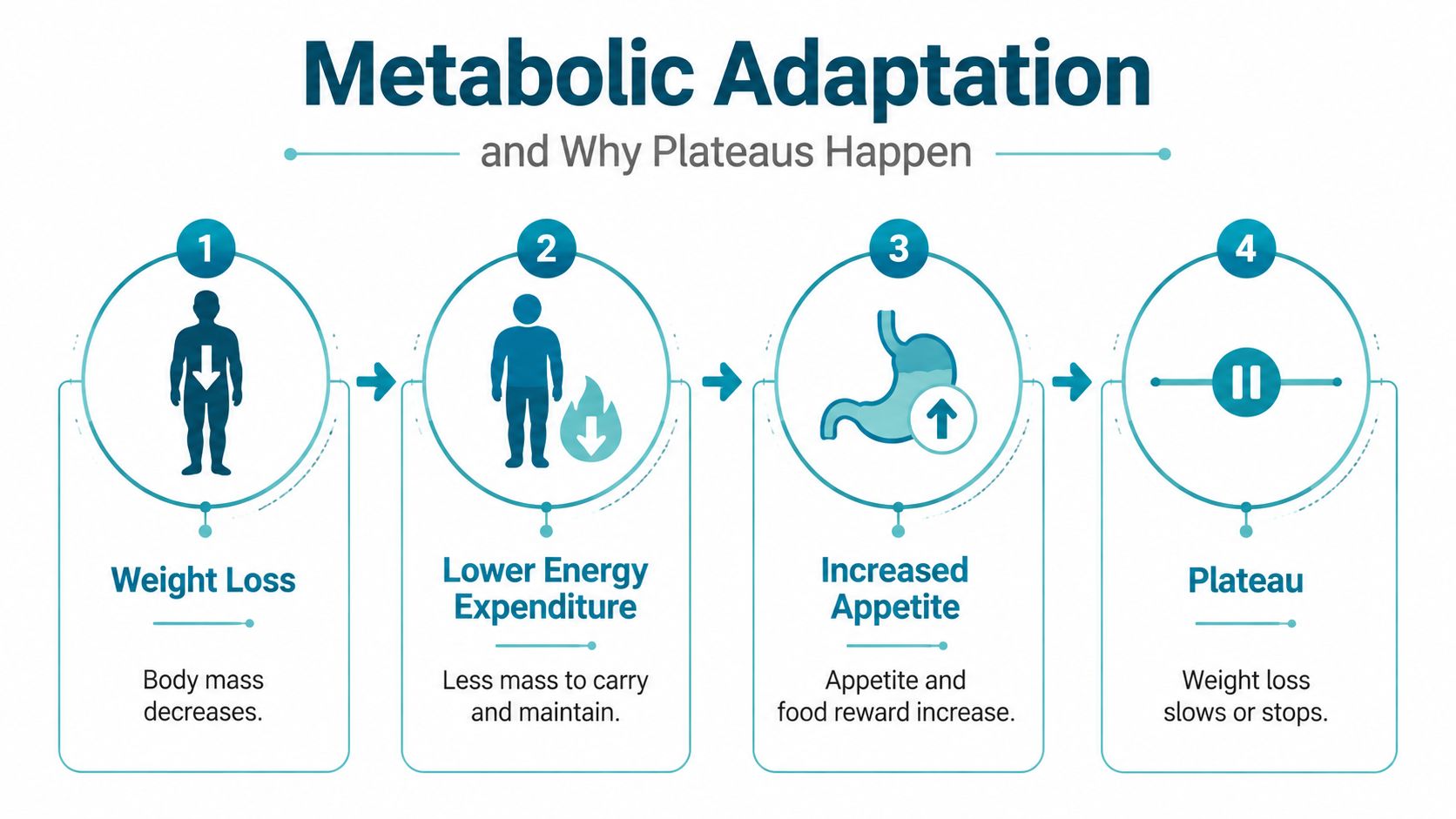
Why can the same calorie target produce slower progress over time? Weight loss lowers energy expenditure in two connected ways. A lighter body needs less energy to maintain and move, while the body may also adjust beyond what changes in body composition predict. This additional reduction is called metabolic adaptation or adaptive thermogenesis.
A human calorie-restriction study found that sedentary 24-hour energy expenditure fell by about 117–135 kcal/day after six months, roughly 6% beyond the reduction predicted by body-composition changes. The study abstract offers useful context, not a personal correction factor.
The practical implication is simple. A target that created a meaningful deficit initially may create a smaller one later. Appetite, food reward, fatigue, and less spontaneous movement can also make the original plan harder to follow. Early scale loss may include water, glycogen, sodium-related fluid shifts, and digestive contents, so the scale is not a direct measure of fat loss.
A clinician decision checklist
Before changing an estimate, examine the pattern rather than reacting to one weigh-in:
- Measurement quality: Are portions, beverages, oils, snacks, and activity recorded consistently?
- Time frame: Is the plateau a sustained trend or ordinary short-term fluid variation?
- Daily movement: Has fatigue reduced steps or activity outside planned workouts?
- Health context: Have sleep, stress, illness, menopause-related changes, or medications changed?
- Function: Are hunger, energy, strength, mood, or exercise tolerance worsening?
- Nutrition quality: Does the plan include adequate protein, fiber, and micronutrient-dense foods?
- Recalculation: Has estimated maintenance been updated after meaningful weight change?
A plateau does not automatically call for severe restriction. Recheck the assumptions in the estimate, assess food quality and activity, and seek medical evaluation when symptoms or function worsen. Adults considering physician-led care can review obesity medicine information while discussing personal risks and options with a qualified clinician.
A review describes adaptation across different time scales, including approximately 72 kcal/day after three weeks of 50% restriction, about 40 kcal/day after one year, and roughly 80–120 kcal/day below expected after two years in a long-running trial. The review in Philosophical Transactions of the Royal Society B supports recalibration, but these findings are not individual formulas.
Common Pitfalls and Special Considerations
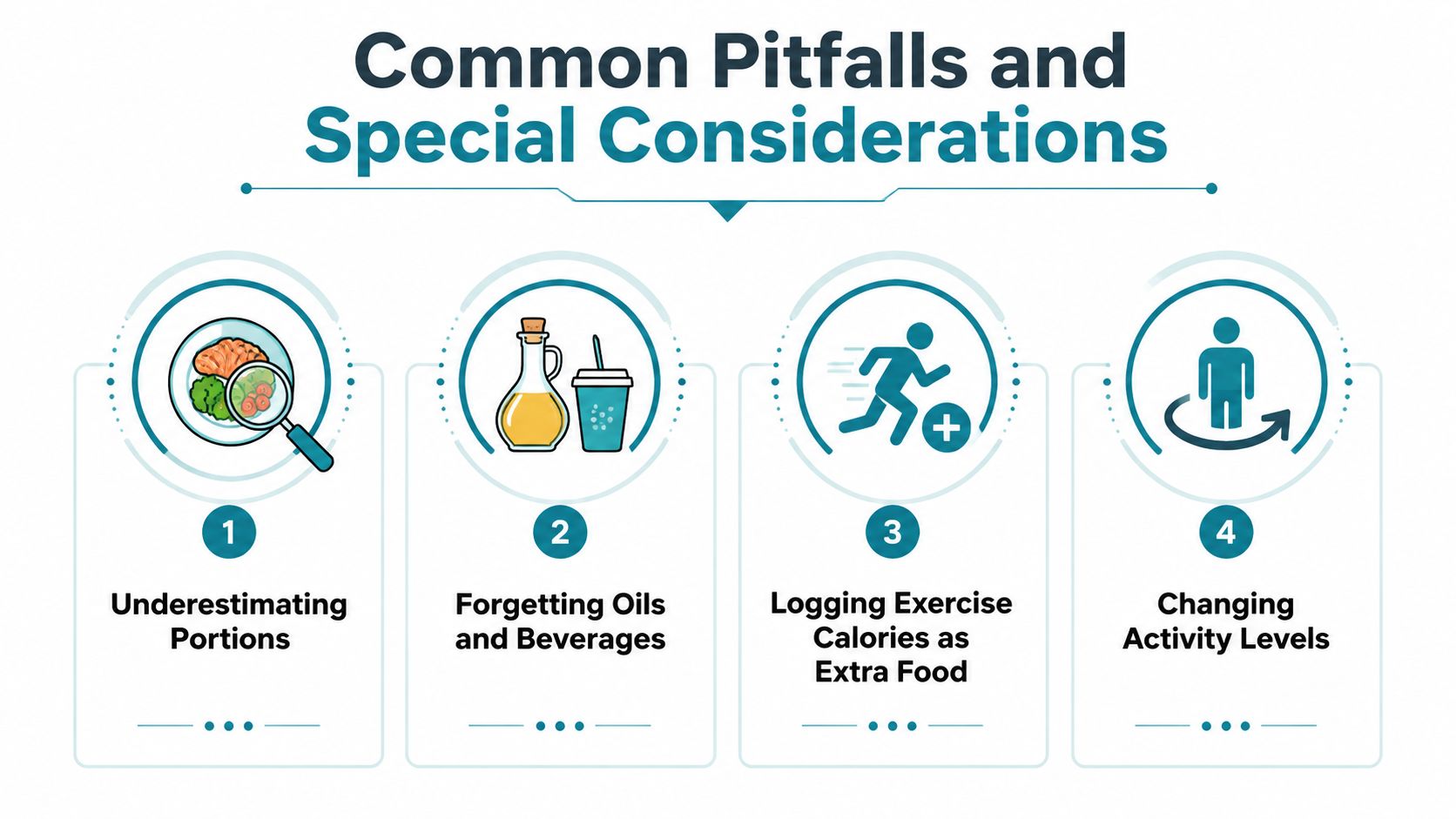
Could a calculated deficit be less precise than it appears? Yes. Portion estimates may miss oils, beverages, sauces, or small bites. Exercise calories are also estimates, not guaranteed permission to eat more. A change in daily movement can shift energy needs without appearing in a food log.
A useful estimate works like a map, not a laboratory measurement. Compare it with weight trends, hunger, energy, training performance, and daily function, then adjust the assumptions when those observations do not fit. Crash diets, prolonged fasting, and overly aggressive restriction can worsen hunger, fatigue, nutrient adequacy, and adherence. Large deficits may also increase lean-tissue loss when protein, overall nutrition, and resistance activity are not addressed.
Situations that need added caution
Medical context can change both the calculation and whether self-directed restriction is appropriate.
- Medical conditions: Diabetes, thyroid disease, gastrointestinal disorders, pregnancy, and unstable health conditions warrant clinician input.
- Eating concerns: A history of an eating disorder, compulsive restriction, bingeing, or purging can make calorie tracking unsafe or counterproductive.
- Mental health: Depression, anxiety, and severe stress may affect appetite, judgment, energy, and adherence.
- Medications: Anti-obesity medicines may reduce appetite, change gastrointestinal tolerance, and alter previous intake assumptions. A prescriber should oversee their use.
- Alcohol or other substances: These can add calories or impair judgment. Dependence, withdrawal risk, or reduced food intake may require integrated medical and addiction care.
A practical resource, such as these pre-run fueling tips, illustrates why activity needs context rather than a simple “calories burned” credit. It should not set an individual calorie target.
Seek prompt medical help for fainting, severe weakness, repeated vomiting, dehydration, compulsive restriction, bingeing, purging, or other concerning symptoms. Suicidal thoughts require immediate crisis support, such as calling or texting 988 in the United States, or contacting emergency services when there is immediate danger.
When to Bring It to a Physician and Next Steps
Physician-led input makes sense when a plateau persists despite a carefully observed deficit, when excess weight occurs with relevant health conditions, when medications may affect appetite or nutrition, or when disordered eating, mental-health concerns, or substance use complicates the plan.
Bring a two-to-four-week food and weight log, current medications including GLP-1 agonists, relevant mental-health history, symptoms, activity information, and a specific goal such as 5%–10% weight loss. A clinician may use NIDDK tools, medical and metabolic assessment, shared decision-making, and follow-up data to decide whether the plan needs adjustment, additional support, or evaluation for another concern. A metabolic panel can help assess health conditions, but it doesn't measure calorie needs.
Adults physically located in New York, New Jersey, Connecticut, Pennsylvania, or Virginia can review physician-led weight-loss care and decide whether a private outpatient consultation fits their needs.
Byline: Empire Medical Wellness Editorial Team
Published: August 26, 2026
Updated: August 26, 2026
Sources
- NIDDK Body Weight Planner
- NIDDK adult overweight and obesity treatment guidance
- NIDDK structured education manual
- Peer-reviewed evidence on calorie deficit and self-monitoring
- Peer-reviewed evidence on adaptive thermogenesis
Empire Medical Wellness offers physician-led obesity medicine with individualized weight-management planning, medical and metabolic assessment, and follow-up based on treatment response. Visit Empire Medical Wellness to learn about outpatient care for adults physically located in New York, New Jersey, Connecticut, Pennsylvania, or Virginia.
This article is educational and isn't personal medical advice.