
You've started semaglutide for weight management, and now you're awake with mild nausea, wondering whether this is expected or a reason to call the clinic. Nausea, diarrhea, vomiting, constipation, abdominal discomfort, and related digestive symptoms are among the most common semaglutide side effects, particularly early in treatment or after a dose increase. Most are mild to moderate and temporary, but some symptoms require prompt medical attention.
Semaglutide is a GLP-1 receptor agonist, meaning it acts like a naturally occurring hormone involved in appetite and blood-sugar regulation. Its effects on appetite, stomach emptying, and digestion help explain why gastrointestinal symptoms dominate the safety profile. If you're comparing experiences, a general guide on what to expect on Wegovy may offer additional context, but your prescribing clinician's advice should guide decisions about your own treatment. You can also review Empire Medical Wellness' information about GLP-1 medications before a consultation.
Table of Contents
- Understanding Semaglutide Side Effects
- Most Common Side Effects and Why They Happen
- Warning Signs That Require Prompt Medical Attention
- Less Common Risks Patients Should Know About
- Practical Strategies for Managing Side Effects
- Risk Factors and What Monitoring Involves
- How Physician-Led Care Supports Safe Treatment
Understanding Semaglutide Side Effects
You may notice that a familiar meal feels unusually heavy, followed by nausea or early fullness. Semaglutide slows stomach emptying and changes how quickly food moves through the digestive tract. These effects can support appetite control, while also explaining why digestive symptoms are common.
The FDA labeling lists nausea, diarrhea, vomiting, constipation, abdominal pain, headache, fatigue, dyspepsia, dizziness, abdominal distension, eructation, flatulence, gastroenteritis, gastroesophageal reflux disease, and nasopharyngitis among common adverse reactions in adults. Several occur at an incidence of at least 5%, and this broad pattern appears across labeling for Wegovy, Ozempic, and Rybelsus (FDA prescribing information).
Why symptoms often appear early
Symptoms often emerge during dose escalation, as the body adjusts to a stronger medication effect. In the STEP obesity trials, gastrointestinal reactions were generally mild to moderate, non-serious, and transient, and few led participants to stop treatment (clinical safety review). Guidance on what to expect on Wegovy can provide general context, while Empire Medical Wellness' information about GLP-1 medications may help you prepare for a clinical discussion.
That said, “common” does not mean every symptom should be ignored. Repeated vomiting, inability to keep fluids down, fainting, severe abdominal pain, or signs of low blood sugar call for a different response than mild queasiness that settles.
Practical rule: Track the symptom, when it began, whether it followed a dose change, and whether you can eat, drink, and urinate normally. These details help a clinician separate tolerability problems from warning signs.
A supervised conversation is safer than stopping treatment or changing the dose independently. The appropriate response depends on your medical history, other medications, and the specific semaglutide product prescribed.
Most Common Side Effects and Why They Happen
A patient may feel queasy after the first dose, notice looser stools during escalation, or become constipated as digestion slows. These effects are usually gastrointestinal and often improve as the body adjusts. In the STEP 1 through STEP 4 obesity trials, nausea affected 11.4% to 20% of semaglutide-treated patients compared with 3.3% to 8% of placebo-treated patients. Vomiting affected 4% to 11.5% compared with 2% to 3%, while diarrhea affected 4.5% to 11.3% compared with 1.5% to 6% (STEP trial safety review).
A broader review of phase 3 studies also found greater risks of nausea, vomiting, and diarrhea with semaglutide than with placebo. The relative risks were 3.00, 4.12, and 1.88, respectively. These findings explain why digestive tolerance is discussed before treatment begins.
What patients commonly notice
| Side effect | Approximate incidence rate | Typical onset and duration |
|---|---|---|
| Nausea | 11.4% to 20% in STEP obesity trials | Often appears early or after escalation, then may ease as tolerance develops |
| Vomiting | 4% to 11.5% in STEP obesity trials | May accompany nausea, especially during adjustment |
| Diarrhea | 4.5% to 11.3% in STEP obesity trials | Often occurs during early treatment or dose changes |
| Constipation | Listed among common FDA-labeled reactions | Can develop as digestion slows and may persist without a management plan |
| Abdominal symptoms | Listed among common FDA-labeled reactions | May include pain, distension, reflux, gas, or indigestion |
The table covers the symptoms patients most often notice. Headache, fatigue, dizziness, and injection-related reactions are also listed as common reactions, although the exact experience varies by product, dose, indication, and health factors.
Semaglutide affects appetite and blood-sugar regulation while slowing stomach emptying and altering intestinal movement. The digestive system works more slowly, so eating beyond comfortable fullness can increase nausea, pressure, reflux, or bloating. Smaller meals and attention to fullness may therefore improve comfort, but persistent symptoms still deserve clinical review.
For plain-language background, see this semaglutide side effects guide. Empire Medical Wellness also explains Ozempic side effects, including why product-specific labeling matters. Mild symptoms that settle can often be monitored, while worsening symptoms or trouble maintaining fluids require prompt medical advice.
Warning Signs That Require Prompt Medical Attention
A mild stomach upset that is easing usually calls for observation. Severe, persistent symptoms, especially with signs of dehydration or organ stress, require medical advice.
The FDA identifies rare but serious gastrointestinal risks, including acute pancreatitis and necrotizing pancreatitis. Some reported events resulted in death, so severe, ongoing abdominal pain should not be treated as routine nausea (FDA safety labeling).
A practical response table
| Symptom category | Common or expected | Warning sign, contact your provider |
|---|---|---|
| Nausea | Mild queasiness that allows fluids and gradually improves | Persistent nausea with repeated vomiting or inability to keep fluids down |
| Abdominal discomfort | Mild bloating, gas, reflux, or short-lived discomfort | Severe or persistent pain, especially pain that may radiate to the back |
| Bowel changes | Temporary diarrhea or constipation without severe weakness | Diarrhea or vomiting with dizziness, fainting, markedly reduced urination, or dehydration |
| Blood sugar symptoms | Mild fatigue without neurological symptoms | Confusion, sweating, tremors, weakness, or loss of consciousness, particularly with insulin or sulfonylureas |
| Allergic symptoms | Mild localized injection-site redness or soreness | Facial or throat swelling, widespread rash, wheezing, or difficulty breathing |
| Upper abdominal symptoms | Indigestion or mild post-meal discomfort | Right upper abdominal pain with fever or yellowing of the skin or eyes |
Hypoglycemia, or very low blood sugar, deserves particular attention when semaglutide is combined with other diabetes medicines. The risk is more relevant for people using insulin or sulfonylureas, because these medicines can also lower glucose. Confusion, sweating, tremors, marked weakness, or loss of consciousness should prompt urgent action.
What to do when symptoms escalate
Contact the prescribing practice promptly if symptoms persist or worsen. Seek emergency care for difficulty breathing, facial or throat swelling, fainting, confusion, severe dehydration, or severe persistent abdominal pain.
Before calling, gather the medication name, most recent dose, symptom timing, other medicines, ability to drink, urine output, and available blood-glucose readings. These details help the clinician judge whether the problem may reflect dehydration, hypoglycemia, an allergic reaction, pancreatitis, or another condition.
For a separate medication comparison, Empire's guide to Mounjaro side effects describes another treatment's reported reactions. It does not replace an assessment of symptoms occurring during semaglutide treatment.
Less Common Risks Patients Should Know About
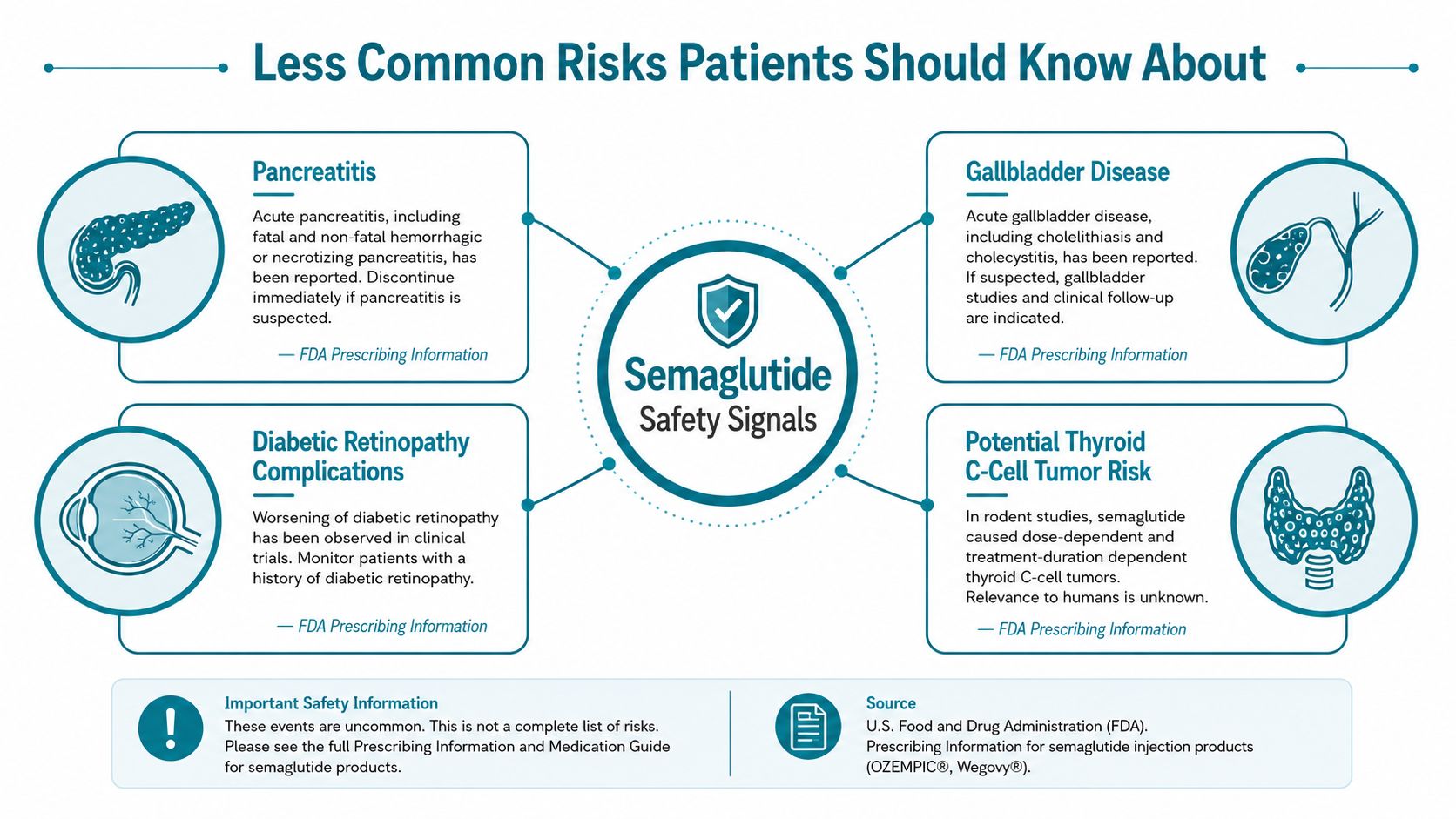
Semaglutide safety involves more than nausea and constipation. Some risks appear in product labeling, while others are early signals that require careful interpretation rather than alarm.
Gallbladder and biliary tract problems, including cholelithiasis and cholecystitis, are recognized risks in clinical summaries of semaglutide (NIH StatPearls review). Severe upper abdominal pain, fever, or jaundice warrants medical evaluation because these symptoms can indicate a biliary problem rather than ordinary indigestion.
Eye symptoms require nuance
A 2025 systematic review of 78 trials found no higher overall risk of most eye disorders with semaglutide, but it did identify a signal for nonarteritic anterior ischemic optic neuropathy, or NAION, with an odds ratio of 3.92 (2025 systematic review). The evidence is not sufficient to establish that semaglutide causes NAION.
The practical distinction is important. Temporary blurred vision may occur with dehydration or changing glucose levels. Sudden or significant vision loss can reflect a more urgent neuro-ophthalmic problem, so new vision symptoms should be reported instead of automatically attributed to routine treatment adjustment.
Mood and kidney concerns
The same evidence review described pharmacovigilance signals involving anxiety, depressed mood disorders, suicidality, and eating-disorder reporting, with variation across demographic groups. A signal does not prove that semaglutide caused an event, but meaningful mood changes or thoughts of self-harm require prompt clinical attention.
Kidney injury can develop indirectly when vomiting or diarrhea causes substantial dehydration. Reduced urination, swelling, faintness, or inability to replace lost fluids should prompt urgent contact with a clinician.
The FDA label also includes a boxed warning about thyroid C-cell tumors and contraindicates use in people with a personal or family history of medullary thyroid carcinoma or multiple endocrine neoplasia syndrome type 2. The warning is based on animal findings, so it belongs in treatment screening rather than being treated as a diagnosis or prediction for a particular person.
Practical Strategies for Managing Side Effects
Mild symptoms often become easier to manage as the medication's effects and the body's response align. Don't change the dose, skip scheduled doses, or accelerate escalation without instructions from the prescribing clinician. A symptom log can help distinguish a brief adjustment from a pattern that needs review.
Start with food and fluids
Smaller meals can reduce the feeling of gastric overload. Eating slowly and stopping when comfortably full may help because semaglutide can affect appetite and stomach emptying. Rich, high-fat meals and strongly spicy foods worsen nausea for some people, so simpler foods may feel easier during adjustment. A balanced meal to lose weight can provide general meal-planning context, though dietary choices should reflect individual medical needs.
Hydration becomes especially important with vomiting or diarrhea. Sip fluids if tolerated. If fluids will not stay down, or dizziness and reduced urination develop, home measures are no longer enough. Contact a clinician promptly.
Constipation may improve with gradual fiber intake, suitable fluids, and movement when tolerated. An over-the-counter osmotic laxative may suit some adults, but a clinician should confirm that choice after reviewing medications and health history.
Use a structured symptom plan
| Side effect | At-home strategies | When to call your provider |
|---|---|---|
| Nausea | Smaller meals, slower eating, lighter foods, hydration | Symptoms persist, worsen, or prevent adequate fluid intake |
| Vomiting | Sip fluids if tolerated and pause heavy meals | Repeated vomiting, dizziness, fainting, or very low urine output |
| Diarrhea | Replace fluids and choose gentle foods temporarily | Ongoing diarrhea, weakness, dehydration, or blood in stool |
| Constipation | Gradual fiber, fluids, and clinician-approved treatment | Severe pain, persistent symptoms, vomiting, or inability to pass stool or gas |
| Injection-site reaction | Follow product instructions and rotate sites as directed | Worsening redness, spreading swelling, severe pain, or systemic allergic symptoms |
| Fatigue | Review hydration, food intake, sleep, and other medicines with a clinician | Fatigue occurs with confusion, sweating, tremors, faintness, or severe weakness |
Hypothetical example: An adult develops mild nausea after an early semaglutide dose but can drink fluids and eat small meals. Instead of changing the schedule independently, the person records symptoms and contacts the prescribing clinician. The clinician then decides whether the plan should continue, pause, or change. Individual outcomes vary, and this example is not a personal treatment recommendation.
Maintaining nutrition and physical function may also involve reviewing this BionicGym guide for GLP-1 users. Practical tracking gives the clinician clearer information than judging a single difficult day.
Risk Factors and What Monitoring Involves
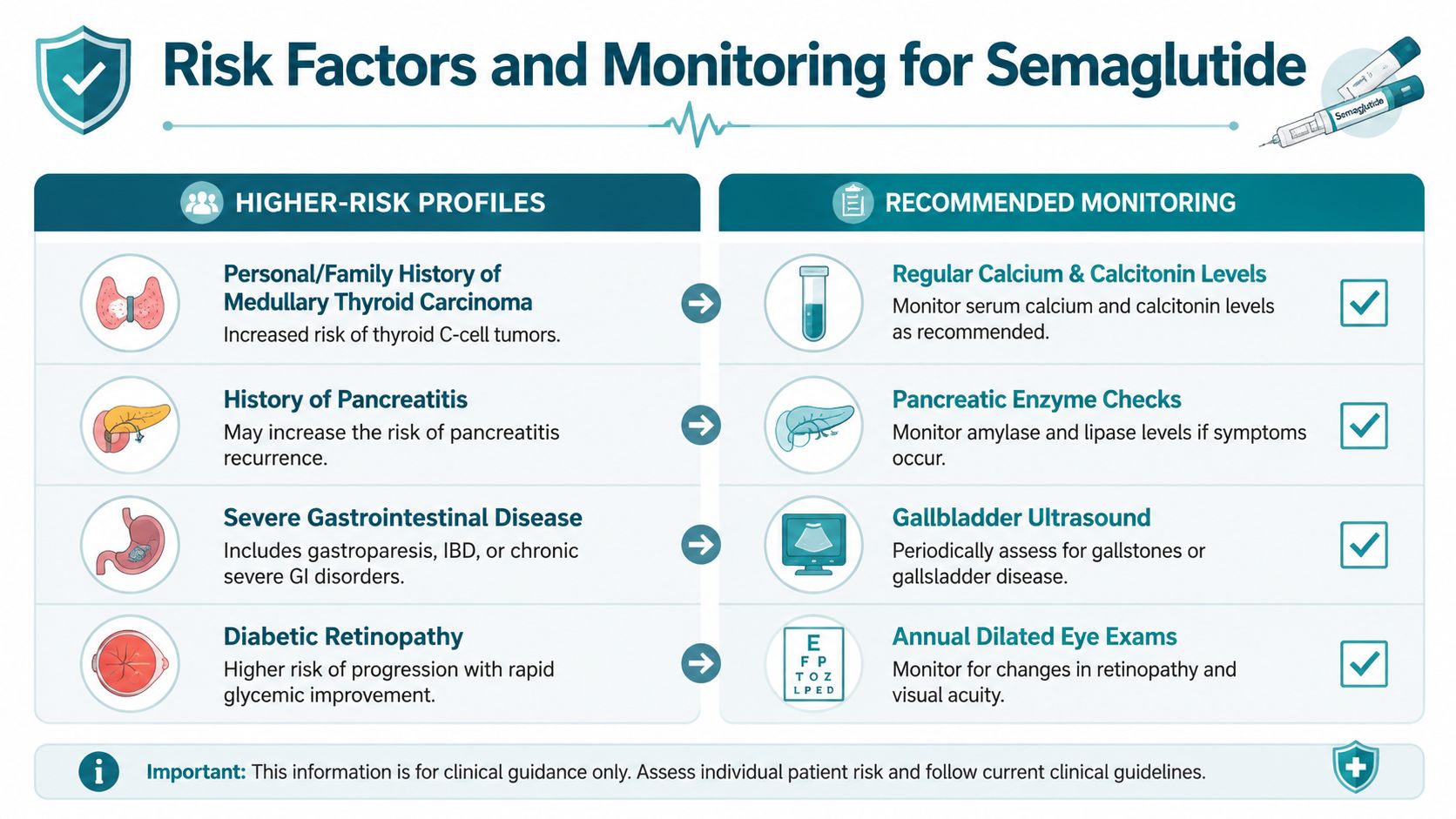
A patient's medical history can change the meaning of the same symptom. Before prescribing semaglutide, a clinician may review previous pancreatitis, gallbladder disease, severe gastrointestinal problems, diabetic retinopathy, kidney concerns, pregnancy plans, and current diabetes treatment. These details help separate an expected reaction from a sign that needs prompt assessment.
Semaglutide is contraindicated for people with a personal or family history of medullary thyroid carcinoma or with MEN2. People using insulin or sulfonylureas also need careful review for low-blood-sugar symptoms, because combining glucose-lowering treatments can increase that risk.
Screening is more than a checklist
Assessment may include medication reconciliation, questions about gastrointestinal symptoms, previous pancreatitis or gallbladder problems, kidney history, glucose-related complications, and relevant mental-health symptoms. Laboratory monitoring may include metabolic and glycemic markers when appropriate. The tests and timing depend on the indication, medical history, and other treatments.
The current FDA labeling adds hair loss to the common adverse reactions reported in adults and pediatric patients age 12 years and older. That detail broadens counseling beyond nausea, vomiting, diarrhea, and constipation. Hair loss should be reported if it is persistent, distressing, or accompanied by other changes that could suggest inadequate nutrition or another medical issue.
| Higher-risk consideration | Why clinicians pay attention |
|---|---|
| Personal or family history of medullary thyroid carcinoma or MEN2 | Semaglutide is contraindicated under FDA labeling |
| Insulin or sulfonylurea use | Low-blood-sugar symptoms may require closer review |
| Prior gallbladder disease | New upper abdominal symptoms may need faster assessment |
| Severe gastrointestinal symptoms or dehydration risk | Fluid loss can affect kidney function |
| Existing diabetic retinopathy or new vision symptoms | Eye monitoring may be clinically relevant |
| Prior pancreatitis | Severe abdominal pain requires prompt evaluation |
Monitoring continues after the first appointment. Follow-up helps determine whether symptoms are settling, whether nutrition and fluid intake remain adequate, and whether another medication may be contributing. Review is particularly useful during dose escalation or when a new symptom does not fit the usual gastrointestinal pattern.
How Physician-Led Care Supports Safe Treatment
Semaglutide shouldn't be managed in isolation when other medical conditions or medications are involved. A physician-led approach connects the medication decision to the person's health history, current treatments, laboratory information, symptom pattern, and longer-term goals.
At Empire Medical Wellness, obesity medicine may include medical and metabolic assessment, review of weight history and relevant health factors, individualized weight-management planning, anti-obesity medication when clinically appropriate, ongoing monitoring, and long-term maintenance planning. The practice's published obesity medicine care information describes this broader evaluation model without promising a particular medication or outcome.
What follow-up can clarify
A follow-up appointment gives the clinician an opportunity to review tolerability, hydration, gastrointestinal symptoms, blood-sugar concerns, and any new warning signs. It also creates a safer setting for considering whether the treatment plan needs adjustment or whether another option deserves discussion.
The practice should also know about insulin, sulfonylureas, cardiovascular medications, supplements, and care from outside clinicians. Coordinated information reduces the chance that a symptom such as fatigue, dizziness, or nausea gets viewed without its medication context.
A second clearly labeled composite hypothetical illustrates the principle. Hypothetical example: An adult reports nausea after a dose increase but also mentions new sweating and confusion while taking another glucose-lowering medication. The clinician treats the combination of symptoms and medication history as more significant than nausea alone and directs the person toward prompt evaluation. Individual outcomes vary, and no hypothetical can determine what's happening in a real patient.
If you're considering semaglutide or are having side effects while using it, bring a written symptom timeline and complete medication list to a qualified clinician. Don't make unsupervised dose changes or assume that a severe symptom is part of adjustment.
Publication date: August 22, 2026
Updated date: August 22, 2026
Byline: Empire Medical Wellness Editorial Team
Sources
- FDA Wegovy, Ozempic, and Rybelsus prescribing information
- Peer-reviewed review of semaglutide safety in STEP trials
- Harvard summary of serious semaglutide adverse events
- 2025 systematic review of semaglutide and eye, mood, and reporting signals
- NIH StatPearls semaglutide review
Empire Medical Wellness provides private-pay, physician-led obesity medicine for adults seeking evaluation, medication guidance when clinically appropriate, and ongoing monitoring. Visit Empire Medical Wellness to learn more and request a consultation about semaglutide side effects and whether supervised care fits your health needs. This article is educational and isn't personal medical advice.