
Physiological dependence is bodily adaptation: stopping a repeated medicine, or cutting the dose sharply, can cause withdrawal. Addiction means impaired control, craving, or continued use despite harm, and tolerance or withdrawal alone does not diagnose it.
Popular advice often collapses those ideas into one warning. If a missed dose leaves someone unwell, the advice says they are addicted and should stop. That advice mixes a pharmacologic response with a behavioral disorder. A person can take an opioid, a benzodiazepine, or another prescribed medicine exactly as directed and still adapt to it. Feeling sick after a sudden gap is not, by itself, compulsive use.
The more useful question is which medication effects, which behaviors, and which other health conditions need separate clinical review. Anxiety, insomnia, chronic pain, and trauma-related symptoms can sit beside a legitimate prescription. Some medicines used to treat opioid use disorder can produce physical dependence too. Treating every adaptation as addiction adds stigma and can push someone to stop a needed medicine all at once. A valid prescription does not rule addiction out either.
What follows separates the terms in prescription drug dependence vs addiction, shows how criteria are applied over time, and lists questions for a qualified clinician. It is not a self-test, a taper, or a personal treatment plan.
Table of Contents
- Dependence and Addiction Side by Side
- How Clinicians Apply Diagnostic Criteria
- Opioids Benzodiazepines and Stimulants
- Clues, Overlapping Medicines, and Interacting Risks
- Different Care for Dependence and Addiction
- When to Seek Urgent Care or a Routine Evaluation
Dependence and Addiction Side by Side
Physiological dependence means the body has adapted to a repeated medicine, so stopping it or cutting the dose sharply can cause withdrawal. That adaptation can occur when someone takes a prescription exactly as directed and does not compulsively seek it.
Addiction, captured within substance use disorder, is a different pattern: impaired control, craving, unsuccessful efforts to cut down, or continued use despite harm. Tolerance and withdrawal do not establish that pattern.
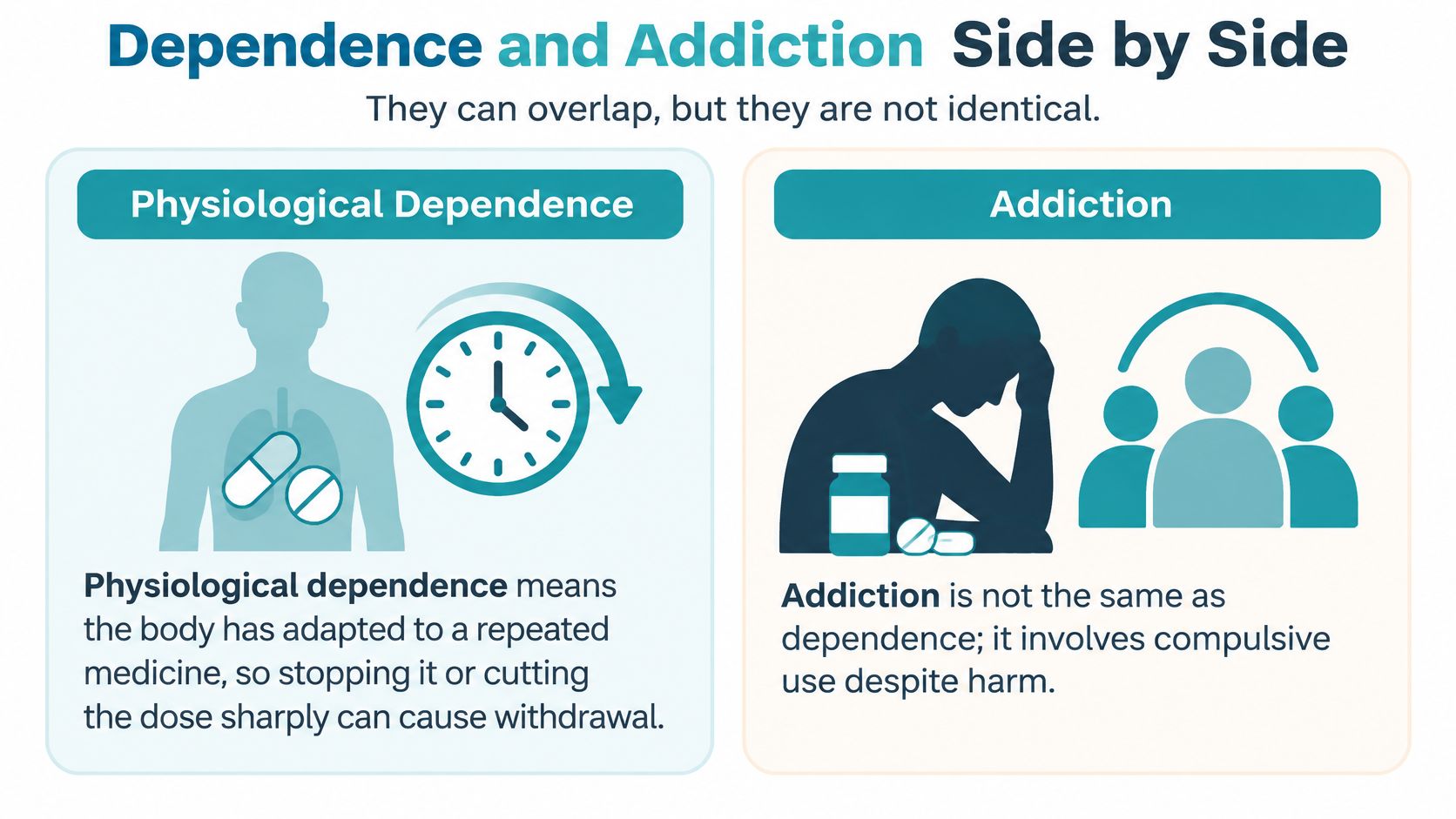
Physiological dependence compared with addiction
The rows below are educational only. They are not a diagnosis.
| Feature | Physiological dependence | Addiction or substance use disorder |
|---|---|---|
| Meaning | The body adapts, so stopping or a large dose reduction can cause withdrawal | Impaired control, craving, or continued use despite harm |
| Use exactly as prescribed | Can still occur | A valid prescription neither proves nor rules it out |
| Tolerance | May develop as a pharmacologic effect | Not diagnostic by itself |
| Withdrawal | Central to the definition of physical dependence | One possible feature and not enough alone |
| DSM-5 status | Not itself an addiction diagnosis | Substance use disorder on a mild-to-severe continuum |
| Care focus | Clinician review and any dose change directed by a clinician | Assessment of behavior, function, safety, and appropriate treatment |
The National Institute on Drug Abuse drug facts on prescription opioids describe physical dependence as a pharmacologic adaptation, not a diagnosis of addiction. Repeated exposure can leave the nervous system functioning in its usual way only while the medicine is present. Abrupt discontinuation, or a substantial dose reduction, can then produce a substance-specific withdrawal syndrome. That sequence can follow long-term opioid therapy taken as directed.
FDA labeling ties physical dependence to withdrawal after abrupt discontinuation or a significant dose reduction. NIDA states that dependence and addiction are not equivalent. The actionable distinction is behavioral control: whether use matches the prescription, whether a higher dose reflects tolerance or worsening disease, and whether any dose change should be directed by a clinician rather than assumed to mean addiction.
The American Psychiatric Association treats dependence as a possible normal physiological response, not automatic evidence of addiction. CDC education makes a similar split for opioids. Dependence there means the body adapts and withdrawal may follow discontinuation. Addiction may involve inability to control use, social problems, or missed responsibilities.
Practical rule: Withdrawal risk means abrupt stopping can be unsafe. This article gives no taper schedule. Any dose change belongs with the prescribing clinician.
One row of the table does not settle the question. Dependence and a substance use disorder can coexist, and they still call for different parts of the review.
How Clinicians Apply Diagnostic Criteria
DSM-5, published in 2013, replaced the older split between "abuse" and "dependence" with one diagnosis, substance use disorder, measured on a mild-to-severe continuum. DSM-III, published in 1980, had kept those categories separate, and that wording still confuses patients who hear "dependent" and hear "addicted."
A peer-reviewed discussion of the terminology traces that shift and the reason it matters. Physical dependence is biological adaptation after repeated exposure. Stopping or substantially reducing the medicine can produce withdrawal even when the person took it exactly as prescribed and did not seek it compulsively. Addiction, within substance use disorder, involves impaired control, persistent use despite harm, craving, or unsuccessful efforts to reduce use.
A pattern over time, not a single feature
Clinicians do not score a reader from a webpage, and a prescription, a long course of treatment, or withdrawal alone does not meet the diagnosis. For opioids, NIDA's overview of opioids describes opioid use disorder as a pattern involving two or more substance-related symptoms or behaviors. Examples include wanting to cut down and being unable to, using more or longer than intended, spending substantial time obtaining or using the drug, craving, failing to meet obligations, and continuing despite physical, psychological, or social problems.
Withdrawal can be one feature in that pattern. It does not prove the compulsive pattern by itself. The same caution applies to tolerance. A higher dose that a prescriber sets because pain or another condition worsened is not the same decision as using more than intended.
Studies often define misuse and disorder differently, so prevalence figures are not interchangeable. A count of people who took extra doses is not a count of moderate or severe disorder. A more detailed walk-through of how severity is grouped sits on the page about DSM-5 substance use disorder criteria.
Only a qualified clinician can apply the criteria to a full history, including medical conditions and other medicines.
That history is the point of an evaluation. It is not something a checklist can finish.
Opioids Benzodiazepines and Stimulants
Adults usually ask about three classes. The prescribed reason, the expected adaptation, and the behaviors that need assessment are different in each. Nothing below is a dose, a brand preference, or an instruction to start, stop, or switch a medicine. Naming a class is not a treatment menu, and FDA-approved use should be distinguished from any off-label use when a specific medicine comes up with a prescriber.
How dependence looks across common prescription classes
| Class | Dependence can mean | A separate concern | Safety boundary |
|---|---|---|---|
| Opioids | Adaptation and withdrawal after abrupt reduction, even with prescribed use | Loss of control or continued use despite harm | Do not stop suddenly; overdose risk rises with sedatives |
| Benzodiazepines | Physiological dependence with regular use | Use beyond the indication, concealment, or harm | Abrupt cessation can be medically dangerous |
| Stimulants | Tolerance or rebound fatigue and low mood | Escalation, nonprescribed use, or impaired function | Dose changes belong with the prescriber |
Opioids. Long-term opioid therapy can produce tolerance and physical dependence even when each dose follows the prescription. Withdrawal discomfort, flu-like illness, or a strong wish to avoid that discomfort does not by itself mean opioid use disorder. Loss of control and continued use despite harm are the separate concern. A closer look at that split is in the discussion of opioids, dependence, and opioid use disorder.
Benzodiazepines. Regular use can cause physiological dependence. Sudden stopping can be medically dangerous, including seizure risk in some people, so the safety point is not to stop on your own. There is no home schedule here. Use past the original indication, concealment, or ongoing harm is what warrants a fuller substance-use assessment, distinct from the adaptation itself.
Stimulants. Tolerance can develop, and a lower dose can bring rebound fatigue or low mood. Those effects still differ from impaired control or use despite harm. Unauthorized escalation, use of someone else's prescription, or function that is getting worse despite the stated indication are the patterns to bring back to the prescriber.
Combining a sedative with an opioid raises overdose risk even when each prescription was written for a real symptom. A pharmacist and the prescribing clinicians should see the full list, including alcohol and over-the-counter sedating products.
Drug-specific questions go back to the prescribing clinician and a pharmacist. Labeling, interactions, and whether a use is FDA-approved or off-label are individual decisions, not general rules from an article.
Clues, Overlapping Medicines, and Interacting Risks
Clinicians sort expected physical dependence from a developing substance use disorder by watching behavior, day-to-day function, and medicines that interact. No single observation is a diagnosis. Withdrawal discomfort can itself feel like craving, so one rough day is a poor test.
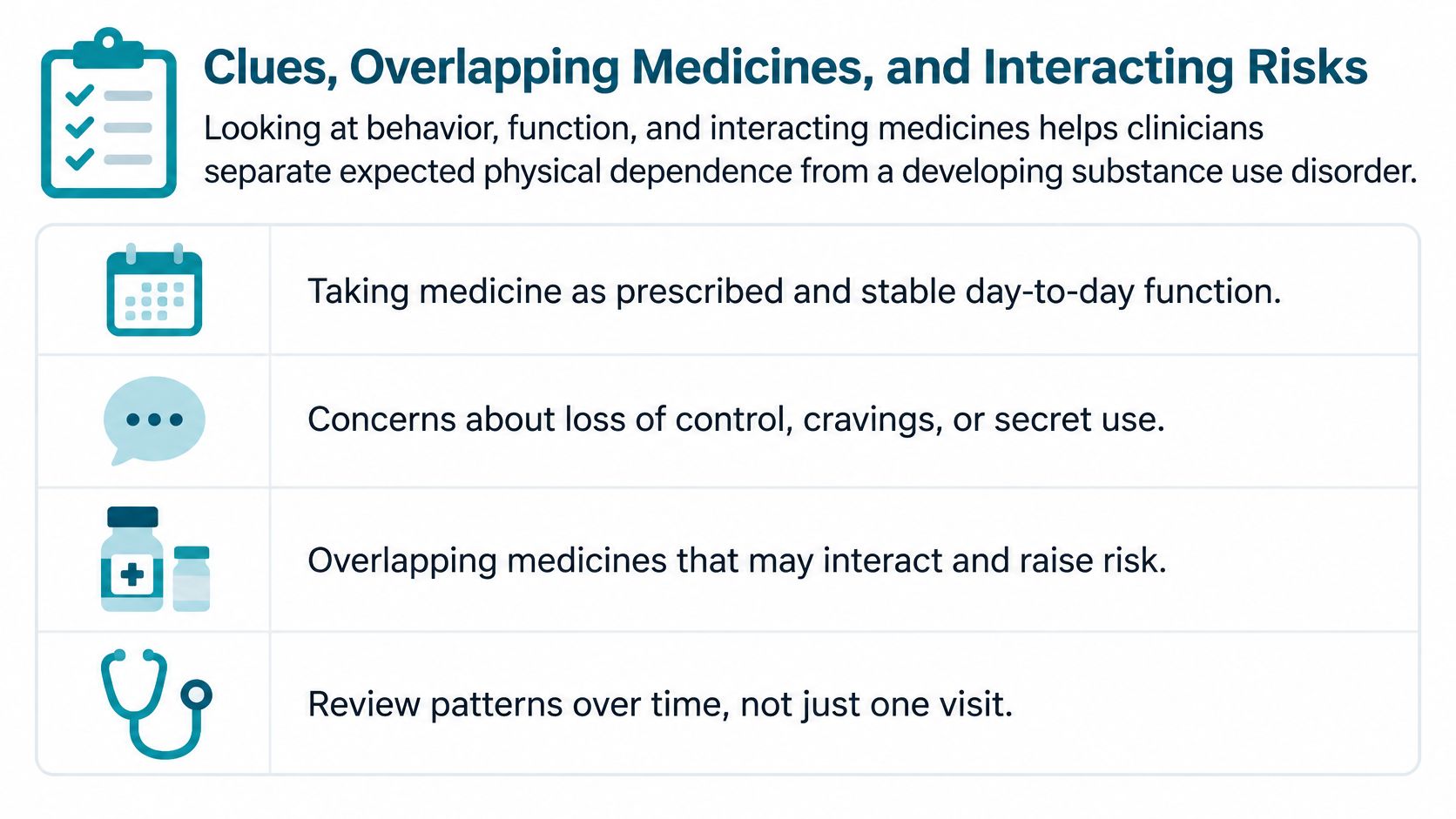
Medication effects versus concerning patterns
| Observation | Often fits expected dependence | Warrants fuller assessment |
|---|---|---|
| Reason for use | Matches the prescribed indication | Mainly for euphoria, numbing, or unprescribed purposes |
| Dose changes | Agreed with the prescriber or explained by tolerance or disease | Unauthorized escalation or running out early |
| Refills | On schedule | Repeated early requests or multiple undisclosed sources |
| Control | Able to follow the plan | Cannot cut down despite wanting to |
| Consequences | Withdrawal fear without ongoing harm | Continued use despite health, work, or relationship harm |
| Openness | Use is known to the care team | Concealment or misleading clinicians |
NIDA's prescription drug report makes the same separation. Physical dependence can develop during appropriate, supervised treatment and does not by itself establish addiction. Compulsive use, impaired control, drug-seeking, or continued use despite harm is the other side. Patients on opioids, benzodiazepines, and similar medicines often read tolerance, withdrawal, or fear of stopping as proof they are "addicted." That reading is too coarse.
Population figures are not personal scores
These estimates describe groups, not one person's risk.
- CDC, 2015: The CDC's 2017 prescribing report estimated that approximately 2.0 million Americans had an opioid use disorder associated with prescription opioids in 2015.
- SAMHSA, 2024: SAMHSA's release of the 2024 survey reported that 4.8 million people aged 12 or older had a past-year opioid use disorder.
Definitions and years differ, so the two figures should not be read as a simple rise from one study to the next. Exposure is also uneven. In one treatment-seeking sample described in NIDA's media guide, nearly one-third met criteria for prescription-drug dependence, with benzodiazepines and narcotic analgesics among the most frequently reported drugs. That sample is people already seeking treatment, not the general population.
When several problems overlap
NIDA notes that physical dependence may occur with regular use of a prescription drug even when it is taken as directed, while addiction is compulsive use and continued use despite negative consequences. The line is not always clean. Dependence can coexist with a substance use disorder or progress into one.
Anxiety, insomnia, chronic pain, trauma-related symptoms, and other mental health conditions can mimic or worsen the picture. A dose taken "to function" might match a prescribed indication, or it might have drifted toward numbing. Sedatives and opioids can raise overdose risk together even when each prescription looks legitimate on its own. Sedative overdose patterns, including barbiturates, are a related safety topic on the page about barbiturate overdose.
Labeling every dependent patient as addicted can add stigma, discourage medically necessary treatment, and lead someone to stop a medicine suddenly. The better question is which medication effects, withdrawal processes, behaviors, and health conditions need separate evaluation.
Different Care for Dependence and Addiction
Care goals diverge even when the same medicine is on the list.
For physiological dependence, a clinician reviews whether the medicine still helps, what side effects and interactions have appeared, and whether continuing it or a medically directed reduction is safer. A reader should not stop a benzodiazepine, an opioid, or another dependence-forming medicine alone. There is no taper schedule, detox protocol, or recovery timeline in this article.
For a substance use disorder, care also addresses control, craving, safety, and daily function. A prescription history still matters, but it is not the whole plan.
Medicines that treat opioid use disorder can still cause dependence
NIDA's page on medications for opioid use disorder identifies methadone, buprenorphine, and naltrexone as effective FDA-approved medicines for opioid use disorder. That status is not a suggestion to start one of them. Treatment decisions require clinical assessment and should not be inferred from dependence alone.
NIDA also states that methadone and buprenorphine can produce physical dependence, and abrupt discontinuation may cause withdrawal. Those withdrawal effects are generally milder than withdrawal from other opioid drugs and are managed by gradual dose reduction rather than sudden cessation. Dependence on a treatment medicine is still not the same thing as addiction. Any use outside FDA-approved labeling would need to be named as off-label by the prescriber. This description is not a claim that a clinic administers these medicines.
A general overview of how medication can fit outpatient care is on the page about medication-assisted treatment. Evidence-based medication can be part of addiction medicine care at Empire Medical Wellness when it is clinically appropriate, and an appointment does not guarantee a prescription. The practice does not provide detoxification, residential treatment, partial hospitalization, or intensive outpatient programs. When one of those levels is appropriate, the practice can help coordinate the next step.
Other clinicians are brought in only when that coordination is useful, authorized, and clinically appropriate.
When to Seek Urgent Care or a Routine Evaluation
A smoke alarm and a scheduled home inspection answer different questions. Chest pain, trouble breathing, a seizure, severe confusion, unresponsiveness, or a suspected overdose is the alarm: call 911. A suicidal crisis is also an emergency: call or text 988. Stopping a benzodiazepine or an opioid on your own is not a safe shortcut. If stopping feels urgent, or withdrawal symptoms are severe, contact the prescriber or use emergency care.
A routine visit is closer to the inspection. Dependence can be an expected effect of appropriate prescribing, including some medicines used to treat opioid use disorder. The useful question is narrower. Which medication effects, behaviors, and health conditions need their own clinical review?
Bring a current list of prescriptions, alcohol use, and over-the-counter products. Ask which symptoms fit physiological dependence, meaning the body has adapted and may show withdrawal if the dose drops suddenly. Ask which patterns of use or daily function, if any, call for a substance use disorder assessment. Ask which prescriptions raise risk when taken together, what follow-up and warning signs to plan, and whether another setting would be safer than outpatient care alone.
Addiction medicine care begins with a confidential assessment of the current situation, medical risks, previous treatment, medications, and goals. What that first conversation covers is outlined for a first addiction medicine appointment. Dr. Chhatpar has advanced fellowship training in addiction medicine at Hartford HealthCare in Connecticut. Visit fees are private-pay. A visit does not guarantee a particular medicine or a particular result.
Empire Medical Wellness Editorial Team
Published 8 October 2026. Updated 8 October 2026.
Sources
- National Institute on Drug Abuse, prescription opioids drug facts
- National Institute on Drug Abuse, opioids research topic
- National Institute on Drug Abuse, medications for opioid use disorder
- National Institute on Drug Abuse, prescription drug report and media guide
- Centers for Disease Control and Prevention, MMWR opioid prescribing, 6 July 2017
- SAMHSA, 2024 National Survey on Drug Use and Health release
- Terminology discussion, PMC3812919
This article is educational and is not personal medical advice.
Empire Medical Wellness offers private-pay, physician-led outpatient addiction medicine, including a confidential evaluation of substance use, medicines, medical risks, and goals. That visit can help sort expected prescription drug dependence from a substance use disorder without a guaranteed prescription or a promise of a specific result. To learn how the practice is organized, visit Empire Medical Wellness.