
Wellbutrin XL is FDA-approved for major depressive disorder and prevention of seasonal major depressive episodes, not for anxiety disorders, and anxiety-related side effects can occur. Anxiety accompanying depression may improve during treatment, while some adults experience activation, anxiety, or insomnia.
Could two people describing anxiety be describing different problems? One might mean persistent worry during depression. Another might mean a diagnosed anxiety disorder, or new restlessness after a medication change. Understanding Wellbutrin XL and anxiety starts with separating those experiences rather than assuming the medication always helps or always makes anxiety worse.
By Empire Medical Wellness Editorial Team
Table of Contents
- Approved Uses, Off-Label Use, and Anxiety With Depression
- What Anxiety Side Effects Look Like in Clinical Trials
- Medical Factors That Change the Safety Picture
- Tracking Anxiety Changes With a Monitoring Diary
- When to Contact a Prescriber or Call 911
- Confirm the Plan With a Prescriber Before Any Change
Approved Uses, Off-Label Use, and Anxiety With Depression
An indication is a use included in a medication's FDA-approved labeling. The current DailyMed prescribing information for Wellbutrin XL lists major depressive disorder and prevention of seasonal major depressive episodes, but not anxiety disorders.
Off-label use means prescribing a medication for a purpose outside its approved labeling. It isn't the same as FDA approval for that condition. Prescribing Wellbutrin XL specifically for anxiety requires a physician to assess the diagnosis, available evidence, other medications, safety considerations, and treatment goals.
FDA status of Wellbutrin XL by condition
The following comparison reflects the indications in the current prescribing information.
| Condition | FDA-approved? | Status for Wellbutrin XL | What it means in practice |
|---|---|---|---|
| Major depressive disorder | Yes | FDA-approved indication | Anxiety symptoms can accompany depressive episodes |
| Prevention of seasonal major depressive episodes | Yes | FDA-approved indication | Used before seasonal symptoms return; not a treatment for anxiety |
| Generalized anxiety disorder | No | Off-label if prescribed | Requires individual assessment of diagnosis and goals |
| Panic disorder | No | Off-label if prescribed | Activation and panic-like symptoms are monitored closely |
| Social anxiety disorder | No | Off-label if prescribed | Not established by FDA labeling; discuss the evidence with a prescriber |
The distinction is especially useful when a person has both depression and anxiety. Treating depression in someone who also feels anxious isn't automatically an off-label anxiety treatment. The prescribing goal may still be treatment of major depressive disorder, with anxiety tracked as a separate symptom.
The overview of depression medication offers context for understanding that treatment goal. A medication decision needs a clear target, such as depressed mood, loss of interest, or impaired functioning, rather than a general expectation that every emotional symptom will respond equally.
Three meanings of anxiety
Depression-related anxiety means anxious symptoms occurring alongside depression. A person may describe worry, tension, or feeling overwhelmed during depressive episodes. Those symptoms can change as depression changes, but they still deserve their own assessment.
A primary anxiety disorder is a diagnosed condition such as generalized anxiety disorder, panic disorder, or social anxiety disorder. It may coexist with depression, but evidence from adults with depression cannot automatically establish treatment effectiveness for a standalone anxiety disorder.
Medication-related activation refers to symptoms such as new restlessness, agitation, or difficulty sleeping during treatment. It can feel like anxiety without necessarily representing a new chronic anxiety disorder. Timing helps a prescriber investigate the difference, although timing alone doesn't establish the cause.
Anxiety improvement during depression treatment and anxiety reported as a side effect can both be real. They answer different clinical questions.
What comparative evidence suggests
A 2025 systematic review of bupropion in adults with major depressive disorder and clinically significant anxiety found that anxiety symptoms generally improved alongside depression, without a clear signal of worsening on the anxiety measures studied; pooled analyses suggested a modest advantage for selective serotonin reuptake inhibitors, or SSRIs, among patients with high baseline anxiety.
Most individual comparative studies did not find significant differences. That doesn't establish equivalence for every patient or every anxiety diagnosis. The evidence is population-specific, and the review concerns bupropion evidence rather than proof that Wellbutrin XL treats all anxiety disorders.
A phenotype is a pattern of symptoms that can help guide treatment discussions. Useful patterns and appointment questions include:
- Anxious depression with low energy: Could the treatment choice address depressive symptoms while anxiety is monitored separately?
- Severe generalized anxiety or panic: Which options have the strongest evidence for the main diagnosis?
- Anxiety rising early in treatment: Could the change represent activation, disturbed sleep, or another contributing factor?
- Concern about sexual or serotonergic side effects: How should prior adverse effects influence the comparison of options?
Serotonergic means related to serotonin, a chemical involved in nerve signaling. Approval status establishes what the FDA has reviewed and authorized, but it doesn't settle individual suitability. The clinical evidence requires a more specific question than whether Wellbutrin XL is good or bad for anxiety.
What Anxiety Side Effects Look Like in Clinical Trials
Adverse reactions in seasonal affective disorder prevention trials
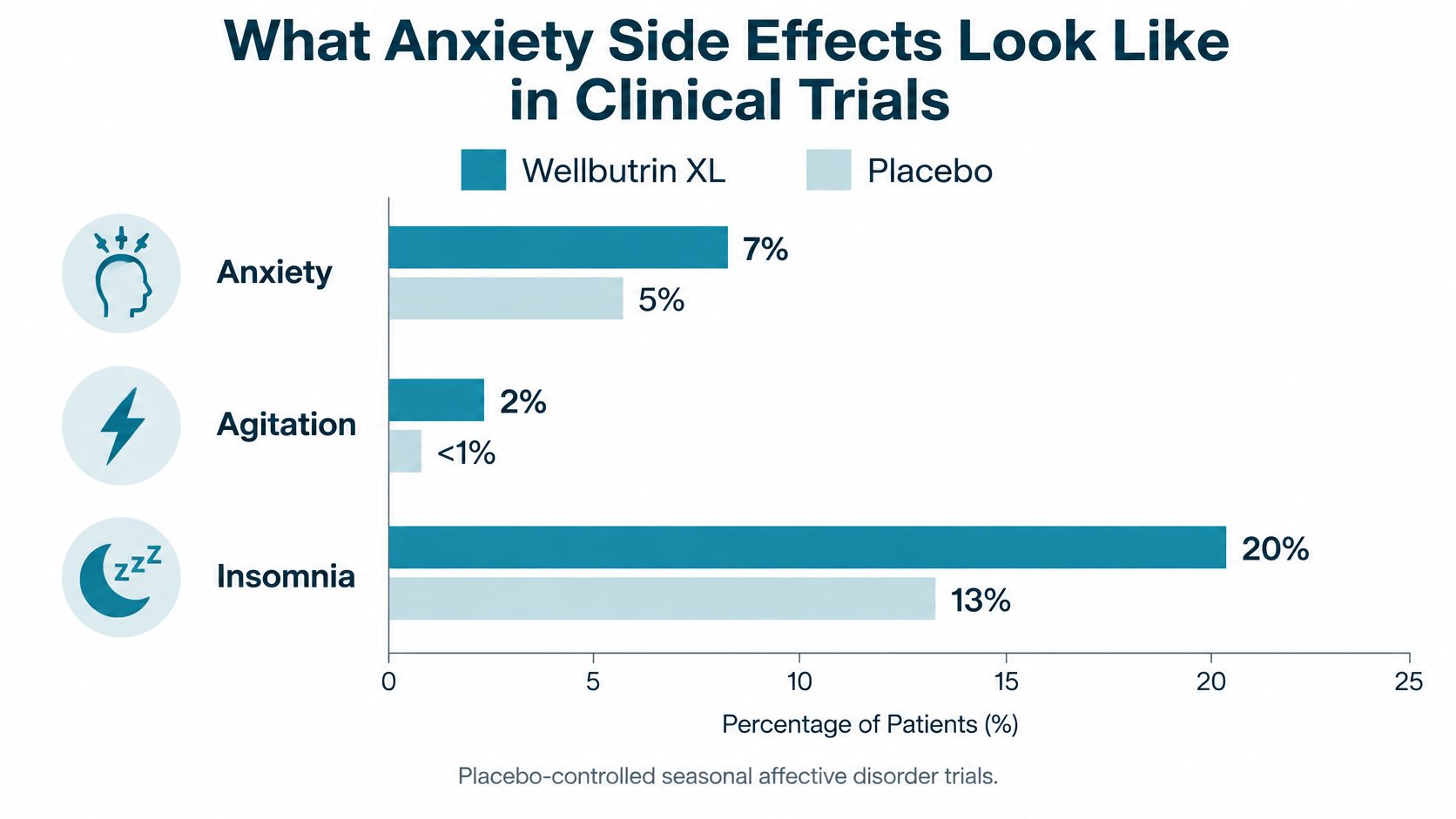
The FDA's 2007 Wellbutrin XL prescribing information reports the following rates from three placebo-controlled seasonal affective disorder prevention trials involving 537 adults receiving Wellbutrin XL at 150–300 mg/day and 511 receiving placebo.
| Reaction | Wellbutrin XL (150–300 mg/day) | Placebo | Difference |
|---|---|---|---|
| Anxiety | 7% | 5% | About 2 percentage points |
| Agitation | 2% | Less than 1% | Higher with Wellbutrin XL |
| Insomnia | 20% | 13% | 7 percentage points |
Label date context: These figures come from the 2007 FDA label, not a newly conducted study. The current DailyMed prescribing information is the reference for present-day prescribing language.
The trial doses identify the study population. They aren't instructions for choosing or changing a dose.
What the comparison does and doesn't establish
A percentage-point difference is the subtraction of one percentage from another. A 7% rate beside a 5% rate is a 2 percentage-point difference, which reads very differently from "2% more anxiety." Keeping that distinction clear prevents a small absolute gap from sounding much larger than it is.
These trials studied prevention of seasonal depression, not treatment of generalized anxiety disorder, panic disorder, or social anxiety disorder. That matters because "anxiety" can describe three different things: anxiety that travels with depression, a diagnosed anxiety disorder on its own, or a temporary medication-related activation early in treatment. These trials measured the first setting. Their adverse-event findings describe what participants reported during those studies, and they don't show whether Wellbutrin XL treats a primary anxiety disorder.
An adverse event is a symptom reported during treatment, not a confirmed medication effect. A group-level difference supports attention to a possible effect, but it doesn't determine what caused one person's symptoms, and it doesn't prove that Wellbutrin XL causes chronic anxiety.
Why clinicians ask about sleep
Insomnia can make anxious feelings harder to interpret. Someone sleeping poorly may describe daytime tension, irritability, or difficulty concentrating as anxiety, even when sleep disruption is an important contributor.
The prescribing information groups anxiety with restlessness, agitation, and insomnia, particularly soon after treatment begins. That cluster is why baseline sleep and symptom timing belong in an antidepressant medication discussion. A monitoring diary that records when symptoms started, how sleep changed, and whether restlessness eased or persisted gives a prescriber the raw material to separate early activation from anxiety that was already present.
Trial averages support monitoring, not personal predictions. A prescriber needs the person's symptom history, treatment experience, and functioning to interpret a change.
Medical Factors That Change the Safety Picture
A medication review needs more than an anxiety rating. The DailyMed bupropion prescribing information describes formulation differences, contraindications, and precautions that make a complete medical and medication history necessary.
Wellbutrin XL isn't interchangeable with every bupropion product. Immediate-release and sustained-release formulations have different release characteristics. Bupropion products used for smoking cessation have their own labeling, and Wellbutrin XL shouldn't be described as though it carries that indication.
Safety factors to review before and during treatment
This checklist supports a physician-led review. It doesn't establish medication eligibility on its own.
| Factor | Why it matters | What to tell the prescriber |
|---|---|---|
| Seizure history or conditions that raise seizure risk | The label describes a dose-related seizure risk | Any seizure history or related medical conditions |
| Current or past anorexia or bulimia | The label lists this as a reason not to use bupropion | Any current or past eating-disorder diagnosis, even if resolved |
| Abrupt alcohol or sedative withdrawal | Can raise seizure risk | Alcohol, benzodiazepine, or other sedative use, and any recent changes |
| Blood pressure concerns | The label warns about hypertension | Blood pressure history and recent readings |
| Bipolar disorder or mania history | Antidepressants can trigger mania or hypomania | Personal or family history of bipolar illness |
| MAO inhibitors or other bupropion products | Contraindicated with MAO inhibitors; avoid duplicate bupropion products | A complete list of prescription, over-the-counter, and supplement products |
| Known hypersensitivity to bupropion or its ingredients | Contraindicated | Any prior reaction to bupropion |
Contraindicated means the medication shouldn't be used in the listed circumstance. A past diagnosis of anorexia or bulimia remains relevant even when symptoms have resolved. Disclosure is a safety step, not a judgment about the person's recovery or current health.
Alcohol and sedative history also requires specificity. The prescriber needs to know the substance, usual pattern, and recent changes. Abrupt withdrawal can create a separate safety concern, so sudden changes shouldn't be attempted without medical guidance.
Screening beyond anxiety
Hypertension means high blood pressure. A history of high readings matters even when the main reason for an appointment is mental health.
Mania and hypomania involve changes in mood, energy, activity, and sleep that require assessment beyond an anxiety diagnosis. Screening includes personal and family history, not just whether someone currently feels depressed. The bipolar disorder information page provides context for that diagnostic discussion.
Medication-list rule: The review should include the active ingredient, not only the brand name, so duplicate bupropion products aren't overlooked.
Dose and formulation decisions belong to the prescriber. A symptom diary can support those decisions, but it can't replace assessment of interactions, seizure risk, contraindications, and the intended treatment benefit.
Tracking Anxiety Changes With a Monitoring Diary
A monitoring diary is a neutral record for a clinical conversation, not a tool for changing medication independently. Its purpose is to preserve details that can be difficult to recall during an appointment. The first entry should record the treatment start or change date and the symptoms already present.

A practical diary template
The rating scale below is an optional recording tool, not a diagnostic test. Consistent descriptions matter more than producing a perfect score.
| Date or day relative to treatment | Anxiety rating | Sleep hours and night wakings | Agitation, restlessness, or panic | Elevated mood signs | Alcohol, caffeine, and other substances | Daily functioning |
|---|---|---|---|---|---|---|
| Record start or change date | Use a consistent personal scale | Record sleep and interruptions | Describe what happened and when | Note unusual energy, racing thoughts, or less need for sleep | Record amounts, timing, and changes | Note effects at work, school, or home |
Useful fields include:
- Treatment timing: Date or day relative to starting or changing treatment.
- Anxiety: A personal rating from 0 to 10, with a brief description.
- Sleep: Hours slept, early waking, and night wakings.
- Activation: Agitation, restlessness, or panic episodes.
- Mood elevation: Unusual energy, racing thoughts, or needing less sleep.
- Substances: Alcohol, caffeine, and other substances, including recent changes.
- Functioning: Effects on responsibilities, relationships, and ordinary activities.
Hypothetical format example, not a real person's record: Day 7 after starting: anxiety 6 of 10, five hours of sleep with early waking, restless evenings, alcohol on two evenings, one missed meeting.
The example shows a format, not an expected response or a conclusion about medication causation. A clinician would still need to ask about baseline symptoms, other explanations, and safety concerns. The diary should record observations rather than a self-diagnosis.
Questions for a weekly check-in
A weekly review can organize an appointment without requiring lengthy daily writing. Helpful questions include:
- Onset: Did anxiety begin after treatment started or changed?
- Sleep: Has sleep become shorter, more interrupted, or less refreshing?
- Activation: Are agitation, restlessness, or panic present?
- Mood: Is energy unusually high, especially with less need for sleep?
- Substances: Has alcohol, caffeine, or other substance use changed?
- Function: Are responsibilities or relationships affected?
- Safety: Have suicidal thoughts or other concerning behavioral changes appeared?
At Empire Medical Wellness, medication review visits discuss whether current treatment is helping, side effects, and concerns about the medication plan. The physician interprets the record alongside the medical history and treatment goals. The patient can bring the diary, the medication list, and the questions that remain unresolved.
When to Contact a Prescriber or Call 911
New or worsening symptoms need prompt clinical contact. Immediate danger needs emergency help. The official prescribing information on DailyMed identifies anxiety, restlessness, agitation, and insomnia as possible treatment-emergent symptoms that warrant attention, particularly early in treatment.
A person doesn't need to establish that the medication caused a change before contacting the prescriber. A clear description of what changed, when it began, and how it affects daily life is enough to start the conversation.
Symptoms and the response for each
| Symptom | Response |
|---|---|
| New, severe, or worsening anxiety, panic, or insomnia | Contact the prescriber promptly; don't change the medication alone |
| Marked agitation, restlessness, or unusual behavior | Contact the prescriber promptly, the same day if intense |
| Signs of mania or hypomania, such as very little need for sleep or racing thoughts | Contact the prescriber urgently |
| Thoughts of suicide or self-harm | Call or text the 988 Suicide & Crisis Lifeline now; call 911 if there is immediate danger |
| Seizure | Call 911 |
Severe symptoms shouldn't be saved for a routine diary review. A scheduled follow-up isn't a reason to delay reporting marked agitation, unusual behavior, or a substantial change in sleep and mood.
The broader guide to anxiety medication assessment describes the role of evaluation. Routine outpatient medication care, however, isn't a substitute for emergency assistance.
Making the contact useful
A brief message can identify the medication, the recent treatment timeline, the main symptom, and its effect on functioning. It should also state whether suicidal thoughts, unusual mood elevation, or severe sleep disruption are present.
With permission, a trusted family member or friend may help notice changes the person hasn't recognized. The antidepressant warning includes clinical worsening and suicidal thoughts or behaviors, particularly in younger patients, including young adults.
Safety takes priority over tracking. A diary can wait when symptoms require urgent assessment.
Suicidal thoughts deserve timely help even when the person is uncertain how serious they are. For immediate danger, an active suicide attempt, or a seizure, emergency services should be contacted rather than waiting for a routine clinic response.
Confirm the Plan With a Prescriber Before Any Change
A reported increase in anxiety can point in three different directions. Anxiety that travels with depression may ease as the depression responds. A separately diagnosed anxiety disorder can persist even when mood improves. Activation effects, such as new restlessness or insomnia after a dose change, may relate to the medication rather than to any condition. Telling these apart is the prescriber's task, and the observations captured in a monitoring diary supply the raw material for that decision.
The central question is whether a treatment fits the working diagnosis, meaning the clinician's best current explanation for the symptom pattern, along with medical history and goals. The answer may be to continue the existing plan, consider another option, or conclude that medication is not appropriate. Those choices rest on a prescriber's assessment rather than a conclusion drawn from comparing medications online.
Benefit and tolerability deserve separate discussion as well. Someone may report better depressive symptoms but troublesome sleep, or unchanged worry despite improving energy. Each observation changes the plan differently: better mood with poor sleep points toward tolerability, while persistent anxiety alongside good energy raises the question of a second, independent condition.
Questions to bring to the appointment
The following list can help structure a medication review:
- Diagnosis: Is anxiety the main condition, associated with depression, or possibly related to treatment?
- Safety: Which medical conditions, past reactions, or interactions affect the options?
- Treatment goals: Which symptoms and daily activities should improve if the plan is helping?
- Monitoring: How will anxiety, sleep, mood, and functioning be tracked between visits?
- Contact plan: Which changes require prompt contact, and which require emergency help?
- Reassessment: What findings would lead the prescriber to reconsider the plan?
Medication management includes evaluation, review of benefits and adverse effects, and follow-up, so it extends beyond the prescription itself. Clear goals make it easier to judge whether a treatment remains worthwhile and whether a reported change calls for further investigation.
Empire Medical Wellness offers adult mental health evaluation and medication management, including anxiety medication assessment through secure telehealth for adults physically located in New York, New Jersey, Connecticut, or Pennsylvania. The physician assesses whether medication is appropriate and explains options, monitoring, and follow-up; the practice does not provide psychotherapy.
The adult mental health medication review page describes that care process. A review can address uncertainty about symptoms without assuming that Wellbutrin XL should be prescribed, replaced, or adjusted.
Sources
- Current Wellbutrin XL prescribing information, DailyMed: Approved indications, warnings, contraindications, and monitoring considerations, linked in the approved-uses section.
- FDA Wellbutrin XL prescribing information, 2007: Seasonal affective disorder prevention trial adverse-event rates, linked alongside the trial table.
- Systematic review of bupropion in adults with major depressive disorder and clinically significant anxiety, 2025: Comparative anxiety findings, linked in the evidence discussion.
- DailyMed bupropion prescribing information: Formulation distinctions and safety considerations, linked in the safety section.
- Official DailyMed prescribing information: Treatment-emergent symptoms and clinical monitoring, linked in the contact guidance.
- 988 Suicide & Crisis Lifeline: Crisis support is available by calling or texting 988.
This article is educational and isn't personal medical advice. It doesn't provide instructions to start, stop, or change medication.
Empire Medical Wellness provides physician-led adult mental health evaluation, medication review, and follow-up when appropriate. Adults with questions about Wellbutrin XL and anxiety can visit Empire Medical Wellness to learn about an assessment of symptoms, medication concerns, and monitoring needs.