
The popular advice to fix morning anxiety by lowering cortisol is too simple. Waking up with anxiety every morning describes a repeating pattern of worry, dread, or physical arousal during the transition from sleep to daytime activity. That timing alone doesn't identify an anxiety disorder or prove that cortisol is abnormal.
A more useful starting point is a brief symptom diary, attention to sleep and daily demands, and assessment when symptoms persist or interfere with life. The aim isn't to find a single explanation before seeking help. It's to give a clinician a clearer picture of what happens around waking.
Table of Contents
- What Repeating Morning Anxiety Does Not Prove
- A Two-Week Diary for Morning Anxiety
- Sleep Timing Without a Cortisol Test
- Contributors Worth Reviewing With a Clinician
- When Morning Symptoms Differ From GAD
- One Gentle Routine Before Changing More
- When to Seek a Physician Instead of Waiting
What Repeating Morning Anxiety Does Not Prove
An uncomfortable morning can feel like evidence that something specific is wrong. Yet the clock time doesn't establish a cause. Neither a racing body nor an immediate sense of dread can reveal a hormone level.
Anxiety symptoms are common, but different measurements answer different questions. In 2024, 12% of U.S. adults regularly experienced worry, nervousness, or anxiety, while 19% had ever been told by a health professional that they had an anxiety disorder, according to the CDC's mental health conditions and care summary. These figures describe populations, not an individual's diagnosis, and don't identify when symptoms are worst.
Useful distinction: A recurring symptom deserves attention without becoming a diagnosis in advance.
A guide to cortisol can help separate hormone terminology from assumptions about morning symptoms. The practical questions concern sleep, symptom timing, anticipated demands, medicines, and daily functioning.

The image illustrates the topic and does not represent an identified Empire Medical Wellness patient. The discussion below offers educational context, not a diagnosis.
A Two-Week Diary for Morning Anxiety
Two-week morning anxiety diary
| What to record | When | What it does not prove |
|---|---|---|
| Bedtime and final wake time | Night before and on waking | A sleep disorder by itself |
| Night awakenings | Each morning | The sole cause of anxiety |
| Anxiety intensity, 0 to 10 | On waking | A diagnosis or a cortisol level |
| Interference with the morning routine | On waking | How severe a disorder is |
| Caffeine amount and clock time | That morning and prior afternoon | That caffeine is the only cause |
| Alcohol or other substances | Prior evening or night | A substance-use diagnosis |
| Medication start, stop, or change | When it occurred | That the reader should change the dose |
| First anticipated task | On waking | That tasks cause a disorder |
| Severe chest pain, fainting, or trouble breathing | Immediately | A reason to keep journaling; seek emergency care |
The diary is an organizing tool, not an experiment that must be completed before care becomes available. A two-week observation period can help capture sleep, waking symptoms, caffeine, alcohol, and medication timing, while peer-reviewed physiological evidence on sleep and cortisol underscores why these relationships shouldn't be reduced to a single hormone explanation.
A paper notebook, phone note, or simple spreadsheet is sufficient. Brief entries are more useful than lengthy attempts to explain every feeling. Recording observations before changing several habits also preserves a clearer starting picture.
Recording observations rather than conclusions
Bedtime is not necessarily the time sleep began. An adult who remembers lying awake can note that separately, without calculating an exact sleep duration. Nighttime waking can be recorded approximately when precise times aren't known.
The intensity scale is a personal tracking aid, not a validated diagnostic cutoff. Consistent use matters more than deciding whether a feeling deserves one particular number. Interference deserves its own entry because intense discomfort and difficulty functioning aren't interchangeable.
Useful interference notes include:
- Delayed activity: Getting dressed or leaving home took longer because of dread.
- Avoidance: A planned call, commute, or household task was postponed.
- Preserved routine: Anxiety was present, but the usual morning activities continued.
- Additional symptoms: Snoring reported by another person, waking gasping, or prolonged difficulty sleeping was noted for clinical discussion.
A hypothetical entry
Hypothetical example, not a patient record: An unnamed adult notes a short night, two awakenings, anxiety intensity of 7, a work deadline as the first anticipated task, and coffee soon after waking. The entry records coexistence, not causation. It contains no assumed diagnosis, medication adjustment, or later improvement.
Medication entries should describe facts: the name, usual timing, and whether a prescription was recently started, stopped, or changed. They aren't instructions to repeat or reverse a change. Questions about the regimen belong with the prescriber.
At the end of the observation period, the useful findings are clusters. Symptoms might appear alongside shorter nights, later caffeine, or a recurring obligation. A cluster can guide a conversation, but it cannot establish insomnia, an anxiety disorder, or a hormone problem.
Persistent interference is a reason to bring the record to a clinician, even when the entries don't reveal an obvious pattern. New severe physical symptoms belong in urgent assessment rather than a diary experiment.
Sleep Timing Without a Cortisol Test
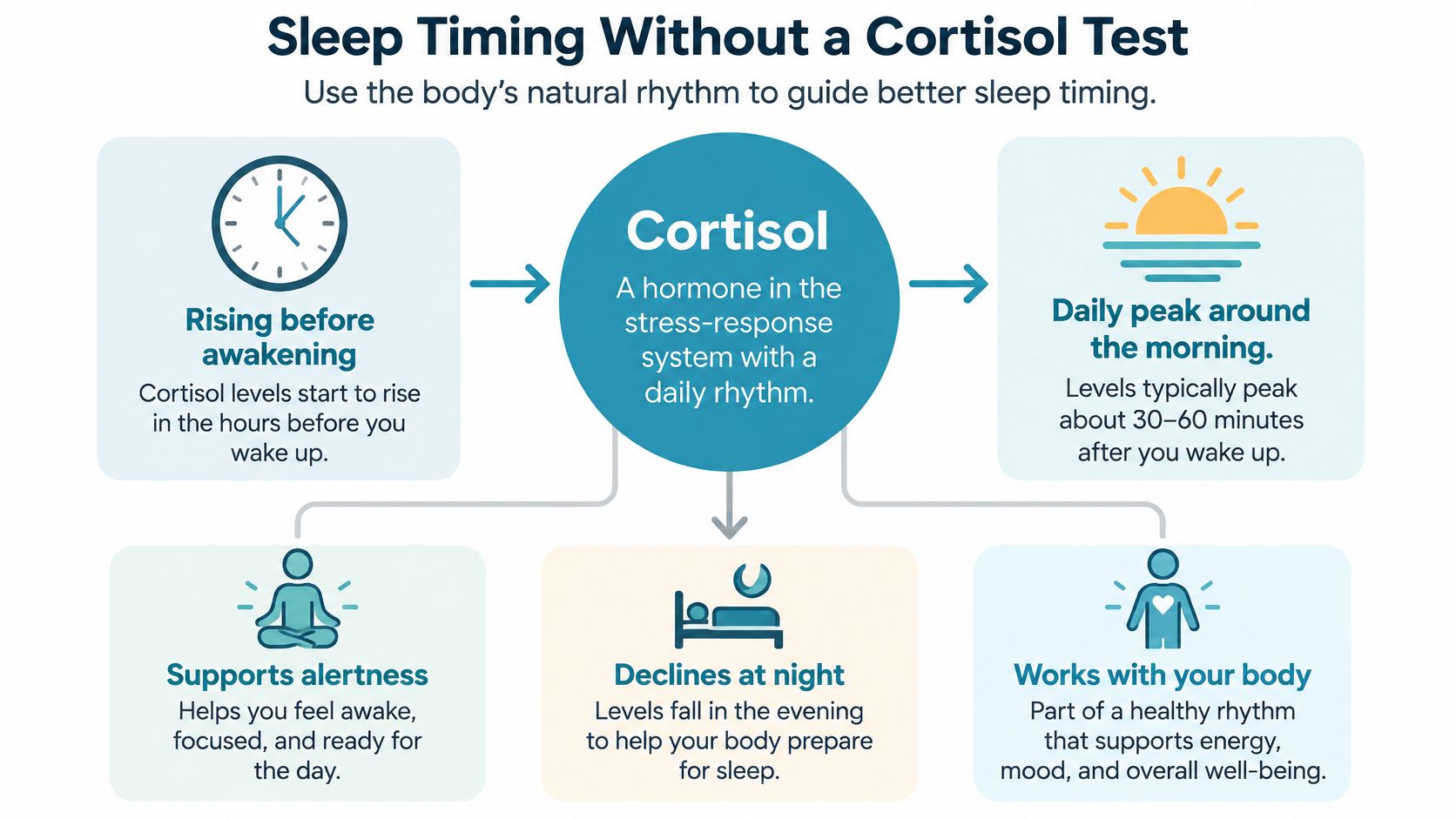
The sudden-surge explanation leaves out an important possibility: cortisol may already be rising before the person wakes. Cortisol is a hormone in the stress-response system that follows a daily rhythm. Its normal morning pattern isn't, by itself, evidence of disease.
A 2025 study of 201 healthy adults found no distinct acceleration in tissue cortisol release during the first hour after waking compared with the preceding hour, according to the University of Bristol's account of the cortisol study. Cortisol began rising before awakening and generally peaked around the first hour awake, with variation linked partly to sleep duration and wake timing.
A useful analogy is a dimmer already turning up before the alarm, rather than a switch flipped by opening the eyes. Waking itself may not be the biological stress event that popular explanations suggest.
What a cortisol test can answer
A cortisol test has specific medical uses. The MedlinePlus explanation of cortisol testing describes testing to help investigate conditions involving too much or too little cortisol, with interpretation affected by factors such as collection timing.
That is different from treating a cortisol measurement as a home test for morning anxiety. A symptom pattern alone doesn't establish a reason for universal testing. The decision should follow a medical history, examination when appropriate, and a clinician's assessment of what a result could clarify.
A hormone number is useful only when it answers a defined medical question.
A normal daily rhythm also shouldn't be treated as a defect that needs supplements or an adrenal fix. Nor does a person's distress become less real because a hormone explanation remains unproven. Symptoms and their effect on daily life still deserve attention.
Why sleep deserves a broader assessment
Sleep can matter through more than hormone timing. A peer-reviewed human sleep-deprivation study found increased anticipatory activity in brain regions involved in threat and emotional processing. This offers a plausible mechanism for greater next-day threat sensitivity, but laboratory findings don't establish an individual reader's cause.
Duration, regularity, and continuity are separate questions. A person can have a stable wake time but frequent awakenings, or long hours in bed with little restful sleep. A circadian rhythm overview provides context for the body's daily timing system without replacing a sleep assessment.
Persistent severe insomnia, snoring, or waking gasping warrants clinical review. These observations are more useful as specific descriptions than as evidence of a self-assigned sleep diagnosis. The next question is how sleep timing and quality fit the whole symptom pattern, not whether one morning hormone measurement can explain everything.
Contributors Worth Reviewing With a Clinician
Light, thoughts, tasks, and physical sensations are all plausible starting points, and no single factor explains every person's symptoms. A careful assessment weighs each possibility against the diary rather than picking a favorite explanation.
Possible contributors to a morning anxiety pattern
| Contributor | Clues to notice | Reasonable next discussion | Limit |
|---|---|---|---|
| Anticipated tasks | Dread tied to the first obligation | Whether worry spreads through the day | Timing does not diagnose a disorder |
| Short or irregular sleep | Brief nights, shifting wake times, daytime fatigue | Sleep schedule and insomnia symptoms | Sleep loss is not every person's cause |
| Caffeine | Later-day or heavy use plus worse sleep or jitters | A one-change trial discussed with a clinician | Caffeine is not automatically the sole cause |
| Alcohol or other substances | Evening use, nighttime waking, morning unease | Confidential substance and sleep history | One symptom does not establish a substance-use disorder |
| Medication timing | Symptoms after a start, stop, or change | Prescriber review of the current regimen | No instruction to change a dose |
| Other medical issues | Snoring, gasping, panic, low mood, or new physical symptoms | Medical assessment chosen by the clinician | Symptoms are not a self-diagnosis |
Thoughts and physical symptoms can overlap
Anticipated work, caregiving, financial, or health demands are worth recording in ordinary language. A note such as dread before a scheduled meeting tells a clinician more than the conclusion that work causes an anxiety disorder. The useful question is whether that concern stays tied to the meeting or expands into unrelated areas of life.
Sequence matters too. Some adults notice a racing heart or a tight chest before they can name a worry. Others wake with a thought about the day already formed. Either order helps describe the experience accurately, and neither order settles what is causing it.
Caffeine deserves attention to amount, timing, and individual sensitivity rather than a blanket assumption that coffee explains everything. A 2025 sleep-research abstract in the journal Sleep reported that greater daily caffeine intake predicted poorer self-reported sleep that night and lower morning alertness the next day. That pattern supports examining a possible tiredness-and-caffeine loop, though an abstract-level finding cannot prove causation for any one adult.
A medication review is not a medication change
A symptom that begins after a prescription starts, stops, or changes is important information. It does not prove the medicine caused the symptom, and it does not show that stopping would be safe. A mental health medication review covers the full regimen, the symptom timeline, previous response, and monitoring needs. At Empire Medical Wellness, that review sits inside an evaluation that also considers medical history, sleep, daily functioning, and past treatment.
Alcohol and other substances belong in the same factual history. The discussion concerns how much, when, and how use lines up with sleep and morning symptoms, without a label drawn from one observation. Confidential, nonjudgmental disclosure lets the clinician weigh competing explanations on equal footing.
Several contributors can coexist. A deadline does not rule out broken sleep, and heavy caffeine use does not exclude another medical concern. The practical question to bring to an appointment is which contributor deserves evaluation first, and what new information would change that order.
When Morning Symptoms Differ From GAD
Generalized anxiety disorder, or GAD, describes more than an anxious start to the day. The National Institute of Mental Health's GAD publication describes excessive, difficult-to-control worry about multiple areas of life on more days than not for at least six months, with at least three associated symptoms in adults.
The associated symptoms include restlessness, fatigue, difficulty concentrating, irritability, muscle tension, and sleep problems. Clinical assessment also considers distress, interference with daily life, and whether another explanation better accounts for the symptoms.
The questions extend beyond the morning
The distinction is not between mild and strong anxiety. A clinician considers the breadth of worry, its duration, how controllable it feels, and its consequences. The time of day supplies context rather than a diagnostic criterion.
| Assessment dimension | What a clinician explores |
|---|---|
| Breadth | Whether worry concerns several areas of life or a specific situation |
| Control | Whether worry is difficult to set aside or manage |
| Duration | Whether the pattern meets the required diagnostic timeframe |
| Associated symptoms | Whether physical, cognitive, and sleep symptoms accompany worry |
| Functioning | Whether symptoms disrupt work, relationships, or daily activities |
| Alternatives | Whether sleep, medicines, substances, or another condition needs assessment |
A stressful period before a known event, grief, increased caffeine use, or a stretch of short sleep can resemble parts of an anxiety presentation. These circumstances still warrant discussion when distress is substantial. They don't permit a GAD diagnosis based on the morning feeling alone.
The NIMH publication is a reference for questions, not a self-scoring form. Counting symptoms without evaluating their context can produce a misleading label.
Care need not wait for a label
Panic symptoms, depressed mood, insomnia, and medication or substance effects may require their own assessment. GAD isn't the only possible explanation, and a person can need help without meeting that particular definition.
Assessment threshold: Persistent interference deserves clinical attention even before a diagnosis is clear.
The generalized anxiety disorder overview addresses the broader condition. The narrower morning question concerns how waking symptoms fit into the person's overall experience.
An adult whose mornings repeatedly disrupt self-care, attendance, or relationships doesn't need to wait for a self-assigned diagnostic deadline. The appropriate next step is assessment, with the diary serving as background rather than proof.
One Gentle Routine Before Changing More
A gentle routine can offer structure without becoming another demanding task. It should be presented as a choice, not an Empire Medical Wellness protocol or a promised way to eliminate symptoms. A difficult morning doesn't mean the person performed the routine incorrectly.
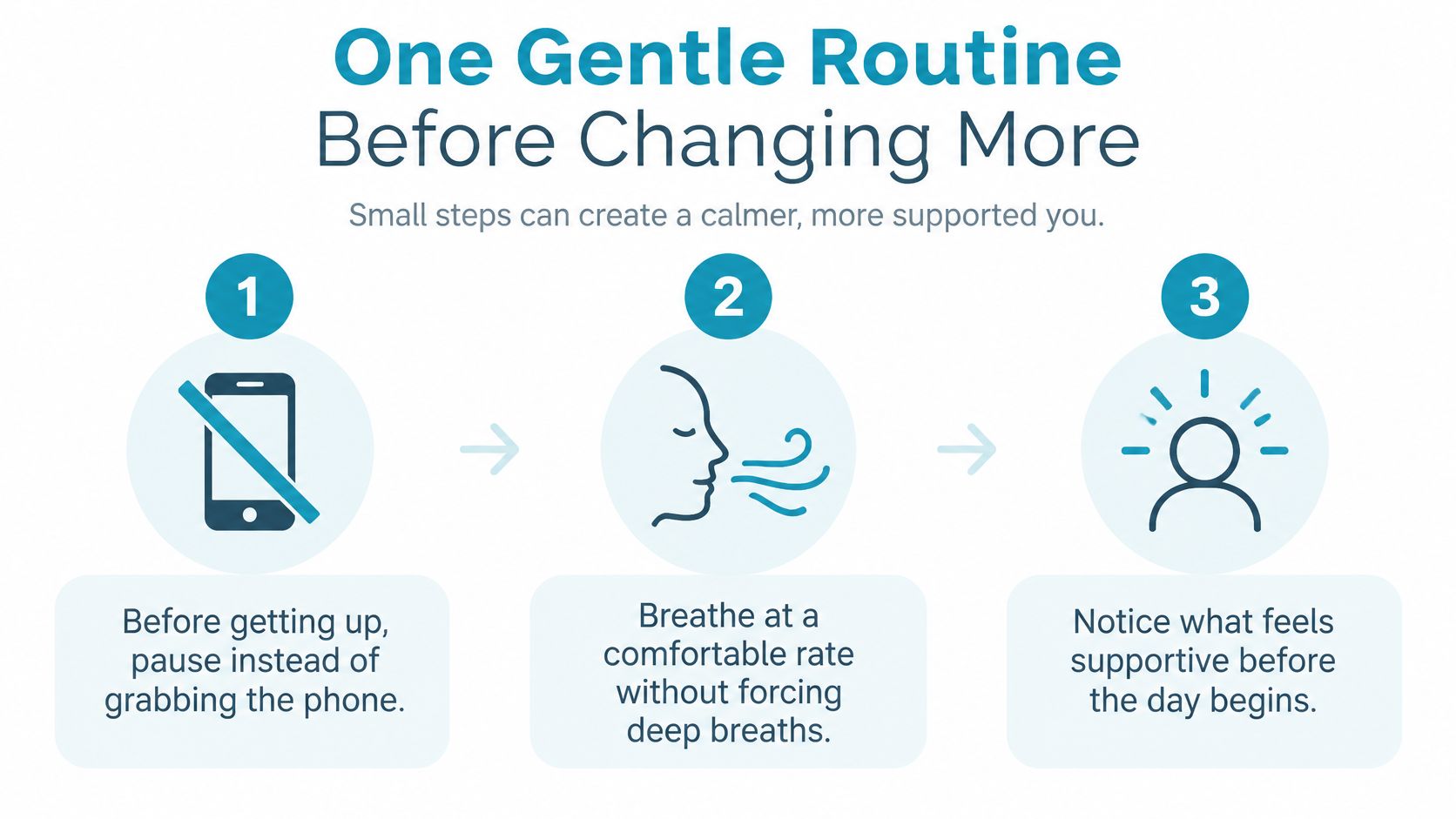
- Pause before the phone. Before getting up, an adult can allow a quiet moment rather than immediately opening messages, news, or work notifications.
- Breathe comfortably. Breathing can remain gentle and unforced. Deep inhalations, breath holding, or rigid counting aren't required.
- Orient to the room. Ordinary sights, nearby sounds, or the feel of the bedding can provide a simple point of attention.
- Choose one small action. Sitting up, drinking water, opening a curtain, or writing down the first task keeps the immediate goal manageable.
- Protect regular sleep. A consistent wake time and room for adequate sleep provide a steadier background for observing symptoms.
- Consider one optional caffeine change. When the diary suggests a connection, a clinician can help consider an isolated change, such as avoiding caffeine from mid-afternoon onward. Medicines remain under prescriber direction.
Why one change is easier to interpret
Changing caffeine, bedtime, exercise, and a prescription together makes the resulting pattern hard to understand. Even an improvement wouldn't reveal which change mattered. A focused adjustment leaves a more useful record for discussion.
The Anxiety and Depression Association of America's general anxiety brochure recommends attention to sleep and caffeine and identifies cognitive behavioral therapy as an established treatment approach for generalized anxiety. Cognitive behavioral therapy is a structured form of psychotherapy that addresses patterns of thinking and behavior.
A morning routine isn't equivalent to that treatment. It is a supportive measure, not a substitute for evaluation or a reason to delay care. Nothing in the routine requires cortisol products, supplements, or independent prescription changes.
A stress management guide can provide additional context for manageable daily practices. Progress need not be defined as immediate calm; a useful observation may be whether the person could begin an ordinary task despite discomfort.
When anxiety remains frequent, causes avoidance, or continues for weeks, the next step is clinical evaluation rather than an increasingly elaborate routine.
When to Seek a Physician Instead of Waiting
Persistent, difficult-to-control anxiety that interferes with work, relationships, or self-care warrants assessment. Insomnia, snoring or gasping, panic symptoms, low mood, or concerns about substance use add important context. A diary can accompany the appointment, but completing it isn't a prerequisite for help.
New severe chest pain, fainting, or trouble breathing may require emergency care and shouldn't be assumed to be anxiety. During a suicidal crisis, 988 offers call or text support; immediate danger requires 911.
What an evaluation can clarify
A physician-led evaluation considers symptoms, sleep, medical and treatment history, medicines, substance use when relevant, and daily functioning. The aim is to explain the clinical assessment and reasonable next steps, including whether further medical or specialist evaluation is needed.
Useful questions include:
- Priority: Which possible contributor deserves evaluation first?
- Review: Do sleep, caffeine, or current medicines need closer attention?
- Next steps: What findings would support additional testing or referral?
Empire Medical Wellness is a physician-led practice. Its initial mental health appointment is 50 minutes, covering symptoms, medical and treatment history, current medications, daily functioning, and goals, followed by an explanation of the assessment, treatment options, and recommended follow-up. Medication questions belong with the prescriber; this article does not recommend starting, stopping, or changing a prescription.
Byline: Empire Medical Wellness Editorial Team
Sources: CDC mental health conditions and care summary; NIMH generalized anxiety disorder publication; MedlinePlus cortisol testing reference; NIH-hosted peer-reviewed articles on cortisol physiology and sleep-related anticipatory brain activity. Direct citations appear alongside the relevant discussion.
Educational notice: This article is educational and is not personal medical advice.
Empire Medical Wellness offers adult mental health evaluation and medication management for concerns such as recurring morning anxiety. During a secure telehealth visit, the physician assesses whether medication is appropriate and explains options, monitoring, and follow-up. Adults considering an assessment can visit Empire Medical Wellness for information about the practice and its care process.