
GERD isn't established as a direct cause of slowed metabolism or weight gain. The better-supported pattern runs the other way: excess body weight is associated with more reflux, including a study finding GERD in 30% of patients with obesity versus 24% of patients without obesity. That association isn't proof of what caused one person's weight to change.
The question “Can GERD cause weight gain?” often combines three different issues: whether reflux causes fat gain, whether higher weight can worsen reflux, and whether symptoms can change someone's eating, activity, or sleep. Keeping those questions separate helps avoid blaming reflux for a change that may have another explanation. It also helps identify what to discuss with a clinician.
Table of Contents
- The Short Answer and the Evidence Behind It
- Why Excess Weight Is the Better-Supported Direction
- How Reflux Can Indirectly Shape Eating and Activity
- Other Causes to Review Before Blaming Reflux
- Meal Timing and Trigger Tracking Without Blanket Food Bans
- Red Flags That Need Prompt Medical Evaluation
- Frequently Asked Questions
- Bring Your Symptom and Weight Record to a Physician
The Short Answer and the Evidence Behind It
GERD, or gastroesophageal reflux disease, is not established as a direct cause of body-weight gain. The stronger evidence links higher weight, particularly fat around the abdomen, with increased reflux risk. The figures below describe patterns across groups, not what caused a specific person's weight change.
| Study | Population | Main finding |
|---|---|---|
| 2024 global healthcare-database study | 2,356,548 propensity-score-matched patients | GERD occurred in 30% of patients with obesity versus 24% without obesity; odds ratio 1.35 (95% CI, 1.34 to 1.36). |
| 2022 systematic review and meta-analysis | 42 observational studies | Abdominal obesity was associated with reflux esophagitis; adjusted pooled odds ratio 1.51 (95% CI, 1.37 to 1.66). |
| 2025 systematic review | 43 studies and 484,219 participants | Estimated GERD risk rose 68% per 10 kg/m² increase in BMI; the authors noted that causality wasn't established. |
| U.S. Nurses' Health Study analysis | 10,545 women | Higher BMI was linked to more frequent GERD symptoms, including within the normal BMI range. |
The 2024 and 2022 findings come from a global healthcare-database study and a systematic review of abdominal obesity. The 2025 systematic review also found an association, while stating that its evidence doesn't establish cause and effect. The Nurses' Health Study finding is discussed in the review of GERD and body weight.
An odds ratio compares the odds of an outcome between groups. It doesn't show that weight gain causes reflux in every person, or that reflux causes weight gain. These results establish a population-level link, not a verdict on an individual's weight change.
Why Excess Weight Is the Better-Supported Direction
An association means two things tend to occur together. Causation means one thing produces another. Current evidence more consistently supports excess weight as a factor that can raise reflux risk than reflux as a direct cause of increased body fat. These are separate questions: whether weight affects reflux, whether reflux causes fat gain, and whether symptoms change eating or activity.
The physical pathway helps explain the first connection. Fat around the abdomen can press on the stomach and raise pressure inside the abdomen. This may make it easier for stomach contents to move upward into the esophagus, the tube connecting the mouth and stomach.
The lower esophageal sphincter is a ring of muscle that helps keep stomach contents in place. In people with obesity, it may have lower resting tone or relax more often. A hiatal hernia occurs when part of the stomach moves above the diaphragm, the muscle separating the chest from the abdomen. Obesity is also associated with changes in esophageal movement. These factors may contribute to reflux, but they do not explain every person's symptoms. NIDDK's GERD treatment information describes these possible mechanical factors.
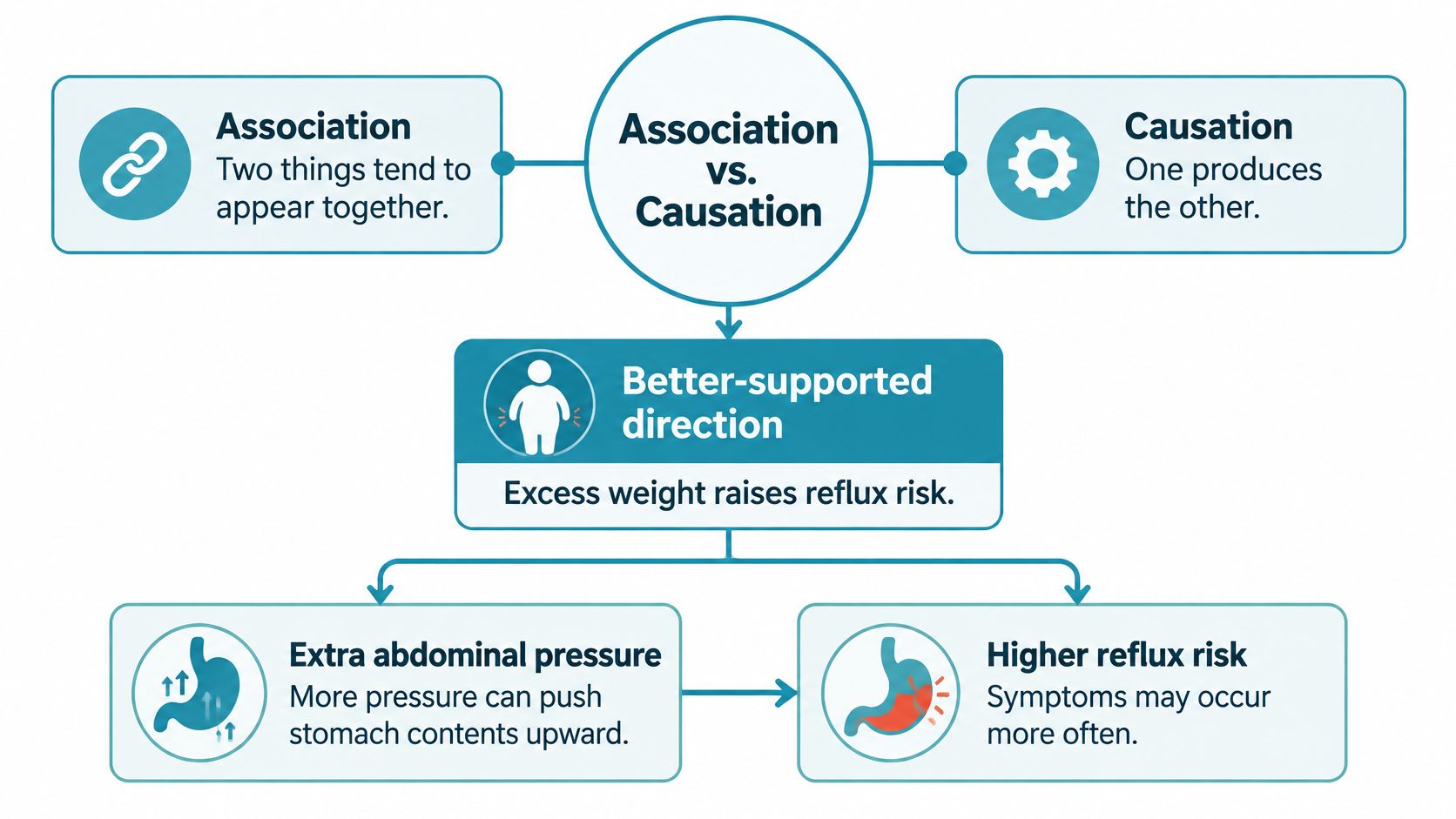
Timing alone cannot show that reflux caused weight gain. Activity, sleep, medication use, mood, and other health conditions may also change over the same period. A U.S. Nurses' Health Study analysis found that GERD symptom frequency increased with BMI, including among women whose BMI remained within the historically normal range. A review of epidemiologic evidence also found that obesity was associated with a higher risk of GERD symptoms and erosive esophagitis than normal BMI.
The review described an observational finding that women who reduced BMI reported fewer GERD symptoms than controls. This does not prove that weight change will ease symptoms for any particular person. It supports the direction from weight status to reflux more strongly than the claim that reflux directly causes fat gain. Population patterns cannot diagnose GERD from body shape or identify the cause of one person's weight change. For a plain-language overview of how metabolism relates to weight, see Empire Medical Wellness's metabolism information.
How Reflux Can Indirectly Shape Eating and Activity
Reflux symptoms may make weight management harder for some people, but they don't create fat directly. A person might choose frequent bland snacks, such as crackers or refined foods, because those seem less likely to trigger symptoms. Depending on portions and frequency, that pattern could increase energy intake. Another person might eat late to ease discomfort, or avoid a walk after meals because movement seems to worsen symptoms.
Poor sleep can also make it harder to stay active during the day and may affect eating patterns. These effects aren't inevitable, and their impact differs from person to person. Avoiding foods doesn't automatically cause weight loss. Broad food bans can also reduce variety without providing a clear nutritional benefit.
A useful distinction: A behavior that changes eating or activity may affect weight for an individual. That isn't proof that GERD is a common or direct cause of clinically significant weight gain.
Hypothetical example: A person skips evening walks and often has a late snack after dinner because reflux symptoms feel uncomfortable. A brief food and symptom record could reveal that these habits occur together. The record would identify a pattern to discuss, but it wouldn't prove that reflux caused any weight change.
For people with overweight or obesity, a clinician may discuss intentional weight reduction as one way to help reduce reflux symptoms. That's not a promise of cure, nor does it mean every person with GERD needs to lose weight. People looking at activity options can read about weight management without exercise. Tracking meal timing and symptoms can help clarify the pattern without assigning causation.
Other Causes to Review Before Blaming Reflux
Unexplained or rapid weight change shouldn't be attributed to reflux alone. A clinician may review eating and activity patterns, sleep, stress, medication use, fluid retention, endocrine conditions such as thyroid disease, and mood. The pattern can help guide which questions need attention.
| Weight-change pattern | Contributors to review | Who to involve |
|---|---|---|
| Gradual gain over months with stable reflux | Calorie intake, activity, sleep, and stress | Primary care or obesity medicine clinician |
| Rapid gain or leg swelling | Fluid retention and possible heart or kidney conditions | Physician evaluation promptly |
| Gain after starting a new medicine | Medication effects, including sedating drugs that can worsen reflux | Prescriber and clinician reviewing the full medication list |
| Gain with fatigue, cold intolerance, or menstrual change | Endocrine conditions such as thyroid disease | Physician for laboratory evaluation |
| Gain with low mood or changed sleep | Mood and sleep factors | Clinician for mental-health or sleep assessment |
Medication review matters because some drugs can worsen reflux. NIDDK lists benzodiazepines and other sedating medicines among medications that may cause GERD or make symptoms worse. Its information doesn't establish that standard GERD treatment routinely causes meaningful weight gain. The NIDDK overview of GERD symptoms and causes also explains that proton pump inhibitors reduce stomach-acid production and are generally more effective than H2 blockers for treating GERD symptoms and healing the esophageal lining.
Any change to acid-suppressing medicine, including the choice or timing of a proton pump inhibitor, belongs with the treating clinician. Medication shouldn't be stopped or adjusted without that clinician's direction. For a broader discussion of medication and weight, see psychiatric medication and weight gain.
A general obesity medicine evaluation may consider weight and growth history, previous treatment, current medications, relevant health conditions, eating and activity patterns, sleep, and a person's goals. The purpose is to investigate possible contributors, not to settle on the most familiar explanation.
Meal Timing and Trigger Tracking Without Blanket Food Bans
NIDDK advises that people with GERD may be told to finish meals 2 to 3 hours before lying down. This timing measure addresses reflux mechanics and symptom control. It isn't a weight-loss promise. The NIDDK eating, diet, and nutrition guidance also describes weight reduction as a possible way to reduce symptoms for people with overweight or obesity, not a cure for everyone.
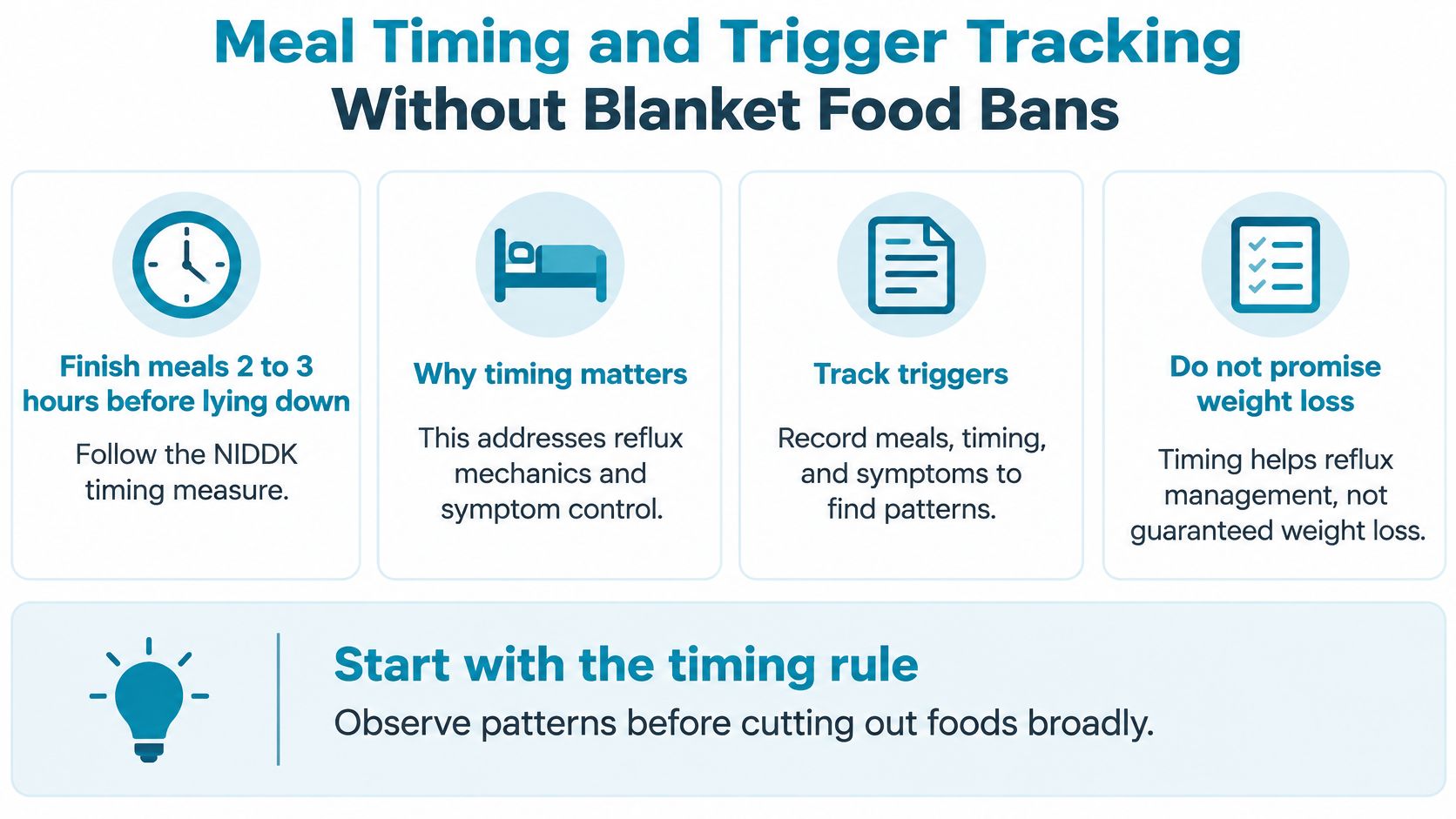
A brief record can show whether symptoms follow a particular routine. It can also help prevent a person from eliminating foods based on guesswork.
- Record meals and bedtime. Note meal times, approximate portion sizes, and when the person lies down.
- Describe symptoms. Record when they begin and rate their severity using a simple, consistent scale.
- Note possible food triggers. Track caffeine, alcohol, large fatty meals, peppermint, and chocolate as possible individual patterns, not universal rules.
- Include sleep details. Record sleep position and whether symptoms disrupted sleep.
- Note activity after meals. Include walking or exercise and whether symptoms occurred.
- Review before making major changes. Share the record with a clinician or dietitian before making a significant diet change.
Hypothetical diary entry: A person eats dinner late, lies down soon afterward, and then records reflux symptoms. Repeated entries may help the person and clinician assess whether timing is relevant. One entry alone can't establish the cause of symptoms or weight change.
Replacing trigger foods with frequent snacks, large low-protein meals, or sugary drinks may make weight management harder. No specific food is banned for everyone, and food responses differ. Diet changes should follow assessment rather than broad restrictions; healthy eating information can provide additional context.
Red Flags That Need Prompt Medical Evaluation
Certain symptoms call for medical assessment, not self-treatment or an assumption that reflux explains everything. Chest pain can be a heart emergency and can feel similar to heartburn. In the United States, new or concerning chest pain or pressure calls for emergency help. Call 911 rather than assuming the symptom is reflux.
| Warning sign | Why it matters | What to do |
|---|---|---|
| Chest pain or pressure | Can be a heart emergency, not only reflux | Call 911 in the United States |
| Blood in vomit or black, tarry stools | Possible bleeding in the digestive tract | Seek urgent medical care |
| Progressive difficulty swallowing | Possible structural or movement problem in the esophagus | Arrange prompt medical evaluation |
| Persistent vomiting | Risk of dehydration and a possible underlying cause | Arrange prompt medical evaluation |
| Unintentional weight loss | Can signal conditions that need a workup | Arrange prompt medical evaluation |
Other findings also deserve clinical review. Fatigue may have several explanations, including anemia. Persistent symptoms despite usual measures, or weight gain with leg swelling or shortness of breath, also warrant assessment.
This list isn't complete. Any new, persistent, or changing symptom deserves attention from a qualified clinician. A clinician can evaluate symptoms in person and order tests when needed. This article doesn't diagnose any condition.
Frequently Asked Questions
Does treating reflux help with weight loss?
There's no established mechanism showing that treating reflux alone restores weight loss. A clinician can assess reflux and weight concerns together, but symptom treatment shouldn't be presented as a way to restart metabolism or guarantee weight change.
Do acid-suppressing medicines cause weight gain?
NIDDK doesn't establish that standard GERD treatment routinely causes meaningful weight gain. Individual concerns belong with the prescriber, and medication shouldn't be stopped or changed without clinician direction.
Should someone cut out trigger foods?
No food is banned for everyone with GERD. Trigger patterns are individual, and significant changes are best made after assessment because broad restrictions can leave meals less nutritious or satisfying.
Is weight loss needed for everyone with GERD?
No. NIDDK recommends that clinicians may discuss weight reduction with people who have overweight or obesity to reduce symptoms. That guidance doesn't mean every person with GERD needs to lose weight, or that weight loss cures GERD.
Bring Your Symptom and Weight Record to a Physician
A simple record can make a clinical conversation more useful. For a few weeks, track weight trends, reflux timing and severity, meals, sleep, activity, and all medicines, including over-the-counter products. Bring the record to a primary care physician or gastroenterologist for reflux concerns, or to an obesity medicine clinician when weight is the main concern.
Questions to discuss include which possible contributors fit the pattern, whether any tests are relevant, and whether a current medicine should be reviewed by its prescriber. Medication changes shouldn't be made independently. The first obesity medicine appointment at Empire Medical Wellness is a 50-minute evaluation focused on weight history, health concerns, previous approaches, current medications, goals, and appropriate treatment options. It ends with recommended next steps and a follow-up plan. No specific amount of weight loss or outcome is promised.

Byline: Empire Medical Wellness Editorial Team
Published: November 2, 2026 | Updated: November 2, 2026
Sources: NIDDK, Eating, Diet, and Nutrition for GER & GERD; global healthcare-database study and systematic review of abdominal obesity; 2025 systematic review of BMI and GERD; U.S. Nurses' Health Study analysis and review of GERD and body weight; NIDDK, Treatment for GER & GERD; NIDDK, Symptoms and Causes of GER & GERD.
This article is educational and isn't personal medical advice.
Empire Medical Wellness offers private, physician-led obesity medicine care that can include medical assessment, individualized weight-management planning, and follow-up. Adults with weight concerns alongside reflux symptoms can visit Empire Medical Wellness to learn more and consider whether an evaluation may be appropriate.