
Cortisol is the body's main glucocorticoid hormone, made by the adrenal glands under control of the hypothalamic-pituitary-adrenal axis, and it follows a daily rhythm rather than holding steady. Testing is useful only for specific clinical questions, and a single random result is not a stress score. Many adults arrive at that distinction after months of fatigue, disrupted sleep, or stubborn weight changes and a search result that blames high cortisol. The symptoms are real. The explanation offered online is often too simple, and the path forward starts with understanding what cortisol normally does.
Table of Contents
- What Cortisol Actually Is and Why It Matters
- The HPA Axis and How the Body Controls Cortisol
- Your Daily Cortisol Rhythm Explained
- When Testing Actually Helps and What Each Test Answers
- Why Everyday Stress Is Not the Same as a Cortisol Disorder
- Cushing Syndrome and Adrenal Insufficiency
- When to Bring It Up at Your Visit
What Cortisol Actually Is and Why It Matters
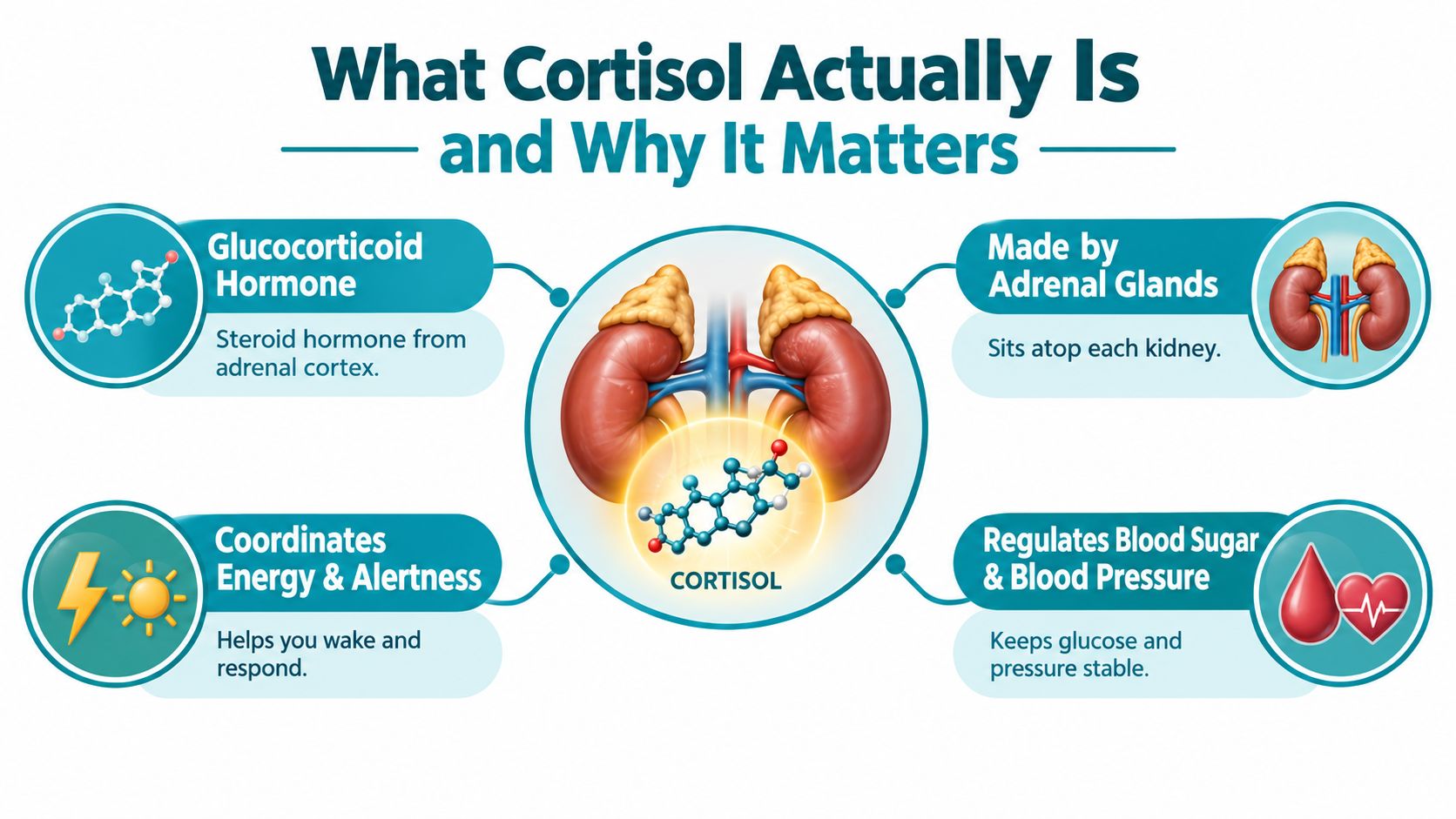
Cortisol is a steroid hormone produced in the outer layer of the adrenal glands, the small glands that sit on top of each kidney. In healthy adults, the adrenal glands produce approximately 8 to 30 milligrams of cortisol per day, as described in the NCBI Bookshelf review of cortisol physiology. That output isn't constant, and it isn't meant to be.
What cortisol does during an ordinary day
Cortisol helps coordinate alertness, energy availability, blood sugar, and blood pressure. It rises before waking so the body is prepared for activity, then falls across the day so rest becomes possible at night. It also helps the body respond to physical stress, such as illness or injury, by making fuel available and supporting circulation. Readers who want broader background on how hormones and energy use connect can review how metabolism shapes energy and weight regulation.
Essential does not mean more is better
Cortisol gets marketed as a hormone to lower, balance, or detox. That framing misses a basic point. Too little cortisol and too much cortisol can both cause harm, and neither state is diagnosed from a single symptom such as tiredness or abdominal weight gain. Fatigue, poor sleep, anxiety, and weight change have many possible causes, and cortisol is only one piece of a much larger picture.
A useful reframe: Cortisol is not a toxin to purge. It's an essential signal whose timing and amount both matter.
A brief note on where the science came from
The hormone's history helps explain why modern medicine treats it precisely. Hydrocortisone, also called cortisol, was isolated from adrenal tissue in the late 1930s, and the work on adrenal cortex hormones was recognized by the 1950 Nobel Prize in Physiology or Medicine ceremony speech. That research separated cortisol from related compounds such as cortisone and laid the groundwork for corticosteroid medicines used today. It also established cortisol as a defined molecule with specific effects, not a vague measure of stress or burnout.
For an adult wondering whether symptoms point to cortisol, the honest starting answer is narrow. Cortisol matters, disorders of cortisol are real, and most everyday fatigue or weight concerns don't turn out to be cortisol disorders. Sorting out which situation applies requires the control system and daily rhythm covered next, plus careful attention to symptoms, medicines, and test timing.
The HPA Axis and How the Body Controls Cortisol
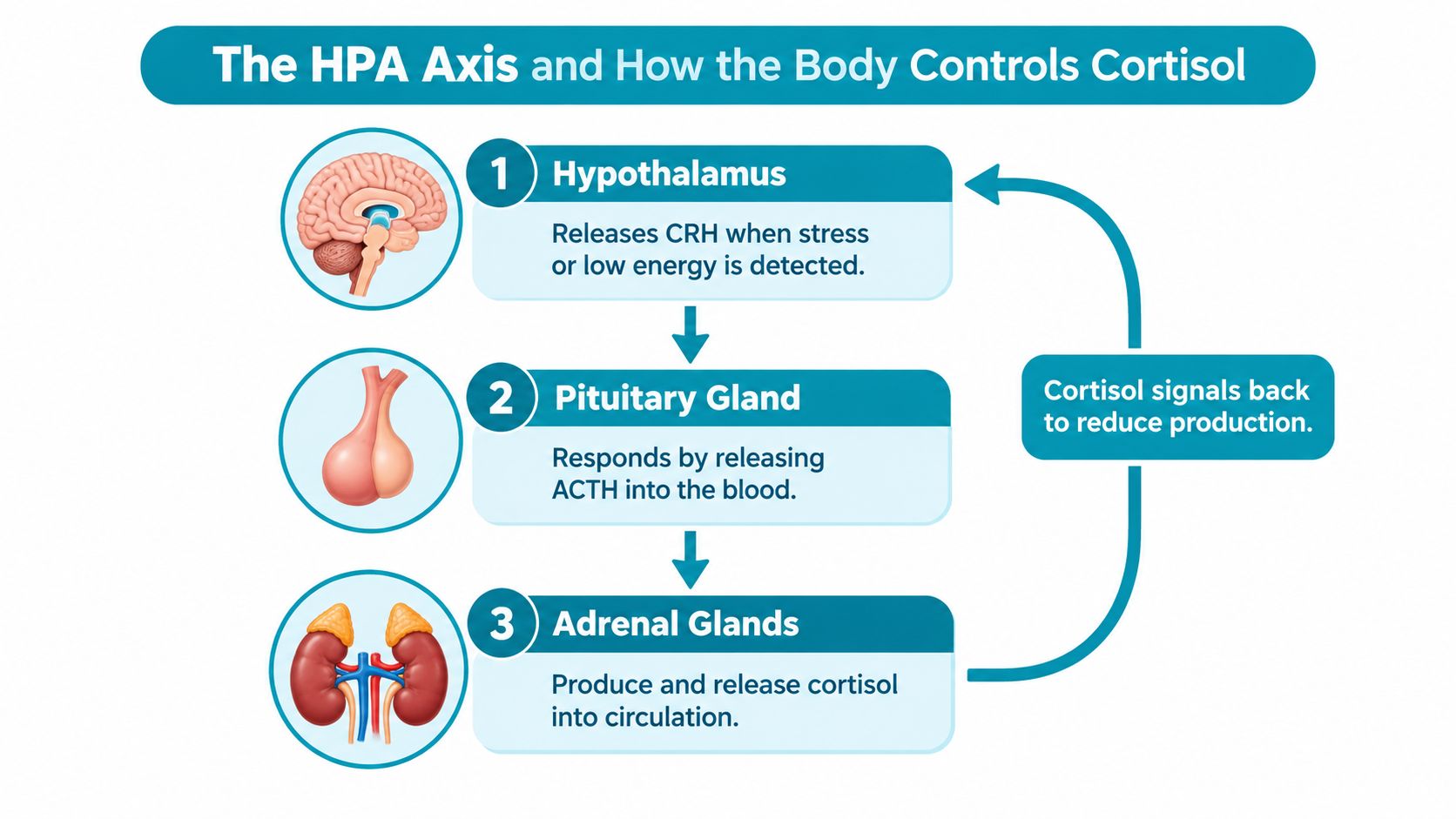
Cortisol production runs through a three step signaling chain called the hypothalamic-pituitary-adrenal axis, or HPA axis. The hypothalamus, a control region in the brain, releases corticotropin-releasing hormone. That signal prompts the pituitary gland to release adrenocorticotropic hormone, known as ACTH, which travels through the blood and tells the adrenal cortex to make cortisol, a sequence outlined in the NCBI Endotext chapter on the HPA axis.
The thermostat analogy
A thermostat doesn't run a furnace at full output all day. It senses temperature, responds, and eases off. The HPA axis works in a similar feedback loop. As cortisol rises, it signals back to the brain and pituitary to reduce the drive for more cortisol. When cortisol falls, that brake loosens and production can rise again.
That feedback loop isn't a textbook detail. It's the reason several cortisol tests work at all, and it's why prescribed glucocorticoid medicines, such as prednisone or dexamethasone, can suppress the body's own production. A clinician reviewing any cortisol result needs a full list of steroid exposure, including pills, injections, inhalers, and skin preparations, because outside glucocorticoids change how the axis behaves.
Two control systems, not one
Readers often assume cortisol responds only to stress. In fact, two influences overlap:
- Circadian control: The body's central clock sets a daily pattern that persists even when light, food, and activity are controlled.
- Moment to moment demand: Illness, pain, psychological stress, and other physical demands can raise cortisol on top of that daily pattern.
- Feedback from cortisol itself: Rising levels restrain further release, which keeps a normal response from running indefinitely.
Why ACTH often gets measured alongside cortisol
Because ACTH is the pituitary signal that drives cortisol, measuring both hormones together helps a clinician locate where a problem may sit. A cortisol result paired with ACTH can point toward the adrenal glands, the pituitary, or another source, depending on the pattern. MedlinePlus guidance on cortisol testing notes that ACTH is often measured with cortisol to help identify the type of disorder. That pairing is one more reason a lone cortisol number, without context, rarely settles anything on its own.
Your Daily Cortisol Rhythm Explained
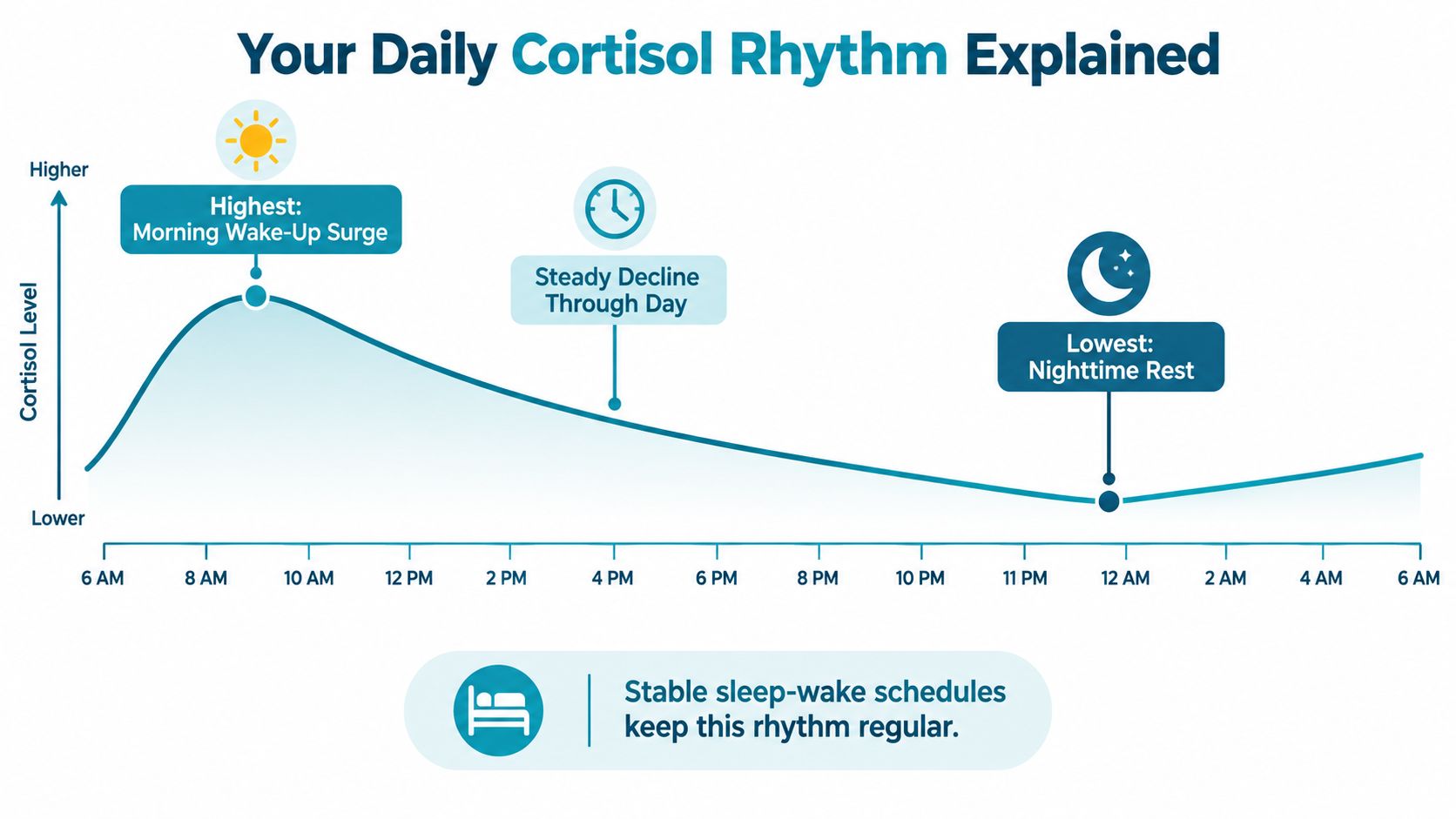
With a stable sleep and wake schedule, cortisol generally begins rising around 03:00 to 04:00, peaks near 07:00 to 09:00, and declines to very low levels during nighttime sleep. On top of that pattern sits the cortisol awakening response, a further rise during the first 30 to 45 minutes after waking. That morning surge supports alertness and metabolic preparation for the active part of the day.
A walk through one day
Late at night, cortisol sits at its lowest point, which fits a body at rest. During the final hours of sleep it climbs, helping raise blood sugar and blood pressure before the alarm sounds. Through the afternoon and evening it drifts downward, so by late evening the signal for activity has faded. Adults who work nights or keep irregular hours can read more about how circadian rhythm affects sleep and daily functioning, because a shifted schedule shifts the rhythm that any test tries to capture.
The clock behind the curve
The rhythm is generated substantially by the suprachiasmatic nucleus, the brain's central circadian pacemaker in the hypothalamus. It isn't a reaction to a busy morning. The pattern persists under controlled conditions, which means the body anticipates waking rather than only responding to it. Sleep timing therefore belongs in any serious discussion of cortisol, and readers curious about the two way relationship can explore how cortisol disrupts sleep as general background reading.
Pulses on top of the pattern
Cortisol also follows an ultradian pattern, meaning secretion happens in repeated pulses layered over the broader daily curve. A single blood sample can catch a peak or a trough of one pulse. Two samples taken hours apart, or on different days, can look quite different in the same healthy person.
A cortisol value without a collection time, wake time, and medication list is closer to a still photograph of moving traffic than to a measurement of the road.
That single fact explains most confusion about home testing. A morning result described as high may be entirely normal morning physiology. A late evening result that fails to fall carries different meaning. Timing isn't a footnote to cortisol testing. It's the foundation of it.
When Testing Actually Helps and What Each Test Answers
Cortisol can be measured in blood, saliva, or urine, and those options aren't interchangeable versions of the same test. Each answers a different physiological question. Matching the test to the question is the step that wellness marketing usually skips.
Testing for possible excess
For suspected Cushing syndrome, in which the body is exposed to too much cortisol over time, Endocrine Society guidance on diagnosing Cushing syndrome recommends a first line test with high diagnostic accuracy rather than a random cortisol measurement. The recommended options include at least two 24 hour urinary free cortisol measurements, two late night salivary cortisol measurements, or a 1-mg overnight dexamethasone suppression test. Repeated measurement matters because cortisol excess can fluctuate.
Each option probes something distinct, as NIDDK information on Cushing syndrome testing describes. Late night saliva testing checks whether the normal nighttime low point has been lost. A 24 hour urine collection estimates cortisol excreted across a full day. The dexamethasone test uses a synthetic glucocorticoid to ask whether the body's own cortisol suppresses the next morning, as it should when feedback is working.
Testing for possible deficiency
Suspected adrenal insufficiency, in which the body doesn't produce enough cortisol, calls for a different approach, typically morning blood testing interpreted with ACTH and the clinical picture. Serum cortisol shows a steep daily gradient, roughly 5 to 25 mcg/dL in the early morning and below about 1.8 mcg/dL at midnight in the reference description cited in the Endocrine Society guideline evidence review in PMC. A morning value judged by nighttime expectations, or the reverse, misleads quickly.
Cortisol Tests and the Clinical Question Each One Answers
| Test | What it measures | Best used for | Key timing or collection note |
|---|---|---|---|
| Morning serum cortisol | Cortisol in blood at one moment | Evaluating possible deficiency, often with ACTH | Drawn early morning near the daily peak |
| Late night salivary cortisol | Free cortisol in saliva late in the evening | Screening for cortisol excess | Collected late at night, usually on two nights |
| 24 hour urinary free cortisol | Cortisol excreted across a full day | Screening for cortisol excess | Requires complete collection, checked with creatinine |
| 1-mg dexamethasone suppression test | Whether cortisol suppresses after a synthetic glucocorticoid | Screening for autonomous cortisol excess | Dose at night, blood drawn the following morning |
What makes any result interpretable
Collection time, sleep pattern, acute illness, recent stress, and glucocorticoid medicines all belong on the record before a result means much. An incomplete urine collection can produce a falsely low value. A blood draw during acute illness can push cortisol up for appropriate reasons. A thoughtful evaluation documents those factors first, then decides whether testing is indicated at all.
Why Everyday Stress Is Not the Same as a Cortisol Disorder
Abdominal weight gain, fatigue, poor sleep, and difficulty losing weight are frequently presented online as proof of high cortisol. Authoritative clinical coverage pushes back on that leap. Harvard Health guidance on whether cortisol is really high notes that true cortisol disorders are uncommon and that a single symptom rarely identifies cortisol as the cause. Common symptoms deserve real evaluation. They don't, by themselves, diagnose a hormone disorder.
The adrenal fatigue claim
Adrenal fatigue is the popular idea that chronic stress wears out the adrenal glands until they can't keep up. The Endocrine Society patient resource on adrenal fatigue states that adrenal fatigue is not an accepted medical diagnosis. Adrenal insufficiency is a genuine, diagnosable condition with specific testing. Blurring the two can delay proper evaluation and steer people toward supplements built around a condition that medicine doesn't recognize.

Supplements, detoxes, and cortisol belly claims
Products marketed to lower, balance, or detox cortisol aren't treatments for Cushing syndrome or adrenal insufficiency, and a cortisol belly diagnosis can't be made from appearance. Fat distribution varies by genetics, age, and many health factors. No supplement substitutes for identifying why a symptom is happening. Adults looking for grounded, non commercial support for daily habits can consider structured approaches to stress management and recovery alongside medical care, and general reading such as a wellbeing guide to reducing daily stress may help with routines, though neither replaces evaluation of persistent symptoms.
Stress still matters, just not as a single hormone story
Chronic stress can influence appetite, reward processing, sleep, and metabolic regulation, and those effects run in both directions. Stress related to weight stigma also deserves acknowledgment rather than blame. In evidence summarized in an Annual Review of Psychology article on stress and health, perceived stress mediated 37% of the association between weight stigma and anxiety and depressive symptoms, even after accounting for body mass index. Supporting sleep, eating patterns, and treatment engagement can help overall health. It isn't a guaranteed weight loss treatment, and it doesn't make cortisol the single hidden cause of a person's weight.
Cushing Syndrome and Adrenal Insufficiency
Real cortisol disorders look different from the vague picture painted online. They tend to involve multiple, progressive features that develop together, and that pattern is what prompts targeted testing rather than screening everyone who reports weight gain or tiredness.
When there is too much cortisol
Cushing syndrome means prolonged exposure to excessive cortisol, whether the body makes too much or a prescribed glucocorticoid medicine supplies it. Features that raise concern, especially in combination, include:
- Easy bruising and thin skin: Bruises appear with minor knocks.
- Wide purple striae: Broad, violaceous stretch marks, distinct from common pale ones.
- Proximal muscle weakness: Difficulty rising from a chair or climbing stairs.
- New or worsening hypertension and hyperglycemia: Blood pressure and blood sugar climb together, a metabolic pattern also discussed in background on insulin resistance and blood sugar regulation.
- Mood and sleep changes: Irritability, low mood, or disrupted sleep alongside physical signs.
Treatment depends on the cause. Endocrine Society guidance on treatment of Cushing syndrome identifies removal of a causative tumor as first line treatment for endogenous disease when surgery is possible, with radiation, chemotherapy, or cortisol lowering medicines used in selected situations. When excess comes from long term prescribed glucocorticoids, clinicians generally taper to the lowest dose that controls the original condition. Steroid medicines should never be stopped abruptly at home, because a suppressed HPA axis may not restart at once.
When there is too little cortisol
Adrenal insufficiency means the body doesn't produce enough cortisol. Reported features include persistent fatigue, unintentional weight loss, salt craving, low blood pressure, and, in primary adrenal disease, darkening of the skin called hyperpigmentation. General background reading, such as the Sunridge Medical hormone optimization guide, can orient readers to terminology, but diagnosis rests on appropriately timed laboratory testing and clinical assessment, not symptom checklists.
Urgent warning signs: Severe weakness, vomiting, fainting, or confusion can signal a medical emergency and warrant urgent care rather than a routine appointment or a home test.
Neither disorder is confirmed or excluded by appearance, a supplement response, or one random cortisol value. Both require the validated, repeated, and correctly timed testing described earlier, interpreted by a clinician who knows the full history.
When to Bring It Up at Your Visit
The practical question isn't whether cortisol matters. It's whether a specific person's symptoms justify testing, and which test would answer the right question. A general assessment follows a sensible order: review symptoms and steroid medicines, decide whether testing is indicated, choose the appropriate test, interpret confounders, and arrange further testing or specialist review when warranted. A suspected endocrine disorder can change the evaluation or referral plan. It doesn't automatically select a weight loss drug or any other treatment.
A short checklist worth bringing to an appointment
- Progressive or multisystem symptoms: Several features developing together, such as easy bruising, wide purple striae, and proximal weakness.
- Steroid exposure in any form: Prescribed glucocorticoids, injections, inhalers, or high dose skin preparations, past or current.
- Sleep and schedule pattern: Wake time, shift work, or irregular hours that would shift the daily rhythm and affect interpretation, especially alongside unexplained changes in weight gain patterns over time.
- Persistent symptoms without an explanation: Fatigue, weight change, blood pressure, or blood sugar changes that haven't responded to reasonable care.
- Red flag symptoms: Severe weakness, vomiting, fainting, or confusion, which need urgent evaluation rather than a scheduled visit.
Preparing for a productive conversation
A brief symptom timeline helps more than a stack of home test results. Notes on when symptoms began, how they've changed, current medicines, and sleep patterns give a physician something concrete to work from. It's also reasonable to mention stress related to weight stigma. Care can address that stress respectfully, without blame, while keeping cortisol in proper context rather than treating it as the whole story.
Hypothetically, an adult with new easy bruising, widening purple striae, trouble rising from a chair, and rising blood pressure presents a very different picture from an adult with tiredness alone after months of short sleep. The first pattern supports targeted cortisol testing and possible endocrinology referral. The second usually starts with sleep, mood, medicines, thyroid and metabolic review, and other common causes. Both deserve to be taken seriously. They don't lead to the same test.
This article is educational and isn't personal medical advice. Adults with unexplained, persistent, or concerning symptoms deserve individual evaluation by a qualified physician who can examine the full picture and decide whether cortisol testing belongs in it.
Adults who want a calm, physician led evaluation of weight, metabolic health, or related symptoms, with careful review of whether hormone testing is indicated, can learn about the practice at Empire Medical Wellness. Empire Medical Wellness offers private pay, physician led outpatient care for adults, including obesity medicine and thoughtful metabolic assessment, with referral for specialty endocrinology care when a cortisol disorder is suspected.