
A high cholesterol result is a starting point for a cardiovascular-risk conversation, not a diagnosis or treatment decision by itself. The 2026 ACC/AHA guideline replaces the 2018 cholesterol guideline, using risk-based assessment rather than one universal LDL goal for every adult.
A result can feel alarming, especially when a laboratory report marks it “high.” Yet the number needs context. Age, blood pressure, diabetes, smoking, kidney disease, family history, current medicines, prior cardiovascular disease, and personal preferences can all change what a physician recommends.
This guide explains how to read each part of a lipid panel, why two adults with the same LDL result may receive different advice, which family-history questions matter, and how to prepare a treatment-choice worksheet and follow-up log. It also addresses a common misunderstanding: body size and diet alone don't determine whether someone has a lipid disorder.
Table of Contents
- What High Cholesterol Means in 2026
- Reading Your Lipid Panel Beyond Total Cholesterol
- Why There Is No Single LDL Target for Every Adult
- Family History Questions That Change the Conversation
- Lifestyle Changes and Medication as Complementary Tools
- A Treatment-Choice Worksheet for Your Physician Visit
- Following Up and When to Repeat Testing
What High Cholesterol Means in 2026
High cholesterol generally means that one or more results on a lipid panel fall outside a range considered desirable for that person's health profile. The panel may include total cholesterol, LDL cholesterol, HDL cholesterol, non-HDL cholesterol, and triglycerides. A single flagged result doesn't establish a diagnosis, and it doesn't automatically determine whether medication is appropriate.
In March 2026, the American College of Cardiology and American Heart Association issued an updated dyslipidemia guideline that replaces the 2018 cholesterol guideline. The updated framework emphasizes absolute cardiovascular risk, meaning the estimated likelihood of a cardiovascular event over a defined period, rather than treating one LDL value as decisive for everyone. The 2026 ACC/AHA dyslipidemia guideline announcement describes the current U.S. direction.
Why one result needs context
LDL is a principal atherogenic particle, meaning it can contribute to plaque formation in artery walls. But the clinical meaning of an LDL result depends on the person carrying that result. Someone with diabetes, kidney disease, tobacco exposure, or established cardiovascular disease may have a different treatment discussion from someone with the same LDL and a lower overall risk profile.
The World Health Organization estimates that approximately 39% of adults worldwide have raised total cholesterol, including about 40% of women and 37% of men. In 2023, high LDL cholesterol was estimated to contribute to 3.6 million deaths and 90.7 million disability-adjusted life years worldwide, primarily through ischemic heart disease and ischemic stroke, according to the WHO dyslipidaemia fact sheet. These are population figures, not a way to diagnose an individual.
A metabolic assessment may consider cholesterol alongside glucose regulation, blood pressure, weight history, and other health factors. Readers seeking broader context can review information about metabolic syndrome, while remembering that a webpage cannot replace a clinician's interpretation of a complete medical history.
Practical rule: A flagged cholesterol value deserves clarification, not shame or a rushed decision.
Reading Your Lipid Panel Beyond Total Cholesterol
A lipid panel is easier to understand when each measure is treated as part of a transport system. Cholesterol travels through the bloodstream inside particles called lipoproteins. LDL particles can deliver cholesterol into circulation and contribute to plaque when present in excess. HDL participates in reverse cholesterol transport, while triglycerides represent another type of blood fat.
Total cholesterol is the broad summary. It combines cholesterol carried in several lipoprotein particles, so it can provide an overview without explaining which component is driving the result. A total value alone can't show whether LDL, HDL, or another factor needs closer attention.
LDL cholesterol, often called “bad” cholesterol, is a principal focus because excess LDL can contribute to plaque buildup in artery walls. The term “bad” is a simplification. LDL isn't a diagnosis, and its meaning depends on the person's overall cardiovascular risk.
HDL cholesterol is commonly called “good” cholesterol because higher levels are generally associated with lower cardiovascular risk. That association doesn't mean a higher HDL automatically cancels out other risks or makes a high LDL harmless.
Non-HDL cholesterol represents cholesterol carried by particles other than HDL. It can help summarize atherogenic cholesterol across several particle types, particularly when triglycerides are high. Triglycerides are another blood fat measured in the panel. Their interpretation can add information that total cholesterol and LDL alone don't provide.
The five parts of a lipid panel
| Measure | What it is | Why it matters |
|---|---|---|
| Total cholesterol | A broad amount of cholesterol in the blood | Useful as an overview, but it doesn't identify which component needs attention |
| LDL cholesterol | Cholesterol carried in low-density lipoprotein particles | Excess LDL can contribute to plaque formation and is interpreted against overall cardiovascular risk |
| HDL cholesterol | Cholesterol carried in high-density lipoprotein particles | Higher levels are generally associated with lower cardiovascular risk, but HDL doesn't erase other risks |
| Non-HDL cholesterol | Total cholesterol minus HDL cholesterol | Summarizes cholesterol in several potentially atherogenic particles |
| Triglycerides | A separate type of blood fat | Adds context to the lipid profile and may affect how the overall panel is interpreted |
The NHLBI guidance on cholesterol diagnosis supports looking at the full lipid panel rather than reading one line in isolation. A physician may also review whether the sample was fasting when relevant, compare prior results, examine medical conditions, and check medicines that could affect cholesterol.
Insulin resistance can also be part of a broader metabolic discussion. Information about insulin resistance may help readers understand why lipid results are often reviewed alongside glucose-related health factors, but it doesn't determine an individual treatment plan.
Why There Is No Single LDL Target for Every Adult
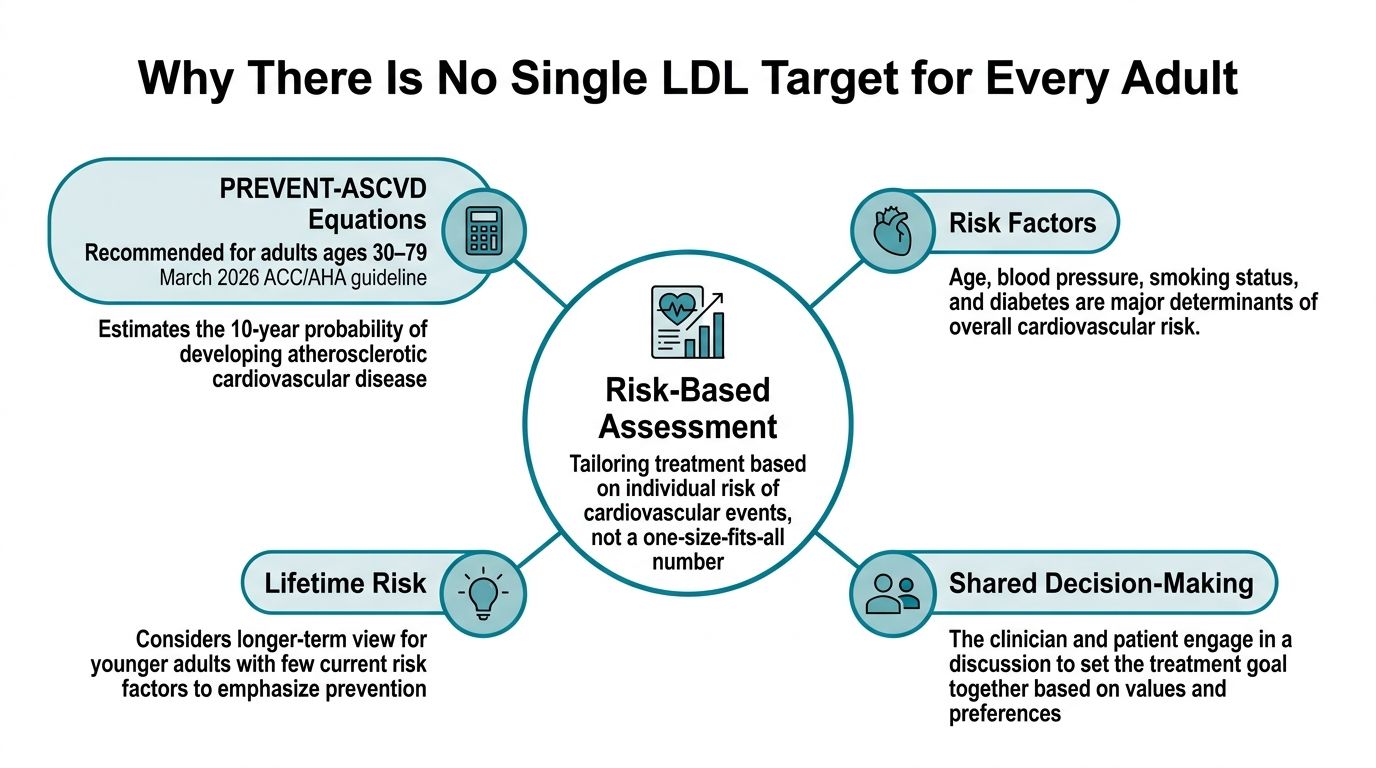
The most popular cholesterol advice often sounds simple: find the LDL number, compare it with one target, and decide what happens next. That approach misses the central point of the 2026 ACC/AHA framework. The same LDL result can lead to different discussions for different adults because expected benefit changes with overall cardiovascular risk.
For adults ages 30 to 79 without known cardiovascular disease and with LDL-C from 70 to 189 mg/dL, the updated guideline recommends the PREVENT-ASCVD equations. These equations replace the older Pooled Cohort Equations and estimate 10-year cardiovascular risk. The calculator supports a discussion. It doesn't replace medical judgment, examination, or the patient's preferences.
How risk categories shape the discussion
The 2026 guidance identifies:
- Borderline risk: a 10-year risk of 3% to less than 5%.
- Intermediate risk: a 10-year risk of 5% to less than 10%.
- Higher risk: a risk level above the intermediate range, with treatment goals generally becoming more intensive as risk rises.
The guideline identifies LDL-C goals below 100 mg/dL for borderline or intermediate risk and below 70 mg/dL for high risk. Those goals don't mean every person with an LDL above one of those values automatically needs the same medicine. They help clinicians frame a risk-based conversation.
Two hypothetical adults with the same LDL
Consider two clearly hypothetical adults, both with an LDL-C of 150 mg/dL.
The first is a younger adult without diabetes, kidney disease, smoking exposure, or high blood pressure. The physician may discuss lifetime risk, family history, lifestyle measures, repeat testing, and the person's preferences before deciding whether medication is appropriate.
The second is an older adult with diabetes, high blood pressure, and chronic kidney disease. The same LDL value may prompt a more urgent discussion about lipid-lowering therapy because the person's underlying cardiovascular risk is higher.
These examples don't diagnose either person and don't predict what a clinician will prescribe. They show why an LDL value cannot carry the entire decision.
Age, blood pressure, smoking, diabetes, kidney disease, family history, and known cardiovascular disease may change the expected benefit of treatment. A person's tolerance for medication, concerns about adverse effects, cost, and willingness to use lifestyle measures also belong in the discussion.
A risk calculator estimates probability. It doesn't decide what a person values or what treatment is medically suitable.
The broader visceral fat information can help explain why metabolic health involves more than visible body size, but appearance still can't determine cardiovascular risk. A physician needs the actual history, examination, laboratory information, and risk assessment.
Family History Questions That Change the Conversation
High cholesterol isn't always caused by eating habits, and a person doesn't need to have a larger body to have an inherited lipid disorder. Low body weight doesn't exclude familial hypercholesterolemia, an inherited condition that can produce persistently high LDL cholesterol. Young age doesn't exclude it either.
Family history can provide useful clues before a formal evaluation is complete. A relative may not know the term “familial hypercholesterolemia,” but may remember early heart disease, long-term cholesterol medication, or an unexplained cardiac death.
Questions worth asking relatives
A short conversation can focus on facts rather than blame:
- Heart events: Did a parent, sibling, or child have a heart attack or stroke at an unusually young age?
- Age at the event: Did a heart attack occur before age 55 in a male relative or before age 65 in a female relative?
- Inherited diagnoses: Has anyone in the family been diagnosed with familial hypercholesterolemia or another inherited lipid disorder?
- Medication patterns: Have several relatives used cholesterol-lowering medication, particularly from a young age?
- Unexpected deaths: Did a close relative die suddenly or from an unexplained cardiac cause early in life?
- Repeated results: Do relatives know whether they had persistently high LDL rather than a single abnormal test?
A free family health history template can help organize names, conditions, approximate ages, and unanswered questions before a physician visit. The purpose isn't to create a perfect family tree. It is to give the clinician better information.
Secondary causes matter too
Inherited risk is only one possibility. A physician may consider hypothyroidism, kidney disease, diabetes, and medication effects as potential secondary causes of an abnormal lipid result. Treating an underlying condition or reviewing a medicine may be part of management.
The conversation should remain people-first. Weight, age, and appearance don't reveal whether someone has high cholesterol, familial hypercholesterolemia, or another condition. A respectful evaluation asks what is happening biologically rather than assuming what caused it.
A history of prediabetes may also be relevant to the broader risk discussion. It doesn't independently determine a cholesterol treatment decision.
Lifestyle Changes and Medication as Complementary Tools
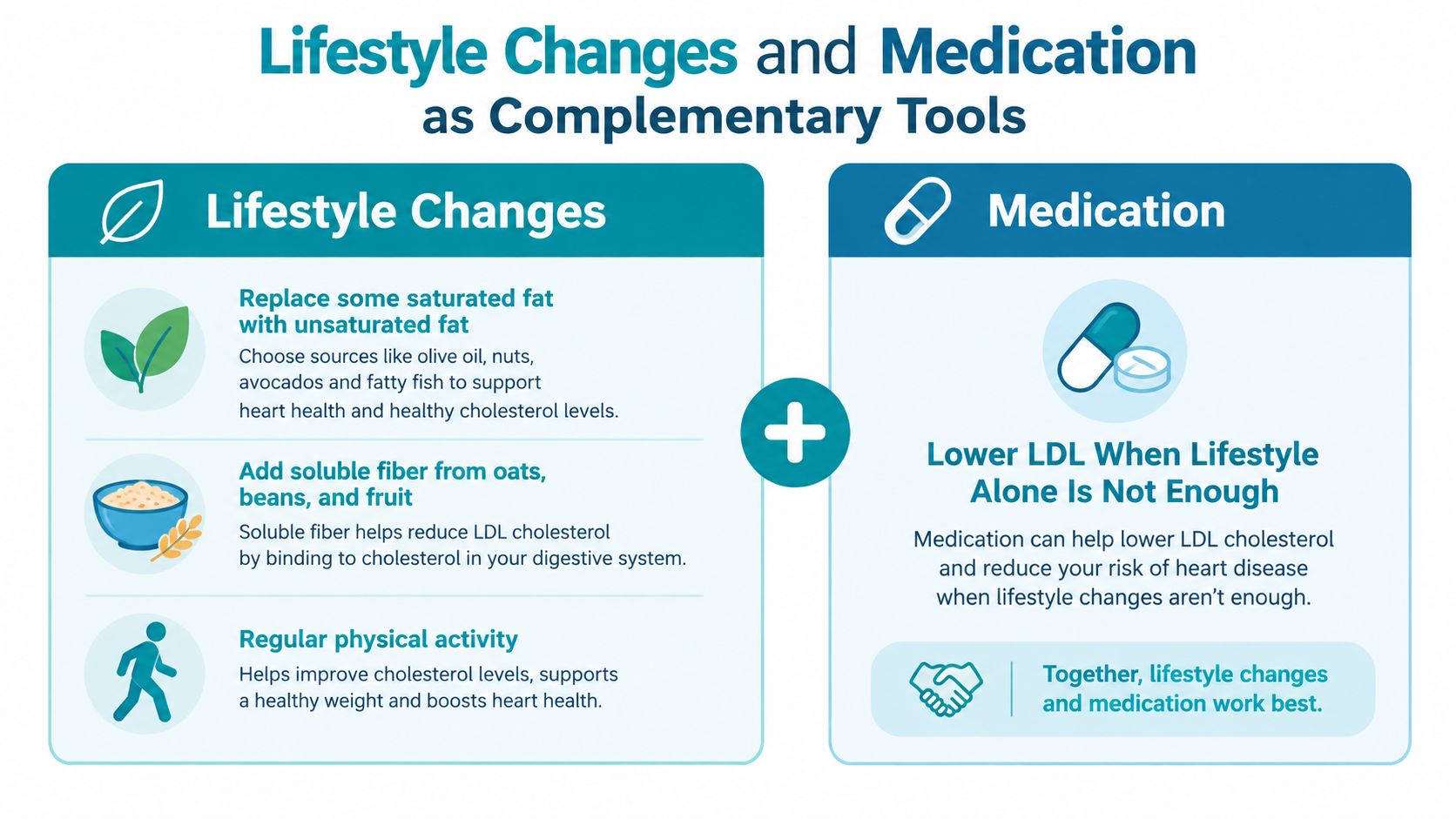
Lifestyle changes and medication aren't opposing camps. Many adults use healthy habits alongside prescribed therapy, and a clinician may recommend both when the expected cardiovascular benefit supports that approach.
NHLBI describes lifestyle treatment as a combination of a cholesterol-lowering eating pattern, physical activity, and weight management when appropriate. Physical activity can lower LDL cholesterol and triglycerides and raise HDL cholesterol, according to the NHLBI blood cholesterol treatment guidance.
What lifestyle work can include
A practical discussion may include:
- Replace some saturated fats: Substituting selected saturated-fat sources with unsaturated alternatives can support a heart-healthy eating pattern.
- Choose foods with soluble fiber: Oats, beans, and fruit can fit into an eating pattern designed to support cholesterol management.
- Build feasible activity: Regular physical activity should match the person's health, schedule, mobility, and preferences.
- Avoid tobacco: Avoiding tobacco reduces an important cardiovascular risk exposure.
- Review the full pattern: The discussion should focus on sustainable choices rather than labeling foods or people as “good” or “bad.”
Readers looking for general life style and wellness tips can use them as background, but general advice doesn't replace an individualized assessment.
What medication does differently
Statins are the most common medicines used to treat unhealthy blood cholesterol levels. They reduce the amount of cholesterol made in the liver. NHLBI also notes that a clinician may review possible secondary causes, current medicines, and medical conditions when selecting management.
The key correction is simple: high cholesterol isn't always caused by diet, and it isn't always cured by dietary change. A person can eat thoughtfully and still have inherited risk, diabetes, kidney disease, a thyroid condition, or another factor that keeps LDL high. Healthy habits should never be treated as proof that prescribed therapy is no longer needed.
Evidence from a meta-analysis of 26 randomized trials involving about 170,000 participants found that reducing LDL-C by 1.07 mmol/L, approximately 41 mg/dL, reduced major vascular events by 22% relative to control. Additional intensive-treatment trials found that each further 0.5 mmol/L reduction, approximately 19 mg/dL, produced about a 15% additional proportional reduction in major vascular events, as reported in The Lancet meta-analysis61350-5/fulltext). The absolute benefit is larger for people whose underlying cardiovascular risk is higher.
The heart-healthy eating information can support a conversation about food choices, but no article can determine whether lifestyle measures alone are sufficient for a particular adult.
A Treatment-Choice Worksheet for Your Physician Visit
A useful appointment begins with organized information. The following is a hypothetical template, not a patient case and not a prediction of any LDL reduction. It gives an adult a way to record what the physician knows, what remains uncertain, and what will be reassessed.
| Step | What to record | Example entries, hypothetical |
|---|---|---|
| Baseline lipid results and risk factors | Date, total cholesterol, LDL, HDL, non-HDL, triglycerides, blood pressure, diabetes status, smoking status, kidney health, family history, prior cardiovascular disease, current medicines | “Lipid panel dated [date]. LDL [value]. Family history [known or unknown]. Medicine list attached.” |
| Intervention agreed with the clinician | Lifestyle measures, medication discussion, additional evaluation, or observation with a planned reassessment | “Discuss saturated-fat substitutions, feasible activity, tobacco avoidance, and whether lipid-lowering medication fits the risk discussion.” |
| Repeat laboratory test ordered by the clinician | Test name, order date, timing chosen by the clinician, and any preparation instructions | “Repeat lipid panel ordered for [date or interval determined by clinician].” |
| Interpretation at follow-up | Results, adherence, side effects, new conditions or medicines, and the next agreed step | “Compare with baseline, review tolerability and risk, and decide whether to continue, adjust, investigate, or monitor.” |
The treatment conversation in plain language
The U.S. Preventive Services Task Force recommends prescribing a statin for adults ages 40 to 75 who have at least one cardiovascular risk factor, such as dyslipidemia, diabetes, hypertension, or smoking, and an estimated 10-year cardiovascular-event risk of 10% or greater. For the same age group with a risk of 7.5% to less than 10%, the recommendation is to selectively offer a statin because expected benefit is smaller, as described in the USPSTF clinical summary.
Those recommendations address primary prevention, meaning adults without known cardiovascular disease or its signs and symptoms. They don't apply to adults with LDL cholesterol above 190 mg/dL or known familial hypercholesterolemia, who require a different clinical approach.
Myth: Diet alone always fixes high cholesterol.
Fact: Family history, other conditions, medicines, and overall cardiovascular risk can change the plan.
A person can bring this worksheet to a physician such as Dr. Chhatpar or another qualified clinician. The aim is not to request a particular medicine. It is to make the decision transparent and ensure that the baseline result, risk factors, preferences, and follow-up plan are all documented.
Following Up and When to Repeat Testing
A follow-up log can keep the discussion focused:
- Record the date: Write down the date of each lipid panel.
- Copy the values: Include total cholesterol, LDL, HDL, non-HDL, and triglycerides.
- Note changes: List medication, supplement, tobacco, activity, or eating-pattern changes since the prior test.
- Record symptoms: Note possible side effects and when they began.
- Capture the plan: Write the agreed next step and any clinician-ordered testing.
Before the visit, obtain the ordered laboratory test, bring the complete medicine and supplement list, review adherence and side effects, and agree on the next step with the clinician. A video or phone visit doesn't measure cholesterol. Laboratory testing remains necessary when the clinician needs updated lipid values.
Common questions
Does normal body weight rule out inherited high cholesterol?
No. Familial hypercholesterolemia can affect adults at any body size. Family history and repeated LDL results may provide clues that appearance cannot.
Can someone stop medication when cholesterol improves?
Medication shouldn't be stopped or changed without clinician guidance. An improved result may reflect treatment working, and the next decision depends on risk, adherence, tolerability, and the reason treatment was started.
Can a healthy diet replace a prescribed medicine?
Sometimes lifestyle changes are part of the plan, but diet isn't a universal substitute for medication. The appropriate combination depends on cardiovascular risk, lipid results, medical conditions, and patient preferences.
Does a calculator replace a physician?
No. PREVENT-ASCVD supports risk estimation for eligible adults, but a clinician must interpret the result alongside medical history, examination, other conditions, medicines, and the person's goals.
Adults seeking physician-led evaluation of lipid results and broader metabolic risk can visit Empire Medical Wellness. The practice provides individualized medical assessment and follow-up planning, with cholesterol-related measures considered in the context of the person's overall health.
This article is educational and isn't personal medical advice.
Sources
- World Health Organization dyslipidaemia fact sheet
- ACC/AHA 2026 dyslipidemia guideline announcement
- NHLBI cholesterol diagnosis guidance
- USPSTF statin-use clinical summary
- The Lancet LDL-lowering meta-analysis61350-5/fulltext)
Byline: Empire Medical Wellness Editorial Team
Published: March 2026
Updated: March 2026