
Can a medication described as non-habit forming still cause withdrawal? For gabapentin, the answer is yes, and most of the confusion comes from vocabulary rather than biology. Physical dependence and addiction are different things. The first can develop while someone follows a prescription exactly, and the symptoms that follow a missed dose or a stopped refill are real.
Gabapentin withdrawal is a group of physical, sleep, mood and neurologic symptoms that can follow a missed dose, a stopped prescription or a substantial dose reduction. It's also only one explanation for feeling unwell after a dose change, which is why sorting the symptoms matters as much as listing them.
What follows is a working map: what withdrawal is and how quickly it can start, a symptom table sorted by urgency, the factors that change a clinical review, the difference between withdrawal and a returning condition, and the questions worth carrying into a visit.
By the Empire Medical Wellness Editorial Team. Published and last updated October 8, 2026.
Table of Contents
- What Gabapentin Withdrawal Is and How Soon It Starts
- Symptoms After a Missed or Reduced Dose
- Risk Factors That Change a Withdrawal Review
- Withdrawal, Recurrence, or Another Cause
- How a Supervised Review Sets the Pace of Any Change
- Questions to Bring to Your Physician
- When to Seek Urgent Care or Book a Routine Review
What Gabapentin Withdrawal Is and How Soon It Starts
What can happen when gabapentin is missed or reduced? The body can adapt to a steady medication level, so a sudden drop may prompt a nervous-system response. Product labeling describes this as neuroadaptation involving voltage-gated calcium-channel signaling. Withdrawal-type symptoms can emerge quickly after abrupt cessation or a large reduction, and can occur after short courses as well as long ones (FDA gabapentin prescribing information).
Dependence and withdrawal
Physical dependence means the body has adapted to a medication and may respond when its level falls. It is a possible drug effect, not a character flaw or, by itself, a diagnosis.
Withdrawal refers to symptoms that can follow that drop. MedlinePlus advises against stopping gabapentin suddenly without medical advice (MedlinePlus gabapentin drug information). The body's response varies, so a physician considers the medication history and the reason it was prescribed when reviewing symptoms.
Misuse and addiction
Misuse means taking a medicine in a way it was not prescribed, such as taking more than directed or using someone else's supply. Addiction is a treatable condition involving compulsive use despite harm. A person can be physically dependent without being addicted. Keeping these terms distinct helps a withdrawal concern receive a clinical review without implying addiction. The same distinction is relevant to other medicines discussed in this benzodiazepine withdrawal symptoms guide.
Timing and the reported symptom range

The reported symptoms range from anxiety, agitation, insomnia, sweating, tremor, nausea, dizziness and returning pain to confusion, psychotic symptoms, depression, and suicidal thoughts or behavior. Seizures warrant particular attention when gabapentin is prescribed for seizure control. These symptoms can have other causes too, so timing alone cannot establish withdrawal.
The rule that matters most: stopping gabapentin abruptly is not a routine medication change. A prescriber should guide any taper, considering the reason for treatment, dose history and seizure risk.
A missed dose is not the same as a stop
One skipped capsule is different from a planned stop or sustained dose reduction. Follow the prescriber's or pharmacy label's instructions for a missed dose rather than guessing, and do not double up to catch up.
If a dose has been reduced or treatment stopped, record the date and time of the last dose, the dose history listed by the prescriber or pharmacy, and when each symptom began. This timeline can help a physician distinguish a possible withdrawal response from a returning condition or another cause. NHS guidance answers common questions about missed doses and side effects (NHS gabapentin guidance).
Symptoms After a Missed or Reduced Dose
The table below sorts symptoms reported after stopping or reducing gabapentin by how quickly a clinician should be contacted.
| Symptom group | What it may look like | Response level |
|---|---|---|
| Anxiety or restlessness | Feeling on edge, unable to settle, racing thoughts | Routine at the next contact; same day if agitation is severe |
| Insomnia | Trouble falling or staying asleep, waking often | Routine: report at the next contact, or sooner if disabling |
| Sweating or tremor | Damp skin, shakiness in the hands | Routine: contact the prescriber promptly |
| Nausea or dizziness | Queasiness, lightheadedness on standing | Same day: contact a clinician; emergency if you faint or can't keep fluids down |
| Returning pain | Nerve or other pain that comes back or increases | Routine: physician review of the pain plan; same day if severe and rising |
| Headache or malaise | Headache, generally unwell feeling | Routine: report at the next contact |
| Confusion or disorientation | New trouble knowing time, place or what's happening | Emergency: seek immediate medical care |
| Psychotic symptoms | New hallucinations, delusions or unusual beliefs | Emergency: seek immediate medical care |
| Depression or suicidal thoughts or behavior | Hopelessness; thoughts of self-harm or suicide | Emergency if suicidal thoughts or behavior are present; same day contact for depression without them |
| Seizures | Convulsions, loss of awareness, sudden jerking | Emergency: call 911 or go to the nearest emergency department |
Two clarifications keep the table honest. It lists symptoms the labeling reports, not the share of people who get each one. The response level describes urgency, not how serious the underlying cause is.
What the trial numbers actually measure
In premarketing trials involving 2,074 patients older than 12 years, approximately 7% discontinued gabapentin because of an adverse event (FDA gabapentin labeling). The adverse events most commonly tied to discontinuation were somnolence (1.2%), ataxia (0.8%), fatigue (0.6%), nausea or vomiting (0.6%), and dizziness (0.6%).
Those figures describe treatment discontinuation during trials. They aren't the percentage of people who develop a withdrawal syndrome, and the labeling doesn't set a single universal withdrawal rate. The postmarketing picture is broader than the trial list: anxiety, insomnia, nausea, pain, sweating, tremor, headache, dizziness, malaise, agitation, confusion, disorientation, psychotic symptoms, depression, suicidal ideation or behavior, and seizures.
The same labeling notes that symptoms can follow shorter courses and appear shortly after discontinuation rather than weeks later. That's why abrupt cessation isn't treated as an ordinary change, and why tapering decisions sit with the prescribing clinician.
A symptom diary worth five minutes a day
- Date and clock time of each entry, so the pattern is visible instead of remembered.
- Hours since the last dose, calculated from the date on the label or pharmacy record.
- The symptom in plain words, one line each, without editing for politeness.
- Severity as mild, moderate or severe, judged against what you could manage that day.
- Sleep, including hours and whether you woke repeatedly.
Risk Factors That Change a Withdrawal Review
Therapeutic use doesn't remove physical dependence. Someone who has never taken an extra capsule can still notice symptoms after a dose change, and that possibility belongs in the plan rather than arriving as a surprise. Canadian prescribing guidance for gabapentinoids makes the point directly, recommending individualized tapering with close follow-up for mood, behavior and withdrawal concerns (CPSA gabapentinoid prescribing companion).
The review looks at the whole medication picture rather than one number.
| Factor | Why it matters | What the review checks |
|---|---|---|
| Dose and duration of use | Longer or higher exposure can increase dependence | Current dose, how long it has been taken, recent changes |
| Original reason for prescribing | Seizure control, nerve pain and anxiety differ in risk and plan | Indication, prescriber, and treatment goals |
| Seizure history | Seizures are a labeled withdrawal concern | Prior seizures, seizure control and who monitors them |
| Other sedating medicines | Opioids, benzodiazepines and other depressants add sedation and respiratory risk | Full medication list including over-the-counter products |
| Alcohol or other substance use | Can change withdrawal severity and overdose risk | Nonjudgmental screening; no assumptions made |
| Mood, anxiety and suicidal thinking | Psychiatric symptoms are reported after stopping | Depression and suicidality screening; recent mood changes |
| Kidney function | Gabapentin is cleared by the kidneys | Recent kidney tests and any known kidney condition |
Combinations change the calculation. FDA labeling for gabapentinoids and other central nervous system depressants warns that pairing these medicines with opioids, benzodiazepines, alcohol or other sedatives adds sedation and respiratory-depression risk (FDA labeling for gabapentinoids). That warning applies whether or not anyone has a substance-use disorder.
A review isn't an accusation. Questions about alcohol, sedatives and mood exist because each answer changes what's safe to do next, and the answers stay in the medical record. The guide to psychiatric drug interactions explains why the full list matters more than the gabapentin dose alone.
Bring these to the visit:
- A current medication list with doses as printed, including supplements, sleep aids and anything bought without a prescription.
- Pharmacy and prescriber names, so a clinician can confirm what was dispensed.
- The original indication, whether the prescription was written for an approved use such as certain seizures or nerve pain, or for an off-label purpose such as anxiety or insomnia.
- Recent kidney tests if they exist, since gabapentin is cleared by the kidneys.
Withdrawal, Recurrence, or Another Cause
Two people can reduce gabapentin on the same day and feel entirely different things. One gets shakiness and insomnia. The other gets back the nerve pain the prescription was written for. A symptom alone doesn't identify its cause, and the cause changes the next step.
| Pattern | What it may suggest | Next step |
|---|---|---|
| Symptoms begin within about 48 hours of a stop or large reduction | Withdrawal is possible | Physician assessment; the plan for any change is set by the prescriber |
| Original pain, anxiety or insomnia returns gradually over days to weeks | Recurrence of the original condition | Reassess the treatment plan with the prescriber |
| Symptoms ease after the prior regimen is restored | Consistent with withdrawal, but not conclusive | Clinician reviews the timeline before any further change |
| Use beyond the prescribed pattern | Many causes, including undertreated symptoms; not a diagnosis of misuse | Nonjudgmental assessment |
| New confusion, seizure or suicidal thoughts | Possible serious complication from any cause | Emergency evaluation now |
Treat the table as a discussion aid. It isn't a diagnosis, and it isn't a substitute for the timeline a clinician can read alongside your history.
The timeline does most of the talking
Withdrawal-type symptoms tend to arrive soon after a dose falls and to ease when the prior regimen is restored. A returning condition usually rebuilds over days to weeks: nerve pain climbs back toward its old level, anxiety returns to its familiar pattern, sleep drifts in the direction it used to go.
Improvement after restarting is suggestive, not proof. A better week can follow a bad one for reasons unrelated to any medication, which is why a clinician reviews the sequence rather than a single good or bad day.
Use beyond the prescribed pattern deserves its own line because it's so easily misread. Taking more than directed can reflect untreated pain, untreated anxiety, a misunderstanding of the instructions, or a developing substance use problem. It's worth discussing plainly, and it isn't a diagnosis by itself. The explanation of prescription drug dependence versus addiction covers why the two get confused.
Emergency patterns cut across every category. New confusion, a seizure, hallucinations, or thoughts of suicide need evaluation now, whatever the cause turns out to be.
A sentence worth preparing: "Reduced on the 3rd, shaky by the 5th, better after restarting on the 7th." Dates and sequence tell a clinician more than a conclusion does.
How a Supervised Review Sets the Pace of Any Change
Tapering is individualized. U.S. labeling calls for gradual reduction rather than abrupt discontinuation, and the GRALISE label describes reducing over a minimum of one week or longer at the prescriber's discretion (FDA GRALISE labeling). UK drug-safety guidance goes further, noting that tapering from a higher dose or after long use may take weeks or months, and that the next reduction can be delayed when symptoms become intolerable (UK drug-safety update on gabapentinoids).
Those two statements explain why no calendar fits everyone. One week is a floor in the U.S. label, not a target. A person on a low dose for a few weeks and a person on a high dose for years with a seizure history aren't solving the same problem.

What the review walks through
- Intake. Addiction medicine care begins with a confidential assessment of the patient's current situation, medical risks, previous treatment, medications, and goals.
- Medication reconciliation. Every prescription, over-the-counter product and supplement, plus any recent change made by another prescriber or pharmacy.
- A symptom timeline. Anchored to the date of the last dose, not to a rough guess about when things started feeling off.
- Screening. Seizure history, mood, anxiety, sleep and suicidal thinking, each asked directly.
- A nonjudgmental review of sedatives. Alcohol and other central nervous system depressants, discussed as safety factors rather than confessions.
- Explanation of options. What would be monitored, how follow-up works, and what would change the plan.
- Written instructions. When to call, when to seek same-day care, when to use emergency services, a scheduled follow-up, and a named contact.
The clinician weighs dose, duration, indication, seizure risk, sleep, mood and other medications together. No single percentage reduction or fixed calendar applies to everyone, which is why the pace gets set in a conversation rather than copied from a forum post.
Practical preparation matters more than people expect. For a first visit, patients should bring an updated medication list, including supplements and any side effects they have noticed. Medication review visits discuss whether current treatment is helping, any side effects, and concerns about the medication plan, which is exactly the conversation a withdrawal question needs. The mental health medication review page describes how that kind of visit is structured.
What a review can't promise: a specific prescription, a fixed timeline, or a symptom-free taper. What it can do is make the sequence deliberate and name the warning signs before they're needed.
This article deliberately contains no taper schedule, no percentages and no dose changes. A review doesn't guarantee a particular prescription or outcome either. Those decisions require a clinician who has the history, the medication list and the examination findings in front of them.
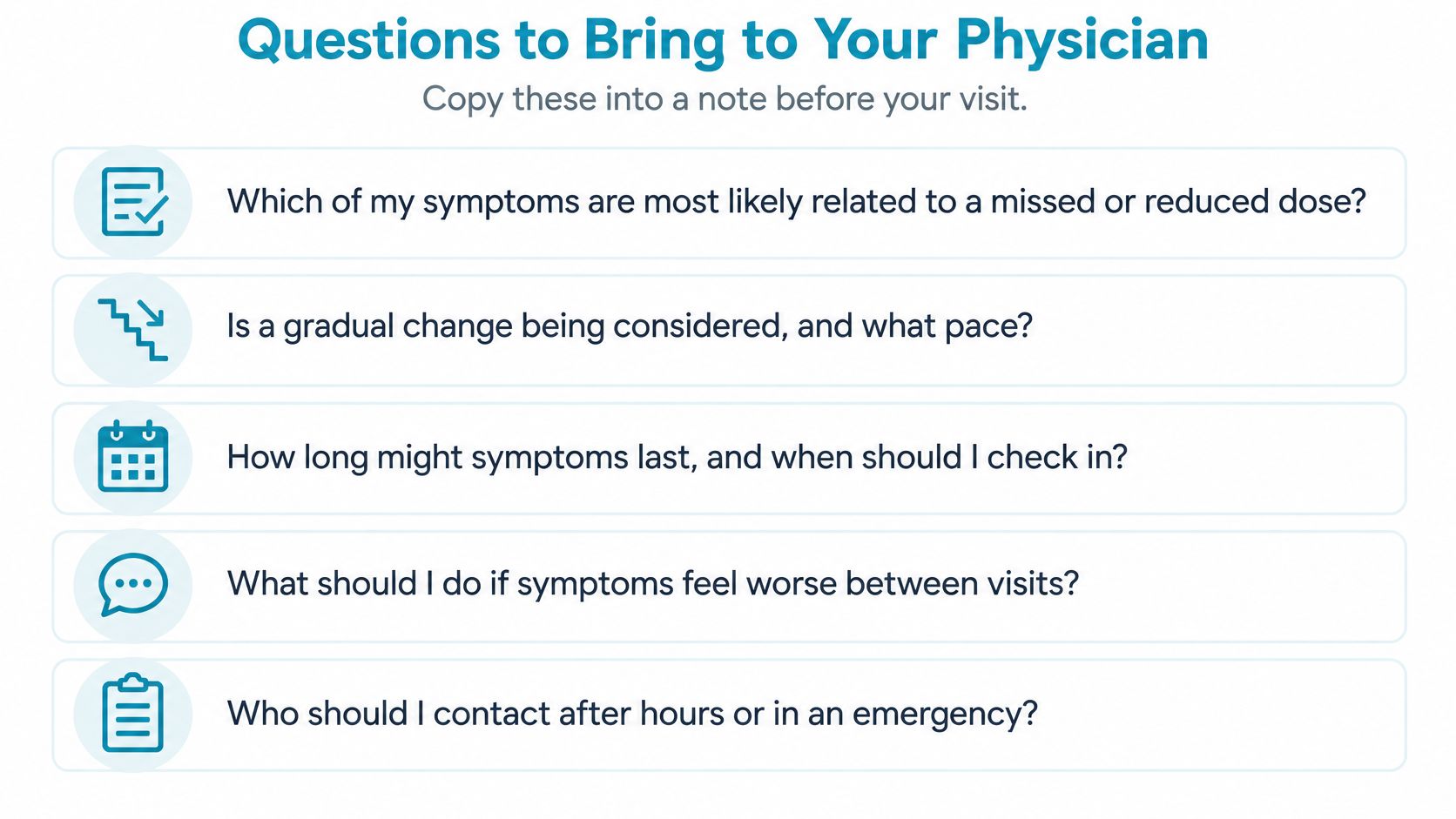
Questions to Bring to Your Physician
Write the questions down before the visit. Appointments move quickly, and a written list is the difference between covering three concerns and remembering them in the parking lot.
- Which of my symptoms are most likely related to a missed or reduced dose?
- Is a gradual change being considered, and what happens if symptoms become hard to manage?
- Are pauses possible within any plan?
- Who should I contact between visits, and who covers after hours?
- Which of my other medications or supplements could add to sedation or withdrawal risk?
- What monitoring will be done for mood, sleep and seizure risk?
- Which warning signs mean I should seek emergency care?
A one-page planning aid
Fill these in, in this order, and the visit starts with facts instead of reconstruction:
- The reason for the prescription, as you understand it.
- The date of the last dose, as recorded on the label or pharmacy record.
- The date symptoms began.
- The symptom diary from earlier in this article.
- Seizure history, if any.
- Sleep pattern and mood changes.
- Alcohol or other substance use, shared only as you choose.
- A full medication and supplement list, with prescriber and pharmacy names.
- Personal goals for treatment.
The aid organizes information. It contains no dose instructions and isn't a self-scoring test. Bring it, along with the written questions, to the appointment. At the initial addiction medicine evaluation, the patient receives an explanation of appropriate treatment options and next steps. The psychiatric medication management worksheet offers a similar structure for tracking how a medicine is working between visits.
When to Seek Urgent Care or Book a Routine Review
Three response levels cover almost everything. Getting the top one right matters most.
Emergency, call 911 now
Call 911 or go to the nearest emergency department for a seizure, severe or new confusion, psychotic symptoms, or immediate danger to yourself or others. For thoughts of suicide or self-harm, call or text 988 to reach the Suicide and Crisis Lifeline, and call 911 if there's immediate danger.
Same day, not next week
Fainting, an inability to keep fluids down, or symptoms that are worsening quickly should prompt same-day contact with a clinician or an urgent care service. Waiting for a scheduled appointment is the wrong trade when the trend is heading the wrong way.
Routine, at a scheduled review
Mild anxiety, disrupted sleep, or manageable sweating or pain can be raised at a scheduled review or with the prescriber between visits. Empire Medical Wellness offers outpatient, physician-led addiction medicine evaluation, and those evaluations are confidential outpatient evaluations. Emergency symptoms belong with emergency services, not a routine appointment.
Adults who want a structured conversation can read about addiction medicine care, see how the addiction medicine specialist works with patients, review fees and how it works, and schedule an appointment when the situation isn't urgent.
If symptoms are uncomfortable but not dangerous, a scheduled review is the right setting to sort withdrawal from recurrence and to build a plan the prescriber signs off on.
Key sources for this article are the FDA gabapentin prescribing information, MedlinePlus gabapentin drug information, UK drug-safety guidance on gabapentinoids, and FDA labeling for gabapentinoids and other central nervous system depressants, each linked in the sections above. This article is educational and is not personal medical advice.
Empire Medical Wellness provides confidential, physician-led outpatient addiction medicine evaluation for adults, including a careful review of current medications, withdrawal concerns, and the goals that shape a safe plan. If a missed dose or a recent reduction has left questions that a friend's experience can't answer, a scheduled visit gives those questions a clinical setting and a documented next step. Visit Empire Medical Wellness to see how evaluations are structured and to schedule a time.