
“Ozempic face” is not a medical diagnosis. It describes facial hollowing and skin laxity associated with rapid or substantial weight loss, including a measurable 9.0% median decrease in total midfacial volume in a 2025 imaging study, and it isn't unique to semaglutide.
The more useful question is whether the change comes from the medication itself or from how quickly facial fat and structural support decrease during weight loss. Current evidence points primarily to a broader rapid-weight-loss phenomenon, not a unique facial toxicity caused by Ozempic. Understanding that distinction can help you discuss treatment pace, nutrition, monitoring, and cosmetic timing without assuming you need to stop medically appropriate care.
Table of Contents
- What Ozempic Face Means and What It Does Not
- Why Rapid Weight Loss Changes Facial Volume and Skin
- Semaglutide and Tirzepatide Products Indications and Dosing Basics
- Who Notices Changes Most and How to Tell Aging Apart
- Prevention and Mitigation During Medical Weight Management
- Medical and Cosmetic Options Benefits Risks and Timing
- When to Seek Physician Assessment and Next Steps with Empire
What Ozempic Face Means and What It Does Not
Could a change in facial appearance reflect weight loss rather than a toxic effect of Ozempic? Ozempic face is an informal phrase describing facial hollowing, reduced fullness, increased skin laxity, and an older-looking appearance after substantial weight loss. Flatter cheeks, more visible temples, deeper under-eye hollows, or looser skin around the jaw and neck may be noticeable. The appearance can be emotionally difficult, but the phrase is not a disease or formal diagnosis.
It is not an FDA-labeled adverse event in the FDA prescribing information for Ozempic. Ozempic contains semaglutide and is FDA-approved for specific type 2 diabetes indications. Facial volume loss is not an approved indication or labeled cosmetic use.
The drug name can obscure the underlying mechanism
Many adults notice facial changes while using GLP-1 medicines, which helps explain why the drug name became attached to the concern. Similar hollowing and laxity can follow any substantial or rapid weight loss, including weight loss without medication. Rapid-weight-loss facial volume loss therefore describes the pattern more precisely than “Ozempic face.”
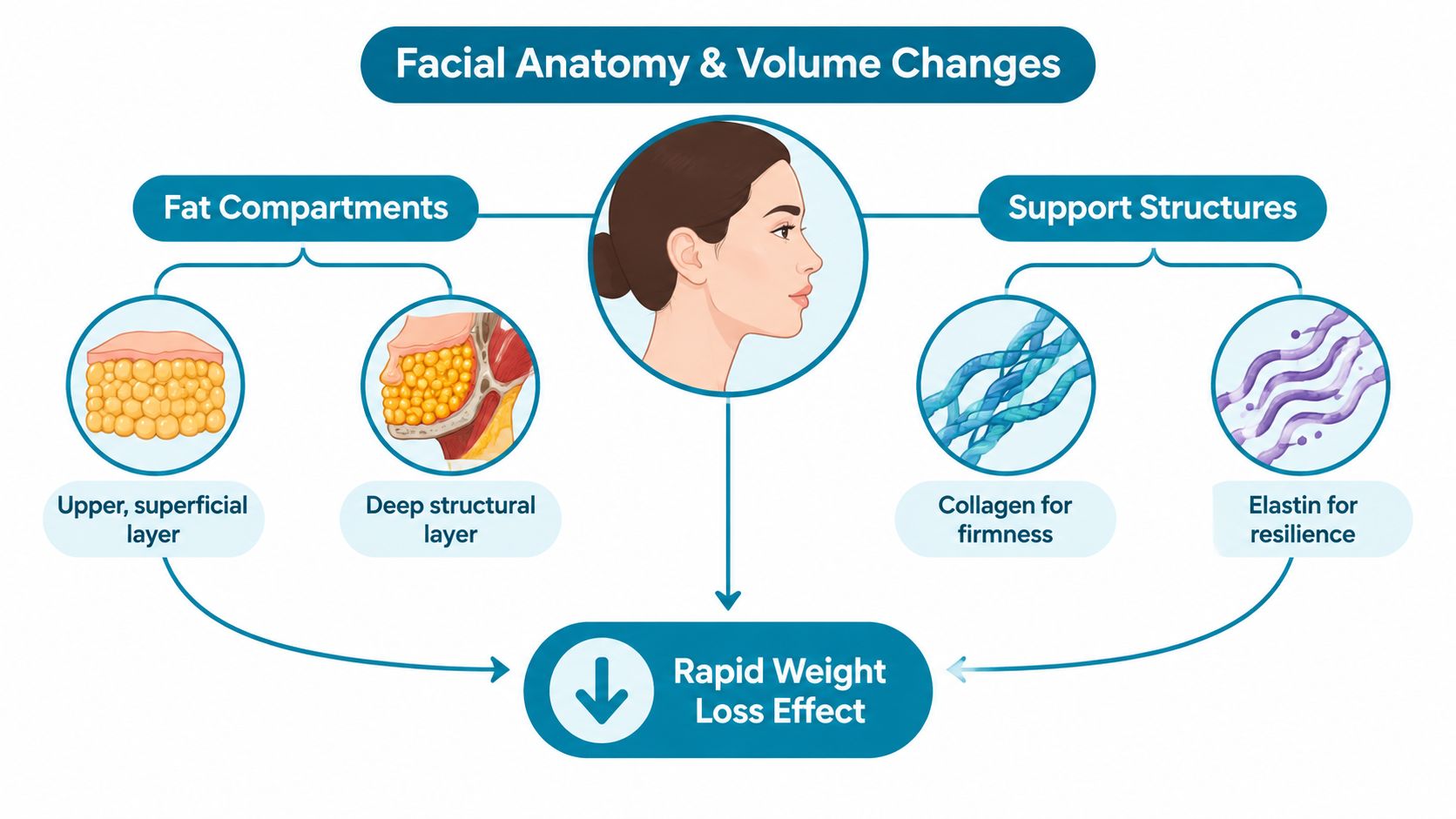
Facial shape depends partly on superficial and deeper fat compartments that provide fullness and support. As these compartments become smaller, the skin may appear less supported. Age, genetics, baseline facial volume, sun exposure, smoking, and skin elasticity can affect how visible the change becomes.
Practical rule: A change in appearance deserves thoughtful assessment, not an automatic conclusion that the medication is harmful or that treatment should stop.
Facial hollowing is generally a routine follow-up topic rather than an emergency. Severe abdominal symptoms, allergic symptoms, or other urgent warning signs require prompt medical assessment. Empire Medical Wellness's educational overview of Ozempic side effects can provide broader context, but appearance alone cannot establish the cause. Do not change prescribed treatment without speaking with the prescribing clinician.
Why Rapid Weight Loss Changes Facial Volume and Skin
Could a face look different because weight changed faster than its supporting tissues could adapt? The answer begins beneath the skin. Superficial fat compartments provide visible fullness, while deeper compartments help support the midface. Collagen contributes firmness, and elastin helps skin resist stretching. During rapid weight loss, subcutaneous fat may decrease before the skin and connective tissues adjust to the smaller underlying volume.
The pattern varies between individuals. Someone with greater baseline facial fullness may notice a different change from someone with naturally leaner cheeks. Reduced skin elasticity can also make looseness more visible after a similar loss of facial volume. Age, genetics, sun exposure, smoking, and pre-existing tissue quality may all influence the result.
What the imaging data show
A 2025 retrospective imaging study of 20 patients receiving GLP-1 therapy reported a median 9.0% decrease in total midfacial volume. Superficial volume decreased 11.0%, and deep volume decreased 7.0%. The study also estimated approximately 7% facial-volume loss per 10 kilograms of total weight lost. The strongest relationship involved superficial fat loss, reported as rho = 0.590 and P = .006. These imaging findings support a measurable anatomical change, rather than treating the concern as purely subjective. The full peer-reviewed imaging study is available through PubMed Central.
The findings do not establish that semaglutide directly injures facial tissue. They show that facial volume can change during GLP-1-associated weight loss. A more useful interpretation considers speed of loss, total loss, body-composition changes, and tissue elasticity, rather than assigning the effect to a brand name alone.
People researching clinician-guided care may also see information about medical weight loss injections Beverly Hills. That type of resource may describe how aesthetic practices approach facial changes, but it does not replace product labeling or an individualized evaluation by the prescribing clinician.
The face changes along with the rest of the body, so the rate and pattern of weight change matter. Nutrition, physical activity, and follow-up measurements can help a clinician determine whether facial changes are occurring during active loss or after weight has stabilized. Empire Medical Wellness provides general education about calorie deficit and energy balance, although an appropriate plan depends on medical history and treatment goals.
Why normal aging can look similar
Aging can also alter facial fat distribution, collagen, elastin, and skin laxity. Timing therefore offers a clue, not a diagnosis. Hollowing that appears during rapid weight change may reflect weight loss, while gradual changes over a longer period may reflect aging or several causes together.
A 2025 review describes “Ozempic face” as a measurable rapid-weight-loss facial-volume issue and notes gaps in practical guidance, including who notices it most and how to distinguish it from ordinary aging. The review in the peer-reviewed literature discusses this distinction.
Semaglutide and Tirzepatide Products Indications and Dosing Basics
Could two medicines used for weight or diabetes care have completely different instructions? Yes. Semaglutide and tirzepatide are different incretin medicines. Their brands, formulations, FDA-approved indications, routes, contraindications, interacting therapies, and titration schedules are product-specific. One product's dosing information cannot safely be applied to another.
The table is an orientation tool, not a personal dosing plan. Current prescribing information and a licensed prescriber determine the appropriate product, dose, and schedule.
Incretin medicines product indication and formulation overview
| Product and active ingredient | FDA-approved indication | Formulation and route | Key prescribing notes |
|---|---|---|---|
| Ozempic, semaglutide | Type 2 diabetes treatment, with label-specific cardiovascular and kidney-risk indications | Once-weekly subcutaneous injection into the abdomen, thigh, or upper arm | The FDA label includes a boxed warning about thyroid C-cell tumors. It is not labeled for facial-volume treatment or cosmetic use. |
| Wegovy, semaglutide | Chronic weight management for eligible patients under its FDA labeling, with additional label-specific cardiovascular-risk information | Prescription semaglutide injection with product-specific administration requirements | Eligibility, contraindications, titration, adverse effects, and monitoring follow the Wegovy label, not the Ozempic label. |
| Mounjaro, tirzepatide | Type 2 diabetes treatment | Once-weekly prescription injection under its product labeling | Tirzepatide is not semaglutide. Its contraindications, warnings, interactions, and titration are product-specific. |
| Zepbound, tirzepatide | Chronic weight management for eligible patients under its FDA labeling, including label-specific obstructive sleep apnea information | Prescription tirzepatide injection with product-specific administration requirements | The Zepbound label governs eligibility and dosing. It is not interchangeable with Mounjaro or semaglutide products. |
The current FDA Ozempic label describes Ozempic's semaglutide ingredient and subcutaneous route. For obesity care, eligibility depends on medical assessment, not facial appearance. A prescriber reviews weight history, related health conditions, current medicines, pregnancy plans, contraindications, tolerability, and follow-up needs.
Empire Medical Wellness offers educational information about semaglutide treatment. Online information cannot select a product for a particular adult. Do not combine incretin medicines or change titration without the clinician managing the prescription.
Who Notices Changes Most and How to Tell Aging Apart
Could a facial change during weight loss reflect lost volume rather than a drug-specific toxic effect? Not everyone who loses weight develops a visible difference. What appears in the mirror depends on the face's starting structure, the speed and amount of weight loss, and how the skin responds.
Hollowing may be easier to notice when baseline facial fat is lower, skin elasticity is reduced, or the overall change in body weight is larger. Age, genetics, smoking, and accumulated sun exposure can also affect laxity and texture. Imaging-based research and clinical reviews describe this pattern as facial soft-tissue volume loss associated with weight reduction, rather than proof that semaglutide itself directly damages facial tissue. A recent review discusses the changing facial appearance reported with rapid weight loss and related volume changes. Review of facial changes associated with weight loss
These factors cannot establish a diagnosis at home. They help explain why two adults with similar weight loss may see different changes.

A practical comparison
| Pattern you notice | What it may suggest | What a clinician can clarify |
|---|---|---|
| The change appeared during active, rapid weight loss | Weight-loss-associated facial volume change may be contributing | Whether the weight trajectory, nutrition, and treatment response need review |
| The change developed gradually over a long period | Aging or several influences may be involved | Whether skin laxity, fat distribution, or another concern is more prominent |
| Hollowing is visible with relatively little loose skin | Reduced volume may be the main feature | Whether a cosmetic assessment is appropriate after weight stabilizes |
| Skin looks loose or crepey, with less obvious hollowing | Laxity may be more prominent than volume loss | Whether skin-care or procedural options are relevant |
| A new facial change appears with illness symptoms | The facial concern may not be the main medical issue | Whether routine or urgent assessment is needed |
Interest in filler and revolumization questions suggests that many readers seek nonsurgical information. That interest should not create pressure to treat immediately. While weight continues to change, cosmetic results can be harder to assess and maintain.
The timeline usually offers the clearest comparison. Record when the change began, whether it looks symmetrical, and how it relates to the overall weight trajectory. Photos may help a clinician assess change over time, but a single angle cannot diagnose the cause or measure treatment success.
A consultation separates two related concerns: appearance and medication safety. Both deserve attention, but they require different questions and assessments.
Prevention and Mitigation During Medical Weight Management
Could a steadier treatment plan reduce avoidable facial changes during weight loss? No approach guarantees that facial volume will stay the same. The practical goals are to avoid unnecessarily rapid loss, support nutrition and lean tissue, and review concerns while treatment can still be adjusted.
A clinician may assess the pace of weight change, appetite, food intake, gastrointestinal tolerance, physical activity, sleep, and relevant medical conditions. This broader review matters because facial appearance reflects more than medication alone. It can change with body composition, hydration, nutrition, and the underlying weight trajectory.
Habits that support stable care
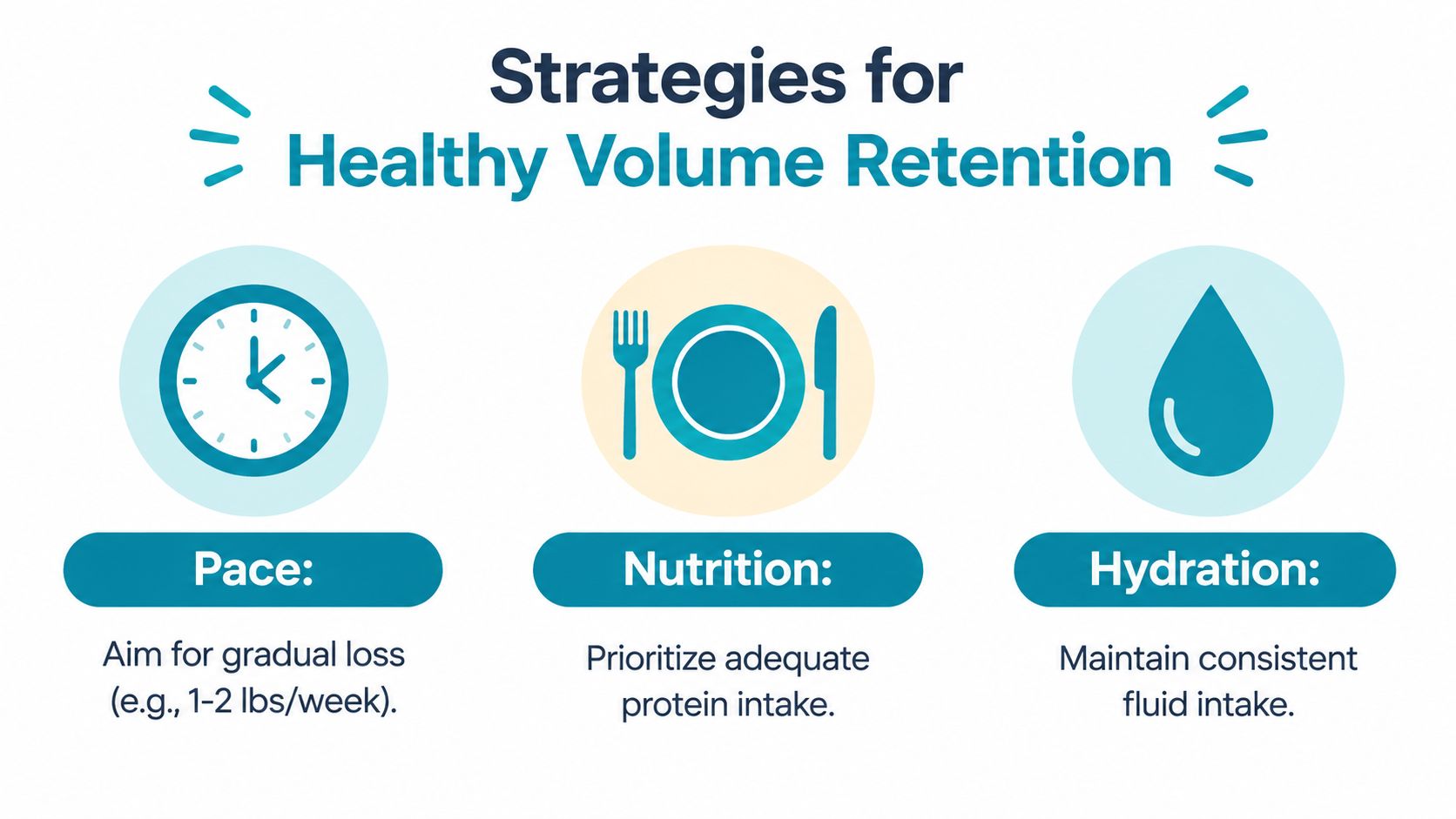
Use a measured pace: The prescriber can decide whether the current rate of loss fits the person's health and response to treatment. Changing medication doses independently can create avoidable risks.
Protect nutrition: Adequate protein and sufficient overall intake support the body during weight loss. Ongoing nausea, vomiting, or difficulty eating warrants a conversation with the care team.
Include resistance exercise when appropriate: Strength-focused activity may help preserve lean mass. The safest routine depends on fitness, medical conditions, and clinician guidance.
Support skin health: Hydration, sleep, gentle cleansing, moisturizer, and sun protection can support the skin barrier and reduce irritation. They cannot replace facial volume that has already been lost.
Track the broader pattern: Weight trajectory, symptoms, nutrition, strength, and treatment tolerance provide more useful information than repeated mirror checks.
A stable plan often serves the face better than a quick cosmetic response. Procedures performed while weight is still changing may require later reassessment.
Cosmetic treatment usually becomes easier to evaluate after weight has stabilized, though timing differs by person. A qualified aesthetic clinician can assess whether persistent changes reflect volume loss, laxity, or both, then discuss appropriate options. Fillers, skin-tightening procedures, and collagen-focused treatments differ in benefits, risks, durability, and cost.
Adults considering physician-led medical weight management can discuss treatment pace, nutrition, side effects, and monitoring with Empire Medical Wellness. The purpose is to assess health factors, select clinically appropriate options, follow the response, and plan for long-term maintenance, rather than promise a particular appearance.
Medical and Cosmetic Options Benefits Risks and Timing
Could facial hollowing reflect ordinary volume loss during rapid weight reduction, a medication problem, or both? The appearance alone cannot answer that question. Medical review focuses on treatment safety, weight trajectory, nutrition, and symptoms. An aesthetic assessment focuses on volume, laxity, and texture. Some adults need one, and some need both.
After weight has stabilized, an aesthetic clinician may discuss dermal fillers, collagen-stimulating injectables, skin-tightening procedures, or other approaches to facial volume loss. These options address different features. Fillers mainly replace volume, while energy-based or collagen-focused treatments may target laxity and texture. A procedure cannot recreate every part of a previous facial appearance, and choosing no procedure is also reasonable.
Comparing possible paths
| Approach | Possible benefit | Limits and risks |
|---|---|---|
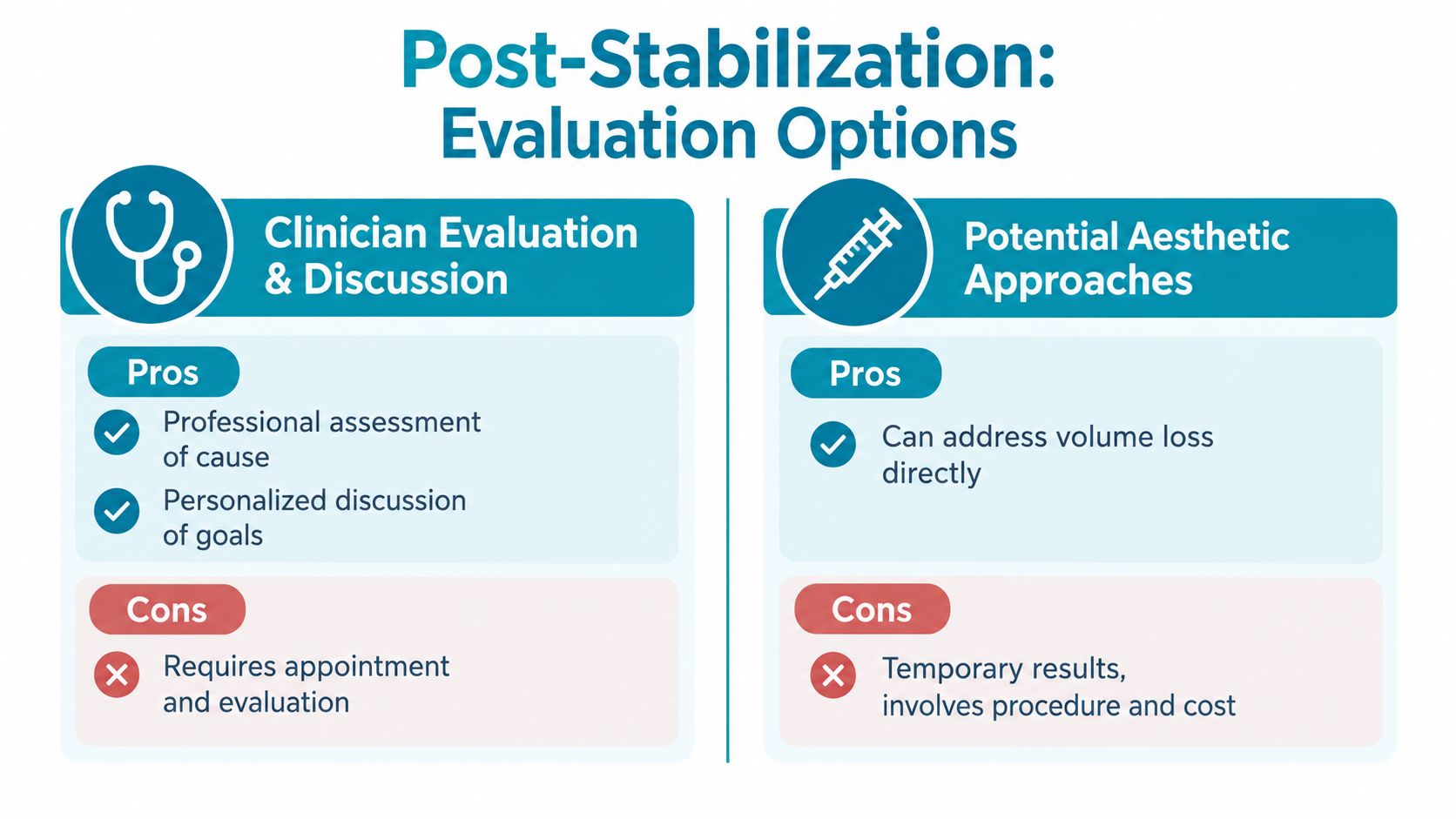
| Medical evaluation | Reviews medication safety, weight trajectory, nutrition, and other causes of change | Requires a clinical appointment and may not directly change facial volume |
| Aesthetic evaluation | Assesses whether volume loss, laxity, or texture is the main concern | Procedures can involve cost, discomfort, temporary effects, and medical risks |
| Volume restoration | May address hollowing in selected areas | Results vary, treatment is not risk-free, and continued weight change can alter the result |
| Skin-focused treatment | May improve selected texture or laxity concerns | It may not replace lost volume and may require multiple treatments |
| Waiting for stabilization | Allows the face and treatment plan to be assessed at a steadier point | It can be frustrating when the change feels distressing now |
Early research has reported improvements in facial contour and skin quality with combined injectable treatment, but the evidence remains developing and does not establish that the regimen suits every adult. It also does not show that Empire Medical Wellness offers those procedures. Results from a study or clinic setting cannot substitute for an individual review of anatomy, health history, and treatment goals.
People researching approaches to medication-induced facial changes may find explanations of aesthetic assessment and treatment categories. Any procedure should be discussed with a qualified provider who can review medical history, current medicines, allergies, pregnancy plans, and whether weight is still changing.
Common versus urgent medication symptoms
Facial volume change is usually an appearance concern. Vomiting, severe abdominal pain, allergic symptoms, or rapidly worsening illness may indicate a separate medication-safety issue. Product-specific counseling should follow the FDA Medication Guide and prescribing information.
| Symptom pattern | Appropriate response |
|---|---|
| Nausea, reduced appetite, diarrhea, constipation, or vomiting that is mild or improving | Mention it during routine follow-up, especially if it affects eating, hydration, or daily activities |
| Persistent or worsening vomiting, inability to maintain fluids, or symptoms that concern you | Contact the prescribing clinician promptly |
| Severe or persistent abdominal pain, especially with vomiting | Seek urgent medical assessment |
| Swelling of the face, lips, tongue, or throat, trouble breathing, or widespread hives | Seek emergency care |
| A suspected serious reaction or rapidly worsening illness | Use emergency services rather than waiting for a routine appointment |
The appropriate response depends on the specific product and the person's symptoms. Do not change a prescription to address a cosmetic concern without speaking with the prescribing clinician.
When to Seek Physician Assessment and Next Steps with Empire
Could facial changes be part of expected weight loss, or do they signal a problem that needs medical attention? Physician assessment is appropriate when changes feel distressing, progress quickly, or occur with difficulty eating, poor hydration, reduced strength, or trouble tolerating medication. Consultation also makes sense before changing treatment, adding another glucose-lowering or incretin medicine, planning pregnancy, or scheduling an aesthetic procedure.
Bring a current medication list and describe when weight loss, facial changes, gastrointestinal symptoms, and recent procedures occurred. The clinician may ask about nutrition, physical activity, relevant medical history, and whether weight is still changing. These details help distinguish routine treatment planning from symptoms requiring prompt evaluation.
Questions to discuss during follow-up
- Product identity: Which exact brand and active ingredient are prescribed, and what indication is being treated?
- Safety review: Are there contraindications, pregnancy plans, interacting therapies, or new symptoms that change the plan?
- Weight trajectory: Does the current pattern of loss and maintenance match the intended care plan?
- Nutrition and strength: Are food intake, hydration, physical activity, and lean-tissue preservation being addressed?
- Procedure timing: Is weight stable enough for an aesthetic assessment to be meaningful?
- Monitoring: Which symptoms require routine contact, prompt contact, or emergency care?
Facial volume loss is generally an appearance concern. Vomiting, severe abdominal pain, allergic symptoms, or rapidly worsening illness may represent a separate medication-safety issue. Use the product's FDA Medication Guide and prescribing information for product-specific counseling, and do not change a prescription to address appearance without speaking with the prescribing clinician.
Common versus urgent medication symptoms
| Symptom pattern | Appropriate response |
|---|---|
| Mild or improving nausea, reduced appetite, diarrhea, constipation, or vomiting | Mention it during routine follow-up, especially if it affects eating, hydration, or daily activities |
| Persistent or worsening vomiting, inability to maintain fluids, or symptoms that concern you | Contact the prescribing clinician promptly |
| Severe or persistent abdominal pain, especially with vomiting | Seek urgent medical assessment |
| Swelling of the face, lips, tongue, or throat, trouble breathing, or widespread hives | Seek emergency care |
| Suspected serious reaction or rapidly worsening illness | Use emergency services rather than waiting for a routine appointment |
Empire Medical Wellness is a private-pay, physician-led outpatient practice offering obesity-medicine evaluation, individualized weight-management planning, medication discussion when clinically appropriate, monitoring, and maintenance planning. Its standard appointments include a 50-minute initial evaluation for $350 and a 25-minute follow-up for $225. Empire does not bill insurance directly, but provides an itemized receipt through the patient portal. Adults concerned about facial changes during physician-led obesity care can schedule an appointment.
This article was published on September 13, 2026, and updated on September 13, 2026. Byline: Empire Medical Wellness Editorial Team.
This article is educational and is not personal medical advice.