
The popular advice is simple: cut carbohydrates, eat more fat, and expect the scale to cooperate. Clinically, that advice is incomplete. The keto diet can be useful for selected metabolic or neurologic conditions, but it isn't automatically superior to other eating patterns, and it requires more planning than eliminating bread and sugar.
For adults considering physician-led obesity care, the central question isn't whether keto works in the abstract. It's whether the dietary pattern fits your health history, medications, food preferences, metabolic goals, and ability to maintain it over time.
Table of Contents
- Understanding the Keto Diet and Nutritional Ketosis
- Evaluating the Evidence for Weight Loss and Metabolic Health
- Navigating Potential Benefits and Known Health Risks
- Identifying Contraindications and Medication Interactions
- Practical Starting Steps and Monitoring Metrics
- Long-Term Maintenance and Transitioning Off Keto
- When to Seek Physician-Led Obesity Care
Understanding the Keto Diet and Nutritional Ketosis
A ketogenic diet is a very-low-carbohydrate, high-fat eating pattern designed to produce nutritional ketosis. In ketosis, the body shifts away from relying primarily on glucose from carbohydrate and increases fatty-acid oxidation and ketone-body production. Ketone bodies then provide an alternative fuel source.
That definition separates keto from the much broader category of low-carbohydrate eating. Reducing sweets or limiting pasta may lower carbohydrate intake, but it doesn't necessarily create ketosis. Clinical references commonly describe a very-low-carbohydrate ketogenic diet as providing less than 10% of total energy from carbohydrate, often around 20 to 50 grams of carbohydrate per day, with fat supplying approximately 70% to 80% of calories and protein around 10% (NCBI Bookshelf).
The Academy of Nutrition and Dietetics' classification system likewise distinguishes a very-low-carbohydrate ketogenic pattern, generally below 20 to 50 grams of carbohydrate daily, from broader low-carbohydrate diets that may allow 50 to 130 grams per day (Academy of Nutrition and Dietetics Evidence Analysis Library). A classic therapeutic ketogenic diet can be even more restrictive, with some classification systems describing approximately 90% of calories from fat, 7% from protein, and 3% from carbohydrate.
Why the threshold matters
Carbohydrate intake influences insulin signaling, glycogen storage, and the availability of fatty acids for ketone production. When carbohydrate intake becomes very low, the liver produces ketone bodies from fatty acids. The shift is metabolic, not merely behavioral.
This is why “keto” shouldn't be used as a casual label for every lower-carbohydrate meal plan. A person can eat fewer refined carbohydrates and still follow a nutritionally balanced, non-ketogenic pattern. For a plain-language overview before reviewing clinical details, readers can find ketogenic diet facts, but medical decisions require more than a food list.
A practical nutrition evaluation should consider food quality, not only the carbohydrate ceiling. A plan centered on nonstarchy vegetables, adequate protein, nuts, seeds, fish, and unsaturated oils has a different health profile from one built mainly around processed meats, butter, and high-saturated-fat foods. Adults seeking individualized nutrition planning can review physician-led nutrition care as part of a broader medical assessment.
Clinical distinction: A low-carbohydrate diet and a ketogenic diet overlap, but they aren't interchangeable. Ketosis requires a substantially stricter carbohydrate pattern.
The diet also has a long medical history. In 1911, physicians in Paris reported that seizures became less severe during starvation. In 1921, Dr. Russell Wilder at the Mayo Clinic coined the term “ketogenic diet” after proposing that a ketone-producing diet could mimic fasting and help control epilepsy. The approach became widely used during the 1920s and 1930s, declined as anticonvulsant drugs expanded treatment options, and resurfaced in the 1990s for refractory epilepsy before attracting broader metabolic interest (history of ketogenic therapy).
Evaluating the Evidence for Weight Loss and Metabolic Health
Keto may produce striking early changes, but rapid scale loss does not establish that it is the best long-term diet for every adult. Much of the initial drop reflects lower glycogen stores and associated water when carbohydrate intake falls sharply. Sustained fat loss still depends on total energy intake, food quality, appetite control, physical activity, and the ability to follow the plan.
Research in adults with obesity generally finds that ketogenic and very-low-carbohydrate diets can produce greater short- to mid-term weight loss than low-fat comparators in some studies. Triglycerides also often decline. Over longer periods, the difference usually narrows, and results are mixed. A 2024 review of obesity research concluded that long-term effects remain uncertain and do not consistently show a significant advantage over other dietary strategies.
A condition-specific question
The more useful clinical question is, “Which patient or metabolic phenotype is most likely to benefit?” This shifts the discussion from universal weight-loss claims to treatment selection.
A 2026 clinical trial involving people with obesity, prediabetes, and fatty liver disease found that all diet groups lost about 10% of body weight. The ketogenic group reduced liver fat by 67%, compared with 45% for Mediterranean and low-fat diets. About half of participants no longer met prediabetes criteria (ScienceDaily report on the 2026 trial). These findings suggest that keto's possible distinct value may involve the combination of insulin resistance, prediabetes, and fatty liver disease, rather than universally greater weight loss.
The result is promising but population-specific. It does not show that every adult with obesity should pursue strict ketosis. Before recommending it, clinicians should review diet quality, cardiovascular risk, kidney health, medication use, and the likelihood of maintaining the pattern.
| Clinical question | What the evidence supports | What it doesn't establish |
|---|---|---|
| Can keto support weight loss? | It can produce short- to mid-term weight loss in some adults. | It is not consistently superior over the long term. |
| Can it affect triglycerides? | Triglycerides often improve on ketogenic diets. | Other lipid markers may worsen. |
| Could it help selected metabolic conditions? | Some people with obesity, prediabetes, and fatty liver disease may experience a larger reduction in liver fat. | The finding does not apply automatically to every patient. |
| Is strict ketosis required for maintenance? | Long-term adherence and overall energy balance remain central. | Permanent ketosis has not been shown to be uniquely necessary. |
Keto should be weighed against other evidence-based options, including nutrition counseling, physical activity, behavioral treatment, and anti-obesity medication when clinically appropriate. Medication decisions remain separate from the choice of diet. Adults considering pharmacologic treatment can review physician-guided semaglutide care, while recognizing that any medication or dietary pattern requires individualized evaluation and clinical monitoring.
Navigating Potential Benefits and Known Health Risks
The keto diet is not automatically healthy because it produces ketosis. Its value depends on the condition being treated, the person's lipid response, diet quality, and ability to maintain the pattern. The same carbohydrate restriction that improves triglycerides and glucose measures for some people can raise LDL cholesterol in others. Review the full lipid profile rather than treating one favorable marker as proof of overall benefit.
In one randomized crossover trial, a whole-food ketogenic diet lowered triglycerides by 16% while increasing LDL cholesterol by 10%. A separate controlled trial in healthy young women identified a deleterious LDL profile and raised concern about that response. These findings do not predict an individual outcome, but they support checking lipids before and after dietary changes.
Clinical Trade-Offs of the Ketogenic Diet
| Potential Metabolic Benefits | Documented Risks and Concerns |
|---|---|
| May support short- to mid-term weight loss in selected adults | Long-term adherence can be difficult |
| Often lowers triglycerides | LDL cholesterol can rise in some people |
| May improve glycemic measures for some adults | Diabetes medicines can create hypoglycemia risk when intake changes |
| May reduce liver fat in a selected obesity, prediabetes, and fatty liver population | Restriction can reduce fiber and micronutrient variety |
| Can produce nutritional ketosis | Constipation, fatigue, headache, or dizziness may occur during adaptation |
| Has an established role in drug-resistant epilepsy under specialist care | Concerns include cardiovascular risk, renal strain, gut microbiome changes, and individual variability |
“Keto flu” commonly describes headache, fatigue, dizziness, or a general sense of feeling unwell during early adaptation. The label should not replace clinical assessment. Symptoms may reflect inadequate intake, dehydration, blood-pressure changes, glucose changes, or medication effects.
Long-term questions deserve the same attention as early metabolic improvements. A 2025 NIH-indexed review described potential improvements in weight and glycemic measures, while identifying adherence difficulties and concerns involving cardiovascular risk, renal strain, micronutrient deficiencies, and gut microbiome changes. A separate 2026 review also reported uncertainty about long-term safety and variation in individual response (2025 Nutrition Reviews review).
A diet that improves one biomarker while worsening another requires reassessment, not loyalty.
Food quality determines whether keto provides a nutritionally sound pattern. Nonstarchy vegetables, fish, nuts, seeds, and unsaturated fats create a different foundation from highly processed foods dominated by saturated fat. Constipation, declining energy, poor sleep, menstrual changes, or difficulty meeting protein and fiber needs should prompt a review of the plan with a clinician.
Ketosis can be useful for selected metabolic conditions, but it is not a universal lifestyle requirement. Its use should match a defined clinical goal, with monitoring that can identify benefit, harm, and the need to change course.
Identifying Contraindications and Medication Interactions
Strict carbohydrate restriction isn't a neutral experiment for everyone. Before starting, a clinician should review pregnancy status, eating-disorder history, pancreatitis or gallbladder risk, kidney or liver disease, lipid disorders, diabetes treatment, blood-pressure treatment, and prior experiences with restrictive dieting.
The word “contraindication” means a reason a treatment may be unsafe or inappropriate. The specific decision depends on the person's medical history, but a history of pancreatitis, active gallbladder concerns, significant kidney or liver disease, or a serious lipid disorder deserves careful evaluation before a high-fat ketogenic pattern is considered.
Medication safety comes first
Adults using glucose-lowering medication may face hypoglycemia, meaning blood glucose becomes too low, when carbohydrate intake changes substantially. People taking blood-pressure medication may also experience hypotension, or blood pressure that falls too low, particularly if fluid and sodium intake change. These medicines may require clinician-supervised adjustment. Patients should never stop or reduce medication on their own.
Diabetes care requires special attention because dietary changes can alter glucose patterns quickly. This is particularly relevant for people taking medicines associated with hypoglycemia risk or medicines that require specific safety counseling during reduced food intake. A physician can determine what monitoring is appropriate.
Adults researching medication-supported obesity care can review GLP-1 treatment information, but medication and diet should be assessed as separate clinical tools. A GLP-1 medication isn't a substitute for safety screening, and a ketogenic diet isn't automatically safer because it's labeled “natural.”
Seek urgent medical care for severe abdominal pain, persistent vomiting, confusion, or suspected hypoglycemia. These symptoms shouldn't be dismissed as ordinary adaptation.
Practical Starting Steps and Monitoring Metrics
A medically responsible keto plan starts with screening, not a shopping list. A useful onboarding process can be organized into three steps. The following is a hypothetical composite framework, not a description of a real Empire patient or a documented practice case.
Step one involves baseline assessment
The clinician reviews medical history, prior dieting patterns, eating-disorder history, pregnancy status, pancreatitis or gallbladder risk, kidney and liver conditions, lipid disorders, diabetes medicines, blood-pressure medicines, symptoms, and goals. Baseline measures may include weight trend, waist circumference, blood pressure, glucose or A1C, fasting lipids, and additional kidney, liver, electrolyte, or uric-acid testing when history or symptoms warrant.
Step two creates a nutrient-dense structure
The plan should prioritize nonstarchy vegetables, adequate protein, fiber, fluids, and unsaturated fats. A carbohydrate target should reflect the person's clinical context and desired level of restriction, rather than defaulting to a bacon-and-butter caricature.
Meals should also fit work, travel, family routines, and cultural preferences. For adults who use coffee while traveling, practical planning can include options such as convenient coffee for travel, while remembering that coffee products vary in carbohydrate and added-sugar content.
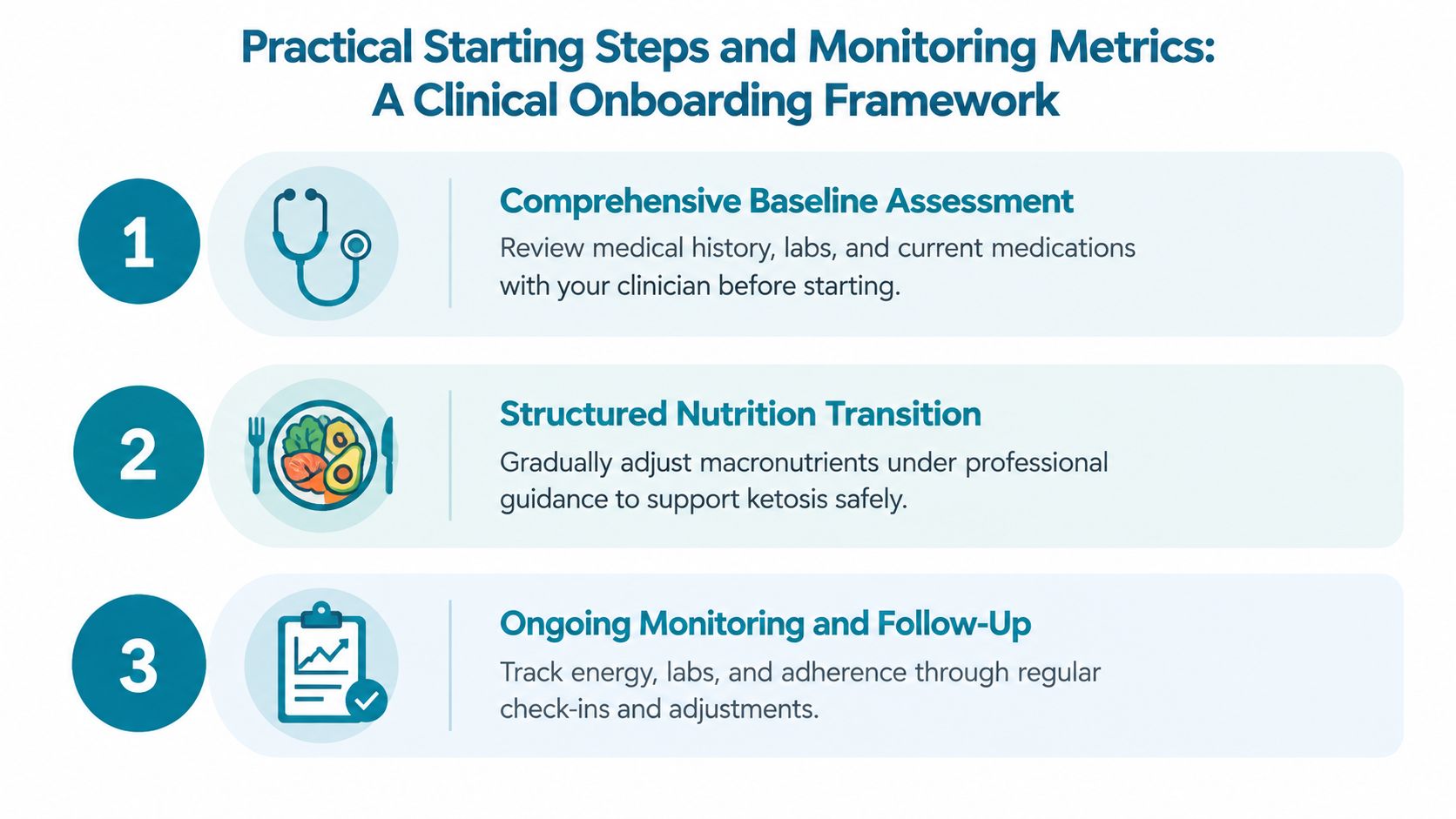
Step three establishes follow-up
Monitoring should match the person's risks. A clinician may track:
- Weight and waist: Look at trends rather than reacting to a single reading.
- Blood pressure: Review symptoms of dizziness or lightheadedness, especially when medication is involved.
- Glucose and A1C: Assess glycemic response and hypoglycemia risk for people with diabetes.
- Fasting lipids: Pay close attention to LDL cholesterol and triglycerides.
- Organ and electrolyte measures: Check kidney, liver, electrolyte, or uric-acid testing when clinically warranted.
- Daily function: Ask about constipation, hydration, menstrual changes, sleep, energy, food quality, protein, fiber, and adherence.
Early scale changes can reflect glycogen and water shifts within days. Tolerability may be reassessed in 2 to 4 weeks, while metabolic laboratory testing may occur on an individualized interval such as 8 to 12 weeks, depending on the person's medical history and treatment plan. These intervals are not a universal schedule.
Practical rule: New fatigue, dizziness, constipation, or glucose changes deserve assessment. They aren't proof that the diet is working.
Common hurdles have practical responses. Headache or fatigue calls for review of hydration, food intake, blood pressure, glucose, and medicines. Constipation may require low-carbohydrate fiber sources, fluids, and clinician guidance. Cravings may improve with structured meals containing adequate protein, while restaurant and travel planning can reduce social rigidity.
A calorie-deficit assessment can help place the dietary pattern in the broader context of energy balance. Readers can review how clinicians calculate a calorie deficit, but the calculation shouldn't replace attention to nutrition quality, hunger, activity, sleep, and medical safety.
For additional educational context, this video may help explain the broader clinical framework:
Long-Term Maintenance and Transitioning Off Keto
Maintenance should be designed before a person reaches an initial goal. The key question is whether the carbohydrate pattern can fit ordinary life, including holidays, travel, restaurants, family meals, exercise, and periods of stress. If strict ketosis requires constant vigilance, it may not be a sustainable maintenance strategy.
Permanent ketosis isn't known to be uniquely necessary for preventing weight regain. Long-term adherence, energy balance, food quality, activity, sleep, eating behavior, and treatment of relevant medical conditions remain central. The 2024 ADA-related summary reported that very-low-carbohydrate or ketogenic diets may show greater weight loss, lower glucose, or reduced medication use in the first 6 months, but advantages become modest by 6 to 12 months and aren't consistently seen at 12 months or later (ADA-related summary).
A flexible transition can be clinically reasonable
If strict ketosis becomes difficult to sustain, a gradual transition to a less restrictive, lower-carbohydrate Mediterranean-style pattern may preserve useful habits without maintaining unnecessary rigidity. That pattern can emphasize:
- Vegetables and other high-fiber foods
- Legumes as tolerated
- Fish and other protein sources
- Nuts and seeds
- Unsaturated oils
- Adequate protein to support lean mass
- Resistance exercise, when medically appropriate
A maintenance plan should also define what happens if weight begins to rise. Monitor weight by trend rather than daily emotion, establish an action threshold with a clinician, and review food intake, activity, sleep, medication effects, glucose, blood pressure, and eating behavior when the trend changes.
Maintenance is a treatment phase, not the moment care ends.
A transition doesn't mean the original approach failed. It may show that the person has learned which foods support satiety, which meals are practical, and which level of carbohydrate restriction can continue without damaging quality of life. The most effective plan is the one that supports metabolic health and can be followed consistently.
When to Seek Physician-Led Obesity Care
Consider a medical evaluation when dietary efforts repeatedly lead to regain, when fatigue or dizziness persists, when glucose or lipid values change unexpectedly, or when strict restriction creates anxiety, social isolation, constipation, or inadequate food quality. People taking diabetes or blood-pressure medication should seek guidance before making substantial carbohydrate changes.
Obesity is a complex chronic disease influenced by biology, environment, medications, sleep, stress, eating behavior, and other health conditions. A temporary diet may be one tool, but it shouldn't be treated as a test of character or the sole measure of health.
Physician-led obesity medicine can integrate nutrition, activity, medication review, metabolic monitoring, and long-term maintenance planning. Adults interested in a personalized evaluation can learn more about physician-led weight-loss care, with the understanding that treatment decisions depend on individual history and clinical assessment.
Empire Medical Wellness offers private-pay, physician-led obesity medicine for adults seeking individualized evaluation, nutrition planning, medication review when clinically appropriate, and ongoing metabolic follow-up. Visit Empire Medical Wellness to learn about the practice and request care focused on sustainable health rather than short-term keto promises. This article is educational and isn't personal medical advice.