
Nar-Anon serves relatives and friends affected by someone else's drug use, while Narcotics Anonymous serves people working on their own drug use; both are peer groups, not medical care. The practical question isn't which fellowship is better, but whose experience needs support.
Can a family member find support even when the person using drugs hasn't sought treatment? That question reveals why these separate fellowships exist. A person addressing personal drug use and a loved one coping with its effects may need different conversations, goals, and meeting spaces.
By Empire Medical Wellness Editorial Team
Published October 8, 2026. Updated October 8, 2026.
Table of Contents
- Nar-Anon vs Narcotics Anonymous at a Glance
- Who Qualifies for Each Group
- Where Each Fellowship Came From
- How Meetings and the Twelve Steps Compare
- Where Peer Support Ends and Medical Care Begins
- Choosing the Right Fit for Your Situation
- Take the Next Step With a Clinician
Nar-Anon vs Narcotics Anonymous at a Glance
Nar-Anon focuses on the family member or friend. Narcotics Anonymous, usually called NA, focuses on the person seeking recovery from drug use. Their similar names reflect a connection, not interchangeable membership or medical services.
The Nar-Anon principles state that its membership requirement is a problem of addiction in a relative or friend. An attendee doesn't need a personal history of drug use. NA's membership requirement is a desire to stop using drugs.
Nar-Anon and Narcotics Anonymous Side by Side
| Feature | Nar-Anon | Narcotics Anonymous |
|---|---|---|
| Who it serves | Relatives and friends affected by someone else's drug use | People who want to stop their own drug use |
| Founded | Officially started November 11, 1960, in Studio City, California | First meetings emerged in Los Angeles in the early 1950s; formally founded in 1953 |
| Program basis | Twelve Steps, Twelve Traditions, and Twelve Concepts adapted from NA | Twelve-Step program |
| Membership requirement | A relative or friend has a problem with addiction | A desire to stop using drugs |
| Clinical provider | No; peer-led fellowship | No; peer-led fellowship, not a clinical provider |
| Published scale | Official materials describe a worldwide fellowship but don't provide a comparable global meeting total | NA estimated more than 72,200 weekly meetings in 143 countries as of May 2023, according to NA's community resource. Its program overview reports more than 79,000 weekly meetings in 122 countries, without a reporting date specified in the available material. |
The NA counts are separate organizational snapshots, not a consistent measure of growth between reporting periods. They don't establish how many people participate, whether a particular meeting will suit someone, or which fellowship produces better outcomes.
Complementary Support, Different Work
A family member may need space to discuss uncertainty, financial boundaries, or reactions to another person's behavior. A person seeking recovery may need peers who understand the experience of wanting to stop using drugs. Combining those needs into a single conversation can leave someone's concerns unaddressed.
Practical rule: Choose the fellowship by the attendee's own reason for seeking support, not simply by the presence of drug use somewhere in the family.
Neither fellowship replaces medical assessment, withdrawal management, or professional addiction treatment when clinically needed. Withdrawal management means medical care for symptoms and risks that can arise after reducing or stopping a substance. The practice's overview of addiction offers a separate starting point for understanding the medical side of a substance-use concern.
Who Qualifies for Each Group
Eligibility by Situation
| Situation | Nar-Anon | Narcotics Anonymous | What to check |
|---|---|---|---|
| Parent of an adult who uses drugs | Yes, if affected by the adult's addiction | Only if the parent wants to stop personal drug use | Whether the parent's own drug use is involved |
| Spouse or partner of someone in active use | Yes; the other person doesn't have to remain in active addiction | Only if the partner wants to stop personal drug use | The meeting's stated audience |
| Adult sibling of someone in treatment or recovery | Yes, if affected by the sibling's addiction | For the attendee's own drug use | Whether the concern is family effects or personal use |
| Friend with no drug use of their own | Yes, if affected by a friend's addiction | Not as a member addressing personal use | Membership in Nar-Anon doesn't require drug use |
| Person who uses drugs and wants to stop | Not for personal drug use alone | Yes; a desire to stop is the stated requirement | Clinical assessment is a separate question |
| Person addressing personal drug use who is also affected by a relative's addiction | Possible as a separate membership focused on that relationship | Yes, for personal recovery | Each fellowship's membership and meeting rules apply separately |
Nar-Anon isn't limited to people sharing a home with someone actively using drugs. Its family-and-friend membership guidance welcomes affected relatives and friends whether or not the other person is currently experiencing active addiction.
That distinction matters for someone whose relative has entered treatment, moved away, or begun recovery. Changes in the other person's circumstances don't necessarily resolve the attendee's questions about trust, boundaries, or personal well-being.
Membership Isn't a Diagnosis
A fellowship's membership rule isn't a medical diagnostic test. Joining a group doesn't establish a diagnosis, and choosing not to attend doesn't rule one out. The practice's explanation of DSM-5 substance use disorder criteria addresses a different question: how clinicians organize an assessment of substance-related problems.
A clearly hypothetical example illustrates the distinction. An adult sibling affected by a brother's drug use may consider Nar-Anon even if the sibling has never used drugs. If that same attendee also wants to stop personal drug use, NA may be relevant for that separate concern.
Before attending, the prospective participant should confirm:
- Audience: Whether the meeting is intended for affected relatives and friends or people addressing personal drug use.
- Participation rules: Whether visitors may attend and how newcomers participate.
- Focus: Whether the attendee's goal matches the meeting's purpose.
Someone with reasons to attend both fellowships should keep those memberships distinct. Nar-Anon isn't a place to manage another adult's treatment, and NA isn't automatically a family-support meeting.
Where Each Fellowship Came From
NA's first meetings emerged in Los Angeles in the early 1950s, and the fellowship was formally organized later. Nar-Anon officially started on November 11, 1960, in Studio City, California, according to the Nar-Anon Family Groups history sheet. The historical account describes Nar-Anon's founding meeting as occurring at the same place and time as the only local NA meeting.
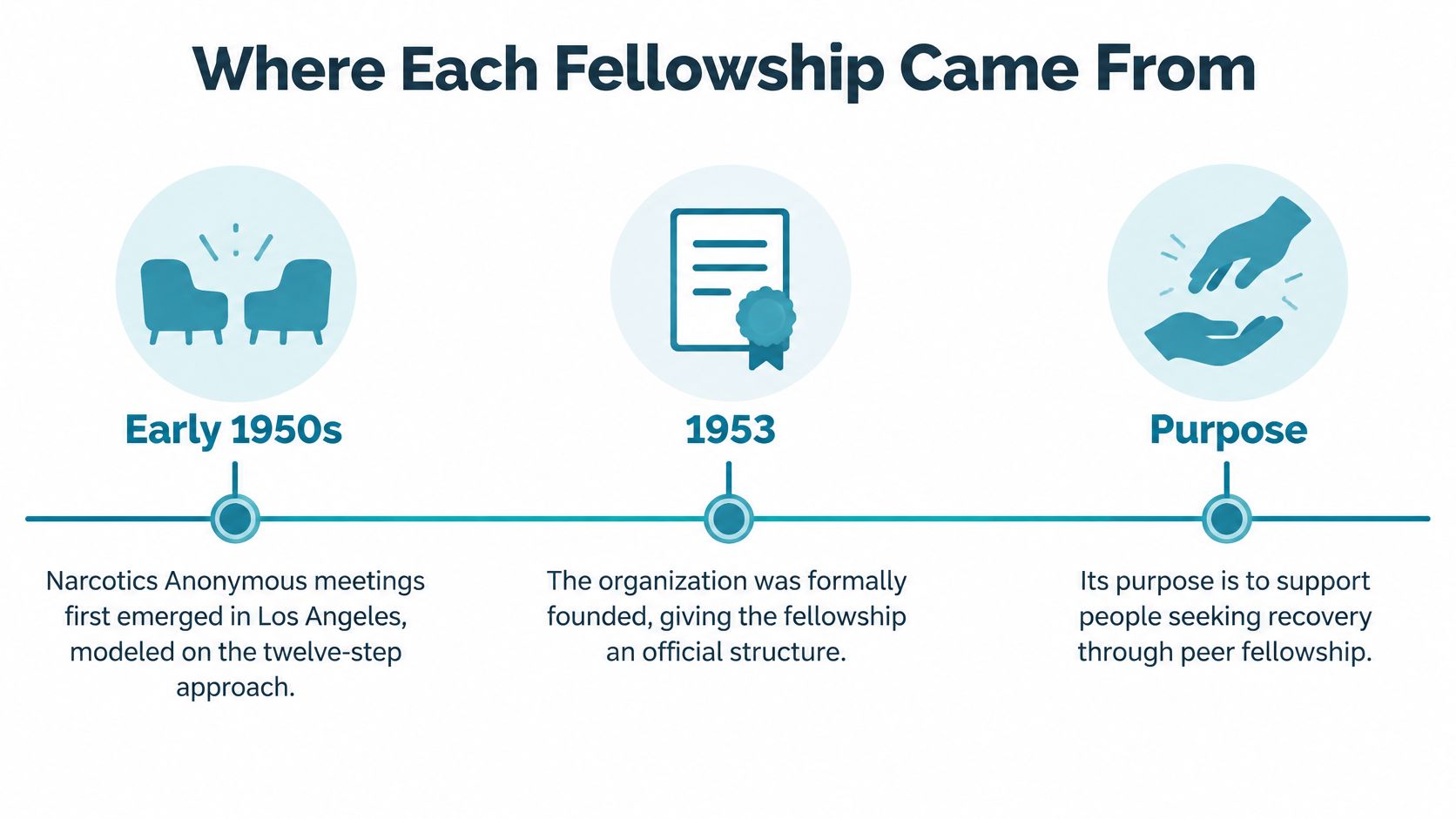
That shared setting explains the similar names better than any definition can. The two groups grew side by side, but they answered different questions. NA developed around people seeking recovery from their own drug use through peer meetings and a Twelve-Step program. Family members and others affected by someone else's drug use built Nar-Anon as a parallel structure, rather than an expanded category of NA membership. One fellowship served the person using drugs; the other served the people around that person. The shared origin never made them interchangeable, and that pairing still describes how the fellowships fit together today.
History Doesn't Determine Personal Fit
A larger published meeting network doesn't make a fellowship more appropriate for every attendee. A nearby meeting with a suitable audience and a workable schedule may matter more than worldwide totals.
Meeting listings and organizational counts can change. For practical planning, the Nar-Anon United States directory provides a more useful starting point than assuming that an older listing remains active.
How Meetings and the Twelve Steps Compare
The fellowships share Twelve-Step roots, but they don't use a single combined program. Nar-Anon adapted its own Twelve Steps, Twelve Traditions, and Twelve Concepts from NA. Its official frequently asked questions describe group-sharing, step or tradition study, topic, and speaker meetings.
Nar-Anon also specifies that only one person speaks at a time. That structure supports orderly sharing rather than a running exchange of interruptions or direct advice.
Similar Framework, Different Subject
A Nar-Anon discussion may center on the attendee's reactions to another person's addiction. Members may consider changed attitudes, mutual support, boundaries, and recovery from the effects of that relationship. The purpose isn't to assemble a plan for making the absent person stop using.
NA's focus is personal recovery from drug use. A participant's desire to stop and develop a drug-free way of living belongs at the center of that fellowship's work. Current NA formats should be checked directly rather than inferred from a Nar-Anon description.
The similar names can also create confusion with alcohol-focused fellowships. The practice's guide to alcohol-related mutual support addresses that adjacent question without making the groups interchangeable.
Listening to shared experience isn't the same as receiving a clinical assessment or an individualized treatment recommendation.
Preparing for a First Meeting
A prospective attendee can arrive with modest expectations: learn the format, listen, and ask about participation rather than assuming that speaking immediately is required. Sharing should stay focused on personal experience, with identifying details about others kept to a minimum.
Useful questions for the meeting contact include:
- Who is the meeting for? Confirm the intended participants and any visitor rules.
- What format does it use? Ask whether the meeting centers on sharing, a topic, a speaker, or program study.
- Where is it officially listed? Confirm the listing and whether the time, location, or access instructions have changed.
A meeting can offer a chance to understand how the fellowship works. It doesn't need to settle every question about recovery, family relationships, or medical care at once.
Where Peer Support Ends and Medical Care Begins
Peer fellowships aren't clinical providers. Attendance doesn't supply medical monitoring, professional crisis intervention, medication decisions, or a guaranteed response to imminent danger. A supportive meeting should never become a reason to postpone emergency care.
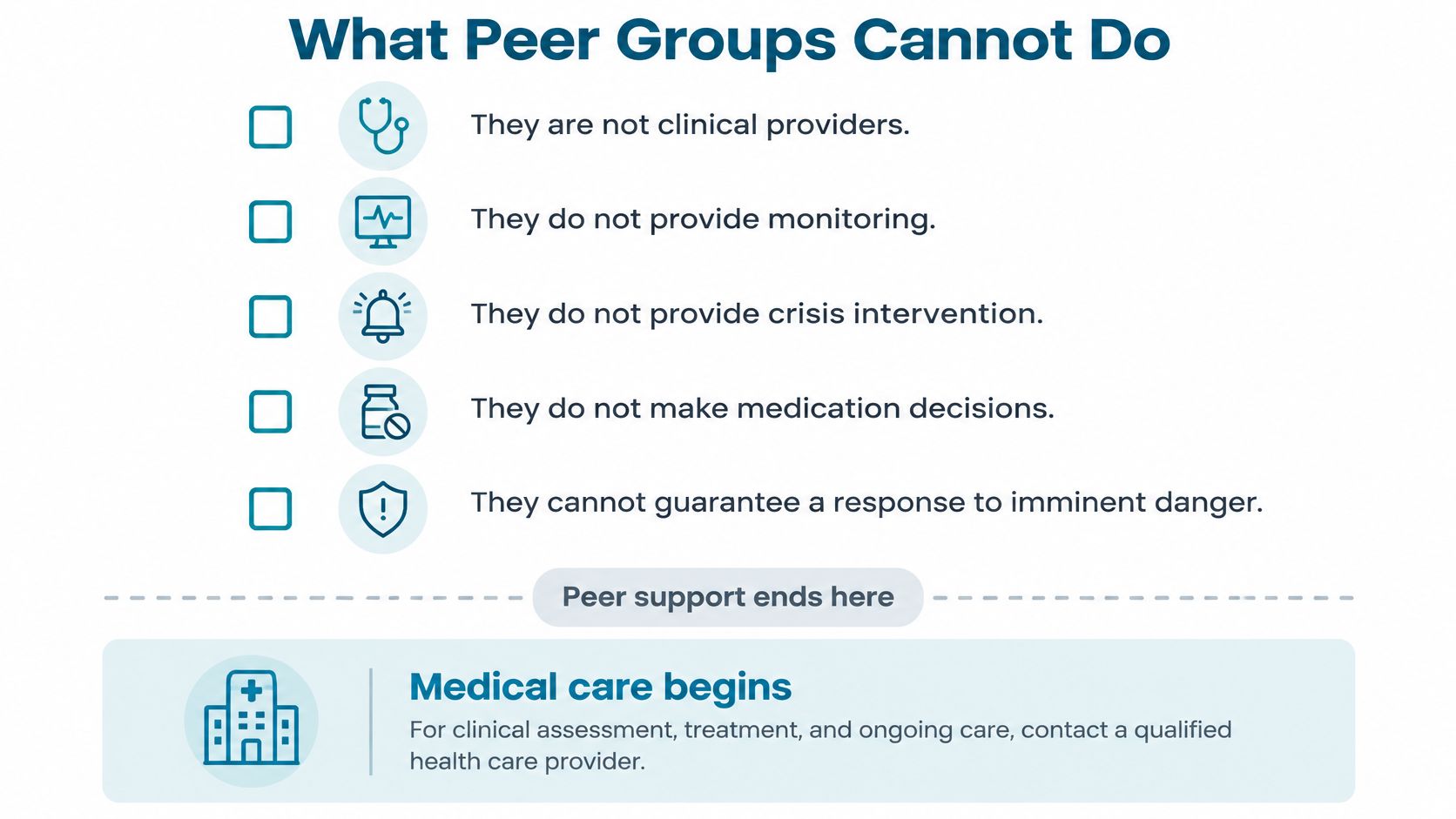
Emergency Needs Come First
An unconscious person, abnormal breathing, a seizure, or a suspected overdose requires emergency help. An immediate threat of self-harm or intoxicated driving also calls for an urgent response, not a meeting or routine appointment.
In the United States, people needing mental-health or suicidal crisis support can call or text 988. Immediate physical danger requires emergency services.
Routine or Urgent, Where to Turn
| Situation | Next step | Type |
|---|---|---|
| Unconscious, not breathing normally, or having a seizure | Call emergency services immediately | Urgent |
| Threatening self-harm or suicide | Call emergency services for immediate danger; call or text 988 for crisis support | Urgent |
| Suspected opioid overdose | Call emergency services; follow dispatcher guidance and any available overdose-reversal product instructions | Urgent |
| Severe or worsening withdrawal symptoms | Seek urgent medical evaluation rather than waiting for a meeting | Urgent |
| Driving while intoxicated | Contact emergency services; avoid a confrontation that creates additional danger | Urgent |
| Medication questions or proposed changes | Arrange clinician review; don't stop, reduce, or change medication independently | Routine, unless symptoms require urgent care |
| Recovery planning or ongoing concerns | Schedule follow-up with a qualified clinician | Routine |
| Meeting times or group details | Confirm through the group's official directory | Routine |
Medical Planning and Family Safety
A qualified clinician assesses medical risks and helps determine the appropriate setting for care. Depending on the situation, that may involve outpatient care or a more structured service. Detoxification addresses withdrawal; residential treatment involves living at a treatment facility; partial hospitalization and intensive outpatient treatment provide structured care without the same residential arrangement.
When those services or another level of support are clinically appropriate, Empire Medical Wellness can help coordinate the next step with trusted treatment partners. This coordination doesn't mean the practice provides those facilities or programs itself.
Medication decisions belong with a qualified clinician. Questions about medication-assisted treatment should address medical suitability, monitoring, and follow-up rather than whether a peer approves of a particular treatment.
Family members can also ask a clinician or pharmacist about naloxone, an opioid overdose-reversal medicine, and about obtaining and using an appropriate product. Product-specific instructions and emergency guidance should be confirmed directly with a qualified professional.
Safety boundary: A family support plan can identify emergency contacts, accessible safety supplies, and personal limits. It can't guarantee another adult's safety or control that adult's treatment choices.
Financial boundaries may include deciding what expenses a family member will or won't cover. Those choices concern the family member's actions, not authority over someone else's medical care.
Choosing the Right Fit for Your Situation
The most useful decision starts with whose drug use is the concern and whether anyone faces immediate danger. A fellowship's size, name recognition, or familiarity shouldn't replace those questions.
A Practical Decision Path
- Address immediate danger first. Emergency symptoms or an immediate safety threat take priority over finding a group or booking outpatient care.
- Identify a concern about personal drug use. NA may fit the peer-support goal. A clinician can separately assess medical risks and explain treatment options.
- Identify the effects of someone else's addiction. Nar-Anon may fit a relative or friend seeking support for personal reactions, choices, and boundaries.
- Recognize overlapping roles. Someone affected by a relative's addiction may also want support for personal drug use. Separate participation in both fellowships may fit those distinct needs, subject to each group's rules.
- Revisit the choice when circumstances change. A change in relationships, treatment, or recovery goals may change the kind of support that feels useful.
A person who hasn't had a medical evaluation can ask what an assessment involves without committing in advance to a particular treatment. Someone already receiving care can discuss how meeting attendance fits with appointments, monitoring, and the existing plan.
A Blank Support-Planning Aid
| Planning question | Information to record |
|---|---|
| What support is being sought? | Personal recovery, effects of another person's addiction, or both |
| Which meeting fits that goal? | Fellowship name and intended audience |
| Have the details been confirmed? | Meeting contact, format, time, and access instructions |
| What medical questions remain? | Current concerns, medication questions, previous treatment, and goals |
| What happens if safety changes? | Emergency contacts and an agreed route to urgent care |
Empire Medical Wellness provides private-pay, physician-led outpatient addiction medicine care. Its addiction medicine service page and addiction medicine specialist information offer relevant details for adults considering medical evaluation.
Addiction medicine can be sought as a focused service on its own. Discussing treatment settings in an educational article doesn't mean the practice offers every treatment mentioned.
Take the Next Step With a Clinician
A medical conversation can clarify what peer support leaves unanswered: medical risks, treatment options, medication concerns, and the appropriate setting for care. A short written list can help keep that conversation focused without requiring a perfectly organized history.
Questions to Bring to an Appointment
- How is a substance-use concern assessed? Ask which parts of the history, current symptoms, and previous care will inform the evaluation.
- How could peer support fit alongside the proposed plan? Clarify the separate roles of meetings and medical follow-up.
- What safety steps apply if circumstances change? Request a distinction between concerns that can wait for follow-up and those requiring urgent help.
- How is follow-up arranged? Ask what will be monitored and how the interval between appointments is determined.
- What options are appropriate, and what does each involve? Discuss the purpose and practical demands of the available choices.
- Which costs apply, and who bills them? Include visit fees and possible charges from pharmacies, laboratories, or outside programs.
Preparing Without Making Assumptions
The practice's addiction medicine evaluations are confidential outpatient evaluations. Assessment considers the patient's current situation, medical risks, previous treatment, medications, and goals, followed by an explanation of appropriate options and next steps. The first addiction medicine appointment guide offers additional preparation information.
Visit fees are private-pay. The fees and care-process page explains practical arrangements, while the appointment scheduling page provides the route to request a visit. An appointment doesn't guarantee a particular medication or outcome, and recommendations are individualized.
For meetings, details should be confirmed directly with each fellowship. The official Narcotics Anonymous website provides a starting point for NA information and meeting searches.
Sources
This article draws on official Nar-Anon Family Groups principles, membership guidance, history, and meeting information, together with Narcotics Anonymous World Services program and community resources linked above. Organizational meeting counts describe published coverage, not clinical effectiveness.
This article is educational and isn't personal medical advice. A qualified clinician should review individual circumstances.
Empire Medical Wellness offers confidential, physician-led outpatient addiction medicine assessment, individualized planning, and follow-up. For adults considering how medical care could complement NA or other peer support, visit Empire Medical Wellness to learn about the practice and appointment process.