
The Mediterranean diet is often presented as a fix for fatty liver, but neither a diet label nor a single food treats the condition on its own. A Mediterranean-style eating pattern is a recognized part of lifestyle care for adults with metabolic dysfunction-associated steatotic liver disease, or MASLD, and may support liver-fat and cardiometabolic goals.
By Empire Medical Wellness Editorial Team
Table of Contents
- Why the Mediterranean Diet Comes Up for Fatty Liver
- What Belongs in a Mediterranean-Style Eating Pattern
- What Studies Show About Liver Fat and Liver Enzymes
- Building Meals and Making Practical Food Swaps
- Sample Meal Plans and Portion Guidance
- Alcohol, Other Conditions, Medications, and When to See a Physician
- Choosing a Sustainable Plan and Taking the Next Step
Why the Mediterranean Diet Comes Up for Fatty Liver
MASLD means excess fat in the liver in the setting of metabolic dysfunction. Older studies usually use nonalcoholic fatty liver disease, or NAFLD, terminology. That difference matters when reading research, although the populations defined by the terms aren't completely interchangeable.
For adults researching a Mediterranean diet for fatty liver, the useful question isn't whether every meal looks Mediterranean. It's whether an eating pattern supports metabolic health and remains manageable over time. The practice's fatty-liver overview provides broader context; the focus here is everyday meal construction.
A framework rather than a food treatment
The appeal of this approach is its flexibility. Vegetables, legumes, whole grains, nuts, fish, and unsaturated oils can fit many food traditions. They don't require imported ingredients, elaborate recipes, or abandoning familiar meals.
A physician may incorporate this pattern into care because dietary quality, energy intake, activity, and metabolic health all matter. The AASLD practice guidance on fatty liver management supports tailoring nutrition to individual needs rather than treating one menu as mandatory.
The central distinction: A food pattern can support treatment without functioning as a cure.
Monitoring also needs more than a diet checklist. ALT, or alanine aminotransferase, and AST, or aspartate aminotransferase, are enzymes measured in blood tests that help clinicians assess liver injury. Changes in those enzymes alone don't prove that the liver has healed or that fibrosis, meaning liver scarring, has improved. A physician should guide how laboratory results, metabolic risk factors, and appropriate liver assessments are interpreted together.
What Belongs in a Mediterranean-Style Eating Pattern
A Mediterranean-style pattern works like a template for a plate, not a required recipe collection. The foundation is plant food, with protein choices and added fats selected to complement it.
Vegetables provide the foundation for savory meals. Whole fruit offers another plant-food option. Legumes, including beans, lentils, and chickpeas, can serve as a substantial part of a meal rather than a small side dish.
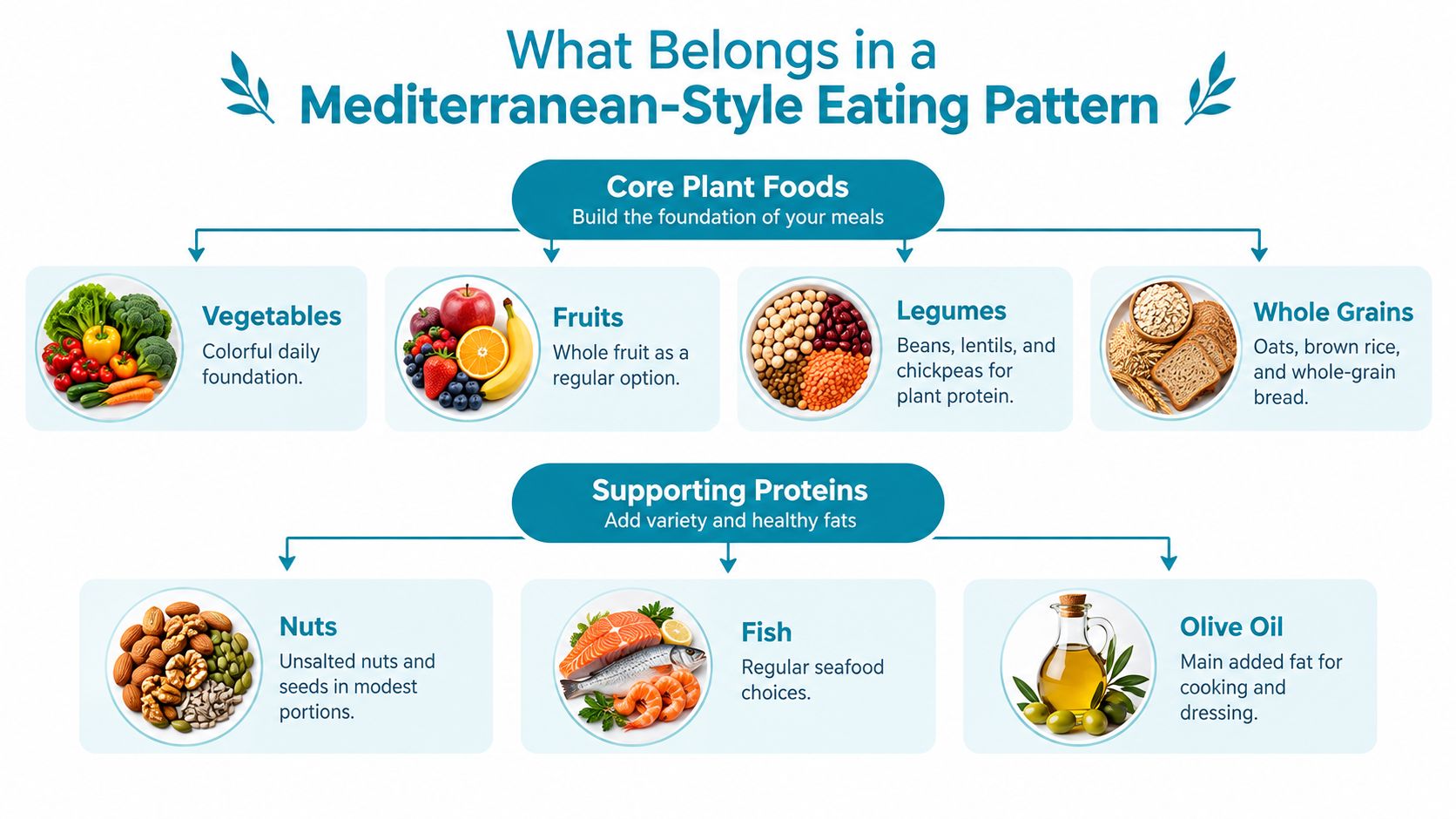
How the components fit together
Whole grains, such as oats, brown rice, and whole-grain bread, replace some refined-grain choices. Nuts contribute texture and variety. Fish offers a protein option, while olive oil and other unsaturated oils provide alternatives to fats higher in saturated fat.
The pattern also involves reducing refined carbohydrates, sugar-sweetened products, processed meats, and excess saturated fat. Adding olive oil to an otherwise unchanged eating pattern misses that replacement principle.
- Plants form the foundation. Vegetables, fruit, legumes, and whole grains belong throughout the pattern.
- Protein remains part of the meal. Fish and legumes can take a central role.
- Added fats still need portions. Olive oil and nuts aren't unlimited foods.
- The overall balance matters. Large portions of cheese or refined-grain foods don't become metabolically different because a meal carries a Mediterranean label.
Why clinicians use this framework
The rationale isn't that one ingredient targets the liver. The combined pattern can improve diet quality, help reduce excess calorie intake, and address cardiometabolic risks, meaning risks involving metabolism and cardiovascular health.
The AASLD lifestyle-treatment summary identifies Mediterranean-style eating as an appropriate option alongside regular physical activity and weight management. The practice's healthy-diet guidance offers related context for building an eating pattern rather than following a rigid food list.
No individual ingredient is a liver-enzyme treatment. The framework succeeds or fails as an everyday routine, not as a collection of foods with therapeutic reputations.
What Studies Show About Liver Fat and Liver Enzymes
A 2022 systematic review and meta-analysis included 26 studies involving 3,037 participants, with 13 Mediterranean-diet interventions, 9 calorie-restriction interventions, and 4 studies of individual Mediterranean components. A meta-analysis combines findings from multiple studies to estimate the overall direction of evidence.
These intervention groups shouldn't be treated as identical experiments. Some tested an overall eating pattern, some emphasized reduced energy intake, and others examined individual components.
Dietary Intervention Groups in the 2022 Meta-Analysis
| Intervention group | Studies included | Reported direction | Limit to note |
|---|---|---|---|
| Mediterranean-diet interventions | Mediterranean-pattern studies described in the linked review | The subgroup showed significant improvements in ALT, Fatty Liver Index, and liver stiffness | These findings don't establish fibrosis reversal |
| Calorie-restriction interventions | Energy-reduction studies described in the linked review | The pooled dietary analysis favored improvements in several liver measures | Pooled findings aren't a separate estimate for this subgroup |
| Individual Mediterranean components | Component-focused studies described in the linked review | Included in the broader dietary evidence base | A component study doesn't establish the effect of the complete pattern |
Fatty Liver Index is an indirect estimate associated with fatty liver, not a direct measurement of scarring. Liver stiffness is another assessment clinicians interpret in context. An improvement in either measure doesn't, by itself, prove reversal of fibrosis.
Across dietary interventions, the review reported improvements in liver enzymes and other liver-related measures. However, it didn't establish that Mediterranean eating outperforms every balanced, calorie-controlled alternative.
Adherence and activity belong in the interpretation
Staying with an intervention was a practical limitation. In the same linked review, 23 studies had a mean participant attrition rate of 14%, while the remaining studies reported no attrition. Attrition means participants left before completing the study, which matters when considering how workable a diet may be outside research settings.
Better study results don't automatically identify the eating pattern a particular adult can maintain.
Physical activity also deserves attention apart from changes on the scale. The NIDDK treatment guidance for fatty liver explains that activity can provide benefits even without weight loss. The AASLD guidance cited earlier also supports exercise as part of care.
Some liver-fat benefit may occur even when weight changes little. Evidence about the best activity pattern and its effects on more advanced liver disease remains limited, so activity shouldn't be presented as proof of fibrosis reversal.
There's no available practice-specific average for ALT or AST reduction after dietary change. No enzyme-normalization percentage or timetable can reasonably be promised.
Building Meals and Making Practical Food Swaps
A useful starting point is an existing meal. Changing its components usually requires less disruption than replacing an entire food routine.
A bowl, stew, sandwich, or familiar dinner plate can all carry the same framework. The practical task is to include vegetables, a satisfying protein source, a whole-grain option when appropriate, and a deliberate amount of added fat.

Building a plate or bowl
- Start with vegetables and legumes. Roasted vegetables, leafy greens, beans, or lentils can provide the main structure rather than garnish.
- Add a whole-grain base. Brown rice, barley, or another familiar whole grain can fit beneath or beside the vegetables.
- Choose a protein. Fish or a plant protein can complete the meal. A substantial serving of legumes may already fill this role.
- Finish deliberately. Nuts or seeds can add texture, while a measured amount of unsaturated oil can be used for cooking or dressing.
This approach reflects the foods emphasized in the research rather than a special liver recipe. A systematic review of randomized dietary trials found that Mediterranean interventions without prescribed calorie restriction reduced intrahepatic lipid content, meaning fat inside the liver. The evidence was insufficient to conclude that the pattern reverses active steatohepatitis, meaning liver inflammation and injury, or fibrosis.
That distinction also prevents a misunderstanding: no prescribed calorie restriction doesn't mean energy intake or weight change played no role.
Swaps that preserve a familiar meal
| Existing choice | Adaptable alternative |
|---|---|
| Refined white bread | Whole-grain bread with a similar filling |
| Sugar-sweetened beverages | Water, sparkling water, or unsweetened tea |
| Processed deli meats | Beans, lentils, or fish |
| A grain-heavy bowl with few vegetables | A bowl with more vegetables and legumes alongside the grain |
The practice's guide to foods high in fiber provides additional ingredient ideas.
Hypothetical meal substitution: Lentil-and-vegetable stew could replace a heavily processed frozen meal. It might include familiar vegetables and seasonings, with whole-grain bread alongside it. This is a meal example, not a patient story or a prediction about liver tests.
Cultural adaptation can be equally straightforward. A bean-and-rice meal can retain its beans and familiar spices while adding vegetables. A vegetable curry can keep its customary flavors while incorporating lentils. A noodle bowl can include tofu and vegetables without needing olives, feta, or a regional Mediterranean identity.
Convenience foods can still help. Frozen vegetables, canned beans, and plain cooked grains are practical building blocks. Food access and preparation time belong in the plan, not outside it.
Sample Meal Plans and Portion Guidance
The examples below translate the framework into ordinary meals. They're adaptable references, not a calorie prescription or a practice-issued meal plan.
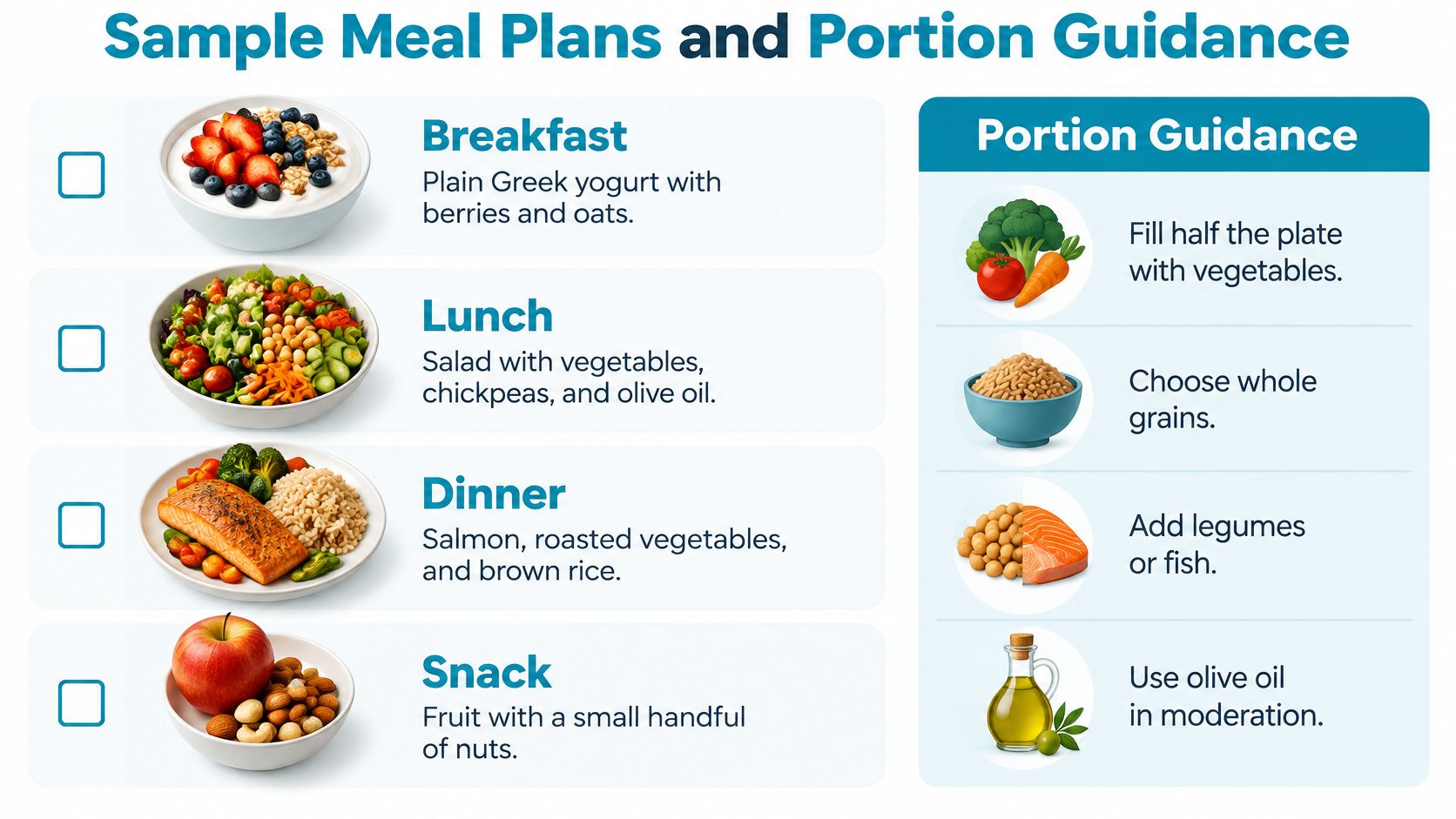
An illustrative day
- Breakfast: Plain Greek yogurt with berries and oats.
- Lunch: A salad containing vegetables, chickpeas, and an olive-oil dressing.
- Dinner: Salmon with roasted vegetables and brown rice.
- Snack: Whole fruit with a small handful of nuts.
A simple three-day rotation can reuse ingredients without repeating every meal. These are organizational examples, not a recommended treatment duration.
| Example day | Breakfast | Lunch | Dinner |
|---|---|---|---|
| First day | Yogurt, berries, and oats | Chickpea-and-vegetable salad | Fish, roasted vegetables, and brown rice |
| Second day | Oatmeal with fruit | Brown-rice bowl with leftover vegetables and beans | Lentil-and-vegetable stew |
| Third day | Whole-grain toast with nut butter and fruit | Leftover stew with vegetables | Tofu with vegetables and the remaining brown rice |
Reusing ingredients reduces the number of separate dishes that need preparation. Roasted vegetables can become a side dish, a bowl topping, or part of a salad. Cooked grains can accompany different proteins rather than requiring a new recipe each evening.
Portion anchors rather than fixed targets
A visual checklist can help an adult discuss portions with a clinician:
- Vegetables: About half the plate can serve as a starting illustration.
- Fish or plant protein: A palm-sized portion offers a rough visual anchor, although protein foods differ.
- Cooked whole grains: A fist-sized portion is another approximate reference.
- Nuts: A small handful keeps the example distinct from eating directly from a large container.
- Added oil: A deliberate amount makes the portion easier to recognize.
These anchors aren't validated personal targets. Calorie and protein needs vary, and portions should reflect medical conditions, activity, appetite, and the broader treatment plan. The practice's balanced-meal guidance for weight management provides related meal-planning context.
Adults who eat little fish can use beans, lentils, or tofu. When olive oil isn't preferred or accessible, canola or another nontropical unsaturated oil can fit the framework.
Adaptability matters: A familiar, affordable meal can fit the pattern without copying the sample menu.
Alcohol, Other Conditions, Medications, and When to See a Physician
Alcohol isn't a required Mediterranean component. Descriptions of traditional eating patterns shouldn't be interpreted as a reason to start drinking. Alcohol intake deserves an individualized discussion with a physician when liver disease is present, as described in the NIDDK guidance cited earlier.
The practice's alcohol-related educational guidance offers additional context. Raising the subject doesn't imply a separate diagnosis or a need for another service line.
Conditions and meal timing need individual review
Diabetes, kidney disease, and heart conditions can change how a meal plan should be built. The AASLD guidance discussed earlier supports considering the broader medical picture. A generic menu shouldn't override a condition-specific nutrition plan.
Medication decisions belong to the prescribing clinician. Changes in food intake and meal timing should be discussed in relation to medicines rather than handled through self-directed dose adjustments.
Fasting isn't a required addition. In the 2025 CHRONO-NAFLD randomized trial, 59 adults followed a hypocaloric Mediterranean-type diet with unrestricted, early, or late eating windows for 12 weeks. All groups improved several measures, and early time-restricted feeding showed additional improvements in some metabolic markers and liver stiffness.
The small sample and short duration limit conclusions. The trial doesn't establish that a narrower eating window independently prevents long-term fibrosis.
Questions for a physician
- Monitoring: Which laboratory tests or liver assessments will help evaluate progress?
- Other conditions: Do diabetes, kidney disease, or heart conditions change the food or portion plan?
- Medication coordination: Could altered meal timing affect the current medication schedule?
- Fasting suitability: Is time-restricted eating appropriate given diabetes medicines, night-shift work, evening hunger, or a history of disordered eating?
- Alcohol: What guidance fits the liver findings and overall medical history?
Time-restricted eating may be unsuitable or difficult to sustain in some of these circumstances. Hydration, sleep, social schedules, and medication timing also belong in that discussion.
Yellowing of the skin or eyes or unexplained abdominal swelling calls for prompt medical contact rather than another dietary experiment. These warning signs warrant clinical assessment, consistent with the liver-disease evaluation principles in the AASLD guidance cited earlier.
Choosing a Sustainable Plan and Taking the Next Step
The most useful choice isn't always the diet with the strongest name recognition. It's an eating approach that fits the person's medical needs and can be adjusted using meaningful follow-up.
A 2025 randomized trial of 250 adults with MASLD and a body mass index of at least 25 compared moderately hypocaloric Mediterranean and low-fat diets over 12 weeks. Both groups improved liver-fat measures, liver stiffness, and body weight, with no statistically significant difference between diets.
Comparing practical options
| Approach | Potential fit | Question to consider |
|---|---|---|
| Mediterranean-style pattern | Adults who enjoy legumes, vegetables, whole grains, fish, and unsaturated oils | Can the pattern fit familiar meals and accessible ingredients? |
| Lower-fat pattern | Adults who prefer meals with less added fat | Can food quality and satisfaction remain adequate? |
| Preference-based calorie-controlled plan | Adults who need a different cultural or practical framework | Can appropriate energy intake and nutritional quality be maintained? |
The third option is a planning framework, not a separate diet proven equivalent by that trial. Preferences, culture, budget, food access, other conditions, and long-term feasibility should guide the discussion.
Physician-led obesity care
The practice is a private-pay, physician-led outpatient practice. Dr. Chhatpar, Medical Director, provides direct patient care. Its obesity medicine service includes medical and metabolic assessment, individualized weight-management planning, ongoing monitoring, and long-term maintenance planning.
The supplied practice information lists a 50-minute initial evaluation for $350 and a 25-minute follow-up for $225. The practice doesn't bill insurance directly; an itemized receipt is available through the patient portal, without a promise of reimbursement.
Telemedicine is available for adults physically located in New York, New Jersey, Connecticut, Pennsylvania, or Virginia, with in-person appointments also available. These details describe the care model, not a guaranteed liver outcome.
Sources
Key references linked above include NIDDK treatment guidance, AASLD clinical guidance, the dietary-intervention meta-analysis, and randomized trials addressing diet comparison and meal timing. Study limitations matter alongside their findings.
For adults seeking physician-led obesity care, Empire Medical Wellness offers individualized assessment, weight-management planning, and ongoing monitoring that can account for fatty-liver concerns. The practice website provides information about care and appointments for those considering a sustainable nutrition plan. This article is educational and isn't personal medical advice.