
The FDA Daily Value for fiber is 28 grams per day on a 2,000-calorie reference diet. That figure is a labeling benchmark, not a one-size-fits-all prescription, and many adults fall short because usual meals rely on refined grains and few plant foods.
A typical day might include toast or a breakfast bar in the morning, a sandwich at lunch, and a protein-centered dinner with a small vegetable side. Those meals can provide protein and calories while still leaving fiber low. The practical answer isn't a dramatic diet overhaul. It's choosing more beans, lentils, whole grains, fruit, vegetables, nuts, and seeds, then increasing portions at a pace the digestive system can tolerate.
For adults considering physician-led weight management, fiber works best as part of a broader meal pattern. It can add volume and texture, support regular digestion, and make meals more satisfying, but it doesn't replace protein, healthy fats, medical assessment, or individualized planning.
Byline: Empire Medical Wellness Editorial Team
Published: October 3, 2026
Updated: October 3, 2026
Table of Contents
- Why Fiber Matters for Balanced Weight-Loss Meals
- High-Fiber Food Choices by Group
- Reading Fiber on the Nutrition Facts Label
- Building Balanced High-Fiber Meals for Weight Loss
- Increasing Fiber Safely and When to Seek Guidance
- Next Steps and When to Consult the Practice
Why Fiber Matters for Balanced Weight-Loss Meals
A rushed breakfast, a refined-grain lunch, and a dinner built around protein can leave an adult hungry again soon after eating. Fiber helps explain why. It is a type of carbohydrate found in plant foods that is not fully digested or absorbed. It adds structure and volume to meals and supports the movement of food through the digestive tract.
The FDA's explanation of the Daily Value uses 28 grams per day as the labeling reference for a 2,000-calorie diet. That number helps with label reading, but it is not a personal prescription. Individual needs vary with calorie requirements, age, sex, health conditions, and the foods a person can tolerate. National Academies-based values summarized in the NIH reference table list 34 grams daily for males ages 19 to 30 and 28 grams for females in that age range, with lower listed values for older adults.
Many adults consume less fiber than reference guidance suggests. Reported average intake is approximately 18.3 grams per day in the United States, 14.8 grams in the United Kingdom, 16.9 grams in France, and 15.0 grams in Japan, compared with the World Health Organization recommendation that adults consume more than 25 grams daily. (Frontiers in Nutrition review).
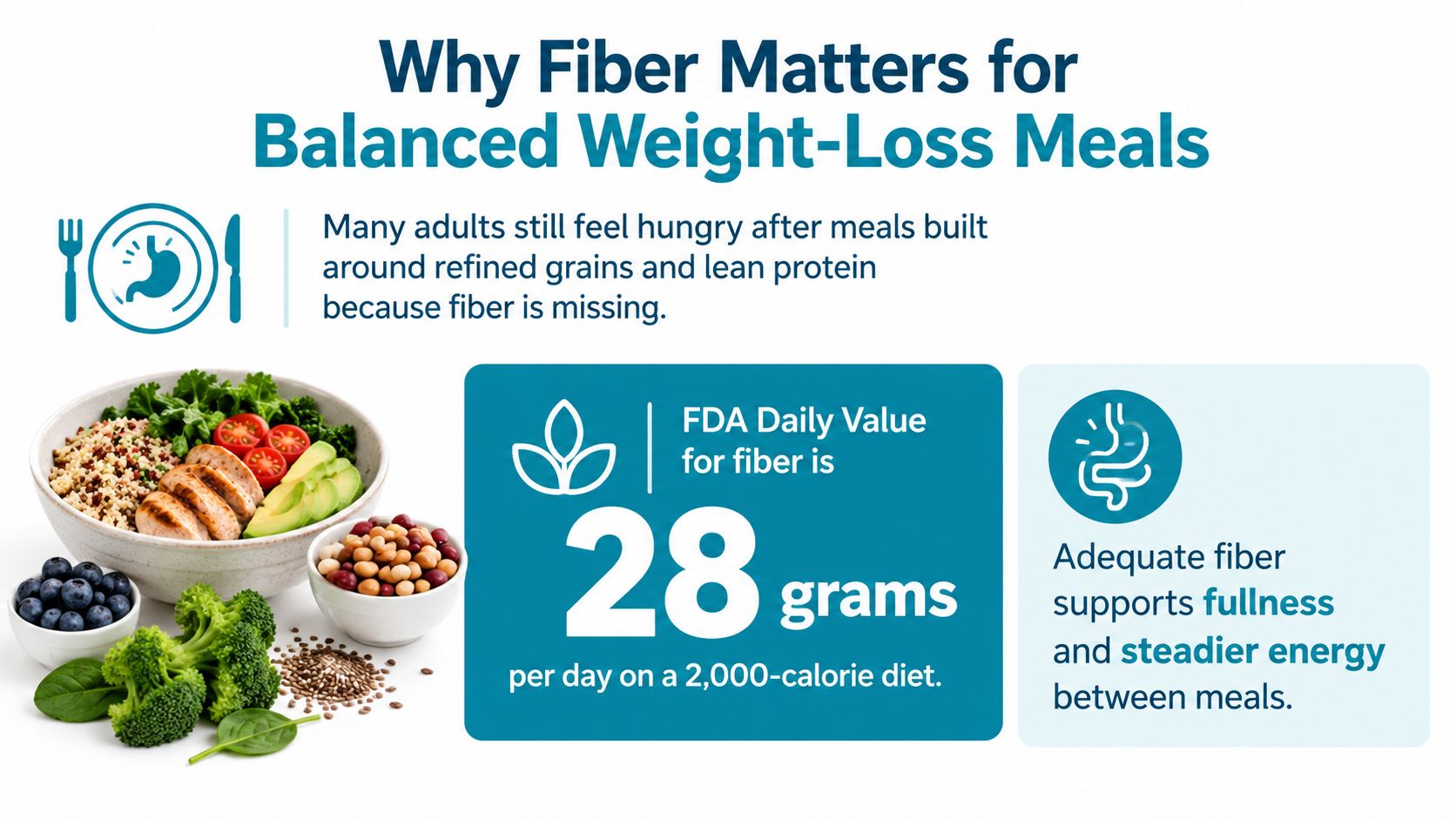
Fiber belongs on a balanced plate
Fiber can support fullness between meals, especially when it appears alongside protein and some healthy fat. Oats with berries and nuts offer a different meal structure from sweetened cereal eaten alone. Lentils with vegetables and a protein source will usually be more sustaining than a large serving of refined grain by itself.
Tolerance matters as much as the number on a food list. A sudden increase in beans, bran, or large portions of raw vegetables may cause bloating or discomfort, particularly for adults with sensitive digestion. Smaller portions, softer preparations, and gradual changes are often easier to maintain.
Research links higher dietary-fiber intake with lower risk of several chronic diseases and mortality, but these findings are associations, not guarantees for one person. Fiber-rich foods often form part of broader eating patterns that include vegetables, less-refined grains, nuts, seeds, and legumes. (Peer-reviewed evidence summary)
Practical rule: Fiber is one anchor of a meal, not the whole meal. Pair it with a suitable protein source, healthy fat, and foods the adult can consistently tolerate.
A workable plan uses label math, varied food choices, balanced meal templates, and gradual increases. Adults seeking physician-led obesity medicine care can discuss how nutrition fits with medical conditions, appetite concerns, digestive symptoms, and long-term weight-management goals. Small changes that feel comfortable often last longer than a dramatic diet overhaul.
High-Fiber Food Choices by Group
A rushed weekday meal may need to come from a can, a freezer, or a package. The most useful choice is the one that provides fiber, fits the meal, and does not trigger digestive discomfort. Fiber content varies by food, preparation, serving size, and brand. Tolerance also differs according to texture, fiber type, and individual response.
Soluble fiber dissolves or thickens in water and appears in foods such as oats, beans, lentils, fruit, and chia. Insoluble fiber adds bulk and is common in whole grains, vegetable skins, nuts, seeds, and bran. Most plant foods contain both types, so building variety is more practical than pursuing one type alone.
| Food group | Typical serving | Everyday use | Source |
|---|---|---|---|
| Legumes | One-half cup cooked can provide at least 4.5 grams of fiber, with exact amounts varying by bean and preparation | Lentil soup, chickpeas in a salad, or beans in a rice bowl | Clinical review of legumes |
| Whole grains | Serving amounts depend on the grain and product. Cooked quinoa and whole-wheat pasta are practical options | Oats at breakfast, brown rice with dinner, or whole-grain pasta | High-fiber food guidance |
| Fruit | Whole fruit supplies fiber and texture, making it preferable to relying only on juice | Pears or berries as snacks, or fruit with breakfast | FDA fiber label guidance |
| Vegetables | Fresh, frozen, and cooked vegetables all contribute, with amounts varying by variety and preparation | Broccoli beside a meal, chopped tomatoes in a bowl, or vegetables folded into pasta | FDA fiber label guidance |
| Nuts and seeds | Use a small serving because these foods are energy-dense. Add chia and other seeds gradually | Nuts over oats, seeds in yogurt, or ground seeds in a meal | Mayo Clinic high-fiber food guidance |
Legumes can support weight-management meals by contributing fiber and plant protein while replacing part of a refined-grain-heavy dish. Canned beans are convenient, but draining and rinsing them can reduce some sodium. Dried legumes require more planning but allow control over cooking texture and seasoning. Adults with sensitive digestion may tolerate a small portion of well-cooked lentils or beans better than a large serving added suddenly.
A packaged whole-grain food can also fit a busy schedule. Compare the ingredient list, serving size, and fiber line rather than relying on terms such as “whole grain” or “multigrain.” For example, adults comparing crispbreads can review Amisa crispbread 100g alongside other options.
Use these groups to assemble simple combinations, such as oats with fruit and seeds, or beans with vegetables and a suitable protein. Guidance on heart-healthy eating supports the same broader pattern, with fiber-containing plant foods paired with suitable protein and unsaturated fats rather than treated as an isolated add-on.
Reading Fiber on the Nutrition Facts Label
Nutrition Facts labels make packaged foods easier to compare, but only when serving size is read before the fiber number. A box may list one serving even when the package contains several servings, and eating the whole package changes the calculation.
The FDA Daily Value for fiber is 28 grams on a 2,000-calorie reference diet. The percentage shown on a label is based on that reference, while an adult's actual needs may differ with calorie intake, age, sex, medical conditions, and dietary pattern. (FDA Daily Value guidance)

A simple label calculation
The following is a hypothetical label example, not the measured value for a named food:
- One serving lists 7 grams of fiber.
- Seven grams divided by the 28-gram Daily Value equals 25% Daily Value.
- Two servings provide 14 grams, which equals 50% Daily Value.
The calculation is useful, but it shouldn't encourage adults to chase a single high-number product. A cereal or supplement can contribute fiber while providing less variety than meals built from legumes, whole grains, vegetables, fruit, nuts, and seeds. Whole foods also bring different textures, water content, vitamins, minerals, and other compounds.
Three label habits that prevent mistakes
- Check the serving size first. The listed grams apply to one serving, not necessarily the entire package.
- Compare grams and percentage. The gram amount shows the actual listed fiber, while the percentage helps compare products against the FDA reference.
- Spread the total across meals. A moderate amount at breakfast, lunch, dinner, and snacks is often easier to tolerate than one concentrated dose.
Adults using nutrition planning support can bring labels from commonly purchased foods to a clinical discussion. That makes the conversation more practical than relying on vague terms such as “high-fiber” or “natural.”
Building Balanced High-Fiber Meals for Weight Loss
Fiber can support weight-management meals, but adding fiber alone doesn't create a balanced eating pattern. A useful plate includes vegetables and legumes for plant-based volume, a suitable protein source, a whole grain or other starch as appropriate, and a small amount of healthy fat.
Portions don't need to be perfect. A plate method can help adults begin with a generous share of non-starchy vegetables, add a palm-sized protein portion when suitable, include a moderate portion of beans or whole grains, and use olive oil, nuts, seeds, or another appropriate fat for flavor and satisfaction. Adults with medical diet restrictions may need a different structure.
Meal templates that fit ordinary routines
A lentil and brown rice bowl is a practical starting point. It can combine cooked lentils, brown rice, chopped cucumber and tomato, and a lemon-and-olive-oil dressing, with herbs adjusted to taste. The ingredients can be prepared separately and combined in portions that fit appetite and dietary needs.
Breakfast can be just as straightforward. Oats with berries and a small serving of nuts or seeds provide several fiber-containing foods without requiring a special product. Adults who aren't accustomed to seeds can begin with a modest amount and watch for digestive tolerance rather than adding several new ingredients at once.
Other useful swaps include:
- Refined grains: Replace part of a white rice or refined pasta serving with brown rice, quinoa, or whole-wheat pasta.
- Soups and stews: Add beans or lentils to a familiar recipe instead of creating an entirely new meal.
- Snacks: Choose whole fruit, vegetables with a suitable dip, or a small serving of nuts when those foods fit the person's dietary needs.
- Toppings: Add seeds, berries, or chopped nuts to oats or another familiar breakfast.
The balanced meal approach for weight loss works better as a repeatable structure than as a rigid menu. It leaves room for cultural foods, schedule changes, appetite differences, and medical restrictions.
A gradual-change checklist
- Start with one swap: Choose one meal that relies heavily on refined grains and add a legume, whole grain, fruit, or vegetable.
- Keep protein present: Pair plant foods with a suitable protein source instead of treating fiber as a replacement for protein.
- Add flavor deliberately: Lemon, herbs, spices, and a measured amount of olive oil can make simple meals easier to repeat.
- Review appetite and tolerance: Adjust portions based on fullness, bloating, stool changes, total calories, and the person's broader nutrition needs.
- Keep the plan flexible: Variety matters more than finding one perfect food.
A meal plan succeeds when an adult can repeat it on an ordinary Tuesday, not only on a highly organized day.
Increasing Fiber Safely and When to Seek Guidance
An adult who moves quickly from very little fiber to large portions of beans, bran, seeds, and vegetables may develop gas, bloating, cramping, constipation, or diarrhea. These symptoms do not automatically mean fiber-rich foods are harmful. They often indicate that the increase was faster or more concentrated than the digestive system could tolerate.
A practical starting approach is to estimate usual intake over three days, then add a small increment, such as 3 to 5 grams per day from one food, and hold it for several days. Reassess stool consistency, abdominal symptoms, hydration, appetite, and total calories before adding another source. The goal is a tolerable pattern that fits real meals, not the fastest possible increase.
What helps during the adjustment
Fiber works best with adequate fluid, but fluid needs vary. Adults with fluid restrictions, kidney disease, heart failure, swallowing concerns, or other medical conditions should discuss changes in fluid or fiber intake with a qualified clinician before making them.
Distributing fiber across meals is often easier than placing most of it in one shake, cereal bowl, or supplement. Responses can differ by fiber type, food structure, preparation method, and the individual gut microbiome. Resistant starch occurs in foods such as legumes, green bananas, oats, and cooked-then-cooled potatoes or rice, yet people do not respond to it uniformly.
Tolerance matters: The highest number on a nutrition label is not automatically the best choice for a sensitive stomach.
Fiber sources are not interchangeable. Count vegetables, fruit, legumes, and whole grains alongside cereal or supplements. Isolated products can deliver a concentrated dose, but they may not provide the wider nutrient package of whole foods and can feel less comfortable for some adults. Label math helps identify the amount, while symptoms and meal context help determine whether that amount is workable.
Adults receiving weight-management care, including those considering or using an anti-obesity medication, should discuss persistent gastrointestinal symptoms, medication concerns, or changes in appetite and bowel habits with the prescribing clinician. Fiber planning may need to reflect comorbidities, existing gastrointestinal conditions, and the current treatment plan.
Persistent pain, vomiting, bleeding, or a major change in bowel habits warrants medical evaluation instead of self-treating with more fiber. The NIDDK offers general guidance on eating, diet, and nutrition for constipation, but general information cannot diagnose symptoms or replace prescribed care.
Next Steps and When to Consult the Practice
A workable sequence is simple: choose varied plant foods, read serving sizes, use label math, build meals with protein and healthy fats, increase gradually, and record tolerance. The aim is a sustainable pattern, not a race toward a large number.
A hypothetical example illustrates the process. An adult notices that refined grains dominate most usual meals, replaces part of one meal with lentils or a whole grain, records digestive tolerance, and later adds fruit or vegetables for variety. This example doesn't assign a weight change or promise symptom resolution.
Adults seeking individualized planning can review the appointment options and discuss nutrition, weight-management goals, medical conditions, and long-term maintenance with Dr. Chhatpar or the practice. This article is educational and isn't personal medical advice.

Empire Medical Wellness offers physician-led obesity medicine that can include medical assessment, individualized weight-management planning, appropriate monitoring, and long-term maintenance planning. Adults can visit the practice to discuss how foods high in fiber, appetite concerns, medical conditions, and current treatment fit into a sustainable plan. This article is educational and not personal medical advice.