
Does naming anxiety explain what's happening, or does it only describe how distress feels? Saying I have anxiety usually means worry, fear, or physical tension that persists or is hard to switch off. A clinician can assess whether those experiences reflect an anxiety disorder, another health concern, or a response to current circumstances.
By Empire Medical Wellness Editorial Team
Table of Contents
- What Saying I Have Anxiety Usually Means
- Anxiety Subtypes and How Clinicians Tell Them Apart
- Self-Check Questions to Ask Before Seeking Care
- When to Seek Medical Evaluation or Urgent Help
- What a Physician-Led Anxiety Evaluation Covers
- Treatment Options and How Progress Is Monitored
- Common Questions About Anxiety Evaluation
- Choose the Right Next Step for Your Symptoms
What Saying I Have Anxiety Usually Means
Anxiety is a normal alarm response to uncertainty or perceived danger. An anxiety disorder involves a pattern of fear or worry that becomes excessive, persistent, or disruptive. Feeling nervous before a presentation doesn't, by itself, establish a disorder.
A smoke alarm offers a useful comparison. Its signal protects people when there's danger, but an alarm that sounds too often, too strongly, or for too long can interfere with ordinary life. The clinical question isn't whether an alarm goes off. It's whether the response fits the situation and whether the person can return to everyday activities.
Hypothetical example: An adult feels tense before a work presentation, then settles afterward. Another adult worries across unrelated situations, struggles to sleep, and increasingly avoids responsibilities. Both experiences deserve respectful attention, but they call for different questions during an assessment.
The distinctions that matter
Clinicians separate several features that everyday conversation often blends together:
- Duration: How long symptoms have been present and whether they come and go.
- Severity: How intense or difficult to manage the symptoms feel.
- Functional impairment: How symptoms interfere with work, school, sleep, relationships, or basic responsibilities.
These distinctions matter more than whether someone appears calm. A person may continue meeting obligations while spending substantial effort managing distress.
The World Health Organization estimates that approximately 470 million people worldwide had an anxiety disorder in 2023, about 5.8% of the global population, and identifies anxiety disorders as the most common category of mental disorder worldwide. The National Institute of Mental Health reports that about one-third of U.S. adolescents and adults experience an anxiety disorder at some point in life.
Those population figures describe frequency, not any individual's diagnosis. The useful starting questions concern how often symptoms occur, how intense they become, and what they prevent the person from doing.
Anxiety Subtypes and How Clinicians Tell Them Apart
Anxiety isn't one condition. Clinicians distinguish patterns by what triggers fear, what the person anticipates, what gets avoided, and how symptoms develop over time.
Common anxiety patterns and their duration guidelines
This comparison prepares a clinical conversation. It doesn't provide enough information for self-diagnosis, and duration alone never establishes a disorder.
| Pattern | Core feature | Duration guideline |
|---|---|---|
| Generalized anxiety disorder | Excessive, hard-to-control worry about several everyday areas | More days than not for at least six months |
| Panic disorder | Recurrent, unexpected panic attacks with persistent concern about future attacks | Attacks followed by at least one month of ongoing concern or behavior change |
| Social anxiety disorder | Marked fear of scrutiny or judgment in social or performance situations | Typically six months or more |
| Specific phobia | Marked, persistent fear of a particular object or situation | Typically six months or more |
| Agoraphobia | Marked fear of two or more situations, such as public transport or open spaces | Typically six months or more |
The pattern behind avoidance can be more informative than the avoided activity itself. Avoiding a meeting because of anticipated judgment suggests a different clinical question from avoiding it because leaving the room might feel difficult during sudden symptoms. A clinician explores the reason rather than assigning a diagnosis from the behavior.
Why a recognizable pattern still needs assessment
The peer-reviewed history of generalized anxiety diagnosis describes how DSM-III in 1980 established anxiety disorders as a central category and recognized panic disorder separately; DSM-5 retained the six-month duration criterion for generalized anxiety disorder. Modern criteria also consider associated symptoms, distress, and impairment.
For generalized anxiety, those associated symptoms may include restlessness, fatigue, concentration difficulty, irritability, muscle tension, or disturbed sleep. A familiar symptom list still doesn't settle whether another explanation fits better.
Depression, attention problems, sleep disorders, and medical conditions can complicate the picture. Readers considering generalized anxiety disorder can prepare by describing the areas of worry and how difficult it is to disengage from them.
Conversation aid: A description such as persistent worry across work, health, and household responsibilities gives a clinician more useful information than a self-assigned label.
Self-Check Questions to Ask Before Seeking Care
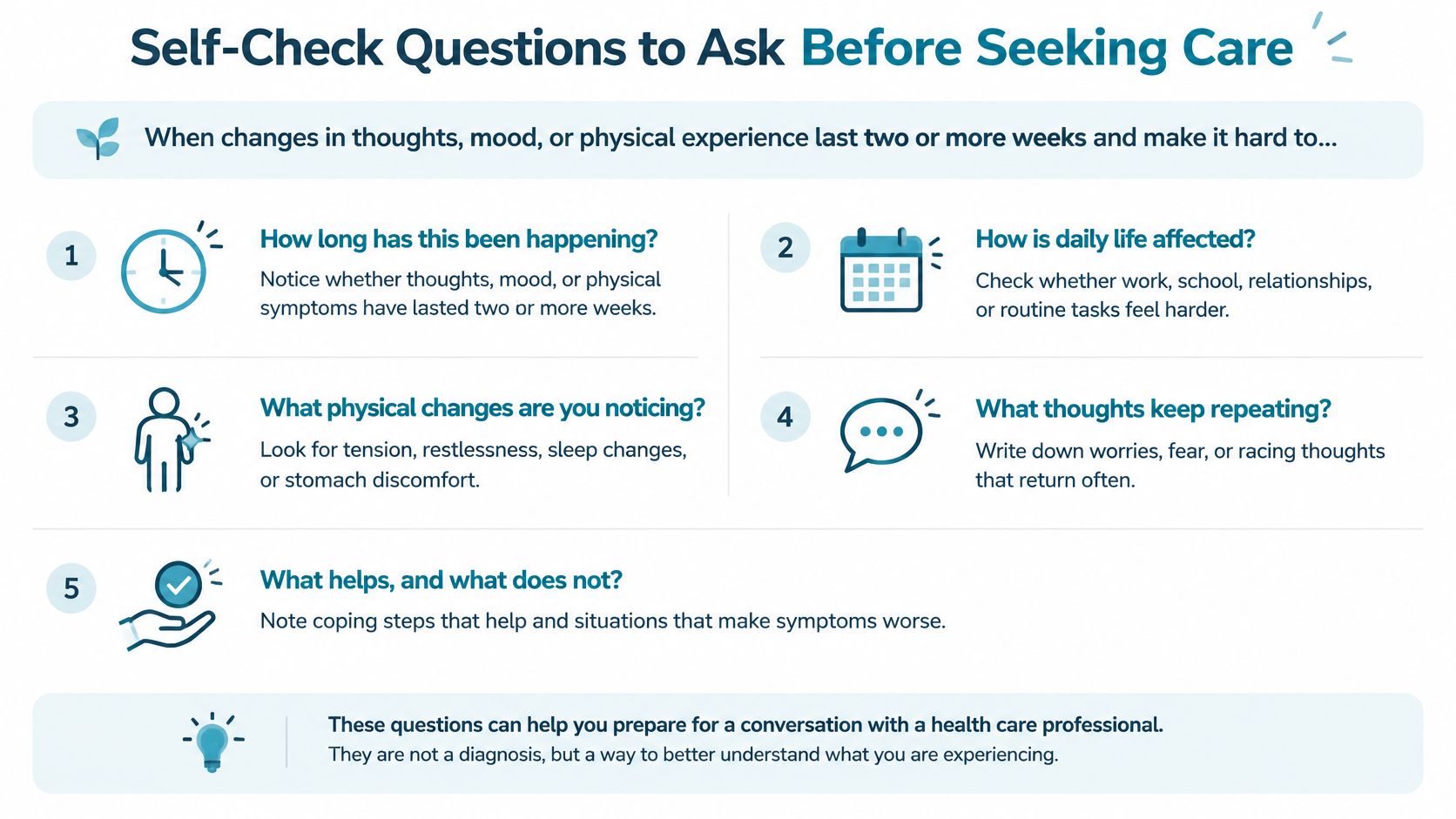
A self-check works best as appointment preparation, not as a pass-or-fail test. SAMHSA's guidance on signs of needing help recommends considering support when changes in thoughts, mood, or physical experience last two or more weeks and make work, school, home responsibilities, or relationships difficult.
That's a screening guideline, not a diagnostic waiting period. Severe, rapidly worsening, or unsafe symptoms warrant attention sooner.
Questions worth answering in writing
A sentence or concrete example for each question is enough. The purpose is to capture a pattern without turning symptom tracking into another demanding task.
- Control: Is worry difficult to interrupt, even when there's no immediate problem to solve?
- Physical experience: Do a racing heart, breathlessness, stomach discomfort, or muscle tension accompany the distress?
- Avoidance: Are places, tasks, conversations, or people increasingly being avoided?
- Sleep: Has falling asleep, staying asleep, or waking comfortably become harder?
- Timing and exposures: Did symptoms change alongside caffeine, alcohol, cannabis, another substance, or a medication change?
- Daily impact: Which responsibility or valued activity has become harder, and what happened the last time it was attempted?
A pattern of waking up with anxiety every morning is worth describing specifically. Notes should distinguish symptoms already present on waking from symptoms that begin after checking messages, anticipating work, or consuming caffeine.
A practical symptom log
A brief log can record the date and time, possible trigger, intensity in plain words, duration, sleep, substances, and effect on the day. A short entry might describe tension before a meeting, difficulty concentrating afterward, and whether the person completed the task.
The log doesn't have to be complete before an appointment. Missing entries are less important than a clear example of what has changed.
Screening questionnaires can also organize information, but a score can't explain the full context. Repeated symptom searches may produce more possible labels without answering the practical question of what needs evaluation.
A useful record describes what happened and what became harder. It doesn't need to prove a diagnosis.
When to Seek Medical Evaluation or Urgent Help
Symptom situations and the appropriate next step
| Situation | Suggested next step | Timing |
|---|---|---|
| Brief worry or tension that doesn't affect work, school, sleep, or relationships | Monitor, keep notes, and raise it at a routine clinician visit if it continues | Revisit if symptoms persist or begin affecting daily life |
| Persistent symptoms that disrupt daily functioning | Schedule a physician-led evaluation | Soon, rather than waiting for further decline |
| Sudden chest pain, severe shortness of breath, or fainting | Call 911 in the United States or go to the nearest emergency department | Immediately |
| Thoughts of harming oneself or ending one's life | Call or text 988; call 911 for an immediate physical safety threat | Immediately |
| New or worsening symptoms after starting, stopping, or changing a medication or substance | Contact the prescriber or a clinician promptly; seek emergency care if severe | Promptly |
The right response depends on safety, physical symptoms, and functional impact, not just how long someone has felt anxious. The self-check threshold helps identify persistent difficulty, but it isn't a reason to delay help when the situation feels unsafe.
Brief, manageable worry can often be documented and discussed during routine care. Persistent impairment calls for a planned assessment even when the person continues attending work or meeting family obligations. Maintaining appearances doesn't make distress unimportant.
Why some symptoms require a faster response
Sudden chest pain, severe breathing difficulty, fainting, or a racing heartbeat with other alarming symptoms shouldn't be assumed to be panic. A medical evaluation may be needed to distinguish anxiety-like symptoms from an urgent physical problem.
For mental-health distress, SAMHSA's 988 guidance states that the U.S. service is available by call or text at 988, 24 hours a day, seven days a week, with online chat also available. Counselors support people experiencing anxiety and other distress even when they aren't suicidal, and they can help someone concerned about another person.
Medication-related changes need a different kind of urgency. A clear timeline of what started, stopped, or changed helps the clinician assess the situation, but severe symptoms still require emergency attention rather than waiting for a routine appointment.
Safety boundary: A familiar history of anxiety doesn't make every new physical symptom an anxiety symptom.
These categories provide general orientation, not individualized medical advice. When an immediate physical safety threat exists, emergency services are the appropriate route.
What a Physician-Led Anxiety Evaluation Covers
An anxiety evaluation is a structured clinical conversation, not a single questionnaire or automatic prescription decision. The physician considers what the symptoms look like, when they began, what affects them, and how they fit the person's medical and mental-health history.
The assessment also examines daily functioning and personal goals. Difficulty completing a work task, avoiding social contact, or repeatedly losing sleep may reveal different treatment priorities even when symptom descriptions sound similar.
What the physician needs to clarify
A thorough assessment commonly includes:
- The symptom pattern: Triggers, worry themes, panic-like episodes, avoidance, and changes over time.
- Other possible explanations: Co-occurring depression or attention problems, sleep disorders, medical illness, and medication or substance effects.
- Relevant exposures: Current and past medicines, caffeine, alcohol, other substances, and possible withdrawal.
- Safety and goals: Urgent concerns, available support, and the activities the person most wants to regain.
Thyroid problems and other medical contributors may warrant investigation when the history or examination suggests them. Laboratory testing isn't automatically necessary for every person with anxiety symptoms.
The clinical anxiety medication guide emphasizes assessing symptom severity, functioning, co-occurring conditions, and potential contributors rather than treating a positive screening score as a diagnosis. GAD-7 is a questionnaire used to assess generalized anxiety symptoms; HAM-A is a clinician-rated anxiety scale. SCARED is a screening tool used in younger populations, not the usual adult self-check.
What this can look like in practice
Hypothetical example: An adult reports a racing heart and restless nights, with symptoms occurring mainly after short sleep and substantial caffeine intake. A clinician might initially focus on investigating those contributors and arranging follow-up tracking without assuming an anxiety diagnosis at the first visit.
At Empire Medical Wellness, the initial mental-health appointment lasts 50 minutes and covers symptoms, medical and treatment history, current medications, daily functioning, and goals. The patient receives an explanation of the clinical assessment, treatment options, and recommended follow-up; sleep, substance use, and lifestyle are considered when relevant.
Preparation for an anxiety medication evaluation can include these questions: What else could explain the symptoms? What findings would change the plan? How will progress be measured?
Treatment Options and How Progress Is Monitored
For adults with generalized anxiety that seriously affects functioning, worsens, or doesn't improve with initial support, care commonly progresses to structured psychological treatment or medication. The choice should follow shared decision-making, meaning the clinician and patient discuss the evidence, trade-offs, and personal priorities together.
NICE's guideline on generalized anxiety and panic disorder recommends cognitive-behavioral therapy, applied relaxation, or medication in appropriate circumstances and finds no evidence that high-intensity psychological treatment is universally superior to drug treatment. NICE is a UK guideline; its reasoning should be considered alongside current U.S. guidance and medicine-specific labeling.
Anxiety treatment options compared
| Option | Evidence summary | Often considered for | Monitoring |
|---|---|---|---|
| Cognitive-behavioral therapy | Structured psychological treatment recommended by NICE for generalized anxiety | Persistent worry and avoidance patterns | Symptoms, avoidance, and everyday functioning |
| Applied relaxation | Structured psychological option named by NICE | Worry accompanied by physical tension | Symptoms and ability to use learned skills |
| SSRI medication | NICE-recommended medication class when medication is chosen for generalized anxiety | Persistent symptoms, prior response, or patient preference | Response, side effects, and adverse reactions |
| Benzodiazepine | NICE advises short-term crisis use rather than routine long-term management | Short-term crisis situations only, as a clinician directs | Dependence risk and continued need |
| Self-guided digital tools | Some tools may help; effectiveness can't be assumed across products | Selected mild-to-moderate symptoms or support between appointments | Engagement, symptoms, functioning, and need for escalation |
Cognitive-behavioral therapy, often called CBT, helps people examine patterns of thinking and behavior and practice different responses. Applied relaxation teaches structured skills for recognizing and responding to tension.
Preference isn't the same as clinical suitability
A peer-reviewed study of digital-care preferences found that digital options compared favorably with other care formats in stated preferences. That finding doesn't establish that every app works or that self-guided care is sufficient for every level of impairment.
A digital tool should have understandable privacy practices, a clear purpose, and a plan for seeking professional help if symptoms worsen. Convenience alone doesn't answer questions about diagnostic uncertainty or medication safety.
What a medication discussion should cover
An SSRI, or selective serotonin reuptake inhibitor, is a medication class used for several mental-health conditions. The specific medicine matters: FDA-approved indications are listed in its labeling, while off-label prescribing means use outside those labeled indications under a clinician's judgment. A class-level recommendation doesn't establish that every medicine has the same approval.
At the practice, anxiety medication management occurs through a secure telehealth visit in which the physician assesses appropriateness and explains options, monitoring, and follow-up. Patients discuss treatment history, medication response, and side effects; the anxiety medication information page offers additional appointment context.
Progress should include both symptom measures and practical goals, such as completing responsibilities or returning to avoided activities. Medication shouldn't be started, stopped, or changed without the prescribing clinician's guidance.
Common Questions About Anxiety Evaluation
Does a single panic attack mean panic disorder?
No. A panic attack is an episode, while panic disorder describes a broader pattern involving recurrent unexpected attacks and subsequent concern or behavior change. An appointment can explore the circumstances, including whether the episode was unexpected or linked to a particular trigger.
A first episode with chest pain, fainting, or serious breathing difficulty shouldn't be labeled panic without medical assessment.
Is a diagnosis necessary before contacting a clinician?
No. Uncertainty is a valid reason to arrange an evaluation, and a person doesn't need to select the correct diagnosis in advance. A concise appointment reason might describe persistent worry, disrupted sleep, or avoidance without naming a disorder.
Previous treatment records can help when available, but the absence of records shouldn't prevent an initial conversation.
Can an app replace an evaluation?
An app may provide exercises or help organize observations, but it can't independently resolve medical contributors, medication concerns, or urgent safety issues. Some people may use digital tools alongside professional care rather than instead of it.
A useful question is whether the tool explains its limitations and provides a clear route to additional help. Symptom improvement recorded within an app also needs to translate into meaningful daily functioning.
Is the goal to eliminate every worry?
Not usually. A realistic goal is that worry becomes manageable and no longer dictates important choices or responsibilities. A person and clinician can agree on concrete markers, such as participating in meetings or sleeping without prolonged worry.
Treatment response isn't guaranteed, and a plan may need adjustment. Reporting limited improvement is useful clinical information, not evidence of personal failure.
Choose the Right Next Step for Your Symptoms
A structured next step is more useful than repeatedly trying to decide whether symptoms are serious enough to count. The immediate task is to choose an appropriate level of help and prepare information that makes the conversation productive.
- Prioritize safety. Emergency physical symptoms or an immediate safety threat call for emergency help. Mental-health crisis support is also appropriate when distress feels difficult to manage.
- Act on disruption. Persistent difficulty with work, sleep, relationships, or routine responsibilities is a reason to arrange a physician-led evaluation rather than wait for a more recognizable label.
- Prepare a compact record. Bring the symptom log, current and past medication information, relevant substance use, previous treatment details, and questions about alternative explanations.
- Leave with a checkable plan. The assessment should lead to an explanation, options, and recommended follow-up, not an assumed prescription. The person should understand what will be monitored and when to raise concerns.
General stress-management information can complement preparation, but it doesn't replace diagnostic clarification when symptoms interfere with daily life. Before booking private care, readers can review the practice's services, clinician information, and availability on its website and confirm current details.
Sources
The linked sources include WHO and NIMH background information, SAMHSA support and crisis guidance, NICE treatment recommendations, and clinical publications on diagnosis, assessment, and digital-care preferences.
This article is educational and isn't personal medical advice. It doesn't diagnose any individual or recommend treatment for a specific person; a qualified clinician should evaluate personal symptoms.
Empire Medical Wellness offers physician-led mental-health evaluation, diagnostic clarification, medication review, and ongoing medication management when appropriate for adults with anxiety concerns. Readers considering a structured assessment can visit Empire Medical Wellness to review current service details and availability before booking.