
There's no single universal time it takes to diagnose a mental illness, because a first evaluation can happen in one visit while diagnostic clarification can take several visits. That gap often surprises adults who expect a screening score or a single conversation to settle the question.
A careful diagnosis depends on the condition being considered, how long symptoms have lasted, and how much reliable history is available. It also helps to separate three milestones that are often treated as one. The first visit gathers information, clarification tests the first impression over time, and effective treatment may begin only after both.
Table of Contents
- How Long Diagnosis Usually Takes and Why Delays Happen
- Why Diagnosis Depends on Symptom History and Overlap
- Red Flags That Call for Faster Assessment
- What Happens at the First Visit and Follow-Ups
- Working With Outside Clinicians and Records
- Questions to Ask and Your Next Step
How Long Diagnosis Usually Takes and Why Delays Happen
The practical answer to how long does it take to diagnose mental illness is that a clinician may offer a working diagnosis and an initial plan at the first evaluation, but confirmation may require follow-up. A working diagnosis is a provisional explanation based on the information available that day. It can guide next steps while leaving room for records, observation, and changes in symptoms to refine it.
Population research measures something broader. It often tracks the time from first symptoms to first treatment contact, which includes months or years before a person ever reaches a clinician. Those figures explain delayed care across large groups, not how long an individual evaluation should take.
Research Reference Points for Diagnosis and Treatment Delays
| Measure | Reported figure | Source | What it does not mean |
|---|---|---|---|
| Mood disorders, including depression, onset to first treatment contact | about 6-8 years | U.S. epidemiologic review | Not a fixed wait for every person |
| Anxiety disorders, onset to first treatment contact | 9-23 years | U.S. epidemiologic review | Many people are identified much sooner |
| Anxiety disorders, treatment started in the first year after onset | 11% of adults | U.S. Preventive Services Task Force | Does not measure diagnostic accuracy |
| Anxiety disorders, median time to treatment initiation | 23 years | U.S. Preventive Services Task Force | Averages can hide shorter and longer experiences |
The U.S. epidemiologic review on treatment delay reported approximately 6-8 years from illness onset to first treatment contact for mood disorders and 9-23 years for anxiety disorders. It also reflects the U.S. Preventive Services Task Force finding that only 11% of adults with an anxiety disorder began treatment during the first year after onset, while the median time to treatment initiation was 23 years. A median means half the group started sooner and half started later, so it isn't a prediction for one person.
Some people are identified promptly through primary care, school-based services, emergency care, or specialist evaluation. Others first describe stress, poor sleep, physical symptoms, or trouble concentrating, which can take time to connect to a diagnosable condition. A short period of distress after a major life change also raises different questions from a longstanding pattern, a distinction explored in the practice guide to adjustment disorder and stress-related symptoms.
Practical rule: Ask whether the timeline being discussed starts at symptom onset, first appointment, diagnosis, or first treatment. Those four starting points produce very different answers.
Why Much of the Delay Happens Before an Appointment
People may not recognize symptoms as a health concern at first. Stigma, cost, limited access, and uncertainty about where to seek care can also postpone an evaluation. The National Institute of Mental Health schizophrenia statistics page reports that people with serious mental illnesses commonly experience substantial delays in seeking care, averaging nearly two years in the cited research.
That delay doesn't mean every diagnosis requires years of testing. It usually means recognition, scheduling, records, and diagnostic clarification are being counted together. Once care begins, several factors can still lengthen the process.
- Symptoms resembling stress, sleep problems, or physical illness: Keep a dated symptom log so timing and patterns are visible.
- Limited access or uncertainty about where to start: Choose a care option that can assess the main concern rather than repeating brief screenings in several places.
- Missing records: Bring summaries of past evaluations and a medication history with dates and observed responses.
- Substance use or medication effects: Share use patterns and all current medicines, including over-the-counter products and supplements.
- Medical conditions affecting mood, energy, or thinking: Report recent diagnoses, laboratory results, and major physical changes.
- Symptoms that change over time: Agree on a reassessment date instead of assuming the first label must be final.
A dated symptom log is often the most useful preparation. Note when symptoms began, how long episodes last, and how they affect work, school, sleep, and relationships. Brief notes made close to the time are usually more reliable than trying to reconstruct several years during one appointment.
Why Diagnosis Depends on Symptom History and Overlap
A clinician doesn't diagnose from one symptom in isolation. The assessment usually covers symptom type, duration, severity, functional effects, medical history, medications, substance use, and prior treatment. Family history and information from other clinicians may also matter when they're relevant and authorized.
The WHO diagnostic guidance for ICD classification treats duration thresholds as clinical guidelines rather than rigid rules and recommends using multiple information sources. Under ICD guidance, a depressive episode generally requires symptoms for at least 2 weeks, while schizophrenia requires characteristic psychotic symptoms for at least 1 month.
Duration and Information Guidelines for Common Diagnostic Questions
| Condition or assessment | Timing or information generally needed | Source |
|---|---|---|
| Depressive episode | Symptoms generally present for at least 2 weeks | ICD guidance via WHO |
| Schizophrenia | Characteristic psychotic symptoms present for at least 1 month | ICD guidance via WHO |
| Personality-related diagnoses | Often more than one interview plus collateral history | WHO diagnostic guidance |
| Overlapping conditions to rule out | Depression, bipolar disorder, anxiety, trauma-related conditions, ADHD, substance-related symptoms, sleep problems, medical causes | Clinical judgment informed by WHO guidance |
These thresholds prevent ordinary short-term reactions from being labeled too quickly. They don't require a person in distress to wait without support until a threshold is met. A clinician can assess safety, treat urgent concerns appropriately, and continue clarification while the pattern becomes clearer.

Overlap is the main source of confusion. Low mood, poor concentration, restlessness, irritability, and sleep loss can appear in several conditions, including generalized anxiety disorder, depression, bipolar disorder, trauma-related conditions, and ADHD. Substance effects and medical problems can also mimic or worsen psychiatric symptoms, so ruling out alternatives is part of diagnosis rather than an extra step.
A single bad week is like one weather report, while a diagnosis needs the pattern over time. Screening questionnaires can flag symptoms and track change, but they support clinical judgment rather than replace it. A high score says further assessment is warranted, not that one specific diagnosis has been proven.
That is why clinicians distinguish a provisional diagnosis from a confirmed formulation. A provisional diagnosis is a working hypothesis that may change after follow-up observation, medication-response review, medical screening, or collateral history. A confirmed formulation explains the pattern more securely, but even that can be revised if new information doesn't fit.
Red Flags That Call for Faster Assessment
Routine diagnostic clarification does not apply when safety is at risk. Hallucinations, delusions, marked disorganization, rapidly worsening loss of reality testing, thoughts of harming yourself or others, inability to care for basic needs, or a sudden major change in behavior call for urgent help. Contact local emergency services right away, or call or text 988, the U.S. Suicide and Crisis Lifeline.
Don't wait for those symptoms to satisfy a duration threshold. A person who is frightened, unable to function, or at risk of harm needs assessment based on current danger and impairment, not on whether a diagnostic time requirement has been completed. A routine appointment is not a substitute for emergency or crisis care.
Waiting is never a safe default when reality testing is worsening, basic self-care has collapsed, or there's a risk of harm.
Other concerns still merit a prompt appointment even when they aren't emergencies. Low mood lasting for weeks, anxiety affecting work or school, persistent sleep loss, and functioning that keeps declining should not be postponed indefinitely. The guide for adults who are thinking I have anxiety and need help deciding next steps can help organize those concerns before a visit.
Medication side effects that feel concerning also deserve timely discussion with the prescriber who manages the medication. This article does not suggest starting, stopping, or changing any medication. The key distinction is urgency, since some side effects need same-day advice while others can be reviewed at a scheduled follow-up.
Why Early Psychosis Has a Different Timeline
For psychosis, the National Institute of Mental Health update on coordinated specialty care reports that psychotic symptoms commonly persist for more than a year before treatment. An NIMH-funded study cited an average duration of untreated psychosis of approximately 74 weeks, about six times the World Health Organization benchmark of no more than 12 weeks, or 90 days, for initiating early-psychosis services.
NIMH also reports better symptom and quality-of-life improvement when coordinated specialty care begins within 18 months of the first episode than when it begins later. Duration of untreated psychosis means the period between emergence of psychosis and beginning adequate treatment. It measures access to effective care, not the length of a diagnostic interview.
What Happens at the First Visit and Follow-Ups
A first evaluation follows a sequence, although details vary by clinician and by the reason for the visit. Understanding the sequence makes follow-up easier to interpret. A return visit usually means the clinician is testing and refining an impression, not that the first visit failed.
At Empire Medical Wellness, the first mental health appointment is 50 minutes and focuses on symptoms, medical and treatment history, current medications, daily functioning, and goals. The patient receives an explanation of the clinical assessment, treatment options, and recommended follow-up. That structure allows time for history and questions, but it doesn't guarantee that every diagnostic question can be settled in one visit.
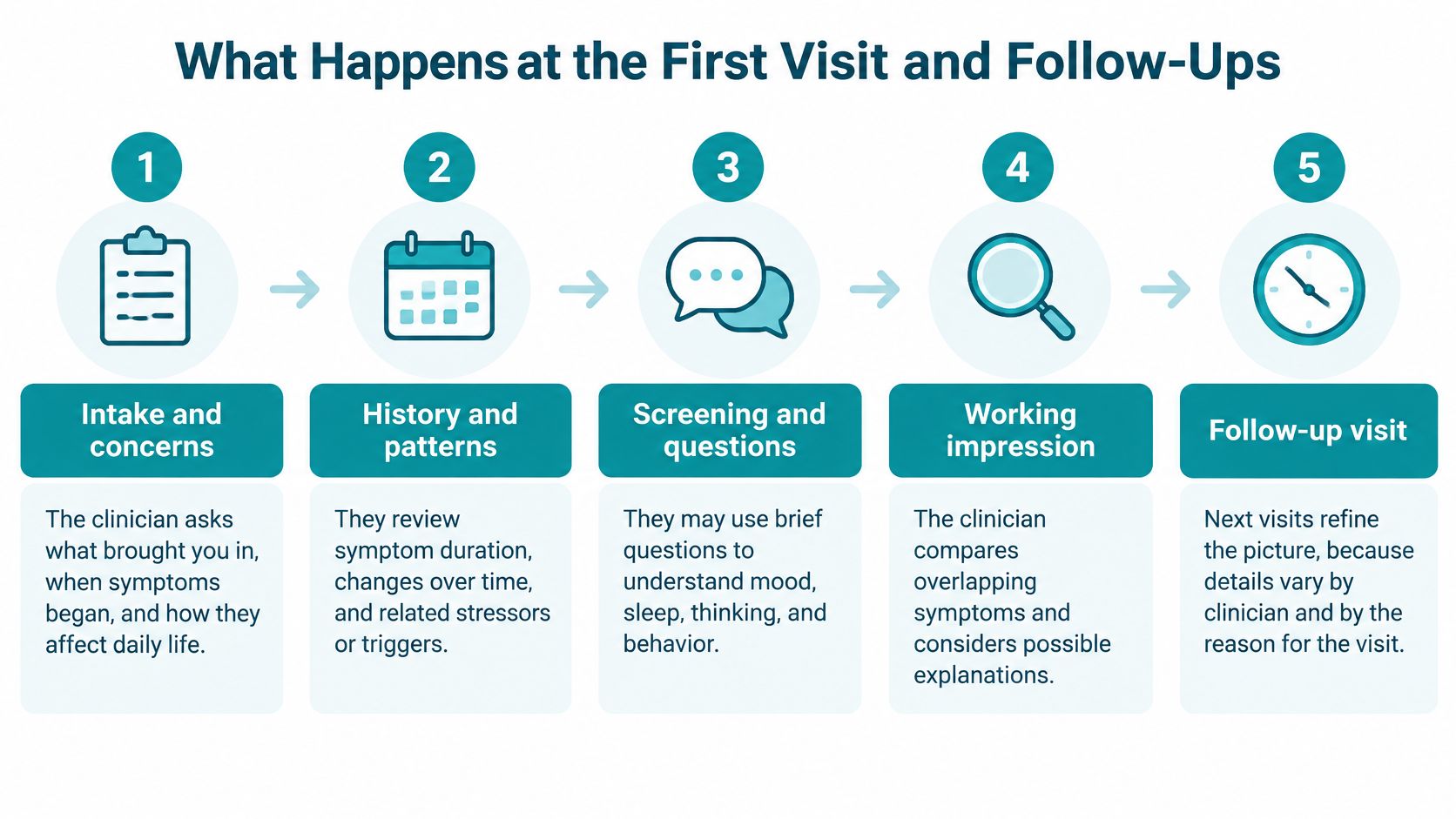
A Typical Evaluation Sequence
- Intake and concerns: The clinician asks what prompted the visit, when symptoms began, and what goals matter most.
- History review: Symptoms, medical history, daily functioning, previous treatment, and current and past medications are reviewed, with sleep, substance use, and lifestyle considered when they affect diagnosis or treatment response.
- Mental-status and safety screening: The clinician assesses appearance, speech, mood, thought process, cognition, and safety, sometimes supported by questionnaires.
- Assessment and options: The clinician explains the assessment, the possibilities under consideration, treatment options when appropriate, and recommended follow-up.
- Follow-up review: Later visits track symptoms, functioning, medication response, and side effects, and test whether the working diagnosis still fits.
- Confirm, refine, or revise: The formulation is confirmed only when the history, course, and response to care support it, or it's revised when they don't.
Evaluation length itself varies with complexity. The National Institute of Mental Health research support services page states that psychological evaluations may be brief, about 30 to 40 minutes, or may last as long as five hours when the referral question is more complex. A longer assessment doesn't automatically mean a more severe condition, since complex histories and multiple referral questions take longer to sort out.
Consider a clearly hypothetical example with no identifying details. An adult describes several months of low mood, poor sleep, and falling concentration at work. The first visit identifies medical factors, medication history, and sleep patterns that need review, while follow-up clarifies whether mood symptoms persist independently and how functioning changes.
That staged approach protects against premature labeling. It also clarifies questions about treatment access, including how to get anxiety medication through an evaluated care plan, because medication decisions depend on the assessment rather than on a screening result alone. The most useful outcome of a first visit is a clear next step, a monitoring plan, and a date to reassess what's still uncertain.
Working With Outside Clinicians and Records
Records shorten clarification because they show what was observed, tried, and learned before. A current clinician shouldn't have to reconstruct years of treatment from memory alone. Organized information also reduces the risk of repeating a medication trial that previously caused problems.
A One Page Planning Aid
- Onset and course: First symptoms, major changes, hospital or crisis care, and periods of improvement.
- Past evaluations: Clinician type, date, diagnosis given, and whether it was described as provisional.
- Medication trials: Name, dates taken, reason for stopping, benefits noticed, and side effects.
- Medical information: Relevant diagnoses, laboratory results, allergies, and current nonpsychiatric medicines.
- Questions to ask: Uncertainties, treatment goals, and symptoms that should prompt earlier contact.
Ask prior clinicians for a summary rather than a full chart when a summary answers the clinical question. Summaries are easier to review and often contain the diagnosis, treatment course, and response in one place. Confirm who may share information and what written authorization the receiving clinic typically requires, since release and coordination rules depend on state law and clinic policy.
Collateral information means observations from family members or others who know the person well. It's one source among several, not a verdict that overrides the patient's own account.
With permission, family members can describe changes in sleep, behavior, functioning, or reality testing over time. Clinicians weigh those observations against the interview, records, and observed course. Disagreement doesn't mean someone is being dismissed, since different settings can reveal different parts of the pattern.
Primary care coordination serves a separate purpose. A primary care clinician can help evaluate medical causes, share laboratory results, and keep the full medication list consistent. Any clinician who manages medication should be told about changes made elsewhere, because fragmented prescribing makes both diagnosis and monitoring less reliable.
Questions to Ask and Your Next Step
Specific questions turn a broad concern about timing into a defined plan. They also reveal whether a label is settled or still being tested.
- Is this provisional or confirmed? Ask whether the diagnosis is a working hypothesis or a confirmed formulation.
- What else was considered? Ask which conditions were considered and what evidence argued against them.
- What could change the assessment? Ask what records, observations, or follow-up findings would alter the conclusion.
- When will it be reassessed? Leave with a follow-up interval or a clear trigger for earlier review.
- Which symptoms need urgent care? Confirm which changes should prompt emergency or crisis support rather than waiting.
- Who manages medication? Ask who monitors benefits and side effects if medication is part of the plan.
For adults considering physician-led care, the practice overview of mental health care and diagnostic clarification explains the service area. More detail is available on mental health medication management, a focused mental health medication review, current fees and how Empire Medical Wellness works, and how to schedule an appointment. Readers should check those pages for current details.
The Initial Evaluation is a 50-minute visit that costs $350 and includes a detailed evaluation and initial treatment planning for new patients. Patients can seek focused mental health care without needing care in the practice's other service areas. When requesting an evaluation, patients tell the practice their location and preferred visit format, and the physician assesses whether telehealth fits their needs.
This article is educational and is not personal medical advice. It can't diagnose any reader or replace an evaluation by a qualified clinician who knows the full history.
Empire Medical Wellness offers private-pay, physician-led adult mental health evaluation, diagnostic clarification, and medication management when clinically appropriate, with follow-up based on response and new information. Adults who want a structured first evaluation and a clear reassessment plan can review services and request an appointment through Empire Medical Wellness.