What should you do when a medicine is no longer needed? The answer depends on the product and the disposal options available. Environmental caution matters, but so does preventing someone in the household from taking medicine by mistake.
The FDA Flush List is a narrow exception to the usual disposal approach. Flush a medicine only if the FDA specifically lists it, and only when take-back is not readily available. For other medicines, use the appropriate take-back or household-trash route.
Dispose of medicine that is no longer needed without changing treatment on your own. If you are unsure whether to stop a prescription, ask your clinician before discarding it.
By Empire Medical Wellness Editorial Team
Publication date: October 8, 2026
Updated: October 8, 2026
Table of Contents
- Choose the Right Disposal Route First
- When a Medicine Is Flushed and When It Is Not
- How to Prepare Medicine for Household Trash
- Controlled Drugs, Patches, Liquids and Other Forms
- Questions to Ask Your Pharmacist or Clinician
- Confirm Your Local Route Before You Act
Choose the Right Disposal Route First
For most unused or expired prescription and over-the-counter medicines, take-back is the preferred route. A pharmacy collection box, another authorized collector, and an approved mail-back program are ways to use that route, rather than competing disposal methods.
The FDA's drug take-back guidance identifies registered collection sites, on-site medicine drop boxes, and prepaid mail-back envelopes as available options. Some programs accept controlled substances, meaning medicines subject to additional legal controls because of their potential for misuse.
Home medication disposal routes in order of preference
| Route | Use it when | Key requirement |
|---|---|---|
| Take-back site, drop box or mail-back envelope | Most unused or expired medicines, including controlled substances where the program accepts them | Use first whenever reasonably accessible |
| Pharmacy or other authorized collector | Any medicine being considered for collection when a collector is reasonably accessible | Confirm the site accepts the specific product before traveling |
| FDA Flush List | Only medicines FDA specifically lists, when take-back is not readily available | Flush only the listed product, never other medicines |
| Sealed household trash | Non-listed medicines when no take-back option is reasonably accessible | Mix with an undesirable substance, seal the container, and remove or conceal personal information |
The pharmacy row describes a common type of take-back location. It doesn't mean every pharmacy accepts every medicine, or that a pharmacy counter and a collection box have identical acceptance rules.
Confirm acceptance before making the trip
The scale of organized collection is substantial. The DEA reported that its October 26, 2024 event collected nearly 630,000 pounds of unused medications at 4,600 locations.
That national participation doesn't establish what a particular neighborhood site accepts. A phone call can clarify whether a location accepts liquids, patches, or controlled substances and whether packaging must remain intact.
Practical rule: A collection location is useful only after its staff or posted program rules confirm that the specific product is accepted.
A psychiatric medication management worksheet can help distinguish current prescriptions from medicines awaiting clarification. That distinction matters when an old bottle remains after a prescription change.
Before choosing a route, the patient or caregiver should check the medication label and ask a pharmacist about any unclear instructions. A familiar drug name alone isn't enough to establish disposal instructions for every formulation.
When a Medicine Is Flushed and When It Is Not
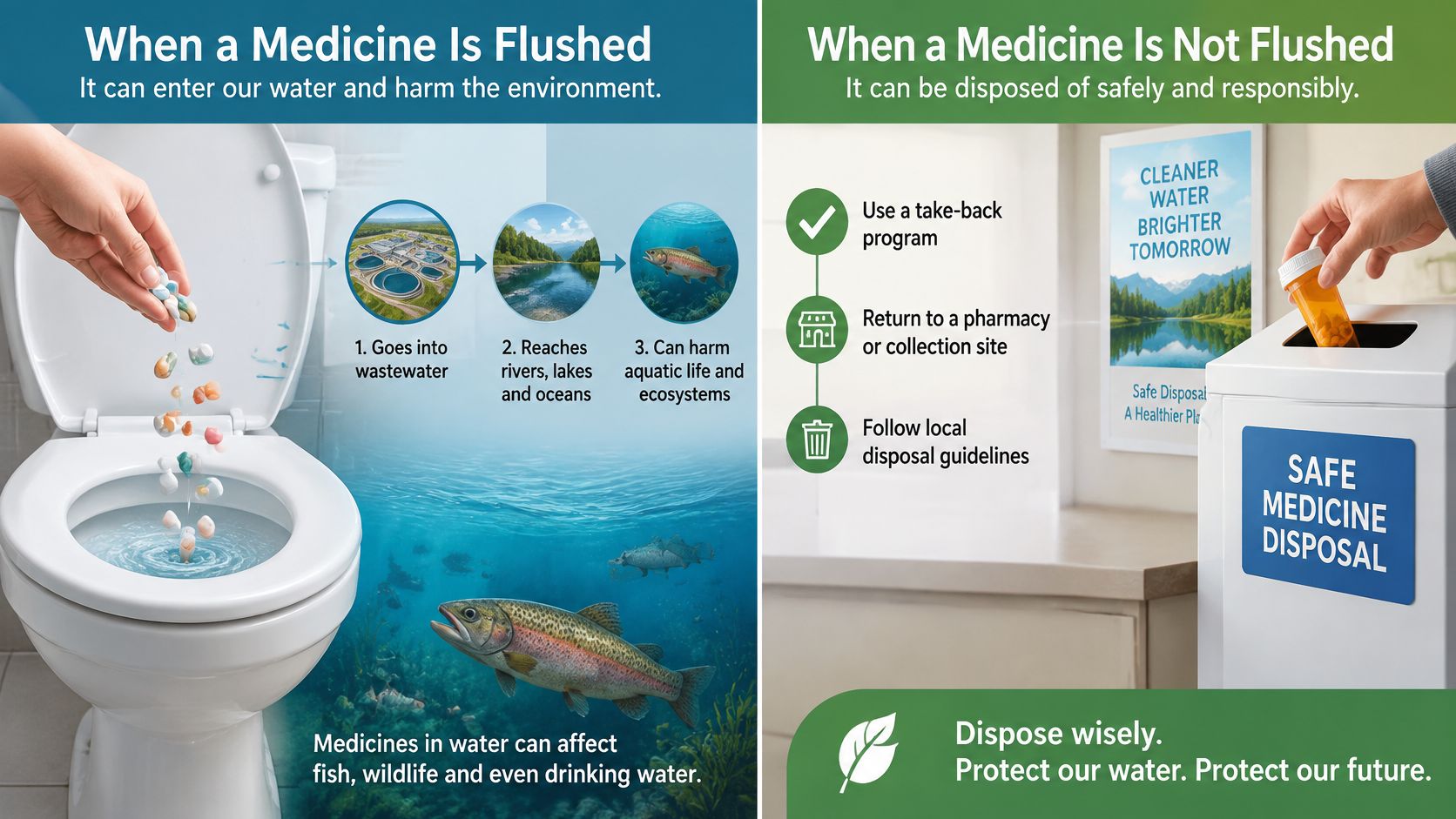
Flushing is a narrow exception, not a general household disposal method. The FDA Flush List identifies particular medicines for which accidental exposure can cause serious harm, making prompt disposal especially important when take-back isn't readily available.
The environmental concern remains real. The EPA explains how pharmaceuticals enter the environment: medicines poured into drains or flushed can pass through wastewater treatment into surface water. In homes with septic systems, pharmaceuticals may move through soil toward groundwater.
Why the exception exists
Environmental caution and immediate household safety aren't contradictory goals. The EPA's explanation of the FDA Flush List describes a limited exception for products whose potential harm from accidental exposure warrants a different approach when preferred disposal options aren't available.
Hypothetical example: A household with a toddler has an unwanted medicine that appears on the FDA Flush List. If take-back isn't readily available, the product-specific flushing instruction applies. The same decision cannot be extended to other medicines in the cabinet.
A general instruction to avoid flushing and a specific instruction to flush a listed medicine address different situations. Neither permits guessing based on a medicine's strength, age, or appearance.
Mistakes that bypass the safety checks
- Flushing an unlisted product: An unfamiliar or potent medicine isn't automatically eligible.
- Emptying a liquid into a sink: Liquid form doesn't create a drain-disposal exception.
- Crushing or burning medicine: Neither is a routine substitute for an approved disposal route.
- Treating expiration as harmlessness: An expired product still requires an appropriate disposal decision.
The drug overdose information page is background reading, not an emergency response service. If a child or adult accidentally swallows medicine or takes an unknown amount, Poison Control should be contacted immediately; an emergency requires 911. For a pet exposure, an emergency veterinarian should be contacted immediately rather than waiting for a routine appointment.
How to Prepare Medicine for Household Trash
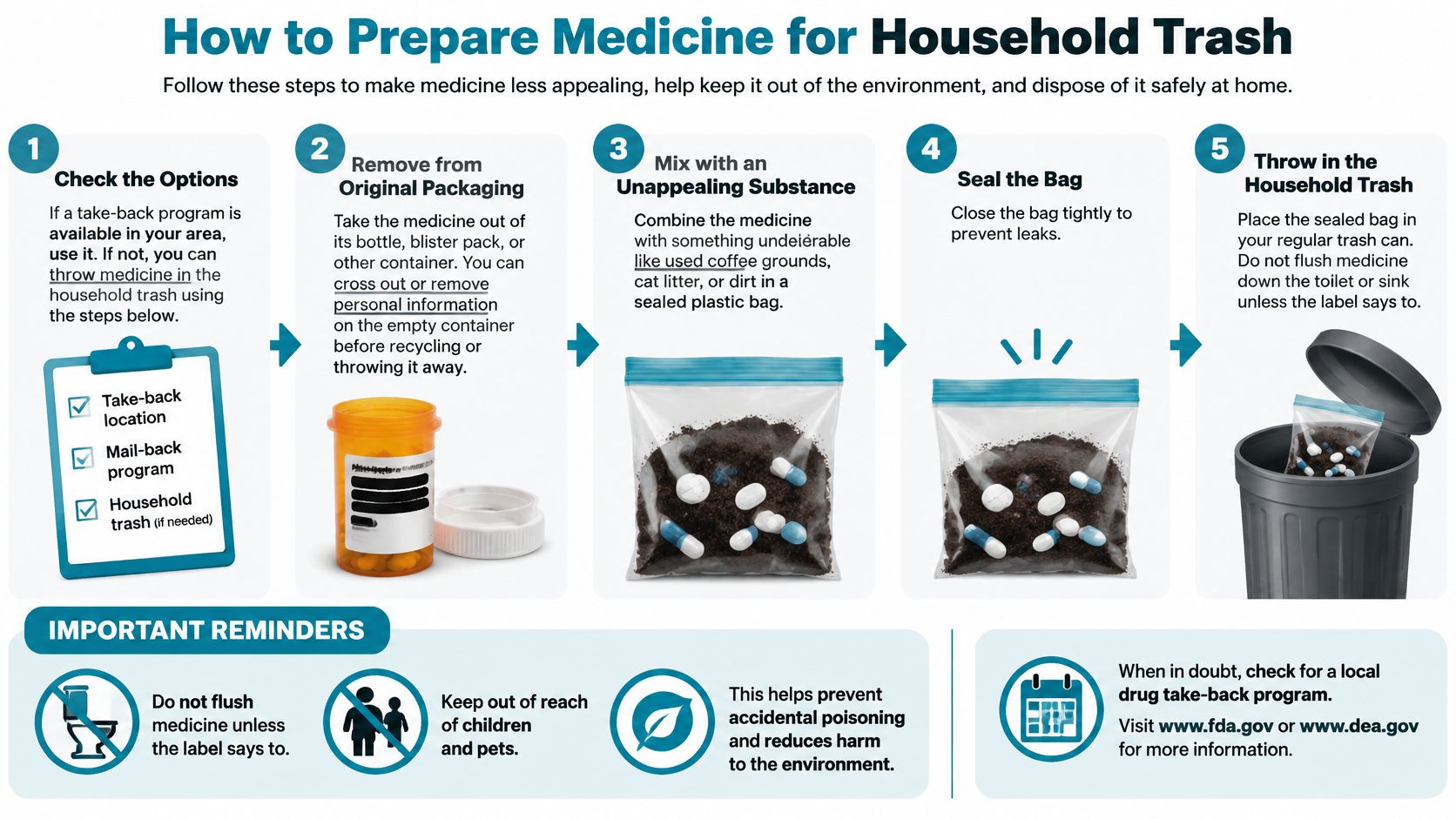
The household-trash method is for an eligible medicine, not for every item found in a medicine cabinet. The FDA's unused-medicine disposal guidance describes mixing most non-flush-list medicines with an undesirable substance and sealing the mixture when take-back or mail-back isn't available.
Until preparation begins, unwanted medicine should remain in its original container, secured away from children and pets. A future collection date isn't a reason to leave controlled substances accessible.
Prepare the medicine and packaging separately
Check the product's instructions. The package label, medication guide, and FDA Flush List establish whether a different route applies. An assumption based on another prescription can send the wrong product into household waste.
Check accessible take-back options. A nearby collector or available mail-back envelope may eliminate the need for home preparation. Lack of transportation makes mail-back worth asking about before ruling out organized collection.
Remove an eligible medicine from its original container. Tablets shouldn't be crushed, and capsules shouldn't be opened unless authoritative product instructions specifically direct otherwise. Leaving an intact prescription bottle in the trash isn't the FDA's preparation method.
Mix it with an undesirable substance. Used coffee grounds, dirt, or cat litter can make the medicine less appealing to someone searching the trash. This is a disposal mixture, not a way to make the medicine safe to consume.
Seal the mixture. A sealable bag or leak-resistant container helps keep the contents contained. An open cup or loosely folded paper wrapper doesn't provide the same protection against spills.
Conceal information on the empty packaging. The patient's name and prescription information should be scratched out or otherwise made unreadable. Removing the medicine doesn't remove the privacy risk from its label.
Confirm the local waste route before discarding it. The city or county waste authority can identify additional household-trash restrictions. The sealed mixture belongs in household trash only when that route is permitted.
Check the finished package
- Contents contained: The medicine is mixed with an undesirable material.
- Closure secure: The bag or container won't readily open or leak.
- Identity protected: Personal details on the empty packaging are unreadable.
- Access restricted: The prepared package remains away from children and pets until collection.
Sealing and mixing reduce opportunities for exposure. They don't turn discarded medicine into a harmless household material.
Leftovers shouldn't be given to another person. Pouring a liquid down the sink for convenience also bypasses the product-specific decision.
Patches need an additional check before any trash preparation. A nicotine patch information page addresses a particular product type, but its handling shouldn't be generalized to every medicated patch.
Controlled Drugs, Patches, Liquids and Other Forms
A medicine's form can change what happens between identifying it as unwanted and handing it over for disposal. A tablet, a liquid bottle, and a used patch shouldn't automatically be prepared alike.
The product name, dosage form, and current labeling are necessary details. When any of those details are uncertain, a pharmacist should identify the product before disposal proceeds.
Disposal handling by medicine form
| Medicine form | Preferred route | Key caution |
|---|---|---|
| Tablets and capsules | Take-back first; household trash only if no option is reasonably accessible and the medicine is eligible | Don't crush or open unless the label directs it |
| Liquids and syrups | Take-back first; mix eligible liquids with absorbent material before trash disposal | Never pour into a sink or toilet unless the product is on the FDA Flush List |
| Transdermal patches | Take-back first; check whether the product is on the FDA Flush List | Follow the label or pharmacist's instructions before disposal |
| Controlled substances | Take-back preferred; some programs accept them | Don't leave unsecured while waiting for disposal |
| Injectables and sharps | Follow local sharps rules | Check local rules and the product label; don't place loose needles in ordinary trash |
| Chemotherapy and other hazardous drugs | Ask the prescriber or pharmacy about a return program | Don't treat as standard household trash; obtain product-specific handling instructions |
Details that change preparation
Tablets and capsules generally don't require grinding or opening for eligible household-trash disposal. Extra handling creates work without replacing the need to follow the correct route.
Liquids and syrups require confirmation that the collector accepts liquids. If an eligible liquid must enter household trash, absorbent material helps contain it; an original bottle of liquid shouldn't be emptied into a drain.
Transdermal patches, which deliver medicine through the skin, need label-specific handling. Some instructions address folding adhesive sides together, but that step and the final destination must be checked for the actual product.
Controlled substances may have collection requirements that differ from ordinary medicines. Product-specific education, such as the OxyContin opioid safety guide, shouldn't be read as establishing the disposal route for an unrelated mental health prescription.
Items outside the ordinary pill-disposal routine
Needles and syringes require a sharps pathway. Disposal of the needle and disposal of any remaining medicine may involve separate instructions.
Chemotherapy medicines and other hazardous products also need an explicit plan from the dispensing pharmacy or prescriber. The ordinary coffee-grounds method shouldn't be assumed appropriate.
Where a product-specific answer is unknown, that uncertainty should remain explicit. Current FDA labeling or MedlinePlus information, interpreted with a pharmacist when necessary, is more useful than a rule inferred from packaging or appearance.
Questions to Ask Your Pharmacist or Clinician
Before deciding how to dispose of a medicine, identify its name and form, and clarify whether it is still part of the treatment plan. A pharmacist can answer questions about handling and collection. The treating clinician can clarify whether the medicine is still needed.
Questions for the pharmacist
- Flush status: Is this exact product on the FDA Flush List?
- Collection eligibility: Does this pharmacy or a nearby authorized site accept this form of medicine?
- Mail-back access: Is an appropriate prepaid mail-back envelope available?
- Product instructions: Does the current label or medication guide specify preparation or disposal steps?
- Local requirements: Which city or county office can confirm whether household trash is permitted?
- Unclear packaging: Can the medicine still be identified reliably if the original label is missing?
Questions for the treating clinician
- Treatment status: Is the remaining supply still needed for a planned follow-up?
- Changed prescription: Should the remaining medicine be discussed at the visit, or should it be disposed of?
- Household considerations: Does access by children, pets, visitors, or other household members affect how the medicine should be stored?
- Uncertain leftovers: Which medicines on the current list are active, and which have been discontinued?
Expired, leftover, and stopped by a clinician describe different situations. None tells you how to dispose of a medicine. Do not stop, change, or taper an active prescription on your own.
Medication reconciliation means comparing a person's medication list with what they currently take. It can clarify whether an old bottle reflects a current instruction or a discontinued prescription.
At a first visit with Empire Medical Wellness, bring an updated medication list, including supplements and any side effects noticed. Written questions can help focus the discussion. The guide to psychiatric drug interactions may help you prepare questions about a current regimen. Interaction concerns should be discussed as part of treatment, not used as a reason to dispose of medicine or change a dose on your own.
Before discarding: Confirm separately whether the medicine is still prescribed and which disposal route applies.
Confirm Your Local Route Before You Act
A practical plan can be completed this week without sorting every household medicine at once. The starting point is one clearly unwanted product whose identity and treatment status are known.
A short local action plan
- Locate an accepted collection route. The pharmacy or DEA's public disposal locator can help identify a take-back site, drop box, or mail-back option. Acceptance should be confirmed for the actual product.
- Verify local trash requirements. The city or county waste authority should confirm any restrictions before a household-trash package is prepared.
- Check product-specific instructions. The current label and FDA website should establish whether the Flush List exception applies.
- Record the practical details. Collection hours, event dates, mail-back availability, and the date checked make the plan easier to complete.
Household medication disposal planner
The planner should be kept private because medicine names can reveal sensitive health information. A blank status should mean “not yet checked,” not “safe for trash.”
| Medicine name | Form | Flush List status | Nearest take-back site | Date checked |
|---|---|---|---|---|
| __________ | __________ | __________ | __________ | __________ |
| __________ | __________ | __________ | __________ | __________ |
| __________ | __________ | __________ | __________ | __________ |
| __________ | __________ | __________ | __________ | __________ |
| __________ | __________ | __________ | __________ | __________ |
| __________ | __________ | __________ | __________ | __________ |
| __________ | __________ | __________ | __________ | __________ |
| __________ | __________ | __________ | __________ | __________ |
| __________ | __________ | __________ | __________ | __________ |
| __________ | __________ | __________ | __________ | __________ |
For an accidental or uncertain ingestion by a person, contact Poison Control at 1-800-222-1222 immediately. In an emergency, call 911 or go to the nearest emergency department. A pet exposure requires immediate veterinary guidance. The website, email, and routine patient messaging shouldn't be used for urgent concerns.
Questions about current prescriptions can be raised through the mental health medication review page, and appointments are booked through the schedule page. Empire Medical Wellness does not handle medication disposal.
Sources
- FDA: Drug Disposal, Drug Take Back Options; Where and How to Dispose of Unused Medicines.
- EPA: How Pharmaceuticals Enter the Environment; The Limited Role of the FDA Flush List.
- DEA: Communities Nationwide Turn in Nearly 630,000 Pounds of Unneeded Medications.
- APA: Safe medication disposal, supplemental reading.
Published and updated October 8, 2026. This article is educational and isn't personal medical advice.
Empire Medical Wellness offers physician-led outpatient mental health evaluation, medication review, and ongoing medication management when appropriate. Adults seeking clarification about their current treatment can visit Empire Medical Wellness to explore care options, while arranging disposal through a pharmacist or authorized collection program.