
What if quitting cannabis depended less on a test of willpower and more on changing the situations connected to using it? Learning how to quit smoking weed starts with a clear goal, a written record of use, and a plan for triggers, support, and follow-up. Abstinence or a structured reduction can be discussed with a physician, especially when previous attempts have been difficult or sleep and mood are concerns.
Empire Medical Wellness Editorial Team
Published October 8, 2026 | Updated October 8, 2026
Table of Contents
- Set a Goal and Track Your Use for Seven Days
- Build Your Quit Plan Around Your Triggers
- Track Sleep and Mood Changes Between Visits
- Handling Lapses, Ambivalence and Access Barriers
- What Medication Questions to Raise With a Physician
- Bring Your Plan to a Physician and Know When to Seek Urgent Care
Set a Goal and Track Your Use for Seven Days
Choose a clear goal before choosing a strategy. Abstinence means stopping cannabis use. A structured reduction means setting measurable boundaries around use and reviewing whether those boundaries are working, rather than intending to smoke less.
These goals aren't interchangeable. Someone who repeatedly exceeds planned limits may need a different approach from someone who can maintain a reduction without ongoing impairment. A World Health Organization review of cannabis health effects describes greater dependence risk with more frequent use, supporting careful attention to the pattern, not just whether cannabis is used at all.
A reduction goal can be a legitimate starting point without being a guarantee of adequate treatment. The useful question is whether the change improves daily functioning and remains manageable.
Establish a baseline
A baseline is a record of the starting pattern. A notebook, phone note, or spreadsheet can capture use without requiring an app or complicated scoring system.
For the baseline week, record each day's use, the situation around it, mood and sleep, and any alternative strategy attempted. Blank spaces below are intended for personal entries, not suggested amounts.
Seven-day use log
| Day | Times or amount used | Trigger or situation | Mood and sleep | Strategy tried |
|---|---|---|---|---|
| Day 1 | _____ | _____ | _____ | _____ |
| Day 2 | _____ | _____ | _____ | _____ |
| Day 3 | _____ | _____ | _____ | _____ |
| Day 4 | _____ | _____ | _____ | _____ |
| Day 5 | _____ | _____ | _____ | _____ |
| Day 6 | _____ | _____ | _____ | _____ |
| Day 7 | _____ | _____ | _____ | _____ |
Honest entries are more useful than impressive-looking entries. The log isn't a test, and it doesn't establish a diagnosis. An explanation of DSM-5 substance-use disorder criteria can help distinguish tracking a habit from a clinician's diagnostic assessment.
- Record entries the same day. Reconstructing a week from memory makes patterns harder to identify.
- Use consistent measures. Record smoking sessions or a known amount rather than guessing THC exposure. Include vaping or edibles if used.
- Note the first use of the day. Timing can reveal a routine that a daily total misses.
After completing the log, circle the highest-risk times and bring it to a clinical visit. Tracking shouldn't delay care when symptoms or safety concerns already require assessment.
Build Your Quit Plan Around Your Triggers
A useful quit plan names what will happen during the moments previously occupied by cannabis. General intentions, such as staying busy or avoiding stress, leave too many decisions for a difficult moment.
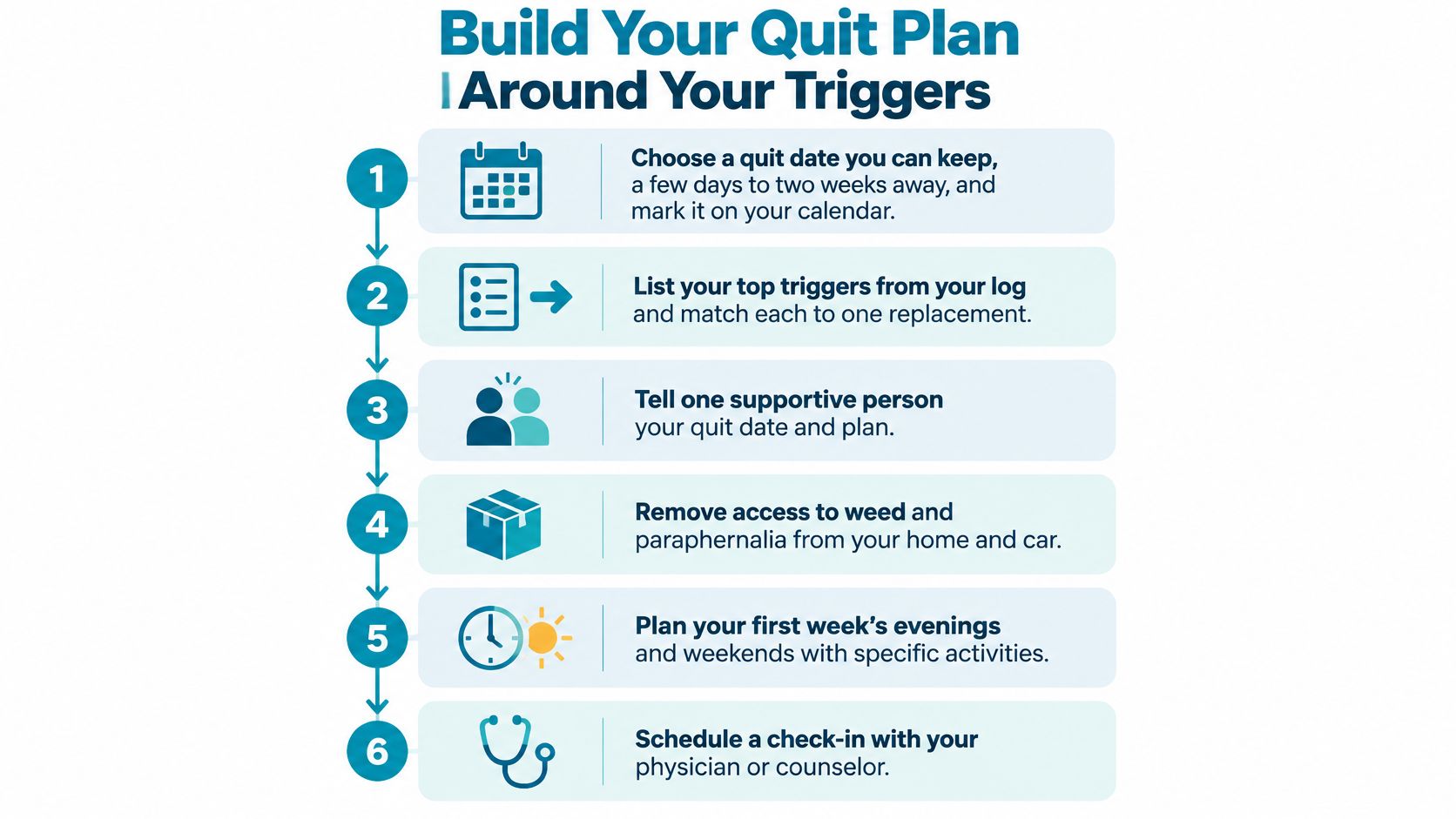
The following visual summarizes the practical tasks involved in preparation.
Write a one-page plan
Choose a workable start date. Mark a quit date on the calendar, or establish a date to begin a clinician-discussed reduction goal. Consider work demands, social commitments, and access to support. The date should make the plan concrete, not create an arbitrary deadline.
Sort high-use situations into people, places, times, and emotions. A gathering with friends is a people-related trigger; arriving home may be a place-and-time trigger. Separating these details makes it easier to change the relevant part of the routine.
Match the strongest triggers to short replacements. A walk around the block, a shower, or a phone call gives a specific action to begin. A replacement should address the need connected to use, such as decompression, company, or something to do.
Remove cannabis and related supplies from the home, car, and bag. Pipes, vapes, rolling papers, and stored supplies can leave an easy route back to the old routine. Clearing access is a practical preparation step, not a judgment about character.
Give a support person a defined task. A scheduled evening text or a planned walk is clearer than a general request for encouragement. That person doesn't need to supervise treatment or become responsible for the outcome.
Arrange follow-up before the start date. A physician or counselor can help evaluate whether the plan fits the person's health history and needs. Scheduling in advance avoids making support depend on finding motivation during a difficult day.
Match the replacement to the situation
The table offers routines to test, not treatments guaranteed to stop cravings. The delay interval is a planning tool, not a prediction of how long a craving will last.
Common triggers and replacement routines to test
| Common trigger | Replacement to test | Preparation step |
|---|---|---|
| Stress after work | Short walk, paced breathing, or a call to a friend | Change the route home to avoid old supply |
| Social gatherings with people who use | Bring a non-cannabis drink and plan an early exit | Tell one friend the exit plan beforehand |
| Weekend boredom | Schedule exercise, a class, or a hobby during usual use hours | Keep cannabis and supplies out of the home |
| Cravings after dinner | Delay for 15 minutes, leave the room, and drink water | Agree on a text check-in with a support person |
Cognitive behavioral therapy, or CBT, teaches skills for recognizing triggers, handling cravings, and regulating stress; a review of cannabis-use disorder treatments describes courses typically involving 4–14 sessions, although treatment needs and outcomes vary.
Practical stress-management strategies can help identify alternatives worth testing. Keep replacements that are feasible and useful, and revise those that don't fit.
Planning rule: A replacement needs a time, a place, and an action. A broad intention isn't yet a routine.
Track Sleep and Mood Changes Between Visits
A sleep-and-mood record gives a physician more useful information than a general impression that everything feels worse. It can show whether difficulties cluster around particular evenings, changes in use, or stressful events.
Cannabis-related concerns shouldn't become the automatic explanation for every symptom. Anxiety, depression, other substances, medications, and medical conditions may also need evaluation.

Keep entries brief and consistent
A daily note can use these prompts without becoming a lengthy journal:
- Sleep: Approximate time needed to fall asleep, awakenings, and unusually vivid dreams.
- Daytime functioning: Energy and any difficulty completing ordinary responsibilities.
- Mood: Irritability, anxiety, or low mood, described in plain words.
- Appetite: Noticeable changes in hunger or ability to eat.
- Cravings: The strongest urge, its setting, and the response attempted.
A consistent sleep-and-wake routine also provides context for interpreting entries. Understanding the circadian rhythm, the body's daily sleep-wake timing system, can help separate schedule changes from other concerns.
Summarize rather than self-diagnose
Review entries weekly and keep them across a two-week tracking period if practical. This is an observation window, not a deadline for recovery or a reason to wait when symptoms are concerning.
For an appointment, highlight the most disruptive changes, their timing, and their effect on work or relationships. A note such as difficulty sleeping before early shifts is more actionable than a conclusion that a particular disorder must be present.
Persistent, manageable changes deserve discussion at a routine visit. Severe deterioration and crisis symptoms require the more immediate steps described under urgent care.
Handling Lapses, Ambivalence and Access Barriers
After a lapse, the useful next action is to record what happened: the situation, the trigger, and the replacement that wasn't used or didn't help. Resume the plan promptly rather than waiting for another symbolic fresh start.
A lapse is information, not a verdict. Understanding what relapse means can help someone describe a return to use without turning it into a judgment about personal worth.
A plan can need revision even when the person remains committed to change.
Support doesn't require perfect certainty
Someone who isn't ready for complete abstinence can still clarify goals, document use days and amounts, and identify situations where cannabis causes problems. Improving routines and discussing concerns are meaningful ways to begin an assessment.
Reduction isn't guaranteed to work for everyone. Repeatedly exceeding intended limits, ongoing impairment, or relying on cannabis to manage sleep or anxiety are reasons to seek a fuller evaluation rather than repeatedly tightening a self-directed plan.
A 2025 analysis of national survey data on cannabis-use disorder treatment identified barriers including uncertainty about where to go, not being ready to stop, employment concerns, stigma, and cost. Reluctance to seek care may reflect fear or poor fit, not indifference.

Make access questions concrete
Before arranging care, useful questions include:
- Privacy: How are records, appointment communications, and authorized disclosures handled?
- Cost: What charges apply, and what follow-up expenses should be anticipated?
- Format: Is outpatient or telehealth assessment appropriate and available in the person's location?
- Goals: Can the evaluation begin with uncertainty about abstinence?
Outpatient and telehealth care may make attendance easier for some adults, but availability, privacy rules, and cost differ. Confidential care shouldn't be interpreted as an unlimited promise about every legal or employment circumstance.
Empire Medical Wellness's addiction medicine evaluations are confidential outpatient evaluations. The addiction medicine service page explains the care setting. This article doesn't establish telehealth eligibility in any particular state; current location requirements should be confirmed during scheduling.
What Medication Questions to Raise With a Physician
A smaller, measured goal can still be the point of care. Fewer evenings of use, or a pause around one known trigger, is a real target. Medication questions belong beside that tracked plan.
A physician still needs the pattern of use, the health history, and the reasons cannabis has been hard to change. The same visit has to separate a cannabis-related symptom from a different condition that needs its own evaluation. Cutting back is hard. A first idea about medicine often needs adjusting once those facts are on the table.
According to the National Institute on Drug Abuse's cannabis treatment information, as of its 2024 update, no medication had FDA approval specifically for cannabis-use disorder or medically assisted cannabis withdrawal.
Understand approval and off-label use
Off-label use means prescribing an approved medicine for a use the FDA has not approved. A medicine approved for another condition does not thereby become an approved treatment for cannabis-use disorder. Off-label status also does not show that a treatment works, or that it fits this person.
A prescription label works like a street sign for one destination. Using that medicine for a cannabis-related goal is a different road. The physician has to say whether any evidence supports that turn, and whether the measured goal is abstinence, fewer days of use, or both.
No specific medicine, dose, or medication change is recommended here. Medicines should not be started, stopped, or changed based on this article.
Bring a complete medication list
The list should include prescriptions, over-the-counter products, supplements, alcohol, and other substances. Pair it with notes on triggers from the first weeks, so the visit reviews a pattern rather than a test of willpower.
Relevant questions for a physician include:
- Interactions: Could any current product raise concerns as cannabis use changes?
- Separate assessment: Do sleep or mood symptoms need evaluation before medication is considered?
- Evidence: Is a proposed use approved or off-label, and how strong is the supporting evidence?
- Monitoring: What benefits, adverse effects, and follow-up would be assessed if the goal is fewer days of use rather than full abstinence?
- Medical history: Which past conditions or treatment responses affect the options?
Any drug-specific proposal requires current prescribing information and an individualized clinical evaluation. An appointment does not guarantee a prescription. A behavioral plan, built around triggers and a use log, remains a distinct part of care.
Bring Your Plan to a Physician and Know When to Seek Urgent Care
Routine follow-up versus urgent care
| Situation | Appropriate next step | Timing |
|---|---|---|
| Difficulty reducing or stopping use with no immediate danger | Routine physician visit with the use log | Routine appointment |
| Persistent sleep or mood changes that are manageable | Routine physician visit to review tracking | Routine appointment |
| Severe, unusual, or rapidly worsening symptoms | Prompt medical assessment; urgent care or emergency services if severe | Same day |
| Thoughts of harming oneself or others, or hallucinations or confused thinking | Immediate crisis or emergency assessment; call 911 for immediate danger or inability to stay safe | Immediately |
For severe chest pain, trouble breathing, fainting, or another potentially life-threatening symptom, call 911. Suicidal thoughts also warrant immediate support through 988; immediate danger requires emergency services rather than a routine appointment.
NIDA's cannabis guidance describes variable withdrawal severity and duration. Severe, unusual, or rapidly worsening symptoms need assessment because symptoms occurring after a change in cannabis use aren't necessarily caused by withdrawal.
Prepare for a focused evaluation
At Empire Medical Wellness, care begins with a confidential assessment of the current situation, medical risks, previous treatment, medications, and goals. The initial evaluation includes an explanation of appropriate treatment options and next steps.
Preparation for a first addiction medicine appointment can include the use log, symptom notes, and medication list. The infographic's written-plan and follow-up wording is a preparation prompt, not a guarantee of specific visit deliverables.
Questions worth bringing include:
- Pattern of use: Does the history suggest dependence or withdrawal concerns?
- Goal: Is abstinence or structured reduction appropriate to discuss?
- Symptoms: Do sleep or mood changes need a separate evaluation?
- Treatment: Is any medication approach relevant, and would it be off-label?
- Follow-up: What monitoring is appropriate, and what should happen after a lapse?
Sources
Evidence informing this article includes the WHO cannabis health review, a peer-reviewed cannabis-treatment review, the national survey analysis of treatment barriers, and NIDA's cannabis guidance, linked at the relevant claims.
Empire Medical Wellness offers private-pay, physician-led outpatient addiction medicine assessment, recovery planning, and follow-up for adults with substance-use concerns. Adults considering support for changing cannabis use can visit Empire Medical Wellness to learn about evaluation and next steps. This article is educational and isn't personal medical advice.