
A few weeks after a job loss or breakup, an adult may find that worry, sadness, or disrupted sleep is making ordinary tasks hard to manage. Adjustment disorder is clinically significant distress or impairment that develops after an identifiable stressor; it isn't a label for having a difficult time. A clinician considers the timing, impact on daily life, and whether another condition better explains the symptoms.
Byline: Empire Medical Wellness Editorial Team
Published: October 21, 2026
Updated: October 21, 2026
Table of Contents
- What Adjustment Disorder Actually Means
- How Adjustment Disorder Differs From Depression, PTSD, and Normal Stress
- Symptom Patterns and the Timeline That Defines the Diagnosis
- Treatment Options for Adjustment Disorder
- What Evaluation Looks Like in Practice
- When Adjustment Disorder Becomes a Safety Concern
- Considering Physician-Led Mental Health Care
What Adjustment Disorder Actually Means
After losing a job, someone might lie awake replaying conversations, struggle to concentrate, or avoid friends because it feels difficult to explain what happened. Those reactions can be painful without automatically indicating a mental disorder. The distinction depends partly on how severe the distress is, whether it interferes with daily functioning, and how it relates to the event.
Adjustment disorder describes emotional or behavioral symptoms that arise in response to an identifiable stressor and cause clinically significant distress or impairment. In plain language, the reaction is more than ordinary strain: it is affecting a person's ability to work, maintain relationships, or manage everyday responsibilities. The event may involve a relationship change, a job or financial disruption, illness, or bereavement. Their relative frequency among patients at any particular practice shouldn't be assumed without actual data.
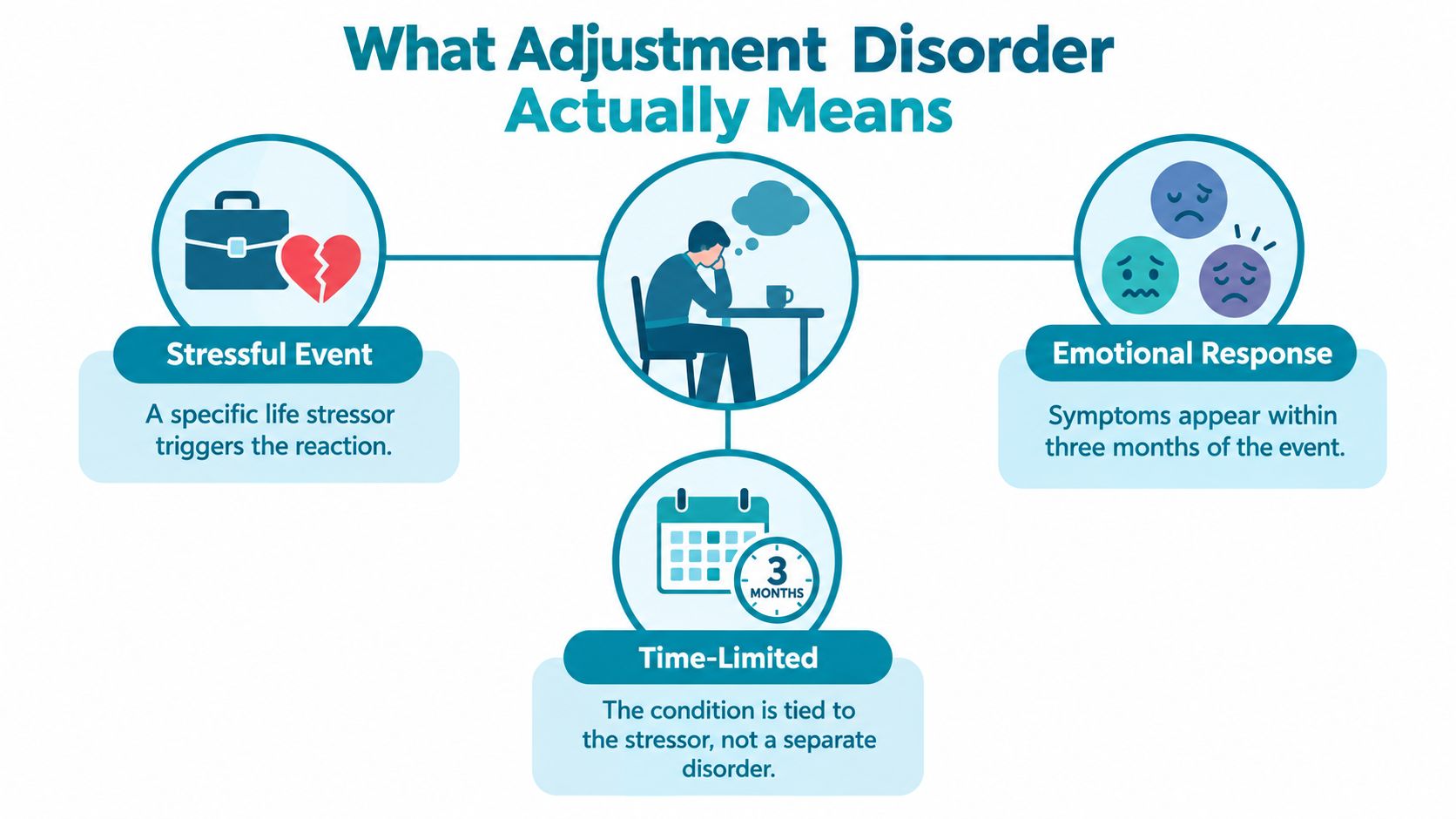
Stress is common, but impairment matters
People commonly feel upset, distracted, or anxious after a major change. That response alone doesn't establish a diagnosis, and it doesn't mean someone is weak or failing to cope. Adjustment disorder is considered when the symptoms are sufficiently distressing or disruptive and follow a clear connection to a stressor.
The MedlinePlus overview of adjustment disorders describes reactions to stressful life events and the range of emotional and behavioral difficulties that may occur. A clinician still needs to consider the person's circumstances and whether a different condition better accounts for the symptoms.
A useful distinction: The event provides context, but its presence alone doesn't establish a disorder. The level of distress, effect on functioning, and full clinical picture matter.
A stressor can be ongoing, and its consequences may continue even after the event itself has ended. A person facing continued financial strain, for example, may still be dealing with its effects after a job change. Understanding the timeline helps explain why symptoms began and whether they remain closely tied to the stressor.
A private, physician-led evaluation can help clarify those questions without asking someone to diagnose themselves. Some people begin by learning practical stress-management strategies, but practical coping information doesn't replace an assessment when distress is severe, persistent, or interfering with daily life.
How Adjustment Disorder Differs From Depression, PTSD, and Normal Stress
Several conditions can involve sadness, worry, sleep changes, or difficulty concentrating. Those overlapping symptoms can make labels confusing, but clinicians don't distinguish conditions by one symptom alone. They consider the pattern, timing, context, impairment, and whether a more specific diagnosis fits.
The comparison below is an orientation tool, not a way to determine a diagnosis at home. Symptoms can overlap, and a clinician may need to assess for more than one possible explanation. For an overview of depressive conditions and evaluation, see this information about depression.
Adjustment Disorder vs Related Conditions
| Condition | Trigger | Onset | Core features | Typical duration |
|---|---|---|---|---|
| Adjustment disorder | An identifiable stressor | Generally within three months of the stressor under DSM-5-based criteria | Distress or impairment linked to the stressor, when another condition doesn't better explain it | Symptoms generally shouldn't persist more than six months after the stressor or its consequences end |
| Major depression | May follow a difficult event or occur without a clear trigger | Not defined by a required link to a recent stressor | A broader pattern of depressive symptoms that a clinician assesses against diagnostic criteria | Varies; requires assessment |
| PTSD | A qualifying traumatic event | Requires assessment of the event and symptom pattern | Trauma-related symptoms, including intrusion, avoidance, and changes in arousal or mood | Requires assessment of the full criteria and duration |
| Anxiety disorder | May relate to a specific situation or occur across different areas | Depends on the specific condition | Persistent or excessive fear or worry, assessed in context | Varies by condition |
| Normal stress or bereavement | A challenging event, loss, or transition | Often follows the event | Distress that can occur without meeting criteria for a mental disorder | Varies by person and circumstances |
This table simplifies distinctions for readability. For example, a person grieving a loss may have intense emotions without having adjustment disorder or depression. Conversely, a stressor preceding symptoms doesn't rule out depression or PTSD. A careful evaluation checks whether those conditions better account for the presentation.
PTSD is associated with trauma-related symptoms, but only a clinician can assess whether the event and symptoms meet the relevant criteria. If spiritual or religious support is meaningful to someone, thoughtful ways to share Scripture may offer an additional source of comfort. That kind of support can sit alongside, rather than replace, appropriate mental-health evaluation.
Symptom Patterns and the Timeline That Defines the Diagnosis
Adjustment disorder is defined partly by when symptoms begin in relation to a stressor. Under DSM-5-based criteria, symptoms generally develop within three months of an identifiable event and cause significant distress or impairment. ICD-11 uses a narrower general onset window of one month and highlights persistent preoccupation with the stressor and difficulty adapting (review of adjustment-disorder diagnosis and classification).
Possible symptoms include disrupted sleep, trouble concentrating, tearfulness, avoidance, irritability, or feeling overwhelmed. Their presence doesn't prove adjustment disorder. The clinician considers how symptoms fit together and what else might explain them. For people who get caught in repetitive, distressing thoughts, learning about rumination may help describe the experience, but it doesn't establish a diagnosis.
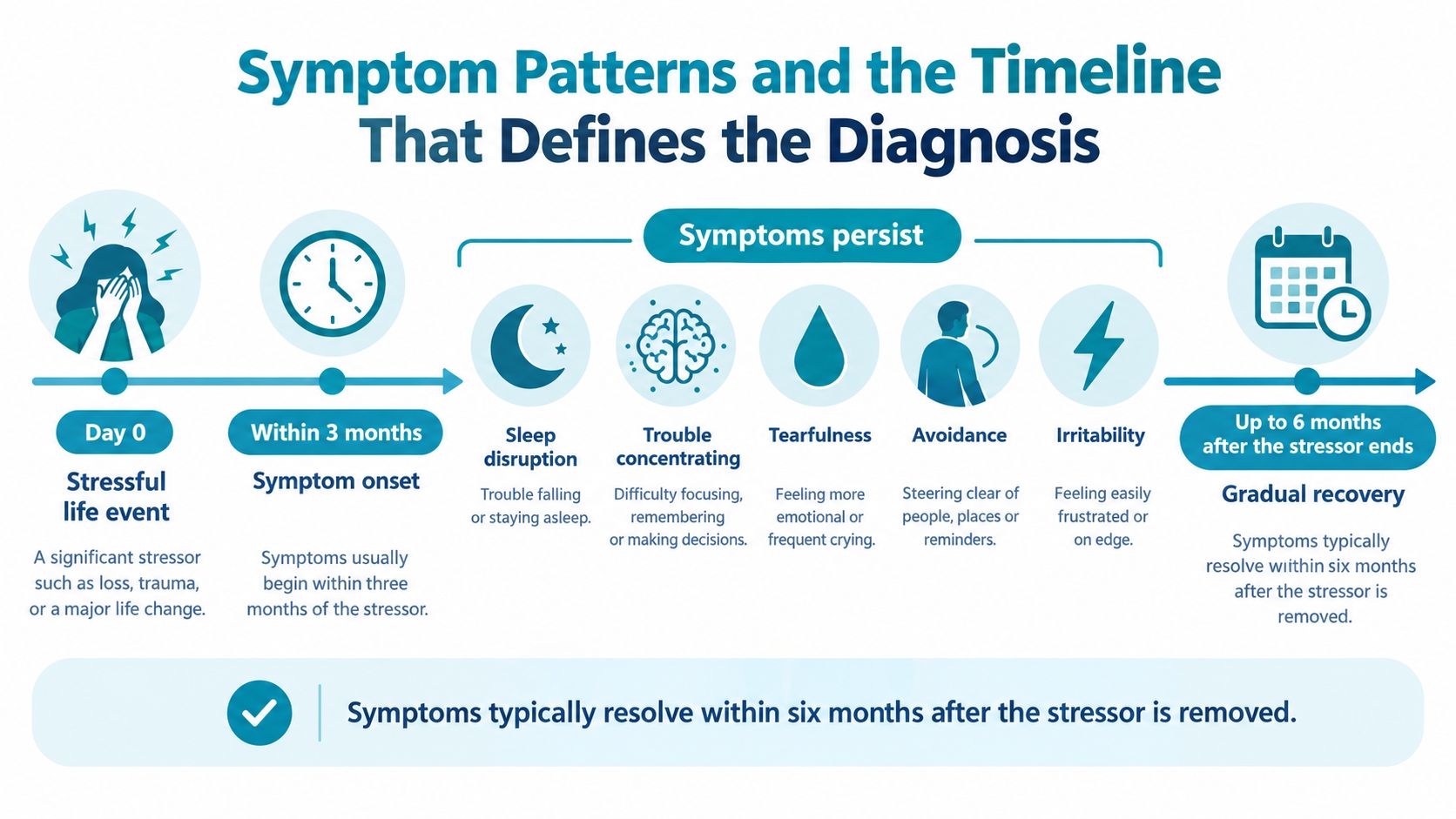
The timeline is a diagnostic boundary, not a deadline
The six-month limit is often misunderstood. Symptoms generally shouldn't continue for more than six months after the stressor or its consequences have ended. If the stressor or its consequences continue, symptoms may also continue. The boundary isn't a promise that distress will disappear on a set schedule, and it isn't a reason to postpone care.
When symptoms persist or worsen, clinicians may reassess whether depression, an anxiety disorder, prolonged grief, or another condition better explains them. The key question isn't how long the symptoms have lasted. It's whether the diagnosis still fits the full picture, including changes in the stressor and the person's functioning.
Prevalence estimates also depend on where people are assessed and which criteria researchers use. A review reports general-population estimates around 1%–2%, while a multinational study using ICD-10 criteria reported approximately 0.2%–1% across Finland, Ireland, Norway, and Spain. A representative German study using ICD-11-oriented criteria and different diagnostic algorithms produced estimates ranging from 0.9% to 2%. These figures come from different methods and populations, so they shouldn't be treated as interchangeable (review of prevalence across settings).
The same review describes higher rates in certain clinical or stress-exposed groups than in the general population. That variation is one reason population estimates can't tell an individual whether a diagnosis applies. Distress and impairment still require personal assessment.
Treatment Options for Adjustment Disorder
A sudden job loss can disrupt sleep, routines, and confidence. Care can address both the distress and the practical problem, with the approach shaped around the person's symptoms, safety, circumstances, and any co-occurring condition. Medication is not an automatic part of treatment.
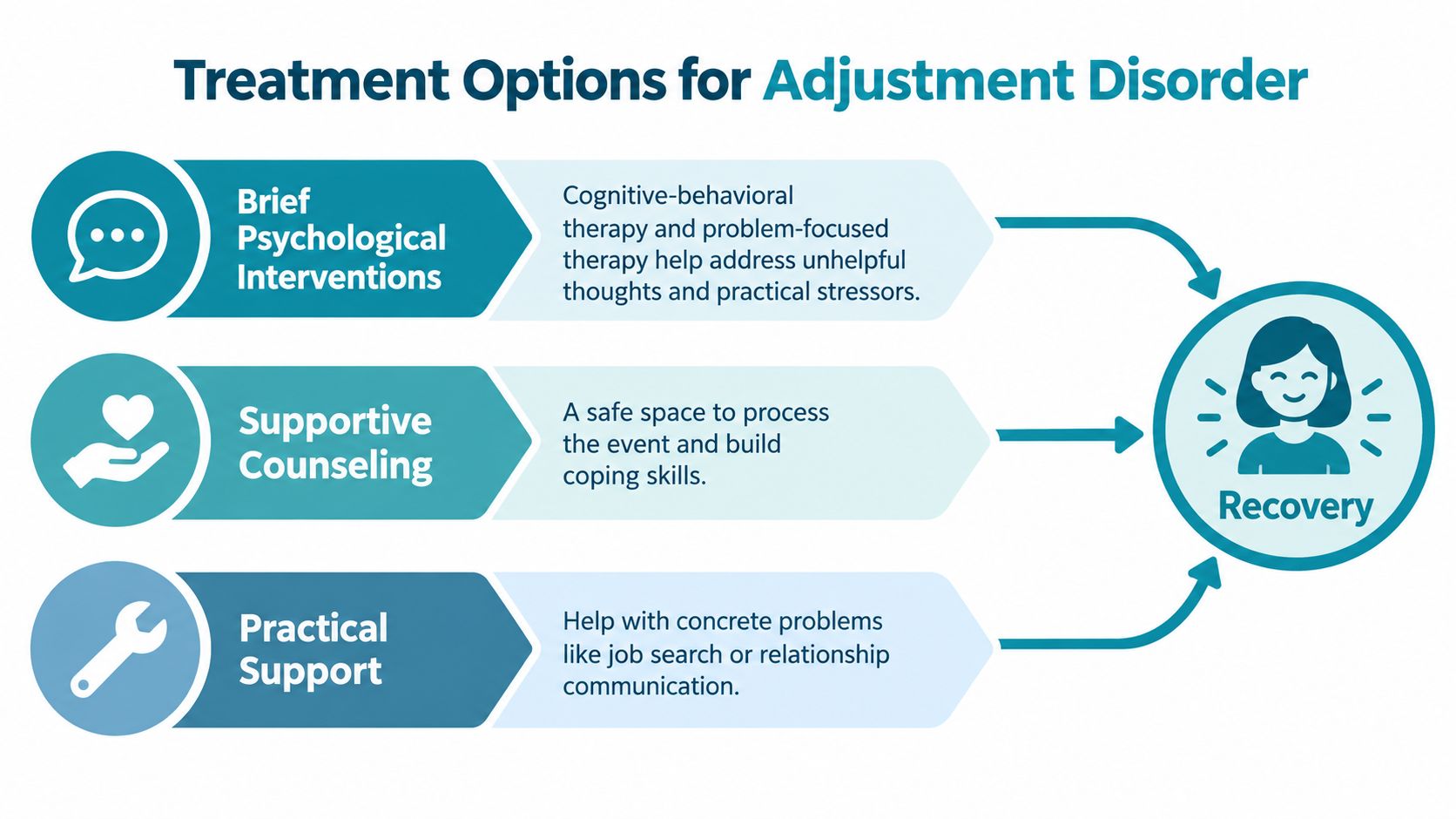
A stepped approach can be individualized
When treatment is needed, brief psychological interventions may help. Cognitive-behavioral therapy can help someone examine unhelpful thought patterns. Problem-focused work addresses specific challenges tied to the stressor, while supportive counseling offers space to process what happened and develop coping approaches.
Practical support can complement therapy. For example, someone facing job loss might work through job-search steps; a person dealing with a relationship change might need help improving communication or restoring disrupted routines. These supports do not replace clinical care when symptoms are severe or safety is a concern.
Evidence for specific treatments remains limited. The Merck Manual's professional discussion of adjustment disorders notes limited evidence for psychotherapy and medication, partly because adjustment disorder includes varied presentations. Findings do not establish one approach as suitable for everyone.
Medication decisions weigh prominent symptoms, co-occurring conditions, medical factors, and potential risks. Relief of a symptom does not establish that a medicine treats adjustment disorder itself. No medication is an automatic or universally appropriate treatment for the condition.
Practical rule: A care plan can include support and follow-up without medication. If the stressor continues or symptoms change, the plan may need review.
Reassessment can clarify whether symptoms fit depression, anxiety, trauma-related illness, substance-related conditions, bipolar-spectrum symptoms, grief, or a medical contributor. For more on PTSD evaluation, see the practice's discussion of trauma-related symptoms. This broader review keeps the initial label open to revision as circumstances or symptoms change.
What Evaluation Looks Like in Practice
A useful evaluation connects the event to the symptoms without assuming that the event explains everything. It typically considers when the stressor began, when symptoms appeared, how daily life has changed, and whether another condition or a safety concern needs attention. No single questionnaire establishes adjustment disorder on its own.
Hypothetical example
A hypothetical adult loses a job and later finds it difficult to sleep, concentrate, and keep up with daily responsibilities. A clinician might ask when those difficulties began, whether they are affecting work-related tasks or relationships, and what has changed since the job loss. The discussion could also cover previous mental-health episodes, substance use, sleep, and suicide risk.
The questions are not a proprietary checklist. They help build a clearer picture of the timeline and functioning, while allowing the clinician to screen for other explanations. The clinician may also ask whether practical supports are available and what difficulties remain unresolved.
If appropriate, the care plan might include supportive therapy, problem-solving, or assistance addressing practical stressors. A follow-up can review functioning, coping, safety, whether the stressor is still active, and whether the initial explanation still fits. No particular recovery timeline or outcome can be assumed.
A routine outpatient evaluation has limits. If someone may be in immediate danger or cannot stay safe, emergency or crisis support is more appropriate than waiting for an outpatient appointment. For general information about what psychiatric evaluation can involve, readers can find psychiatric evaluation in Ohio; the linked provider's information isn't a substitute for care suited to an individual's location and needs.
When Adjustment Disorder Becomes a Safety Concern
A time-limited diagnosis isn't automatically low-risk. A systematic review found a strong association between adjustment disorder and suicidal behaviors, while identifying gaps in evidence about effective treatment strategies (systematic review of suicidal behavior and adjustment disorder). Risk varies across people and settings, so a single number wouldn't capture an individual's situation.
Suicidal thoughts, a prior attempt, escalating substance use, severe difficulty functioning, or worsening symptoms warrant prompt professional attention. Clinicians may assess the person's current thoughts, history, access to means, social support, substance use, and context. That assessment should be individualized; it isn't replaced by a checklist or an online article.
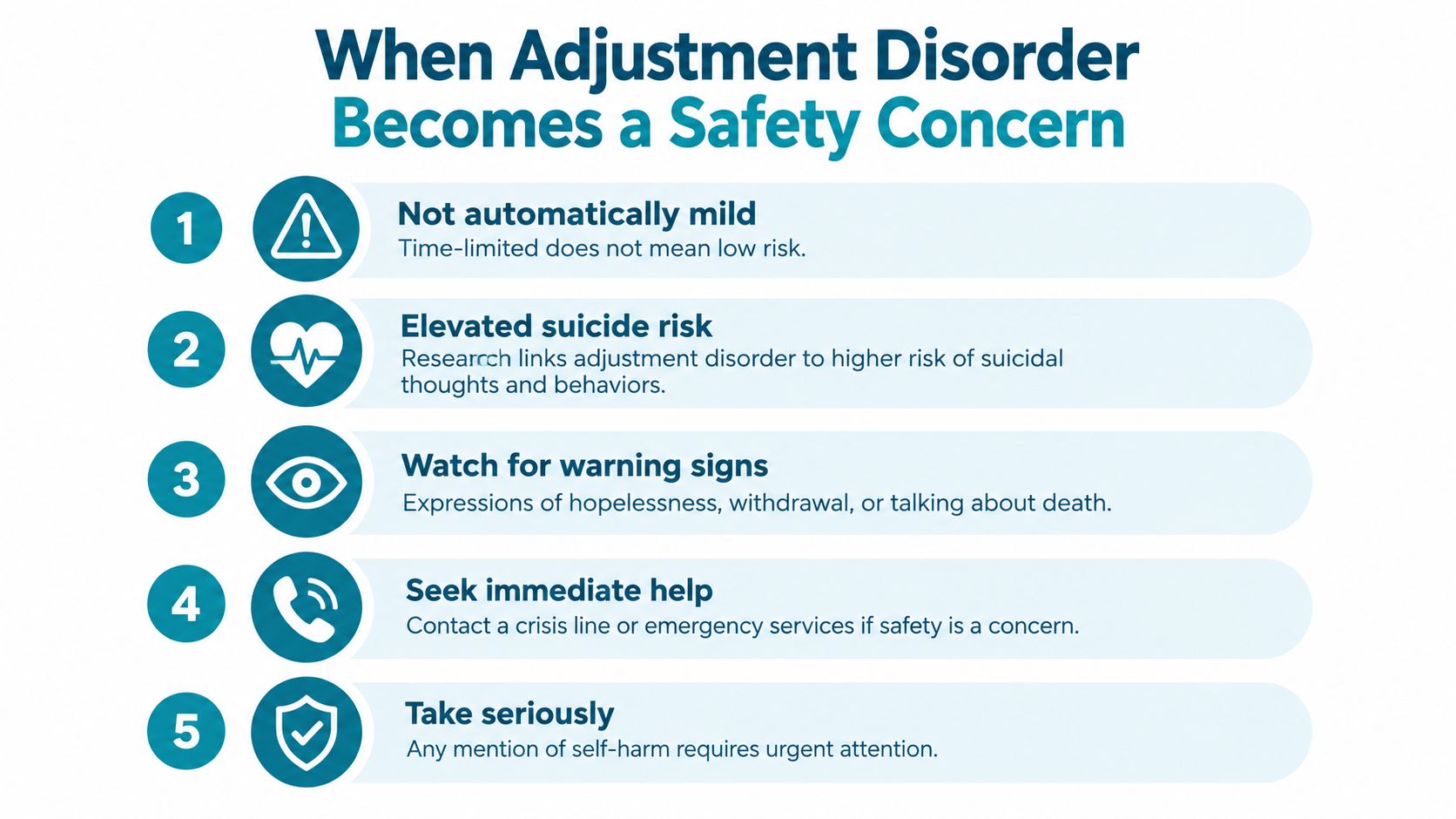
When urgent help is needed
Expressions of hopelessness, withdrawal, or talk about death deserve attention, especially when symptoms are escalating or functioning has sharply declined. Someone doesn't need to be certain that danger is imminent before reaching out for help. A clinician can help assess the level of risk and what support is needed.
In the United States, 988 connects people experiencing a suicidal or emotional crisis with crisis support. 911 is appropriate for immediate danger or a medical emergency. If a person may act on thoughts of self-harm or cannot remain safe, emergency assistance should be sought promptly.
Support from family, friends, or community can be valuable, but it shouldn't be treated as a substitute for professional assessment when safety is uncertain. Practical steps and clinical follow-up should reflect the person's circumstances rather than an assumption that symptoms will resolve on their own.
Considering Physician-Led Mental Health Care
An outpatient evaluation may be worth considering when distress continues, interferes with work or relationships, or follows a major event such as job loss, illness, or bereavement. A physician can assess timing and functioning, clarify whether another condition better explains the symptoms, review medication questions, and discuss appropriate next steps. Evaluation can also be useful when an existing diagnosis or treatment plan no longer seems to fit.
Empire Medical Wellness provides adult mental-health evaluation, diagnostic clarification, medication review, ongoing medication management, and coordination with an outside clinician when useful and authorized. The practice is private-pay and doesn't bill insurance directly. Its standard fee is $350 for a 50-minute initial evaluation and $225 for a 25-minute follow-up; an itemized receipt is available through the patient portal, but reimbursement can't be promised.
Adults considering physician-led outpatient care can learn more about Empire's mental-health services.
Sources
Medical information is linked inline above to MedlinePlus, a peer-reviewed review, and a professional clinical reference. The prevalence and safety sources are population-specific and don't predict an individual's diagnosis or risk.
This article is educational and isn't personal medical advice.
Empire Medical Wellness offers adults physician-led mental-health evaluation, diagnostic clarification, and individualized medication management. Adults seeking help understanding distress after a major life event can visit Empire Medical Wellness to learn about the practice's services.