
Rumination is repetitive negative thinking that loops without producing a next step. It can occur across depression and anxiety, but it isn't a diagnosis on its own.
A conversation has ended, yet the mental replay continues. An adult may keep reviewing a colleague's tone, searching for a mistake, or trying to determine what someone really meant. The effort can feel like problem-solving even when nothing new emerges.
By Empire Medical Wellness Editorial Team
Publication and update dates pending editorial publication.
Table of Contents
- What Rumination Actually Feels Like
- How Rumination Differs From Useful Thinking and Other Conditions
- Why Repetitive Thinking Gets Stuck
- Signs Your Thinking Has Become a Loop
- A Practical Exercise to Interrupt the Loop
- A Hypothetical Example of Putting It Together
- When Self-Help Is Not Enough and What an Evaluation Looks Like
- Key Takeaways and Finding the Right Care
What Rumination Actually Feels Like
The same question returns during breakfast, interrupts a work task, and resurfaces at bedtime. Each pass feels important, but the person reaches the same conclusion, or no conclusion at all.
A useful analogy is rereading a paragraph without taking in anything new. There's activity, but little movement. With rumination, the material is usually personally painful: a perceived mistake, an unresolved conflict, a loss, or uncertainty about what an experience means.
Recognizing the pattern without judging it
Mental-health researchers describe rumination as repetitive, negative thinking that can be difficult to disengage from. It commonly centers on personal problems and their causes or consequences rather than active problem-solving, as explained in this review of rumination in adult mental-health research.
The emotional tone matters, but so does the thinking process. A painful subject can deserve careful attention. The concern is whether attention remains flexible and useful or becomes repetitive and hard to redirect.
- Repeated review: The person revisits the same details without gaining information.
- An unfinished feeling: Another round of thinking seems necessary before attention can move elsewhere.
- Little practical movement: Analysis replaces a decision, a conversation, or another meaningful activity.
Practical rule: The usefulness of thinking depends less on how hard someone thinks and more on what that thinking makes possible.
Recognizing this pattern doesn't establish depression, anxiety, or another condition. It provides language for describing an experience that might otherwise be dismissed as overthinking.
That distinction also avoids blame. A person can care greatly about resolving a problem while becoming caught in a process that isn't helping resolve it.
How Rumination Differs From Useful Thinking and Other Conditions
Useful reflection and rumination can begin with the same event. Their difference becomes clearer when attention turns to what happens next.
Reflection and future-focused worry
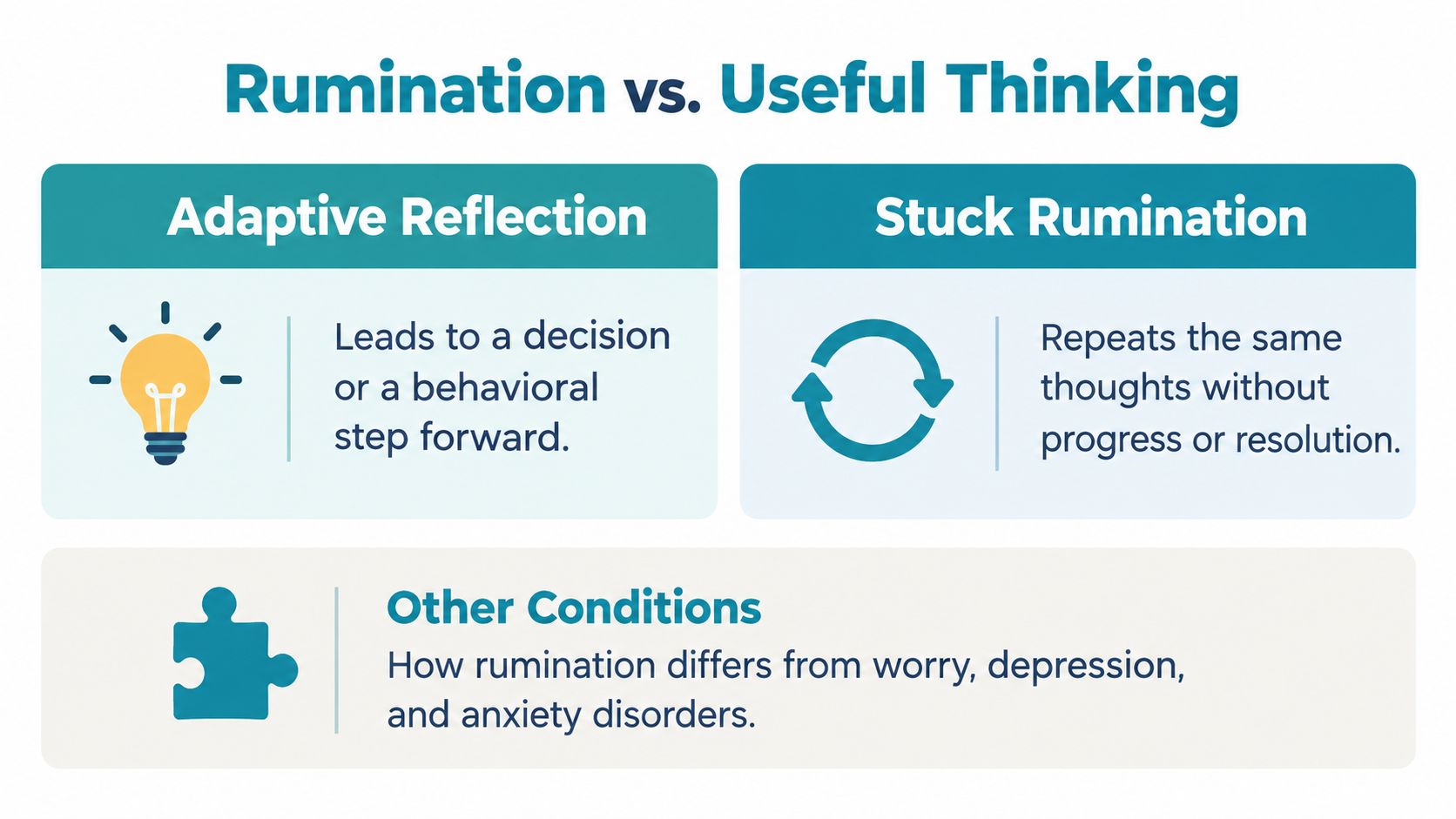
Adaptive reflection allows someone to consider an experience, identify what can be learned, and reach a decision or accept a limit. Stuck rumination repeatedly revisits the experience without adding information or supporting action.
In a hypothetical example, reflection after a difficult meeting might produce a plan to clarify an assignment. Rumination might involve repeatedly analyzing whether a brief response meant disapproval, despite having no additional evidence.
Worry generally looks ahead toward possible threats. Rumination more often reviews distress and its causes, meanings, or consequences. The boundary isn't absolute, and worry isn't automatically productive. Both can become repetitive negative thinking rather than useful preparation.
Performance-related concerns may make this distinction especially relevant. For an additional perspective on that context, Nick Donahue LICSW on high achiever therapy discusses therapy for high achievers. That resource isn't medical evidence or a basis for diagnosing rumination.
A separate condition with a similar name
Gastrointestinal rumination syndrome involves the repeated return of recently ingested food. It isn't the mental-health thinking pattern discussed here.
A systematic review reported pooled Rome IV prevalence estimates of 0.4% in children and 3.7% in adults, while emphasizing substantial differences across studies and diagnostic approaches (systematic review of rumination syndrome prevalence). These figures describe the gastrointestinal condition, not repetitive negative thinking.
Likewise, rumination shouldn't be used as shorthand for depression. Information about depression evaluation can help distinguish a broader mood concern from a thinking habit, but diagnosis requires more than recognizing a recurring thought.
Why Repetitive Thinking Gets Stuck
An unresolved question can seem to demand more attention. Someone may continue reviewing it because stopping feels like overlooking a mistake or abandoning a responsibility. That explanation can be understandable without making the continued review useful.
How distress and attention interact
Susan Nolen-Hoeksema's Response Styles Theory, introduced in 1991, described depressive rumination as repetitive, relatively passive attention to distress and its causes, meanings, and consequences. A major review explains proposed mechanisms: negative mood can shape which thoughts come to mind, while rumination can interfere with problem-solving and behavior that might improve mood (review of Response Styles Theory and rumination).
In everyday language, someone feeling ashamed may repeatedly retrieve details that fit that feeling. Reviewing those details can then make it harder to consider alternatives or return to an ordinary task.
Researchers also use transdiagnostic to describe processes that appear across diagnostic categories. Rumination has been discussed across depression, anxiety disorders, post-traumatic stress disorder, insomnia, and other conditions. That doesn't mean it causes each condition or that everyone who ruminates has one (review of repetitive negative thinking across disorders).
Why evenings deserve attention
A meta-analysis covering 49 studies and 45,287 participants found associations between rumination and both lower well-being and poorer sleep quality. These are associations, not proof that rumination alone causes sleep difficulties or reduced well-being (meta-analysis of rumination, well-being, and sleep).
A difficult evening is information about a pattern, not proof of a diagnosis.
Nighttime, loneliness, or distressing news may be useful contexts to record when they precede a loop. They shouldn't automatically be treated as established causes. Similarly, the self-report research indexed in PubMed should be understood as association evidence, not proof of causation.
A practical response is to observe when thinking becomes less useful and what it displaces, rather than searching for a universal explanation.
Signs Your Thinking Has Become a Loop
The most informative question isn't whether a thought has returned. It's whether the person can engage with it flexibly and then resume life.
A recurring concern may still be useful if circumstances have changed or new information is available. Concern becomes more significant when the thinking repeats, attention feels difficult to shift, and ordinary functioning suffers.
Reflection vs Rumination at a Glance
| Marker | Adaptive Reflection | Rumination Loop |
|---|---|---|
| New information | Incorporates evidence or another perspective | Reviews essentially the same material |
| Direction | Moves toward understanding, acceptance, or action | Returns to causes, blame, or consequences |
| Flexibility | Can pause when another task needs attention | Feels difficult to leave unfinished |
| Emotional effect | Allows perspective, even if sadness remains | Repeatedly returns attention to distress |
| Daily functioning | Leaves room for work, rest, and connection | Interferes with sleep, concentration, or relationships |
This is an educational comparison, not a diagnostic checklist or a scoring system. No single row establishes a disorder.
Questions worth recording
- Frequency: How often does the same loop return?
- Controllability: Can attention shift, even if the concern remains?
- Purpose: Has the thinking produced a decision or only repeated a point?
- Impact: What happens to mood, sleep, work, and relationships?
Some people continue ruminating because it feels analytical, useful, or protective. A replication study found associations with positive beliefs about rumination and related thinking tendencies, which helps explain why effort alone may not distinguish useful reflection from a loop (research on beliefs about rumination).
When low mood is also persistent, information about persistent depressive disorder may provide useful background. The duration and broader symptom pattern still require clinical assessment rather than inference from repetitive thinking.
A Practical Exercise to Interrupt the Loop
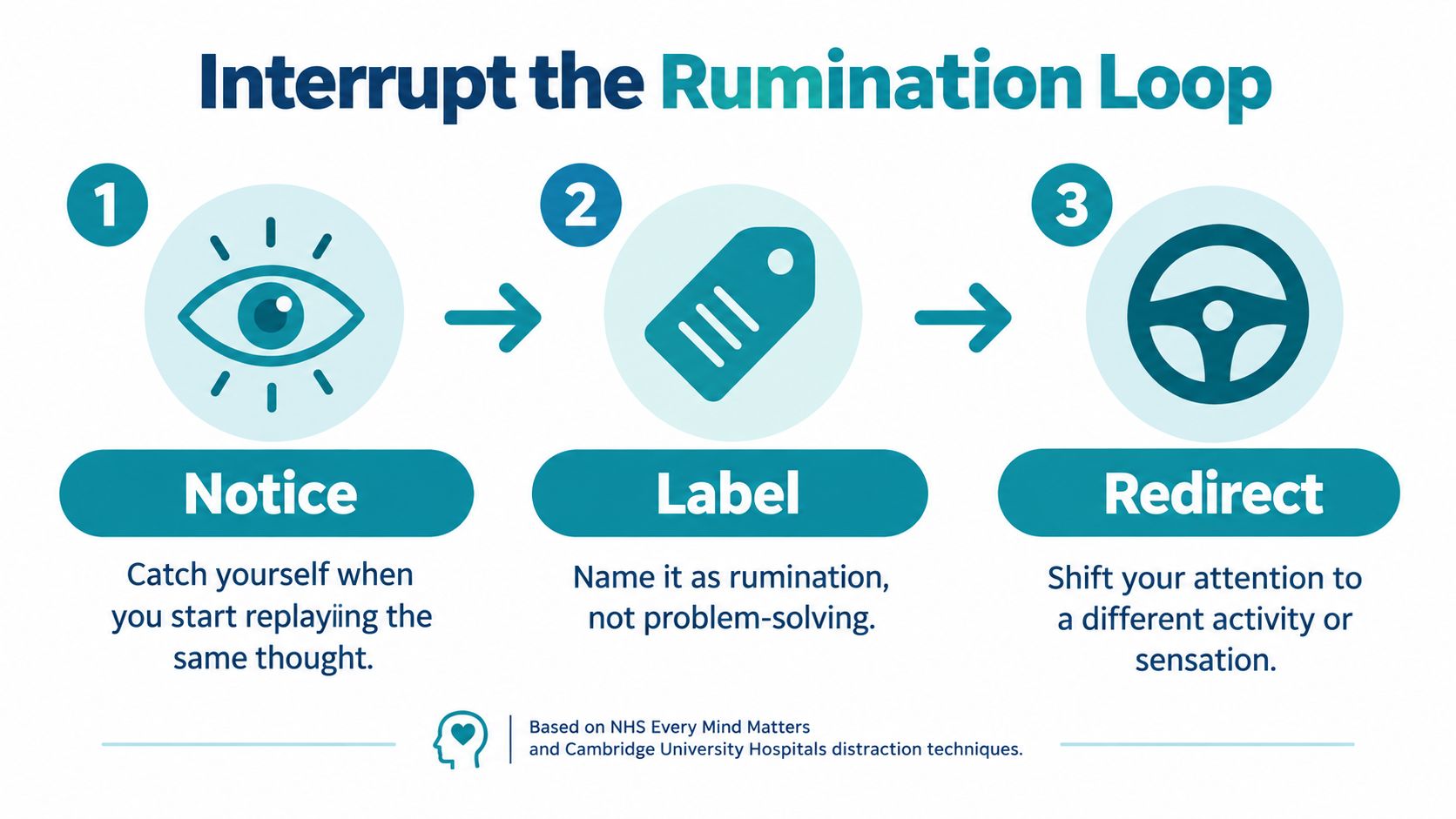
Notice, label, redirect is a practice framework for changing the response to a recurring thought. It combines recognizing repetition, distinguishing practical concerns from hypothetical questions, and deliberately returning attention to an activity.
The approach draws on the NHS Every Mind Matters guidance on tackling worries and Cambridge University Hospitals techniques for unhelpful thoughts. It isn't a separately validated treatment protocol or a guaranteed cure.
Notice, label, redirect
- Notice the repetition. The cue might be another replay of the same sentence or the realization that a task has been abandoned.
- Label the process briefly. A neutral label such as “replaying” or “stuck analysis” can describe what's happening without judging the person.
- Redirect toward something chosen. Attention can return to preparing a meal, completing a work task, or listening to a friend. When it wanders back, the practice is to return gently again.
A short thought record
A brief record can prevent the exercise from becoming another lengthy analysis:
| Entry | What to record |
|---|---|
| Concern | The issue, written once |
| Known facts | What was directly observed |
| Uncertainty | What cannot currently be established |
| Action | A realistic next step, if one exists |
| Return | The activity attention will return to |
| Observation | Any emotional or physical change, including no change |
The purpose isn't to suppress thoughts or force calm. It's to separate a solvable problem from a question that continued review can't answer.
For broader reading, Addiction Resource Center LLC offers practical CBT tools for recovery. That resource has a substance-use recovery focus and isn't evidence for treating rumination or an implication that rumination indicates addiction.
General stress-management information may also provide context alongside individualized care.
A Hypothetical Example of Putting It Together
The following example is illustrative, not an actual patient account or a reported treatment outcome.
An adult keeps replaying a work conversation. A colleague's brief response has become the focus of repeated analysis. The replay interrupts concentration during the day and continues when the adult tries to sleep.

The image is illustrative and doesn't depict an identified patient.
During the workday
After noticing another replay, the adult labels it as repeated interpretation rather than new information. A thought record separates what happened from what remains unknown.
| Thought-record field | Hypothetical entry |
|---|---|
| Concern | The conversation may have gone poorly |
| Known facts | The colleague gave a brief response |
| Unknown | What the colleague privately thought |
| Actionable issue | Whether the assignment needs clarification |
| Next step | Send a concise task-focused follow-up |
| Redirect | Return to the document already open |
The follow-up addresses the practical issue. It cannot establish everything the colleague meant, and the exercise doesn't require that certainty before work resumes.
If the replay returns, the adult can notice that return without treating it as evidence that the exercise failed. The chosen activity remains the document, not another attempt to interpret the colleague.
At the end of the day
The adult records an estimate of minutes lost to the loop and a functional goal, such as completing a task or returning to a usual bedtime routine. Emotional and physical observations can remain descriptive: tense, unsettled, unchanged, or more able to concentrate.
Progress tracking should describe what happened, not manufacture a success story.
No improvement is assumed. A record showing continued disruption can be just as useful when discussing the pattern with a clinician.
When Self-Help Is Not Enough and What an Evaluation Looks Like
Persistent disruption of sleep, work, concentration, or relationships warrants assessment. Self-help tools can support care, but they aren't a substitute for treatment when symptoms remain impairing.
The clinician's task is broader than confirming that someone ruminates. An evaluation may explore when the pattern began, current stressors, mood and anxiety symptoms, sleep, medical history, medications, and safety.
Questions that clarify the next step
- Pattern: How often does the loop recur, and what usually precedes it?
- Function: Does it produce a decision or repeat the same point?
- Flexibility: How difficult is it to shift attention?
- Consequences: What happens to sleep, work, and relationships?
- Broader symptoms: Are there other changes in mood, anxiety, or daily functioning?
Someone seeking a private, physician-led adult mental-health evaluation can bring a short thought record and questions about diagnostic clarification. Medication review, psychotherapy with an appropriate clinician, or other options may be discussed according to the assessment. Rumination alone doesn't establish a need for medication.
Treatment approaches can address the repetitive thinking process rather than debating every thought individually. An American Psychological Association overview describes a framework combining emotional-regulation skills with actions aligned with personally important directions (APA overview of treatment for perseverative distress). That describes a treatment model, not a guaranteed outcome.
When safety becomes the priority
In the United States, 988 provides mental-health crisis support. 911 is appropriate for immediate danger.
A person experiencing thoughts of self-harm or uncertainty about staying safe needs prompt support rather than relying on a thought record or distraction exercise. Routine tracking should never delay urgent help.
Key Takeaways and Finding the Right Care
The most useful distinction is between thinking that supports engagement with life and thinking that repeatedly interrupts it. The subject may deserve attention even when another round of analysis doesn't.
A compact reference can help keep self-observation focused:
- Identify the process: Notice repetition, difficulty disengaging, and the absence of new information.
- Check the consequence: Record effects on a meaningful activity rather than judging the presence of a thought alone.
- Choose a response: Use a brief label, separate action from uncertainty, and return attention to a chosen activity.
- Escalate when needed: Bring persistent impairment and broader symptoms to a qualified clinician.
When repetitive thinking concerns a traumatic experience, information about post-traumatic stress disorder may help frame questions for an evaluation. The subject of a thought alone doesn't establish that diagnosis.
Sources
The linked sources distinguish different kinds of evidence. Foundational theory and clinical reviews explain the process; observational research describes associations; the NHS and Cambridge University Hospitals resources provide practical self-help guidance. The comparison table and illustrative thought record are educational tools, not diagnostic instruments.
A useful clinical conversation can begin with concrete observations: what repeats, what has already been tried, and which part of daily life has become harder. Certainty about the diagnosis isn't required before seeking clarification.
Empire Medical Wellness offers physician-led adult mental-health evaluation, diagnostic clarification, medication review, and ongoing medication management. Adults whose repetitive thinking disrupts daily life can visit Empire Medical Wellness to explore the practice's mental-health services and discuss an appropriate next step. This article is educational and isn't personal medical advice.