
You've probably tried at least one strict plan that felt fine for a few weeks, then got harder to live with. That's a common place to start looking for a balanced diet for weight loss, because the core question isn't just what helps weight come off, it's what you can keep doing without feeling constantly deprived.
A balanced approach has two jobs at once. It has to create a calorie deficit, and it has to stay nutritionally complete enough that you can stick with it. A peer-reviewed review states that weight loss is not possible without negative energy balance, meaning energy intake must stay consistently lower than energy expenditure, even when food patterns differ widely (source).
Table of Contents
- What a Balanced Weight-Loss Diet Actually Means
- Setting a Calorie Target You Can Actually Maintain
- Macronutrients and the Balanced Plate
- Building a Day of Balanced Eating
- Making the Plan Stick in Real Life
- Tracking Progress and Knowing When to Ask for Help
- Key Takeaways and a Note on Personalized Care
What a Balanced Weight-Loss Diet Actually Means
You may have already lived through the usual cycle. Low-carb for a while. Then low-fat. Then calorie counting that got more annoying than useful. A balanced plan is different because it isn't trying to win on novelty, it's trying to win on repeatability.
A balanced balance diet for weight loss is not a fixed food list. It's a pattern of eating that creates a modest energy deficit while still giving you enough protein, fiber, fluids, and food variety to stay comfortable and functional. That matters because the body doesn't care whether weight loss came from a trendy label, it responds to the size of the deficit and whether you can sustain it.
The two mechanisms that matter most
The first mechanism is straightforward. Energy intake has to stay below energy expenditure long enough for the body to use stored energy. The second is more practical, and it's where many plans fail. Food quality affects hunger, meal satisfaction, social fit, and the chance you'll keep going when the first burst of motivation fades.
Practical rule: If a plan makes you feel like you're “on” a diet every day, it's probably too rigid to last.
A balanced plan is also not the same thing as perfect nutrition. It's closer to a workable compromise, enough structure to keep intake lower, enough flexibility to fit real meals, and enough nutrient density to reduce the odds that you rebound when life gets busy. That's why the rest of this guide treats calories, food quality, and behavior as one system instead of separate boxes.
For a clinical overview of how physician-led care approaches weight management, see the Empire Medical Wellness weight loss service page.
Setting a Calorie Target You Can Actually Maintain
The easiest mistake is guessing. The second easiest is slashing calories so hard that the plan collapses under hunger, fatigue, or constant food preoccupation. A more workable starting point is a structured deficit of about 500 to 1,000 kcal/day, which is commonly associated with a target loss rate of 0.5 to 1.0 kg per week when it's matched to a person's energy needs, BMR, BMI, and activity level (source).
Start by seeing what you already eat
A JAMA patient-education article recommends tracking usual intake for 3 to 5 days, then reducing intake by 500 to 1,000 calories per day as a planning framework, while warning not to eat less than 1,000 calories per day without medical supervision (source). That doesn't mean everyone should land at the same number. It means a real baseline is better than a guess, because activity level, body size, and hunger response all change the target.
The energy math behind weight loss is often misunderstood. NIH summaries note that roughly 4,500 kcal of net deficit is needed to lose 0.5 kg per week because 1 kg of fat contains about 9,000 kcal (source). That's useful as a planning anchor, not a promise.
If the number feels aggressive, it probably is. A moderate deficit that you can repeat usually beats a bigger deficit that lasts two weeks.
Adjust after you've given it time
A good rule is to hold a plan steady long enough to see a trend, then adjust based on reality. If your weight trend is flat after a couple of weeks of consistent intake, the issue may be that the deficit is smaller than you thought, or that eating patterns have drifted. If you feel depleted, sleep worsens, or you're thinking about food all day, the target may be too tight.
The point isn't to chase the fastest possible drop. The point is to build a calorie plan that fits your life closely enough to survive ordinary workdays, weekends, and restaurant meals. For a physician-led overview of structured weight management, see the Empire Medical Wellness lose weight page.
Macronutrients and the Balanced Plate
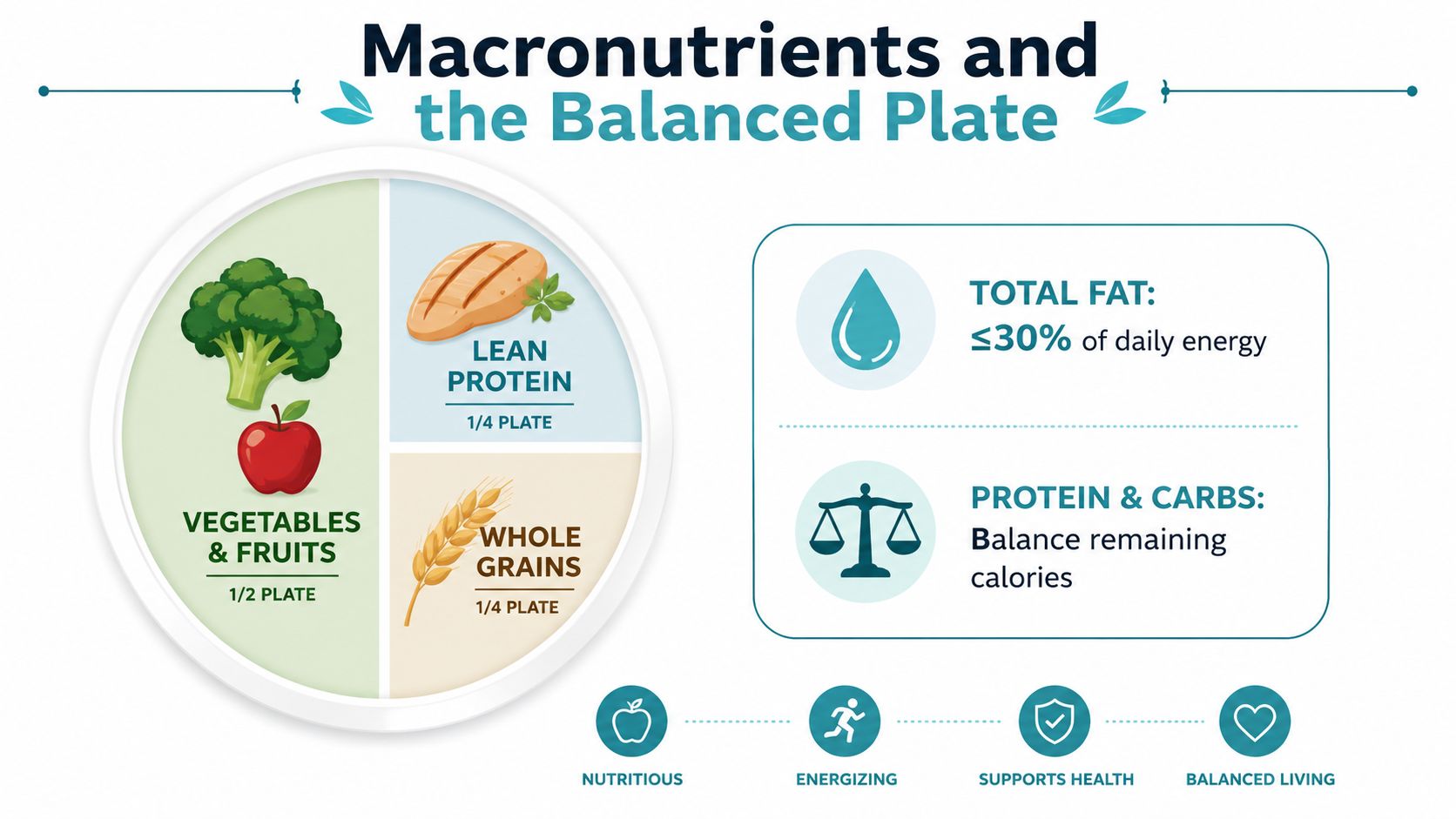
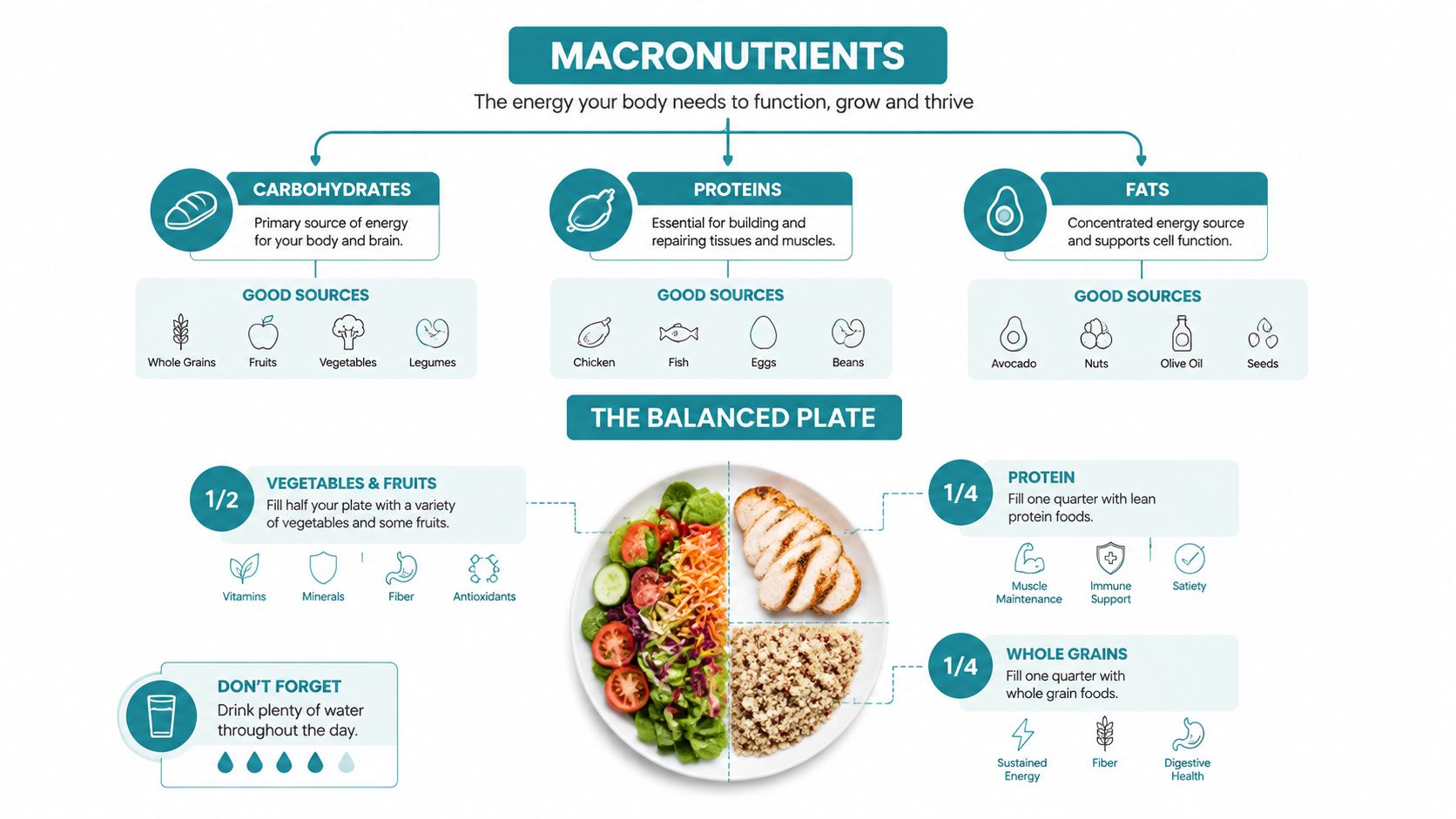
Once calories are set, the next question is what fills the plate. That's where macronutrients matter, not because one split is magical, but because the mix affects satiety, energy, and how easy the deficit is to maintain. The WHO states that for adults, keeping total fat at 30% or less of daily energy intake may help prevent unhealthy weight gain, and the NHS Eatwell Guide recommends at least 5 portions of fruit and vegetables daily, higher-fiber starchy foods as the base of meals, some dairy or dairy alternatives, and protein from beans, pulses, fish, eggs, meat, or other sources (sources, NHS balanced diet guidance).
What belongs on the plate
A practical plate pattern is simple enough to remember. Half the plate is vegetables and fruit. One quarter is lean protein. One quarter is higher-fiber starch such as brown rice, oats, whole-grain bread, beans, or potatoes in sensible portions. That pattern helps because vegetables add volume, protein helps with fullness, and fiber-rich starches can make the meal feel complete instead of punitive.
The details matter less than the overall pattern over time. In a 2-year randomized trial of 811 adults, all four reduced-calorie diets produced about 6 kg loss at 6 months, and the average loss at 2 years remained similar across diets, with 3.0 to 3.6 kg in the 15% vs 25% protein groups, 3.3 kg in both the 20% vs 40% fat groups, and 2.9 to 3.4 kg in the 65% vs 35% carbohydrate groups (source). That finding is one reason rigid macro debates often miss the point. Consistency matters more than chasing the “right” ratio for everyone.
When a more technical macro plan makes sense
Some active weight-loss settings use more precise nutrient targets. One approach summarized in the literature used net carbohydrate 2 to 2.5 g/kg body mass, protein 1.8 to 2.2 g/kg body mass, and fat 1.0 g/kg body mass, and the authors reported that, when combined with exercise, the nutrient-balance diet was more effective than a caloric-balance diet for body-composition change (source). That doesn't mean everyone needs to track at that level.
Precision is the main implementation risk. If tracking slips, the plan often drifts back toward low-protein, energy-dense eating, and that can make satiety worse. For many adults, a plate method is easier to follow than gram-level math.
For readers who like a visual template, the Empire Medical Wellness plate method article fits well with this kind of structured eating.
Building a Day of Balanced Eating
A balanced day doesn't need to look fancy. It needs to be predictable enough that you can repeat it on ordinary weekdays, then adapt it on weekends without throwing the whole plan off. A strong pattern usually starts with protein, uses fiber to slow hunger, and leaves room for a planned snack instead of random grazing.
A simple example of a repeatable day
Breakfast can be something like Greek yogurt with berries and oats, or eggs with vegetables and whole-grain toast. Lunch might be a large salad with chicken or beans, plus a whole-grain side or a piece of fruit. Dinner can follow the same structure as the plate model, vegetables first, then protein, then a measured starch.
A planned snack can help if long gaps lead to overeating later. Think of fruit with nuts, cottage cheese with vegetables, or hummus with raw vegetables. The point is not to ban snacks, it's to place them on purpose so they support the deficit instead of eroding it.
Practical rule: Build each meal around protein and fiber, then add starch or fat to taste, not by default.
Meal timing is less settled than most people think
Emerging and recent reviews in the medical literature still do not show a single universally superior timing pattern, even though some papers discuss higher-calorie breakfasts, overnight fasting, or small frequent meals as possible strategies (source). That's why people arguing over whether breakfast is mandatory often miss the larger issue. The best pattern is the one that controls appetite and total intake without making adherence worse.
That can mean different things for different people. Some adults feel better with breakfast. Others prefer later meals and fewer eating windows. A few do best with three steady meals and no snacks. What matters most is that the day's food pattern fits your appetite, work schedule, and social life without creating constant rebound hunger.
For meal ideas and portion structure that stay close to this pattern, see the Empire Medical Wellness weight loss meals page.
Making the Plan Stick in Real Life
A diet can be nutritionally sound and still fail if it doesn't fit your actual week. Travel, family meals, late meetings, and shift work all change how people eat, and those constraints are clinical realities, not moral failings. Mayo Clinic emphasizes that a weight-loss diet should be varied, nutritionally balanced, and doable long term, and that there is no single best balanced diet for everyone (source).
Common barriers and workable responses
If you travel, keep the meal structure, not the exact foods. If lunch is unpredictable, lean on protein-forward breakfast choices and choose the most vegetable-heavy option you can find later in the day. If family meals are the challenge, serve the same dinner for everyone and adjust portions, instead of cooking two separate menus.
Smaller plates can help with portion control, and planning meals ahead reduces the “what's available right now” problem. The NHS also advises portion control and meal planning as practical supports for adherence, which fits well with a flexible whole-foods pattern rather than rigid restriction (NHS balanced diet guidance).
Here's a short checklist many adults find useful in the first month or two:
- Plan the next day's lunch the night before. That removes one decision when you're tired.
- Keep energy-dense drinks low. Liquid calories don't satisfy hunger very well.
- Use a plate structure at home. It makes portions easier without constant measuring.
- Default to nutrient-dense foods when you're unsure. Protein, vegetables, fruit, beans, and whole grains usually fit the plan better than ultra-processed snacks.
- Expect imperfect days. One restaurant meal doesn't ruin a pattern unless it turns into a week.
A brief reality check on persistence
NIH material reports that about 40% to 50% of participants drop out before reaching goals in weight-loss studies, and in some studies only 30% of those who reached goal maintained the loss for at least 18 months (source). That's why balanced, sustainable eating gets more emphasis than crash diets. The problem is rarely effort alone. It's usually effort plus a plan that was too hard to live with.
Tracking Progress and Knowing When to Ask for Help
Monitoring does not have to become obsession. A weekly weigh-in, a simple food log during the first month or two, and a quick check on energy, hunger, and sleep are usually enough to tell you whether the plan is working. NIH/NCBI maintenance guidance recommends decreasing energy-dense foods, using self-monitoring such as regular weighing and recording food and physical activity during the first month or two of maintenance, and pairing dietary change with about 60 minutes of daily activity or 2,000 to 3,000 kcal per week of expenditure (source).

What to watch besides the scale
Scale trend matters, but it's not the only signal. If your clothes fit differently, your hunger is less frantic, and your energy is steadier, the plan may be on track even before the numbers move much. On the other hand, if fatigue rises, sleep worsens, or cravings become all-day noise, the deficit may be too aggressive or too hard to sustain.
A food log should stay simple. You're looking for patterns, not perfection. Did protein show up at most meals? Did late-night eating creep in? Did restaurant meals turn into all-day grazing? Those answers usually tell you more than a single weigh-in.
When physician input becomes useful
It's reasonable to involve a physician if weight returns quickly after loss, progress stalls despite consistent effort, or the plan is causing side effects that make everyday functioning harder. Medical input also matters when there are medication interactions, chronic conditions, or a history that makes unsupervised restriction less safe. In obesity medicine, the role of the clinician is to help align nutrition, behavior, and treatment options with your medical picture rather than to push a one-size-fits-all plan.
For adults considering medication options alongside nutrition changes, the Empire Medical Wellness GLP-1 vs phentermine page is a relevant place to compare general categories in a physician-led setting.
Key Takeaways and a Note on Personalized Care
A balanced diet for weight loss works best when it stays simple enough to repeat. The durable pieces are a moderate calorie deficit, a balanced plate built from whole foods, and a plan that fits your schedule well enough to last. The food pattern matters, but long-term consistency matters more than a perfect macro split.
Neutral clinical guidance emphasizes that a weight-loss diet should be varied, nutritionally balanced, and doable long term, and that there is no single best balanced diet for everyone. The practical goal is a calorie deficit built from foods you can repeat consistently, not a short burst of restriction that falls apart as soon as life gets busy (source).
If you've already tried several plans and want a more individualized look at calories, food structure, monitoring, and whether medication belongs in the conversation, Empire Medical Wellness offers physician-led obesity medicine visits that can help organize those pieces. Visit Empire Medical Wellness to learn more about their weight-management care and decide whether a structured medical evaluation makes sense for you.
This article is educational and not personal medical advice. If you're having severe symptoms, feel unwell on a restrictive plan, or have a medical condition that affects eating, contact a clinician promptly.