
Ozempic face is a non-medical media term for facial volume and skin changes that can show up after meaningful GLP-1 weight loss. Those changes track with overall weight loss, not a unique drug effect on the face.
If you're noticing a thinner look in the mirror after starting a GLP-1 medication, you're not alone, and you're probably asking the right question. The face can change when body fat drops quickly, especially if the loss is substantial enough that the skin and soft tissues haven't fully adapted yet.
Table of Contents
- What People Mean by Ozempic Face
- How GLP-1 Medications Change the Face
- Common Signs and How Quickly They Appear
- Who Is More Likely to Notice These Changes
- Practical Ways to Support Facial Volume During Treatment
- The Part Most Articles Skip Confidence and Quality of Life
- What to Track and When to Talk With a Clinician
- A Calmer Way to Think About the Whole Picture
What People Mean by Ozempic Face
Ozempic face is a popular phrase, and people use it to describe facial hollowing, softer support in the cheeks, and looser skin that can become more noticeable after weight loss with GLP-1 medications such as semaglutide. The label spread as these medicines moved beyond early diabetes care into broader weight-management use after FDA approval for diabetes in 2017 and FDA approval for weight management in 2021.
The important distinction is that these facial changes usually come from whole-body fat loss. The medication is affecting appetite and calorie intake, then the body draws on stored energy across many sites, including the fat that helps keep the face looking full. Mayo Clinic's explanation of “Ozempic face” gives a plain-language summary of that process. SingleCare's GLP-1 statistics overview also summarizes how quickly this category of medication became more widely recognized.
What this article will and won't do
This is an educational guide for adults researching obesity medicine. It will not tell you to start, stop, or change a medication, and it will not diagnose you from appearance alone. It is meant to help you understand what the phrase points to, why facial changes happen during treatment, and what to bring up in a real clinical visit.
A practical way to read the change is this. If the face looks different while the scale is moving, the first question is usually about weight-loss kinetics, meaning the pace and pattern of loss throughout the body.
That framing keeps the discussion accurate. It also keeps attention on monitoring, nutrition, and planning, instead of treating a facial change as if it were a separate disease. It is also the kind of language that can help a patient describe the concern clearly to a clinician, especially when the issue is more about changing volume than about the medication acting on the face itself.
How GLP-1 Medications Change the Face
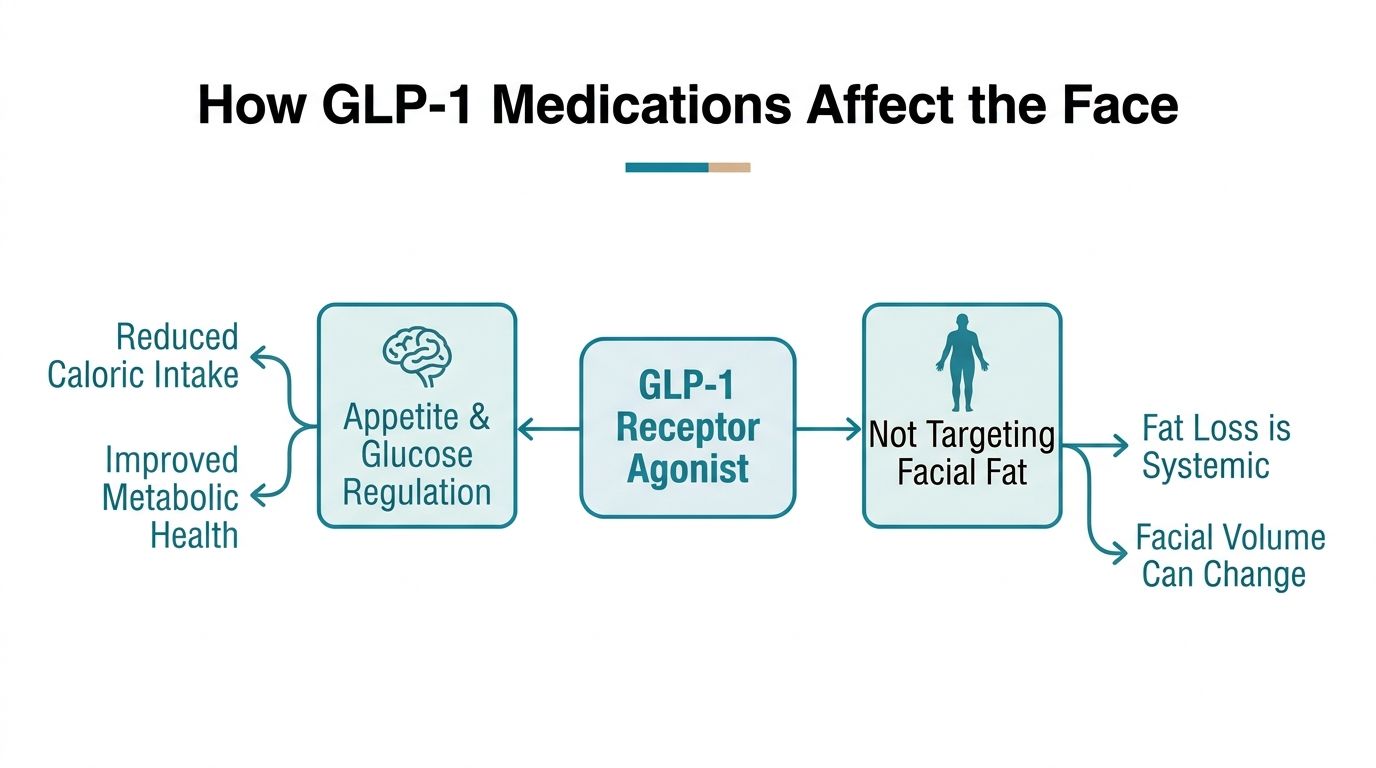
GLP-1 receptor agonists work on appetite and glucose regulation, and that change in signaling can alter body composition over time. They reduce hunger, help people eat less, and support lower calorie intake. As the body draws on stored energy, fat loss happens systemically, across multiple sites at once.
Why the face changes before people expect it
Facial soft tissue provides support in the cheeks and temples. When that support thins, the face can look less full, the same way a cushion looks flatter after some of the stuffing is gone.
That is why people may notice changes in cheek fullness, jawline contour, or skin laxity even though the medication is not targeting the face itself. A 2025 systematic review in plastic surgery literature described these changes as a downstream result of rapid body-fat reduction, and it cited radiographic evidence showing an average 7% loss of midfacial volume for every 10 kg of weight lost. The review in PMC also notes that visible sagging often becomes more apparent with larger total losses.
A clinical visit can make this easier to discuss. The phrase Ozempic face is often shorthand for a body-wide weight-loss pattern showing up where volume is easy to see, and readers looking for a practical overview of treatment questions can also review Empire Medical Wellness's Ozempic information page.
Why the speed of loss matters
The face has to adjust as the rest of the body changes. If weight drops faster than soft tissues can remodel, the mismatch becomes more visible. That helps explain why the same medication can look different from one person to another.
The product labeling also matters clinically. Ozempic pens are designed for once-weekly subcutaneous use and deliver fixed doses of 0.25 mg, 0.5 mg, 1 mg, or 2 mg depending on formulation. DailyMed's Ozempic prescribing information describes that weekly subcutaneous dosing design, which helps frame the change as part of a structured medical process rather than a sudden cosmetic event.
Facial change is usually downstream of overall loss, a pattern patients can mention in clinic when they want to describe volume loss rather than a problem isolated to the face.
Common Signs and How Quickly They Appear
The earliest changes people usually mention are visual, not painful. Cheeks can look flatter. Temples can look a little hollow. The folds around the mouth may stand out more because the surrounding support has softened. Some people also notice a looser jawline or a more drawn overall appearance.
What people tend to notice first
The signs often overlap with ordinary facial aging, which is why the phrase causes confusion. Facial aging is multifactorial. Weight loss can make preexisting lines or laxity easier to see, but it isn't the only reason a face changes over time. That's one reason a calm, clinical look at the whole picture matters more than a quick label.
A useful way to think about it is through thresholds rather than exact predictions. The literature notes that noticeable sagging and skin laxity often become most apparent after about 10% to 20% total body-weight loss, and this can happen within 2 to 6 months in some patients using semaglutide. The PMC review on GLP-1 and facial changes places those visible changes in context.
Reported Facial Changes and Approximate Timing
| Common Visible Sign | Approximate Trigger | Typical Window |
|---|---|---|
| Hollowing at the temples | Ongoing overall fat loss | Often noticed after meaningful body-weight reduction |
| Flattening of the cheeks | Loss of midface volume | Can appear as weight loss becomes more visible |
| More pronounced nasolabial folds | Reduced soft-tissue support | Often noticed when facial fullness drops |
| Looser skin along the jawline | Skin laxity after fat loss | May become clearer during the first months of rapid change |
| Generally more drawn appearance | Combination of volume loss and remodeling | Often noticed during active weight-loss phases |
The important caveat is that no table can diagnose a person. A changed face doesn't tell you why the change happened by itself. It's a prompt to look at the broader pattern, not a conclusion.
Who Is More Likely to Notice These Changes
A face does not change in isolation. People notice Ozempic face more or less strongly because they begin with different amounts of baseline reserve, and because they lose weight at different speeds. Someone with fuller cheeks at the start may have more soft-tissue support to lose. Someone who begins with less facial volume may see changes sooner. A faster pace of weight loss can make those shifts more visible in a shorter time.
Fixed factors that set the baseline
Age shapes the skin's ability to bounce back, because elasticity changes over time. Genetics matter too, since facial fat is distributed differently from one person to the next. Sun exposure, smoking history, and prior weight cycling can also affect how much support the skin has when weight drops.
Those factors help explain why two adults can look very different during the same treatment, even if they are using the same medication. None of them reflect character or discipline, and none can be determined with certainty just by looking at a face.
Adjustable factors that can be discussed in clinic
The more changeable side is the practical one. Faster dose escalation can mean faster weight loss. A large calorie deficit leaves the body with less room to adapt. Inadequate protein or micronutrient intake can make the whole weight-loss phase feel more draining. Hydration, sleep, and resistance training influence how well lean tissue is preserved while the body is changing.
If a patient wants a concrete way to discuss this with a clinician, a simple framing can help: ask whether the rate of loss matches the amount of body fuel, protein, and recovery support being provided. A balanced plan for meals during weight loss, such as a balanced meal approach for weight loss, can also be part of that conversation.
Risk here is layered, and it does not mean personal failure.
That is why two adults can take the same medication and have very different experiences. One may see almost no facial change. Another may notice a sharper look early on. Both experiences can be real, and neither one tells the full medical story by itself.
If you are comparing your experience with someone else's, pause at the comparison. The better question is whether your own pace of loss, nutrition, and facial reserve are being monitored in a way that fits your goals.
Practical Ways to Support Facial Volume During Treatment

The most useful approach is layered. A cream, supplement, or procedure by itself usually cannot fully counter facial change that happens during medication-related weight loss. The practical goal is to support the body while weight is coming off, then decide whether facial treatment makes sense after the pattern has settled.
Start with nutrition and training
Adequate protein and enough total food intake matter during weight loss because the body needs building blocks as well as a calorie deficit. Resistance training helps preserve lean mass, which supports overall body composition during treatment. Hydration and sleep are recovery inputs, not luxuries. When people feel depleted, the whole experience of weight loss tends to look and feel worse.
A sensible skincare routine can help the surface layer look healthier even though it will not replace lost volume. Focus on barrier support and sun protection. That means gentle cleansing, moisturizing, and daily sunscreen rather than chasing miracle actives.
Cosmetic options belong later, after the pattern settles
Once weight has stabilized, a dermatologist or plastic surgeon may discuss hyaluronic acid fillers, biostimulators, or skin-tightening procedures. Those tools can help address volume loss or laxity in selected cases, but timing matters. Doing procedures while the face is still changing can make results harder to judge.
A practical sequence is simple. Support the body during active loss. Reassess once the trend slows. Then decide whether the face needs a procedural plan.
For adults comparing treatment paths, Empire Medical Wellness also discusses physician-led obesity medicine as one part of a broader medical visit when anti-obesity medication is being considered or monitored. If you want the office-level overview, see the practice's GLP-1 information page and bring questions about facial change, nutrition, and follow-up into the conversation.
If the face is changing while the weight is still changing, it is usually too early to judge the final result.
For a practical food framework, this balanced meal guide can help people think about structure without turning food into a guessing game.
The Part Most Articles Skip Confidence and Quality of Life
The cosmetic part is only part of the story. A visible change in the face can affect confidence, social comfort, and willingness to stay on a medication that's otherwise helping with weight management. That's not vanity. It's part of how people live in their own bodies.
Why this matters clinically
Most quick explainers stop at appearance. They don't ask whether a person feels less like themselves in meetings, photos, or social settings. They don't ask whether a changed face makes someone second-guess an otherwise useful treatment. That gap matters because the emotional reaction can shape adherence and follow-through.
The evidence on psychosocial impact is still emerging, which is exactly why the conversation should stay open rather than dismissive. People deserve room to say, “I feel better metabolically, but I'm struggling with how I look.” That sentence is clinically relevant.
If mood, self-image, or anxiety around appearance becomes part of the picture, a medication review can include those concerns alongside the physical ones. Empire Medical Wellness's mental health medication review page is relevant for adults who want a broader medication conversation that stays respectful and private.
A useful distinction is this. Cosmetic concern means you're noticing a change and want to understand it. Clinically meaningful distress means the change is affecting how you function, relate, or make treatment decisions. Both deserve a real answer.
What to Track and When to Talk With a Clinician
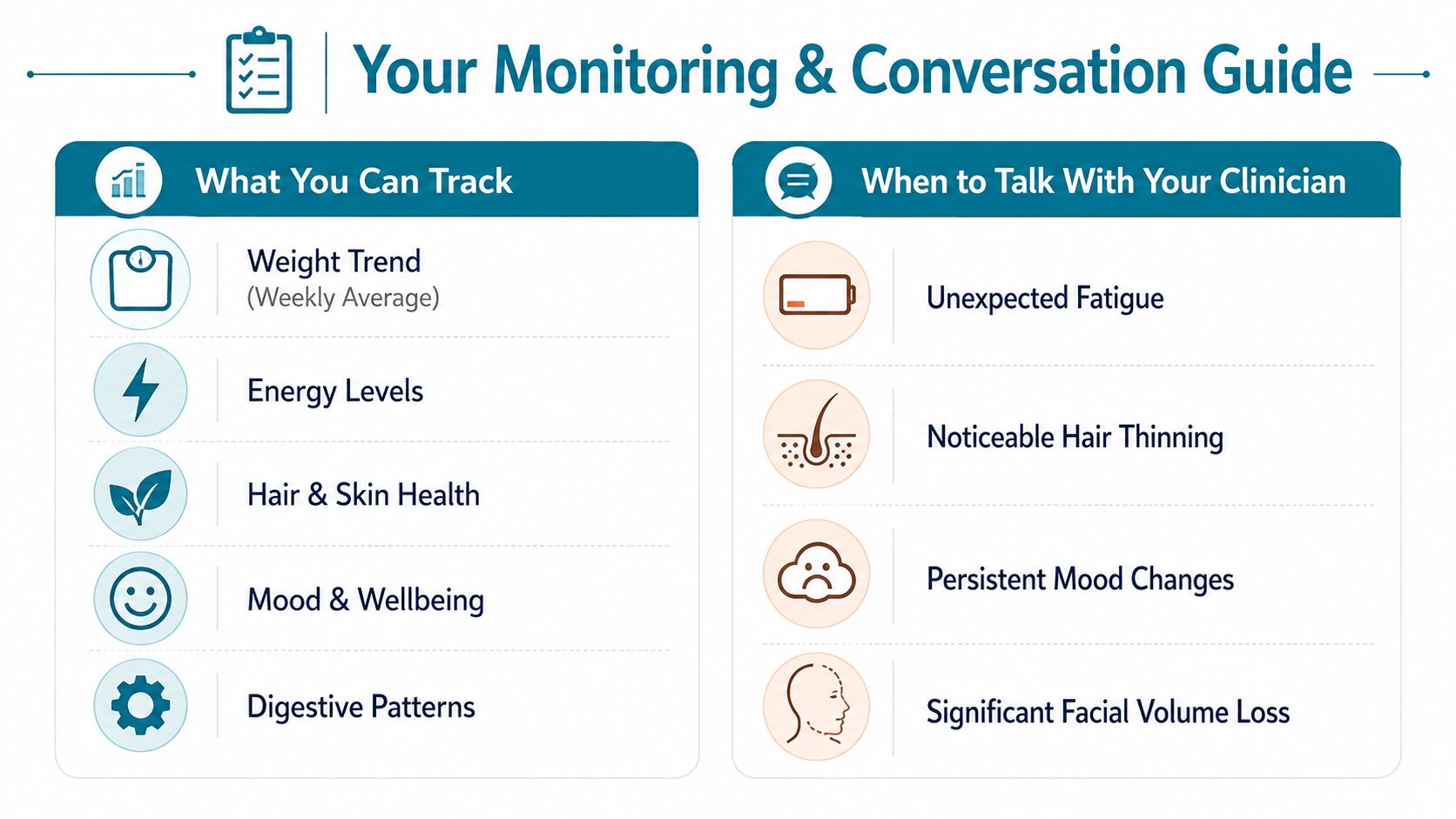
Track patterns, not every hour of the day. A weekly weight trend is more useful than daily panic over a single number. So are changes in energy, hair and skin health, mood and wellbeing, and digestive patterns. Those clues help show whether weight loss is steady and tolerable or whether the body is struggling to keep up.
What to bring up in a visit
A visit is a good time to ask practical, non-dosing questions. You might ask how planned dose changes could affect the pace of whole-body fat loss. You might ask how nutrition should be paced during a loss phase so you don't feel run down. You might ask whether facial changes are likely to settle once weight stabilizes.
Conversation starter: “I'm noticing facial volume loss along with weight loss. How do we monitor whether the pace is appropriate for me?”
The point is to keep the discussion clinical, not cosmetic alone. Significant facial volume loss can be one signal that the overall change is moving quickly enough to affect how you feel about treatment. Unexpected fatigue, noticeable hair thinning, persistent mood changes, and digestive issues are also worth raising.
For adults comparing access options, Empire Medical Wellness's GLP-1 access page is one place to review physician-led care questions before a visit. The YouTube video below is included for additional context.
A Calmer Way to Think About the Whole Picture
The face can change when weight changes, and that doesn't mean something is wrong with the medication or with the person taking it. It usually means the body is losing fat faster than the face can adapt. That's a medical pattern, not a verdict.
For adults using or considering GLP-1 treatment, the useful questions are practical. Is the pace of loss appropriate? Is nutrition holding up? Are facial changes mild and expected, or are they part of a broader problem that should be reviewed?
If you want a clearer comparison of anti-obesity medication options, this GLP-1 versus phentermine overview can help frame a physician visit. The right next step is a thoughtful conversation, not a guess from the mirror.
Empire Medical Wellness offers physician-led obesity medicine visits for adults who want careful monitoring around anti-obesity medication, weight loss, and long-term maintenance planning. If facial change has become part of your GLP-1 experience, you can visit Empire Medical Wellness to learn more about the practice's obesity medicine care and discuss whether a medical evaluation makes sense for you.
This article is educational and not personal medical advice.
Sources