
A lock is checked once, then again, then again. The person knows it's probably secure, but leaving still feels difficult, and the repeated checking makes them late for work. A pattern like this can raise questions about obsessive-compulsive disorder (OCD), but one behavior alone can't establish a diagnosis.
OCD is a recognized mental health condition, not a personality flaw or a synonym for being neat. Understanding the difference between unwanted intrusive thoughts and ordinary preferences can help adults decide what to discuss with a qualified clinician. A careful evaluation can clarify what's happening and whether treatment such as exposure and response prevention (ERP), medication, or coordinated care is appropriate.
Byline: Empire Medical Wellness Editorial Team
Published: October 21, 2026
Updated: October 21, 2026
Table of Contents
- A Calm Starting Point for Adults Exploring OCD
- How Clinicians Define Obsessions and Compulsions
- What a Careful First Evaluation Looks Like
- How Exposure and Response Prevention Actually Works
- Medications for OCD and How to Think About Them
- Three Common Pitfalls in Adult OCD Management
- When to Seek Physician-Led Care and What to Ask
- Sources
A Calm Starting Point for Adults Exploring OCD
The hypothetical lock-checking scene isn't proof of OCD. It illustrates a question clinicians consider: does a repeated behavior respond to a distressing thought or fear, and does the pattern take up substantial time or disrupt daily life? Someone may check a lock because they're distracted or want to be careful. In OCD, checking may become part of a recurring cycle that feels hard to stop.
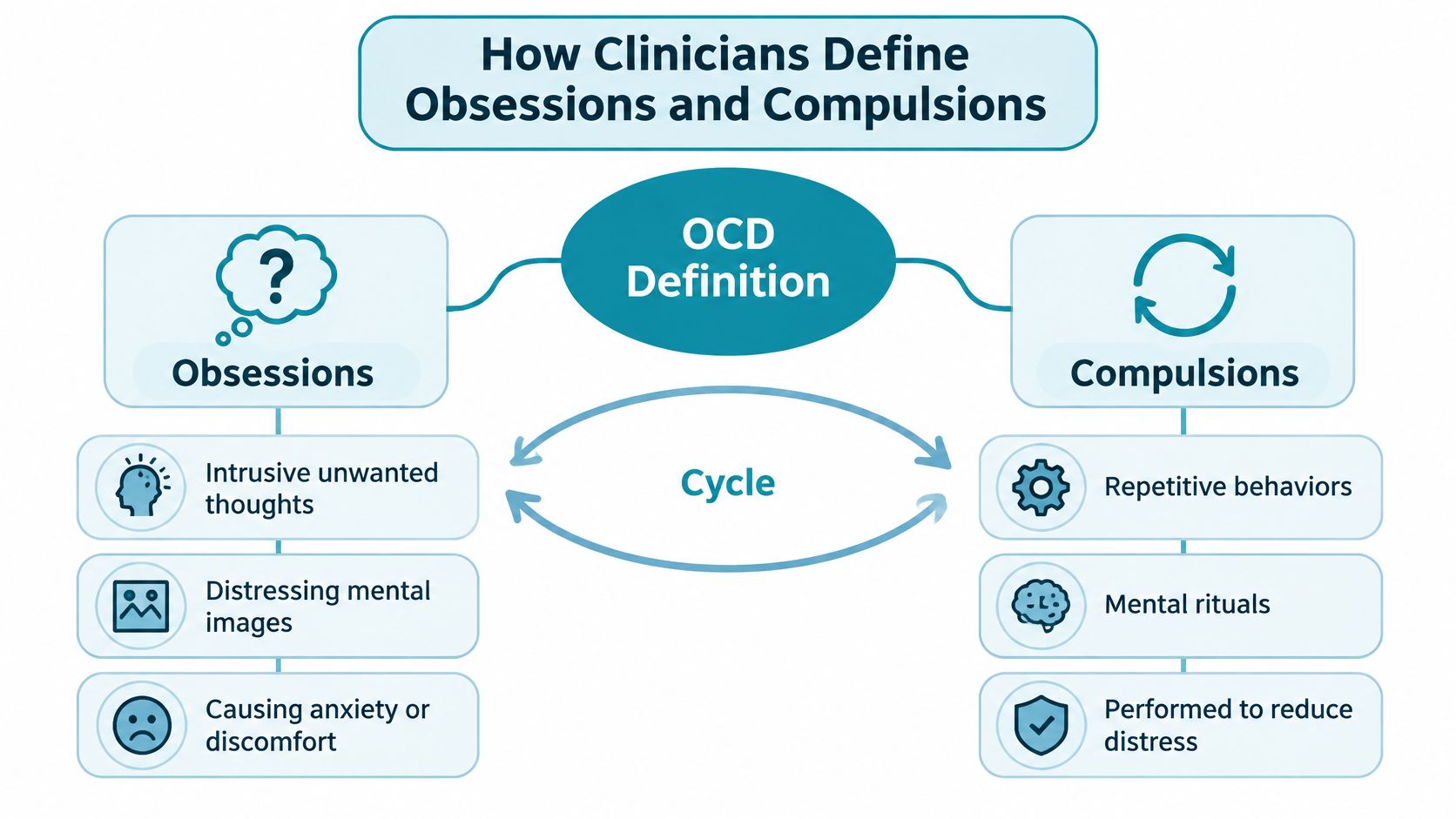
Obsessions are unwanted, intrusive thoughts, images, or urges that keep returning. Compulsions are repeated behaviors or mental acts performed in response, often to reduce distress or follow rigid rules. A compulsion can be visible, such as checking or washing, or mental, such as repeating a phrase or reviewing an event.
OCD doesn't look the same for everyone. The content of a thought can be upsetting, and people may hide it because they fear being judged or misunderstood. The presence of a distressing intrusive thought, by itself, doesn't show that a person intends to act on it.
A useful starting point isn't “Does this sound like a stereotype?” It's “Is this pattern unwanted, difficult to interrupt, and interfering with life?”
A clinician looks beyond a single habit or thought. They consider the pattern over time, the distress it causes, how much time it consumes, and whether it affects work, relationships, or other daily activities. An adult mental-health evaluation can also help distinguish OCD symptoms from other concerns that may need a different assessment.
Adults considering care can review adult mental health services to understand the practice's stated scope. This guide focuses on how OCD may be assessed and treated, and on questions to ask before starting care.
How Clinicians Define Obsessions and Compulsions
The distinction between an ordinary preference and OCD isn't whether someone likes order or feels worried. Clinicians assess whether unwanted thoughts or urges and repetitive behaviors or mental acts form a persistent pattern that causes marked distress, consumes substantial time, or significantly interferes with social or occupational functioning. The FDA-approved clomipramine labeling describes these features as relevant to the diagnostic threshold, but diagnosis requires clinical assessment, not matching a phrase to a checklist (FDA clomipramine labeling).
An occasional unwanted thought doesn't, on its own, establish OCD. Neither does liking a tidy desk, checking something once, or following a familiar routine. The relevant question is how the experience functions: whether it feels intrusive and unwanted, whether a repeated response follows, and whether the cycle is hard to interrupt or disrupts ordinary activities.
| Experience | What a clinician may explore |
|---|---|
| Preference for neatness | Whether tidiness is enjoyable or chosen, rather than driven by intrusive fears and distressing rituals |
| Everyday double-checking | Whether checking is proportionate and easy to stop, or repeated in a way that interferes with leaving or working |
| Intrusive thought | Whether it recurs, feels unwanted, and is linked to distress or rituals, rather than being an isolated thought |
| Possible OCD pattern | How thoughts and responses affect time, distress, avoidance, and daily functioning |
This comparison is a guide to the kinds of questions that can arise, not a diagnostic tool. People can have intrusive thoughts without OCD, and clinicians consider the whole history rather than judging by the topic of a thought alone. Further background on repetitive thinking is available in this overview of rumination and mental health.
What a Careful First Evaluation Looks Like
A thoughtful assessment starts with a conversation, not a test that produces a diagnosis from one answer. A clinician asks what the unwanted thoughts or urges are like, what visible or mental rituals follow, and how the pattern affects the person's daily life. The purpose is to understand the experience and consider other possible explanations.
A qualified clinician may ask about:
- Time and distress: How much time the thoughts and rituals take, and how upsetting they feel.
- Daily impact: Effects on work, relationships, sleep, or routine responsibilities.
- Avoidance: Situations, objects, or activities the person avoids because of distress.
- Onset and course: When the pattern began and how it has changed.
- Other relevant symptoms: Mood, anxiety, tic-related symptoms, substance use, and medical or medication history.
A short timeline can help an adult explain what has changed and when. It may also help to bring a current list of medications and substances, along with notes about what seems to worsen or ease the symptoms. These details aren't a test to pass. They give the clinician a clearer picture and can help identify other causes or co-occurring concerns.
Appointment preparation: Describing what happens before, during, and after a ritual can be more useful than trying to choose a diagnostic label in advance.
Ordinary double-checking alone doesn't establish OCD. A careful clinician considers persistence, distress, time burden, and interference, and may recommend assessment by a qualified mental-health professional when that's needed for diagnostic clarity or treatment planning. The National Institute of Mental Health describes clinical history and assessment for other causes as part of understanding OCD (NIMH overview of OCD).
How Exposure and Response Prevention Actually Works
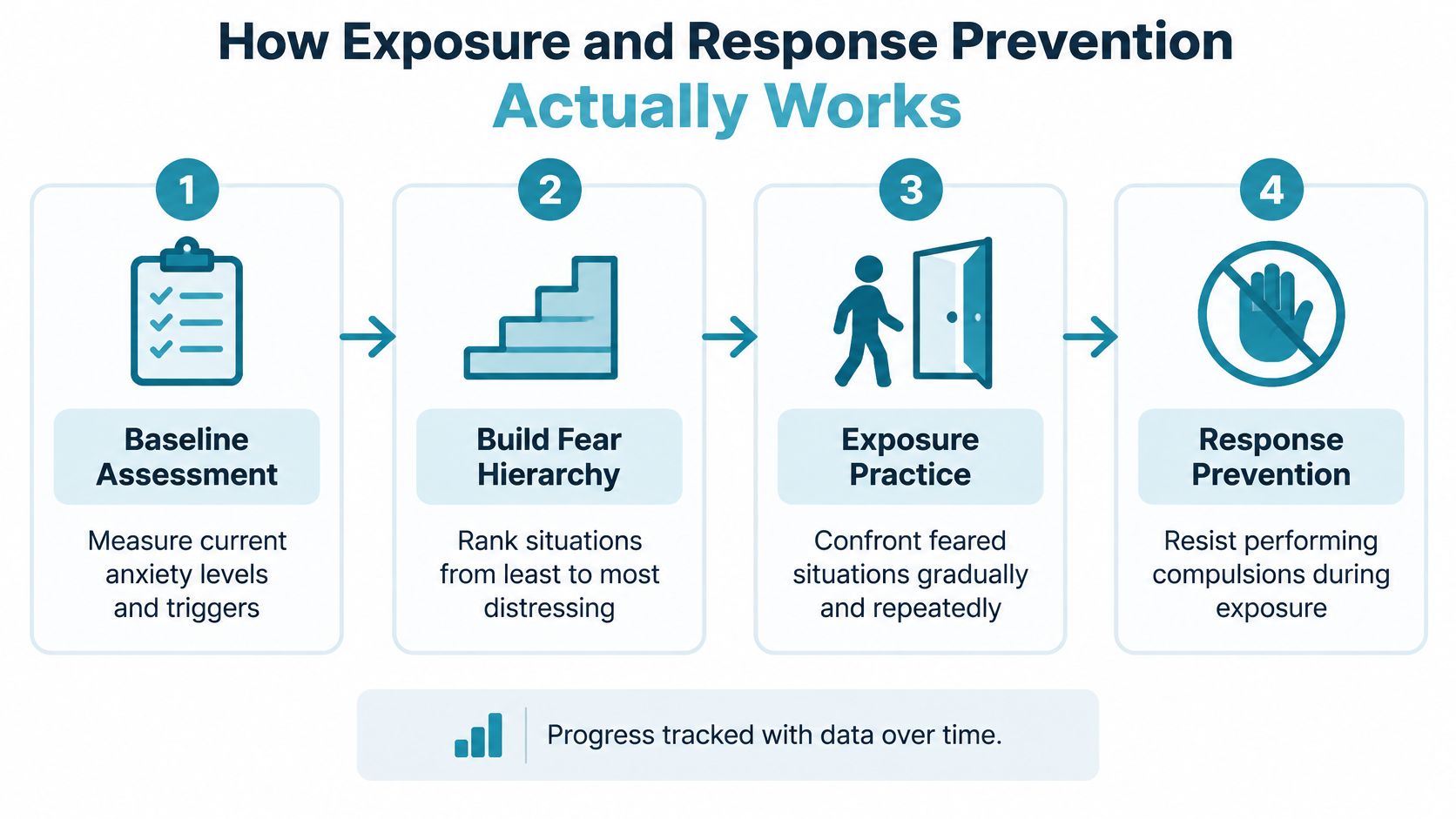
Exposure and response prevention is a specific form of cognitive behavioral therapy (CBT) for OCD. Exposure means gradually approaching a feared thought, situation, object, or sensation in a planned way. Response prevention means practicing not doing the usual compulsion or mental ritual that follows. The work is structured and deliberate, not an instruction to "face fears" without guidance.
A therapist typically begins by identifying the obsession-compulsion cycle and setting goals, then plans repeated exposures that progress from more manageable to more challenging situations. The person practices resisting the usual ritual, reviews what happened with the therapist, and works toward additional triggers. Progress can be monitored through symptoms, functioning, and practice between sessions.
This differs from reassurance, thought suppression, or relaxation advice alone. Those approaches may have a role in broader care, but they don't necessarily include planned exposure and response prevention. A 2025 survey of people with OCD found that the average delay before OCD was recognized was 5.58 years, and only 49.5% of surveyed participants who had received CBT said therapist-guided ERP had been included (2025 survey of OCD treatment experiences). The finding highlights why it's reasonable to ask what a proposed CBT treatment involves.
ERP isn't a license to attempt unsafe exposures. A qualified therapist individualizes the plan and uses safe conditions. For families seeking general context about specialist services for younger people in California, this resource on California OCD care for children addresses a different age group and isn't a substitute for adult treatment guidance.
Treatment quality also depends on what happens around the planned exposure. A therapist should notice covert rituals, such as repeating words or mentally reviewing an event, as well as reassurance-seeking or family accommodation that may reinforce the cycle. Exposures that don't meaningfully challenge the fear, or practice that isn't reviewed, may limit the usefulness of the work. Questions about therapist training, between-session practice, and how progress is measured can help adults understand whether the approach is specifically ERP.
Medications for OCD and How to Think About Them
A person may still have intrusive thoughts while treatment is helping. Medication can be part of OCD care, often alongside psychotherapy. NIMH describes serotonin-targeting antidepressants, including selective serotonin reuptake inhibitors (SSRIs), as medication options. The choice depends on a person's health and history, so a prescriber should discuss expected benefits, risks, interactions, and follow-up.
Medication response takes time to assess. Stanford Medicine's OCD medication guidance describes an adequate SSRI trial as 10–12 weeks total, including at least 6 weeks at the maximum comfortably tolerated dose. NIMH notes that medication benefit for OCD can take 8–12 weeks. That range is not a promised recovery timeline, and these time frames describe evaluation, not instructions to change a dose.
Clinicians may assess symptom change alongside day-to-day functioning. Improvement does not require every unwanted thought to disappear. If one SSRI has not helped enough, a prescriber may discuss trying another. After unsuccessful SSRI trials, clomipramine may be considered, with attention to its side effects and monitoring needs. Partial benefit may also lead to a discussion of other care, including ERP, rather than an automatic conclusion that treatment has failed.

At follow-up, an adult can ask how symptoms, side effects, and daily functioning will be monitored, and when the next appointment should happen. The prescriber should guide decisions about doses, adjustments, and stopping medication. Do not start, change, or discontinue medication without clinical guidance. For background on what medication reviews can cover, see this overview of antidepressants and treatment discussions.
Three Common Pitfalls in Adult OCD Management
Some barriers to care have little to do with motivation. These practical pitfalls can be discussed without blame, and a clinician can help identify safer next steps.
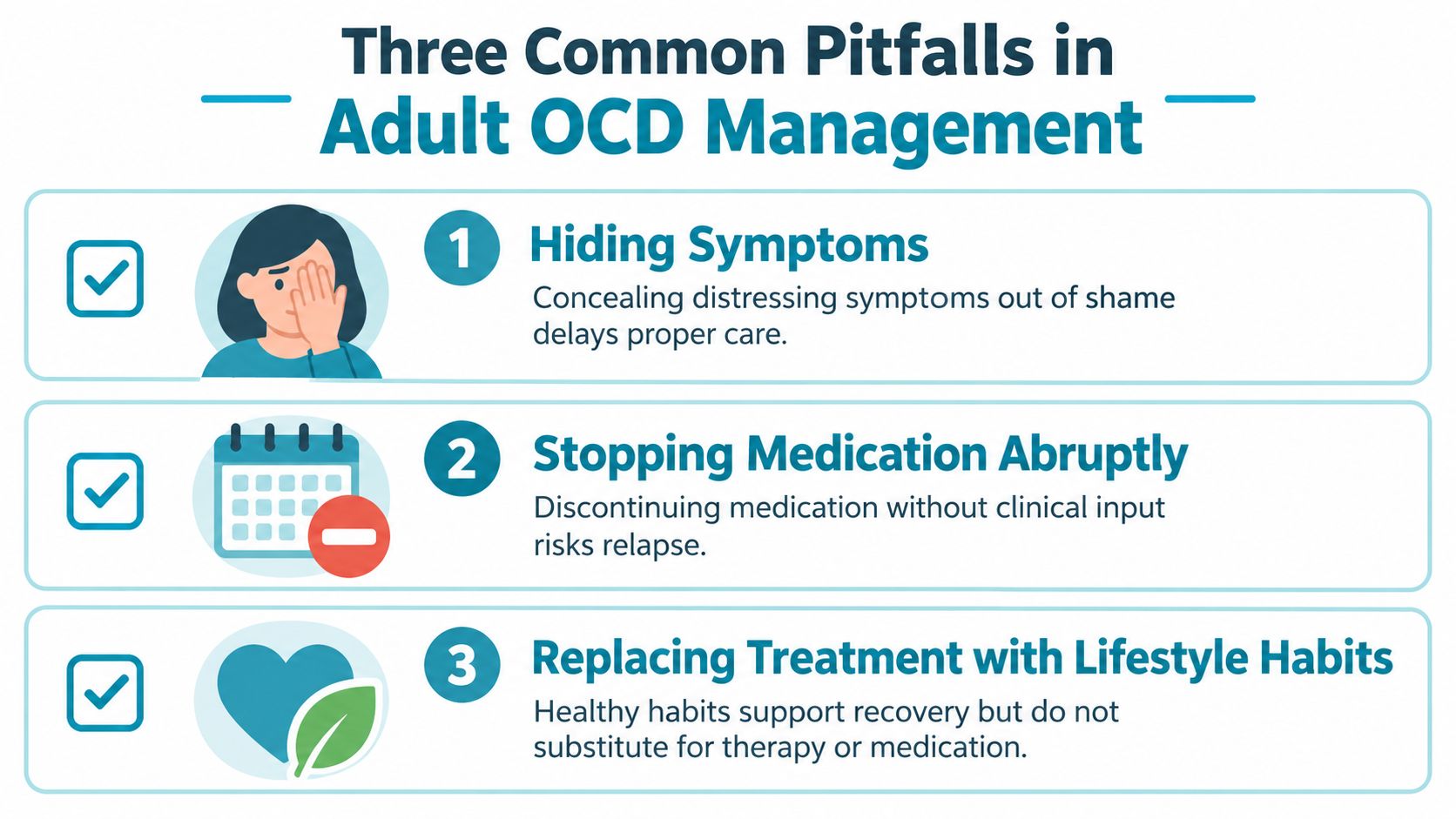
Hiding distressing symptoms. Shame can make it hard to describe intrusive thoughts or mental rituals. Honest disclosure gives a clinician more useful information for assessment and treatment planning. A person can start by saying that a thought feels unwanted and is difficult to discuss.
Stopping medication without clinical advice. Side effects, cost, doubts about benefit, or difficulty remembering medication can all complicate treatment. Rather than stopping or changing a prescription independently, the person can contact the prescriber to discuss the concern and plan follow-up.
Treating lifestyle habits as a replacement for indicated care. Sleep, exercise, and stress management may support general well-being, but they aren't substitutes for OCD-specific treatment when a clinician recommends it. They're best discussed as part of a broader plan.
A useful follow-up conversation covers what's working, what isn't, and what has made treatment difficult to follow. Side effects and barriers are information for the care team, not evidence of personal failure.
When to Seek Physician-Led Care and What to Ask
Physician-led outpatient care may be useful when an adult wants diagnostic clarification, a medication review, or ongoing medication management. The clinician can review symptoms, prior treatment, and relevant medical history, then discuss appropriate next steps. If ERP is needed, the care plan may involve coordination with an outside therapist; medication management and psychotherapy are distinct services.
Before starting with any clinician, an adult can ask:
- Assessment: How will the evaluation distinguish OCD from other possible causes?
- ERP: If ERP is part of the plan, who provides it, and what training or experience do they have?
- Progress: How will symptoms and daily functioning be monitored?
- Coordination: With permission, can the clinician coordinate with an outside therapist or other treating professional?
- Referral: If the clinician's scope doesn't match the person's needs, what referral options can be discussed?
A private-pay setting or a medical title alone doesn't establish OCD-specific expertise. Clear answers about scope, follow-up, and referral can help an adult decide whether a practice is a suitable fit. The practice's page on mental-health medication review describes its relevant service area.
In the United States, call or text 988 for crisis support. Call 911 if there's immediate danger. This article is educational and isn't personal medical advice.
Sources
- National Institute of Mental Health, OCD overview
- FDA-approved clomipramine labeling
- 2025 survey of OCD treatment experiences
- Stanford Medicine, OCD medication guidance
Empire Medical Wellness provides physician-led adult mental-health evaluation and medication management, with coordination with outside clinicians when useful and authorized. Adults considering a medication evaluation can learn more by visiting Empire Medical Wellness.