
Medical detox manages the acute physical and psychological effects of withdrawal, while rehab is ongoing treatment for a substance-use disorder. Detox alone is not recovery, and it is not always the right first step.
Popular guides still sell one sequence. Finish detox, then enter residential rehab, or the work was wasted. That advice treats two different clinical jobs as if one were a stronger version of the other. Some adults need medically supervised withdrawal before counseling can even start. Others can begin with an outpatient medical evaluation because withdrawal risk is low and a safe place to stay is already in place.
The useful choice is whether withdrawal could become dangerous, which supervision level matches that risk, and how quickly continuing treatment starts. A scheduled outpatient visit can sort those questions. It cannot stand in for emergency care when withdrawal is already unstable.
Table of Contents
- Medical Detox and Rehab Side by Side
- Settings Matched to Withdrawal Risk
- Timelines and When Withdrawal Is an Emergency
- Medicines and the Handoff After Detox
- Which Path Fits Common Situations
- Costs Payment and Questions to Ask
- Plan the Next Clinical Step
Medical Detox and Rehab Side by Side
A detox episode and a rehab episode are different kinds of treatment, not competing versions of the same service. Medical detox, also called withdrawal management, addresses the acute effects of stopping a substance. Rehab provides care for a substance-use disorder over time, either after or, when appropriate, instead of withdrawal management.
The National Institute on Drug Abuse describes detox as an initial stage of treatment and cautions that detox alone generally does little to change long-term drug use. Ongoing care can address continued use, relapse risk, health conditions, and recovery goals. Withdrawal from some central nervous system depressants can be severe or potentially life-threatening, making medical supervision important in the right cases.
What each one is built to do
Detox has three jobs: evaluation, stabilization, and linkage. Evaluation checks withdrawal risk, other medical or psychiatric concerns, substance use, and the person's surroundings. Stabilization addresses immediate medical needs as the body adjusts. Linkage means arranging a connection to continuing care, rather than handing someone a list of programs.
Rehab focuses on treatment over time. Care may return to health, triggers, coping skills, medication when clinically appropriate, and recovery supports. A useful measure of detox completion is medical stability plus a plan for continuing care. Rehab progress is better understood through ongoing engagement, safer functioning, and preparation for possible return to use.
The NIAAA overview of alcohol treatment types maps settings for alcohol care, from brief intervention to specialty treatment. It can help explain the range of options, but it does not determine an individual's placement.
| Question | Medical detox | Rehab |
|---|---|---|
| Main job | Manage acute withdrawal and medical instability | Treat the substance-use disorder and support longer-term recovery |
| Required work | Evaluate risk, stabilize immediate needs, and link to ongoing care | Reassess needs, provide counseling or behavioral care, consider medicines when indicated, and plan recovery support |
| Medical intensity | Varies with withdrawal risk, from ambulatory monitoring to intensive hospital care | Outpatient or residential; intensity is not defined only by withdrawal nursing |
| Useful completion marker | Medically stable with a plan for the next level of care | Continued engagement, safer functioning, and a plan for possible return to use |
| What it does not do | Does not by itself address every need related to long-term substance use | Does not replace emergency or intensive care for unstable withdrawal |
Episode counts are not a ranking
Treatment records include episodes of detox and rehab, such as inpatient detoxification, intensive outpatient treatment, and residential rehabilitation. These categories describe services received, not which setting works best for a particular person. Comparing their totals cannot establish that residential care outperforms outpatient care, or the reverse.
Practical rule: Match supervision to withdrawal risk, then make a timely plan for continuing treatment. The right care may involve both supervised withdrawal and later structured treatment, or it may begin with outpatient evaluation.
Settings Matched to Withdrawal Risk
The setting follows withdrawal severity and the rest of the clinical picture. It does not follow a preference for detox over rehab, or for a residential campus over a clinic.
The American Society of Addiction Medicine, summarized in the AHCCCS ASAM criteria brochure, sorts withdrawal management by how much supervision the risk requires.
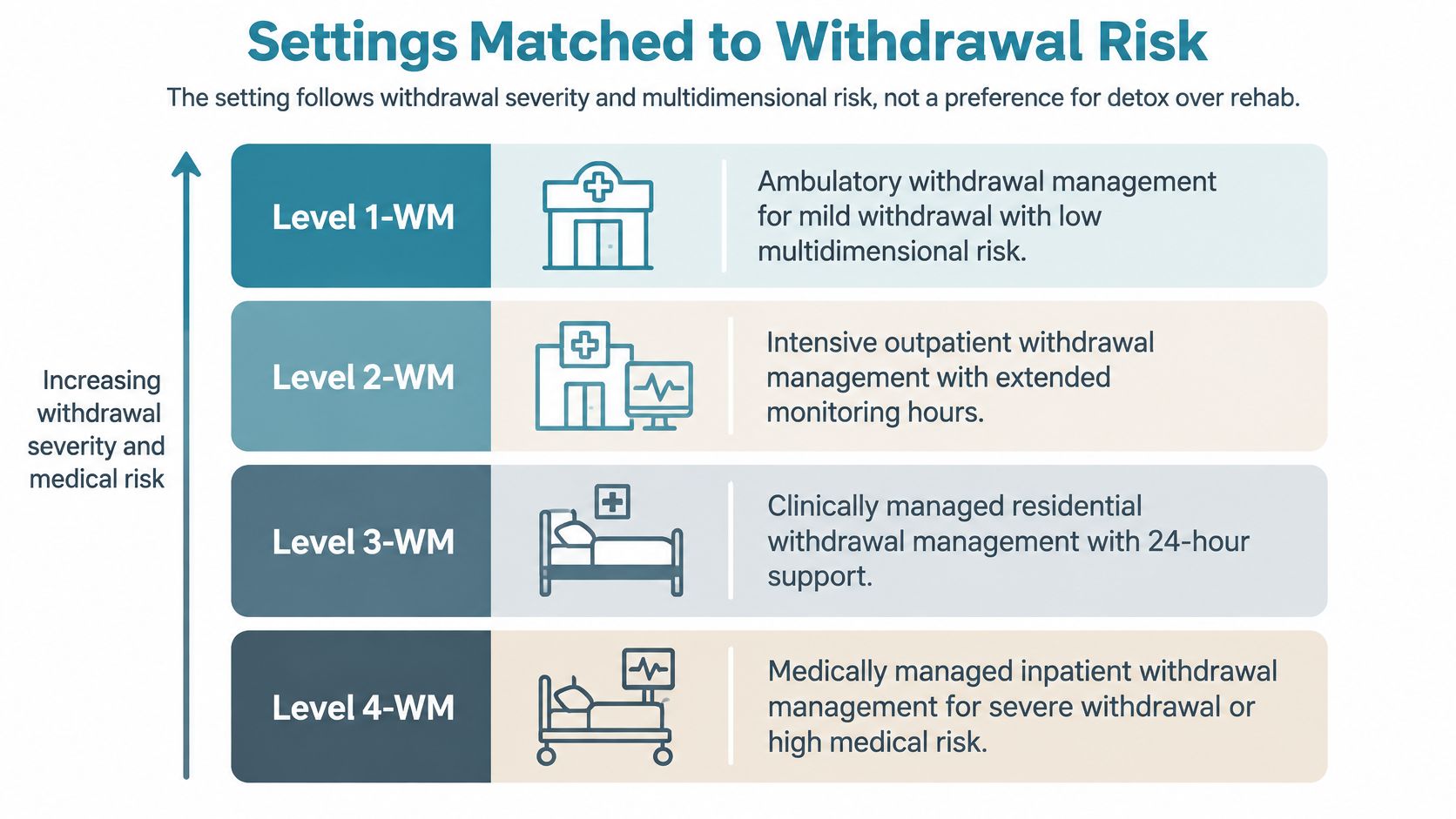
| Level | Setting | Supervision | General fit |
|---|---|---|---|
| 1-WM | Ambulatory | Daily or less-than-daily | Mild withdrawal with a safe recovery environment |
| 2-WM | Ambulatory with extended on-site monitoring | Longer on-site clinical monitoring | Withdrawal that needs more observation but not 24-hour care |
| 3.2-WM | Clinically managed residential | 24-hour support | Need for structure and supervision without hospital-level medical care |
| 3.7-WM | Medically monitored inpatient | 24-hour nursing and physician availability | More severe withdrawal or important biomedical risk |
| 4-WM | Medically managed intensive inpatient | Continuous nursing and daily physician management | Severe, unstable withdrawal |
Level 3.2-WM and Level 3.7-WM are not the same stay with a different name. One supplies round-the-clock structure. The other adds hospital-level nursing and a physician who can be reached at all hours. Level 4-WM is for severe, unstable withdrawal that needs continuous nursing and daily physician management.
What else moves the level up or down
Placement also weighs biomedical complications, psychiatric or cognitive conditions, readiness to change, risk of continued use, and whether housing and support are safe. A clinician documents those dimensions and reassesses symptoms and vital signs over time. Less intensive care is appropriate only when clinical and environmental risks are controlled.
Mild withdrawal with a reliable support person and fast access to emergency care may fit ambulatory monitoring. The person is seen, symptoms are checked, and someone reliable is present overnight.
Severe unstable withdrawal, a prior withdrawal seizure, or delirium needs hospital-level nursing and physician management. Feeling steady in the waiting room does not cancel that history.
SAMHSA training material for frontline staff states that medically supervised withdrawal for people using large amounts of alcohol or sedative-hypnotic drugs may occur in an inpatient or outpatient setting, provided supervision is adequate. Adequate is the operative word. A private outpatient physician can assess risk and coordinate a referral. That physician's office is not an inpatient detox unit, and routine follow-up is not a substitute when acute risk is high. Adults looking at outpatient alcohol treatment still need this level decided before a schedule is treated as the plan.
What to bring to the placement conversation
Write these down before the visit, in plain figures rather than estimates you hope sound moderate.
- Substance and pattern: What was used, about how much, how often, and when the last use was.
- Withdrawal history: Prior seizures, delirium, or a hospital stay for withdrawal.
- Current status: Other illnesses, medicines, and whether the person is intoxicated now.
- Overnight safety: Who is available through the night, and how quickly emergency care can be reached.
Worsening symptoms, unstable vital signs, inadequate supervision, or an inability to complete withdrawal safely should trigger escalation. They should not be folded into the next routine outpatient slot.
Timelines and When Withdrawal Is an Emergency
Alcohol timing is a clinical window, not a personal schedule you can negotiate because the morning felt fine.
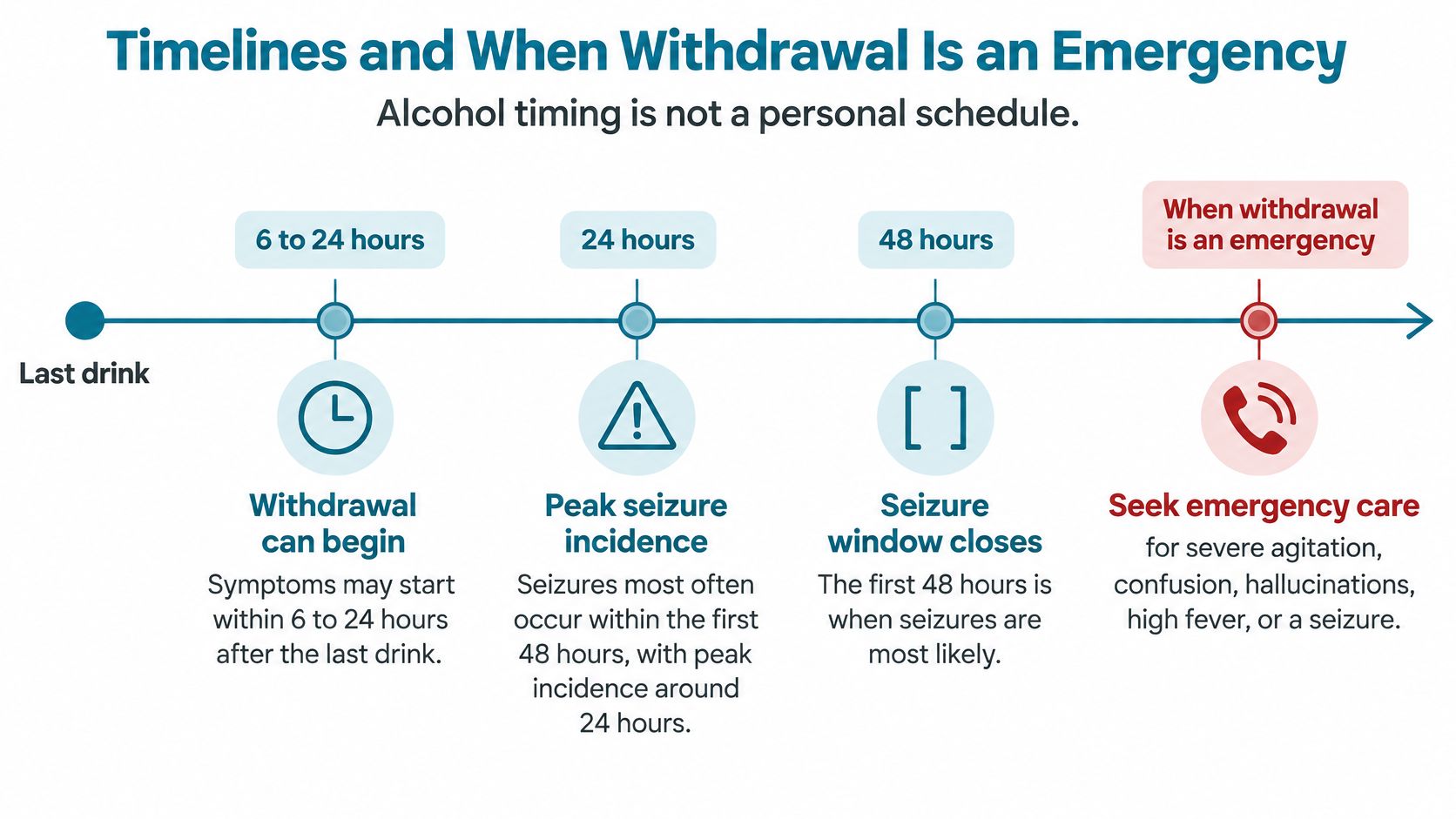
SAMHSA's alcohol withdrawal guidance states that withdrawal can begin within 6 to 24 hours after the last drink. Seizures most often occur within the first 48 hours, with peak incidence around 24 hours. Severe withdrawal may progress to delirium tremens, a dangerous state of confusion, disorientation, agitation, hallucinations, tremor, and unstable vital signs. People with severe delirium tremens generally need emergency transport and hospitalization. Stopping heavy or prolonged drinking without a medical assessment can carry risk even when the person initially feels well.
A deeper look at alcohol withdrawal belongs beside that clock, not after a weekend of waiting to see what happens.
Three responses, not one phone number
- Routine follow-up is a scheduled visit after the person is medically stable, to review cravings, medicines, and the recovery plan.
- Urgent same-day contact fits symptoms that are worsening quickly but have not yet become an emergency. Do not leave that message for the next business morning if vital signs are already unstable.
- Emergency care fits the warning signs below. Do not wait for an outpatient appointment or a rehab admission date.
Call 911 for a seizure, confusion, severe agitation, hallucinations with instability, breathing trouble, chest pain, inability to stay awake, pregnancy with severe withdrawal, or any other medical emergency. Call or text 988 for a suicidal crisis. Those lines come before any scheduling decision.
Why the substance changes the risk
Opioid withdrawal can be distressing. It is less likely to cause the same immediately life-threatening complications as alcohol or benzodiazepine withdrawal. The later danger is overdose. After a period without opioids, tolerance falls, and a previous amount can be far more dangerous.
Benzodiazepine withdrawal should not be managed with an improvised self-taper. Dose changes belong with a clinician in a setting that can supervise them. This article does not provide a taper schedule.
Supervised programs may track symptom scores, vital signs, hydration, coexisting illness, and changes in mental status. Those checks are how a team notices deterioration early. They are not a home checklist for riding out severe withdrawal alone.
SAMHSA's treatment-options page is clear that detox alone does not constitute treatment for the underlying disorder. Medication plus counseling and behavioral therapies is the whole-patient approach when those pieces fit. Commonly used FDA-approved medicines for alcohol use disorder include acamprosate, disulfiram, and naltrexone. For opioid use disorder they include buprenorphine, methadone, and naltrexone. No single medicine is appropriate for everyone, and naming them here is not a recommendation to start one.
Medicines and the Handoff After Detox
Continuing care is where longer-term change is supposed to happen. A finished detox episode is a transition point. It is not evidence that the substance-use disorder has been treated.
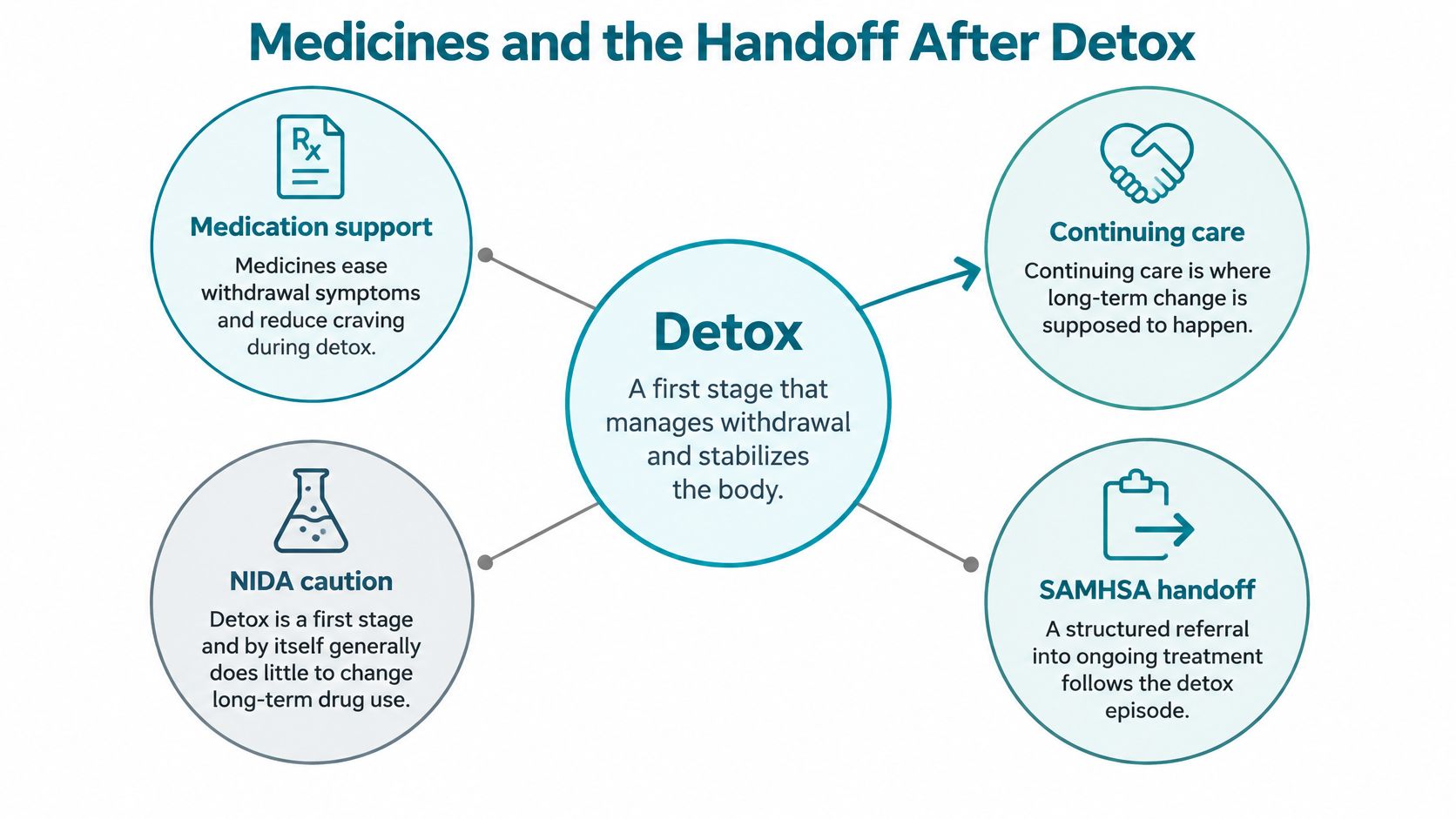
SAMHSA's whole-person model combines medication with counseling and behavioral therapies when those fit the person. Nobody is assumed to need every component, and nobody is assumed to need a residential stay. Medication-assisted treatment is one tool inside that model, not a reward for completing withdrawal.
What the medicines are for
The alcohol medicines and the opioid medicines above are not interchangeable. Some reduce withdrawal or craving. Others reduce alcohol-related reward or discourage drinking. A clinician matches the substance, medical history, other medicines, and the person's goals, and checks current FDA labeling before any prescription. An evaluation does not guarantee a prescription. This article gives no doses and no instructions to start, stop, or change a medicine.
Methadone for opioid use disorder is delivered through federally regulated opioid treatment programs. It is not started as a routine outpatient office visit. For opioid use disorder, medication treatment is usually more effective than withdrawal management alone. Delay matters because tolerance drops while the person is waiting for the next program to call back.
The SAMHSA TIP 45 detoxification consensus frames the practical handoff. Discharge planning should begin during detox and name the next setting, medication or medical follow-up when indicated, recovery supports, transportation, and the signs that should trigger escalation. A physician-led outpatient practice can assess, monitor, and coordinate with outside detoxification or rehabilitation programs. It should not present that follow-up as a substitute for medically supervised withdrawal when acute risk is present.
Five items to write down before discharge
- The next appointment and its date, not a promise to call sometime next week.
- Whether a qualified program will continue or start a medicine, and which clinician owns that decision.
- Whom to call if symptoms worsen, with a number that works after hours.
- Transportation to that next visit, including who is driving if the person should not.
- A naloxone and overdose plan when opioids are part of the history, without dosing instructions from a blog.
If any of those five lines is blank, the detox episode is not finished in the clinical sense, even if the withdrawal symptoms have eased.
Which Path Fits Common Situations
Two assumptions cause a lot of mismatched care. The first is that everyone should enter residential rehab. The second is that more intensive care is always better. Intensity that does not match the risk can delay the treatment that would help, including medication for opioid use disorder.
The rows below are general starting questions for a clinician. They are not a diagnosis and not a guaranteed placement.
| Situation | Main risk question | Care to discuss |
|---|---|---|
| Heavy alcohol use or prior withdrawal seizure or delirium | Could withdrawal become medically dangerous within hours | Urgent medical assessment and possible inpatient withdrawal management |
| Benzodiazepine or other sedative dependence | Is unsupervised dose reduction unsafe | Clinician-directed withdrawal plan in a setting with adequate supervision |
| Opioid use with stable housing and reachable follow-up | Will detox alone raise overdose risk without treatment | Outpatient or program-based medication treatment and monitoring, not detox as the endpoint |
| Repeated overdose, unsafe housing, or inability to engage | Can this person stay safe between visits | Residential, inpatient, or another structured level plus rapid medication access |
| Mild concern and reliable supports | Is ambulatory care enough | Confidential outpatient physician assessment and a follow-up plan |
| Detox finished but no next appointment | What care starts this week | Immediate linkage to ongoing treatment rather than a wait for rehab |
Reading the rows without turning them into a verdict
Some people need supervised withdrawal and, later, residential or intensive outpatient treatment. Others can begin with outpatient medical assessment and medication monitoring. Addiction treatment while working is a real option when the person can stay safe between visits and keep appointments. It is a poor fit when nights are unsupervised and withdrawal has already been dangerous.
Return to use can happen in a chronic illness. It is a reason to reassess the plan. It is not proof that treatment failed, and it does not automatically mean the person must restart at the highest level of care.
Hypothetical example, not a patient: An adult stops daily heavy drinking and feels well for several hours. That stretch of feeling well does not clear the person for home observation. Withdrawal-risk assessment still comes first, because symptoms can start later in the day.
Suspected severe withdrawal is an emergency. It is not a scheduling decision between two programs.
Costs Payment and Questions to Ask
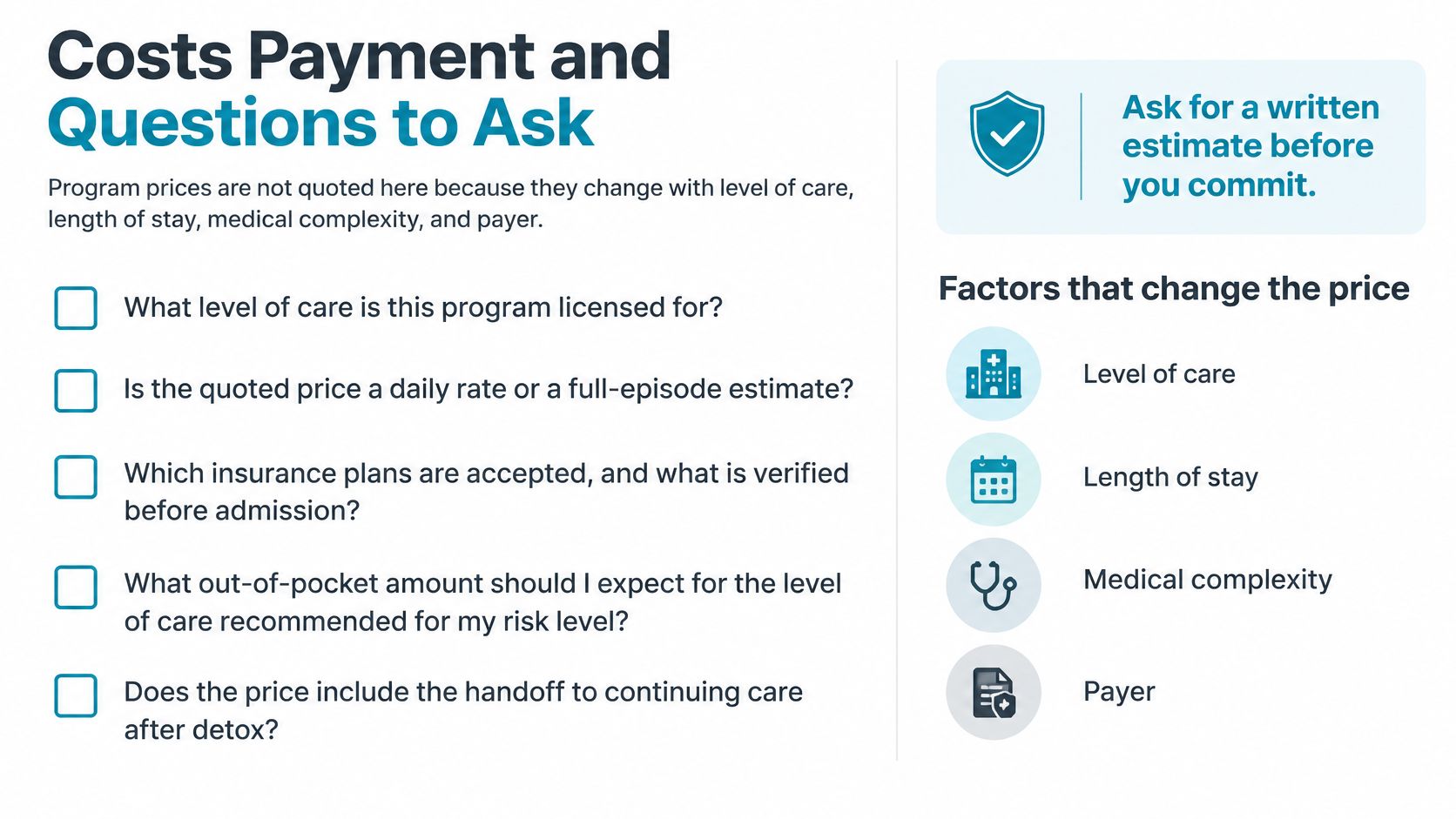
Program prices are not quoted here. They change with level of care, length of stay, medical complexity, and who pays. A national average would not be a personal estimate, so none is offered.
A detox or residential quote is not the same bill as later physician follow-up. Laboratory testing, pharmacy costs, imaging, treatment programs, and services from outside clinicians or facilities are billed separately by those organizations.
Empire Medical Wellness is private-pay, physician-led outpatient care. The Initial Evaluation is a 50-minute visit that costs $350 and includes a detailed evaluation and initial treatment planning for new patients. The Standard Follow-Up is a 25-minute visit that costs $225 and includes focused treatment monitoring, medication management, and progress review. Those figures are visit fees. They are not a detox package, a residential rate, or a promise about insurance reimbursement. Questions about what a visit includes are handled by contacting the practice.
Seven questions before you compare headline prices
- Which ASAM or equivalent level is offered on that campus or in that clinic?
- Do physician and nursing hours match that level, including nights?
- Which medicines can be started or continued on site, and which require a different program?
- How soon is the next provider scheduled after discharge?
- What happens if withdrawal worsens overnight?
- Which services sit inside the quoted fee?
- Which labs, medicines, and housing costs are extra?
Ask those questions before you rank two programs by the number on the first page. A lower detox fee can become the expensive path if it ends without medication or a follow-up appointment.
Plan the Next Clinical Step
The next step depends on withdrawal risk and the level of supervision needed. A medically stable person can request a confidential outpatient addiction medicine evaluation. The assessment covers current circumstances, medical risks, previous treatment, medications, and goals. At the visit, the patient receives an explanation of appropriate treatment options and next steps.
Addiction medicine care may include evidence-based medication when clinically appropriate, recovery planning, follow-up, and coordination with other treatment professionals when useful and authorized. If detoxification, residential treatment, partial hospitalization, intensive outpatient treatment, or another level of support is appropriate, Empire Medical Wellness can help coordinate the next step with trusted treatment partners. An appointment does not guarantee a prescription or placement in another program.
Read about what to expect at a first addiction medicine appointment. The practice's addiction medicine service describes its outpatient care. See the fees and visit process or use the appointment page to request a visit.
Byline: Empire Medical Wellness Editorial Team. Published and updated 8 October 2026.
Sources: NIAAA, types of alcohol treatment. NIDA, medical detox as a first stage of treatment and 2023 treatment-episode figures. SAMHSA, dangerous alcohol and sedative withdrawal, delirium tremens timing, and medication plus counseling as a whole-patient approach. ASAM withdrawal-management levels, as summarized for providers. SAMHSA TIP 45, evaluation, stabilization, and linkage.
This article is educational. It is not personal medical advice, a diagnosis, or a treatment plan.