
Yes, some psychiatric medicines can lead to addiction, and the risk depends on the medicine class. Benzodiazepines and prescription stimulants carry the most recognized misuse risk, and many people taking these medicines don't develop a use disorder. Approximately 30.5 million U.S. adults used benzodiazepines in the prior year in a 2015 to 2016 survey, while approximately 0.5 million met criteria for a benzodiazepine use disorder.
Those figures come from a nationally representative analysis of 102,000 adults, available through PubMed Central. The usual mistake is treating every psychiatric prescription as either addictive or harmless. A benzodiazepine, a stimulant, and an antidepressant don't share one profile. Dose, duration, and the person change the picture again.
Can you get addicted to psychiatric drugs? The useful answer separates addiction from physical dependence, withdrawal, and a return of the original illness.
Empire Medical Wellness Editorial Team. Published 8 October 2026. Updated 8 October 2026.
Table of Contents
- Addiction, Dependence, Withdrawal and Recurrence Compared
- Which Psychiatric Medicines Carry Addiction or Dependence Risk
- Warning Signs and Risk Factors to Discuss With a Clinician
- Why Withdrawal Can Look Like the Original Condition
- Urgent Symptoms Versus Routine Follow-Up
- Safe Prescribing, Monitoring and Questions to Ask
- What to Write Down Before a Medication Visit
- Confirm Your Next Step With a Qualified Clinician
Addiction, Dependence, Withdrawal and Recurrence Compared
Addiction and physical dependence are different medical concepts. The National Institute on Drug Abuse defines addiction as compulsive drug use despite harmful consequences, such as an inability to stop or repeated failure to meet work, social, or family obligations. Physical dependence is a physiological adaptation to repeated exposure. It can produce withdrawal when a medication is abruptly reduced or stopped. Dependence can occur with many prescription medicines, including when they're taken as directed.
Dependence alone does not establish that a person is addicted.
A body can adjust to a steady condition and then need time to readjust when that condition changes. Eyes do this when a room gets brighter. The adjustment isn't a decision, and it isn't the same as being unable to stop a behavior that is causing harm.
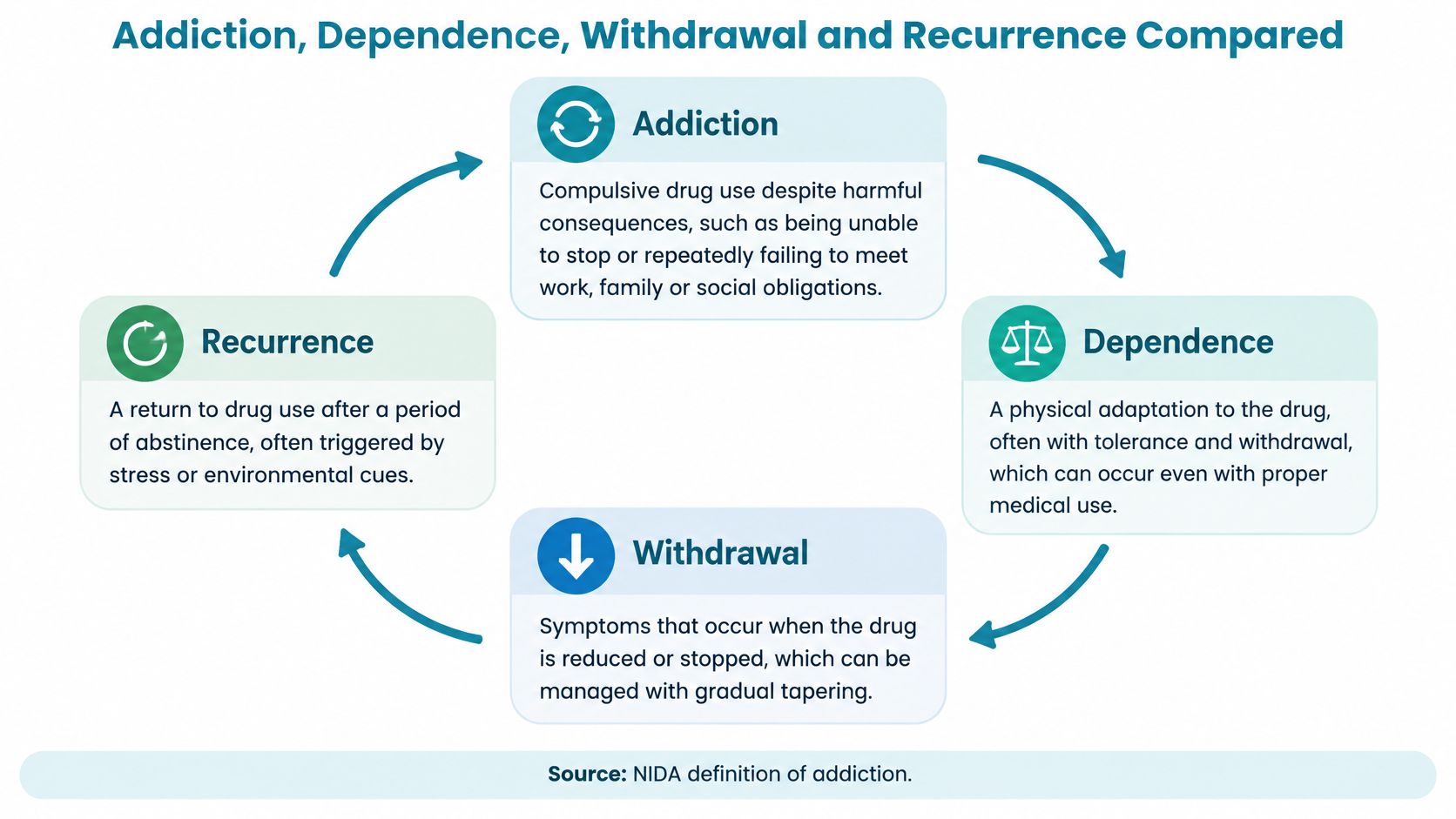
Four concepts people often confuse
| Concept | What it means | Can it occur with prescribed use? | Key question |
|---|---|---|---|
| Addiction | Compulsive use with impaired control and continued use despite harm | Possible; defined by loss of control, not by dose alone | Is there loss of control? |
| Physical dependence | Body adaptation that produces withdrawal when a medicine is reduced or stopped | Yes, even when the medicine is taken as directed | Is this an expected physical adaptation? |
| Withdrawal | Symptoms that follow reducing, missing, or stopping a medicine | Yes | Did symptoms follow a change, and do they improve over time? |
| Recurrence | Return of the original condition | Can occur with or without a medication change | Do the symptoms match the original condition over time? |
Withdrawal symptoms can show up after a reduction, and they don't always start the same day or stay at one intensity. Recurrence means the illness being treated comes back. That can happen whether or not the medicine changed.
Two questions keep the rest of this discussion straight. Is there loss of control? Is this expected adaptation, or a return of the condition? The DSM-5 substance use disorder framework describes impaired control in clinical terms, separate from ordinary side effects.
Which Psychiatric Medicines Carry Addiction or Dependence Risk
Classes don't share one misuse profile. In 2024, an estimated 4.6 million U.S. people misused prescription tranquilizers or sedatives during the past year, according to SAMHSA's National Survey on Drug Use and Health. That count covers misuse, not a diagnosis for any one person.
The FDA required a Boxed Warning on September 23, 2020, for the benzodiazepine class, covering abuse, misuse, addiction, physical dependence, and withdrawal. Physical dependence can develop after steady use for several days to weeks, even as prescribed. Abrupt stopping, or an overly rapid dose cut, can cause severe withdrawal, including seizures.
How the main classes compare
| Medicine class | Common examples | Addiction or misuse risk | Dependence and withdrawal |
|---|---|---|---|
| Benzodiazepines | alprazolam, lorazepam, diazepam | Recognized misuse and use-disorder risk; FDA boxed warning added in 2020 | Physical dependence can develop after several days to weeks of steady use; abrupt stopping can cause severe withdrawal, including seizures |
| Prescription stimulants | amphetamine, methylphenidate | Recognized misuse and stimulant use-disorder risk | Discontinuation effects can follow a stop; confirm the current product label |
| Z-drugs (sedative-hypnotics) | zolpidem, eszopiclone | Misuse risk is recognized for this sedative-hypnotic group | Dependence and withdrawal are possible after steady use |
| Opioid analgesics (relevant when co-prescribed) | opioid pain medicines | Opioid use disorder is a recognized risk | Dependence and withdrawal are well documented |
| Antidepressants | sertraline, escitalopram, venlafaxine | Not generally classified as addictive | Discontinuation symptoms can occur, especially after abrupt stopping |
| Antipsychotics | aripiprazole, risperidone, quetiapine | Lower addiction potential than benzodiazepines or stimulants | Not typically dependence-forming; main concerns are side effects and relapse |
Z-drugs such as zolpidem and eszopiclone can still lead to dependence after steady nightly use. Opioid pain medicines matter when they're prescribed with a sedating psychiatric medicine, because the combination can deepen sedation. Antidepressants aren't generally classified as addictive. They don't typically drive compulsive intoxication-seeking. Some still cause discontinuation symptoms if they're stopped suddenly. Antipsychotics are more often a question of side effects and relapse than of reward-seeking.
Product labels differ. Checking alprazolam isn't the same task as checking sertraline. Current FDA labeling is the right place to confirm a specific drug. Adults comparing anxiety treatment can also review how anxiety medication decisions are framed before a first prescription.
Warning Signs and Risk Factors to Discuss With a Clinician
The signs below are prompts for a conversation. They aren't a diagnosis. Only an individualized clinical assessment can determine whether a substance use disorder is present.
Behavioral signs worth naming
- Taking more, or for longer: The medicine is used in a larger amount, or for longer, than prescribed.
- Wanting to cut down: There's a wish to use less, and repeated trouble doing so.
- Time and attention: A lot of time goes to obtaining the medicine or thinking about it.
- Continued use despite harm: Work, relationships, or health keep getting worse, and use continues.
- Use to escape: The medicine is taken to get away from feelings, rather than for the symptoms it was prescribed to treat.
- Use other than prescribed: Tablets are crushed, shared, saved up, or taken on a different schedule.
Factors that raise concern
- Other sedatives: Alcohol, opioids, or other sedating medicines are used at the same time.
- Dose and time: The daily amount is high, or the course has already been long.
- Substance use history: The person, or a close family member, has had a substance use disorder.
- Other conditions: Anxiety, depression, or a sleep problem is also active.
- Medical history: Seizures, lung disease, or another condition makes sedation more dangerous.
Expected adaptation is usually physical and tied to a change in exposure. Craving, concealment, and harm that continues anyway point somewhere else. One sign doesn't settle the question. A clinician looks at the full pattern, not a single missed dose or a single rough week.
Why Withdrawal Can Look Like the Original Condition
Anxiety, insomnia, irritability, dizziness, or low mood can show up after a reduction and look exactly like the illness that led to treatment. Treating that cluster as relapse, on the spot, can push an unnecessary dose increase or a rapid switch to another drug.
Say a hypothetical adult has taken a prescribed benzodiazepine nightly for several months. The prescriber lowers the dose. Two nights later, sleep breaks up and worry spikes. Those feelings resemble the original anxiety. A clinician would line up the timing with the dose change, ask whether earlier missed doses caused the same pattern, and watch whether the symptoms ease over several days or keep building. This example isn't a real patient, and it isn't a diagnosis.
What helps separate the two
- Timing: Symptoms that start soon after a reduction point toward withdrawal more than a slow return of illness.
- Half-life pattern: A short-acting medicine often declares a missed dose faster than a long-acting one.
- Earlier missed doses: The same cluster after past skipped doses is a useful clue.
- Direction over time: Withdrawal often eases. A returning illness more often holds or worsens.
The National Institute on Drug Abuse states that withdrawal symptoms may range from mild to severe and are influenced by the drug involved. They can often be reduced through a slow, medically supervised taper rather than an abrupt stop. The same source warns that people who are addicted to central-nervous-system depressants, including tranquilizers, sedatives, and hypnotics, shouldn't try to stop without medical guidance. For some of these medicines, withdrawal can be severe and potentially life-threatening.
Practical rule: Don't stop, skip, or stretch doses on your own.
A sensory jolt sometimes called a brain zap from an antidepressant is one discontinuation symptom that may not match the original depression at all. Sorting that from recurrence is a clinical judgment, not a self-diagnosis. At Empire Medical Wellness, patients discuss symptoms, treatment history, medication response, and side effects with a physician. Contact the prescriber about any symptom change rather than adjusting the medicine alone.
Urgent Symptoms Versus Routine Follow-Up
Emergencies come before any appointment. Call 911 or go to the nearest emergency department for a seizure, severe confusion, hallucinations, trouble breathing, or extreme drowsiness, especially after combining sedating medicines or alcohol. Call or text 988, the Suicide and Crisis Lifeline, if suicidal thoughts appear. Call 911 if there is immediate danger.
How to sort the situation
| Symptom or situation | Timing | Action |
|---|---|---|
| Seizure or convulsion | Emergency | Call 911 or go to the nearest emergency department now |
| New confusion, hallucinations, or severe agitation | Emergency | Call 911 or go to the nearest emergency department now |
| Trouble breathing or extreme drowsiness, especially with alcohol or other sedatives | Emergency | Call 911 or go to the nearest emergency department now |
| Suicidal thoughts | Urgent | Call or text 988; call 911 if there is immediate danger |
| Mild symptoms that may relate to a recent change in medicine | Routine, but prompt | Contact the prescriber the same week; don't stop, skip, or change doses on your own |
| Questions about dependence, side effects, or a medication review | Routine | Schedule a follow-up visit |
A routine visit is for planning and review. It never replaces emergency care.
A clinician decides the next step after urgent symptoms are already in medical hands. Waiting for a scheduled visit isn't the path for seizures, new confusion, breathing trouble, or suicidal thoughts. For a routine visit, bring a current list of medicines and of alcohol or other substances. That list is what lets the prescriber judge sedation risk instead of guessing.
Safe Prescribing, Monitoring and Questions to Ask
A careful medication review is general practice, not a plan for any one person. It starts with the original reason for the medicine and whether that reason is still current. It then covers the agreed goal, how long treatment was expected to last, the current dose and formulation, other sedating medicines, alcohol and other substance use, sleep, and any seizure or medical history that changes risk.
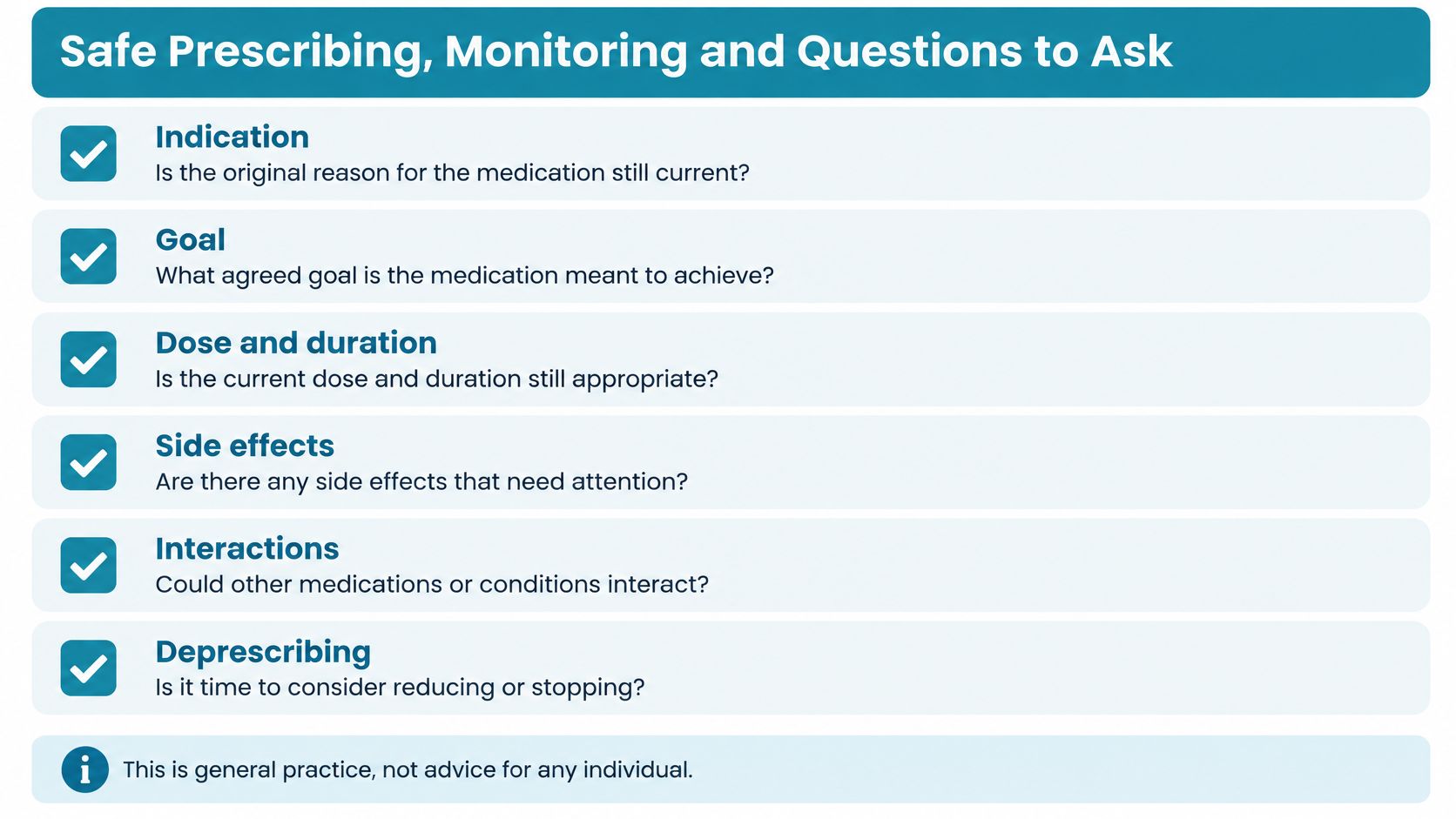
Where state law allows, a clinician may check prescription drug monitoring program data. Later visits reassess benefit, side effects, and signs of impaired control, on a set follow-up interval, with a written plan for what to do if symptoms change. If stopping is appropriate, the reduction is individualized, gradual, and monitored, with follow-up for a return of the underlying condition. No taper schedule belongs in a general article.
Medication may be included when clinically appropriate. Treatment decisions follow a review of history, current condition, safety, and goals. Eligibility for any medicine depends on age and individual medical needs, so the questions below are a starting point for a mental health medication review, not a personal recommendation.
Purpose and duration
- Original reason: Why was this medicine prescribed, and is that goal still the one being treated?
- Time course: How long was this course expected to last, and what would prompt a reassessment?
Risk and interactions
- Label language: What does the current FDA label say about misuse, addiction, and physical dependence for this exact product?
- Added sedation: Which other medicines, alcohol, or supplements could add sedation?
Changes and monitoring
- If the dose changes: What would withdrawal look like, and how would it be told apart from the original condition?
- Who to call: Which signs mean a call to the office, and which mean emergency care?
What to Write Down Before a Medication Visit
A short record beats a reconstructed story in the exam room. Fill it in before the visit, and don't change any dose while doing it.
| What to record | What to include |
|---|---|
| Current medicines | Each name, strength, how it is taken as prescribed, and who prescribed it, plus over-the-counter sleep aids, allergy medicines, and supplements |
| Recent changes | The date of any change by any prescriber, what changed, and any missed or stopped doses, without deciding a new plan |
| Symptoms | What was noticed, when it began relative to the change, how long it lasted, and whether it improved, stayed the same, or worsened |
| Substances | Alcohol, cannabis, nicotine, and other substances, with how often they're used |
| Daily life | Changes in sleep, work, school, relationships, and driving |
| Questions | The top three questions from the list in this article |
| Contacts | The office number, the after-hours plan, and the emergency numbers from the urgent-care guidance above |
Bring the page to the visit and update it between visits. A blank psychiatric medication management worksheet can hold the same headings if a printable page is easier to keep with other records. Honest substance details matter because sedation risk can't be judged from the prescription list alone.
Confirm Your Next Step With a Qualified Clinician
Psychiatric medicines differ in their risks. A clinician who knows your medical history can help assess questions about a specific medicine.
Seizures, severe confusion, trouble breathing, and suicidal thoughts call for urgent help. For physical emergencies, call 911 or go to the nearest emergency department. Call or text 988 for suicidal thoughts; call 911 if danger is immediate.
For non-urgent questions, Empire Medical Wellness offers outpatient mental health evaluation, medication management when appropriate, and follow-up care for children ages 8 and up, adolescents, and adults. Read about mental health medication management and fees and how it works, or request a routine visit through the schedule appointment page.
An appointment does not guarantee a prescription. The practice prescribes FDA-approved medications when a medical evaluation supports their use. This article is educational, not personal medical advice.
Empire Medical Wellness provides private, physician-led outpatient mental health care for children ages 8 and up, adolescents, and adults seeking a careful review of psychiatric medication. A visit can address whether a medicine remains appropriate and how dependence differs from loss of control. For non-urgent questions, visit Empire Medical Wellness to review the mental health service and request a routine appointment.