
Does worry have to feel dramatic before it deserves medical attention? Generalized anxiety disorder (GAD) involves persistent, difficult-to-control worry about several areas of life, accompanied by other symptoms and meaningful distress or interference with daily life. The pattern matters more than how alarming any single thought sounds, and the diagnostic duration requirement isn't a reason to delay seeking help.
Table of Contents
- Persistent Worry Versus Everyday Stress and Panic
- DSM-5 Criteria for GAD and the Six-Month Rule
- Keeping a Worry and Function Diary
- Preparing for the First Evaluation and Questions to Ask
- Treatment Options Matched to Severity
- Monitoring Progress and Deciding When to Adjust or Stop
- Choosing Your Next Step and When to Get Urgent Help
Persistent Worry Versus Everyday Stress and Panic
Everyday stress usually has an identifiable focus, such as a deadline, an unexpected expense, or a difficult conversation. The worry often eases as the situation improves. With GAD, resolving one concern may not bring much relief because attention shifts to another concern.
The distinction isn't whether someone worries about reasonable subjects. Work, health, money, and family can concern anyone. Clinicians look at frequency, controllability, associated symptoms, and the effect on daily life.
The National Institute of Mental Health's GAD guide describes a sustained pattern of difficult-to-control worry rather than occasional anxiety. A person can appear productive while privately spending considerable effort managing that pattern.
Everyday stress, GAD and panic attacks compared
| Feature | Everyday stress | GAD pattern | Panic attack |
|---|---|---|---|
| Trigger | Usually a specific event or deadline | Worry moves across several topics, often without one clear trigger | Often sudden, sometimes with no obvious trigger |
| Duration | May last days to weeks, easing when the situation resolves | Most days for at least six months | Symptoms peak within minutes, then subside |
| Control | Usually possible to set the worry aside | Hard to stop or redirect | Attention centers on bodily alarm rather than a worry theme |
| Physical signs | Often situational tension or sleep disruption | Restlessness, muscle tension, fatigue, sleep trouble | Pounding heart, sweating, trembling, breathlessness, chest discomfort, dizziness |
| Impairment | Usually temporary | Ongoing interference with work, school, or relationships | Can lead to avoidance of certain places or situations |
| Usual next step | Problem-solving and self-care | Physician-led or mental-health evaluation | Medical evaluation to rule out other causes, then mental-health evaluation as needed |
These are orientation points, not rigid boundaries. Stress can become severe, and a panic attack doesn't by itself establish panic disorder. Sustained worry and sudden fear episodes can also occur in the same person.
Chest pain or trouble breathing shouldn't automatically be attributed to anxiety. Other medical causes exist, and new or concerning symptoms need prompt medical evaluation. Emergency warning signs require emergency care.
How common is GAD?
The NIMH GAD statistics page reports National Comorbidity Survey Replication estimates of 2.7% of U.S. adults in a given year and 5.7% over a lifetime. These are survey estimates with different time frames, not interchangeable measures.
For the broader category of any anxiety disorder, NIMH reports a 12-month prevalence of 18.1% among U.S. adults, as summarized in the American Psychiatric Association's anxiety-disorders overview. That broader figure shouldn't be presented as the prevalence of GAD.
Overthinking about one topic can overlap with anxiety, but the label alone doesn't identify its cause. Repetitive thinking deserves assessment when it becomes difficult to interrupt or interferes with daily life.
General stress-management information can provide useful context, but self-care isn't a substitute for diagnostic clarification. A practical starting point is identifying which comparison-table column most closely resembles the pattern over recent weeks and bringing that observation to an appointment.
DSM-5 Criteria for GAD and the Six-Month Rule
The Diagnostic and Statistical Manual of Mental Disorders, Fifth Edition, commonly called DSM-5, provides a framework clinicians use when evaluating GAD. Its criteria describe a pattern, not a self-administered test.
The NCBI Bookshelf clinical overview of GAD describes excessive worry across multiple areas, occurring more days than not for at least six months, difficulty controlling it, and clinically significant distress or impairment. Adults also need at least three associated symptoms from the group below, with attention to alternative explanations.
DSM-5 criteria for GAD with self-check questions
| DSM-5 element | What it requires | Reflection question |
|---|---|---|
| Excessive worry | Worry about several areas of life, more days than not | Does the worry span work, health, money, and relationships, or concern only one event? |
| Duration | At least six months | Has the pattern been present on most days across that period? |
| Difficult to control | Hard to stop or redirect | Does worry repeatedly return despite attempts to shift attention? |
| Associated symptoms | At least three: restlessness, fatigue, difficulty concentrating, irritability, muscle tension, sleep disturbance | Which symptoms occur, and how frequently? |
| Distress or impairment | Significant distress or effects on social, occupational, or other important areas | Which activities have become harder or less accessible? |
| Exclusion | Not better explained by a substance, medication, medical condition, or another mental disorder | Did symptoms begin alongside another health or treatment change? |
Practical rule: The duration requirement is a diagnostic threshold, not a waiting period for care.
A clinician can assess a shorter history, address current distress, and consider other explanations. Someone doesn't need to establish the diagnosis before making an appointment.
Hypothetical example: Persistent worry begins shortly after a new medication. The clinician would review the timing and medication effects rather than assume the symptoms establish GAD.
Evaluation also includes psychiatric and medical history, substance use, life circumstances, and mental status. Information about rumination and repetitive thinking may help describe the experience, but a checklist match can't replace that broader assessment.
Keeping a Worry and Function Diary
A worry and function diary is a memory aid for an appointment. Its purpose is to make the pattern easier to describe, not to produce a diagnosis or judge how well someone handles stress.
A manageable recording routine
- Choose a short observation window. A two-week period is a practical organizational choice, not a validated diagnostic cutoff. One notebook page or phone note is enough.
- Record an episode close to when it happens, when practical, rather than reconstructing the whole day at bedtime.
- Describe the topic and control. Note whether attention could shift and roughly how long that took.
- Add a concrete effect, such as an unfinished task, an avoided call, or lost sleep.
- Include physical symptoms and same-day factors. Note tension, fatigue, sleep changes, caffeine, alcohol or other substances, medication changes, and illness.
- Mark whether the experience built gradually or surged suddenly.
- Review weekly. Summarize recurring topics, times of day, and changes in functioning.
Worry and function diary fields
| Field | What to record | Why it helps the evaluation |
|---|---|---|
| Date and time of day | Approximate start and end | Shows clustering across hours or days |
| Worry topic | A short description in ordinary language | Shows whether concerns span several life areas |
| Control | Whether redirection was possible and how long it took | Helps describe difficulty controlling worry |
| Pattern of onset | Gradual buildup or sudden surge | Helps distinguish sustained worry from panic-type episodes |
| Effect on daily life | Missed task, avoided situation, lost sleep, strained conversation | Documents distress and interference |
| Physical and sleep symptoms | Restlessness, tension, fatigue, concentration problems, irritability, sleep changes | Organizes associated symptoms over time |
| Same-day factors | Caffeine, alcohol, other substances, medication changes, illness | Identifies matters for clinical review |
| Weekly summary | Recurring topic, typical timing, change from the previous week | Provides a compact appointment summary |
The most useful entries are concrete rather than elaborate. “Rechecked a routine message repeatedly and missed lunch” provides more information than “anxious all afternoon.” Approximate observations are sufficient; constant monitoring isn't necessary.
The diary also has limits. It can't establish why symptoms occur, and missing entries don't invalidate the experience. If recording becomes another source of repetitive checking, a shorter summary may be more useful.
With the person's permission, a partner can hear a brief weekly summary: what was noticed, what became difficult, and one specific request for support. That request might involve quiet time for an appointment or help protecting an evening routine, rather than repeated reassurance about every worry.
Preparing for the First Evaluation and Questions to Ask
A first evaluation typically moves from assessment and safety review to goals, preferences, treatment options, and follow-up planning. The sequence may change when a medical concern or urgent safety issue needs attention.

Illustrative consultation image, not an identified practice patient.
Questions that help clarify the pattern
A clinician may begin with questions such as:
- Timing: How long and how often has worry occurred?
- Control and function: How difficult is it to control, and which activities does it prevent or complicate?
- Other contributors: Which symptoms, medicines, substances, or medical factors might contribute?
These are useful assessment questions, not a claimed practice-specific protocol. Depression, other anxiety disorders, and substance-use concerns may need attention alongside suspected GAD.
A medical evaluation isn't just a prescription appointment. The discussion may identify uncertainty, a need for additional assessment, or a preference for a nonmedication approach. Information about seeking an anxiety-medication evaluation can help set expectations, but an initial visit doesn't guarantee a prescription or a particular drug.
Questions to bring to the appointment
- Alternative explanations: Which possible causes have been considered, and what remains uncertain?
- Priorities: Which symptoms or functional difficulties need attention first?
- Meaningful improvement: What changes would indicate that treatment is helping?
- Measurement: How will symptoms, daily function, and adverse effects be checked?
- Follow-up: What schedule is appropriate, and which concerns warrant earlier contact?
- Coordination: With written authorization, how could an outside therapist and prescribing clinician clarify their roles and exchange relevant updates?
Coordination should reflect consent, clinical need, and what the professionals in fact offer. Direct therapist contact or shared records shouldn't be assumed.
A compact preparation folder can contain the diary summary, current prescription medicines, over-the-counter products, supplements, and earlier evaluations. The person can also identify one practical goal, such as completing routine work without repeated checking, to make the discussion more specific.
Treatment Options Matched to Severity
No treatment is automatic after a GAD diagnosis. Severity includes distress and daily functioning, not just how many symptoms appear on a checklist.
The NCBI Bookshelf guideline summary on GAD treatment supports a stepped approach that considers severity, preferences, and treatment risks. Research supports several options, but studies differ in size, quality, and comparison treatments.
Treatment options commonly discussed by severity
| Severity pattern | Options guidelines commonly discuss | Points to raise with a clinician |
|---|---|---|
| Mild | CBT-based treatment may be preferred | Access, time commitment, preference, effects on work or sleep |
| Moderate | An SSRI or SNRI, or CBT, may be offered | Side effects, personal goals, measurement of progress |
| Severe | Some contemporary guidelines recommend CBT combined with an SSRI or SNRI | Therapist coordination, monitoring, follow-up |
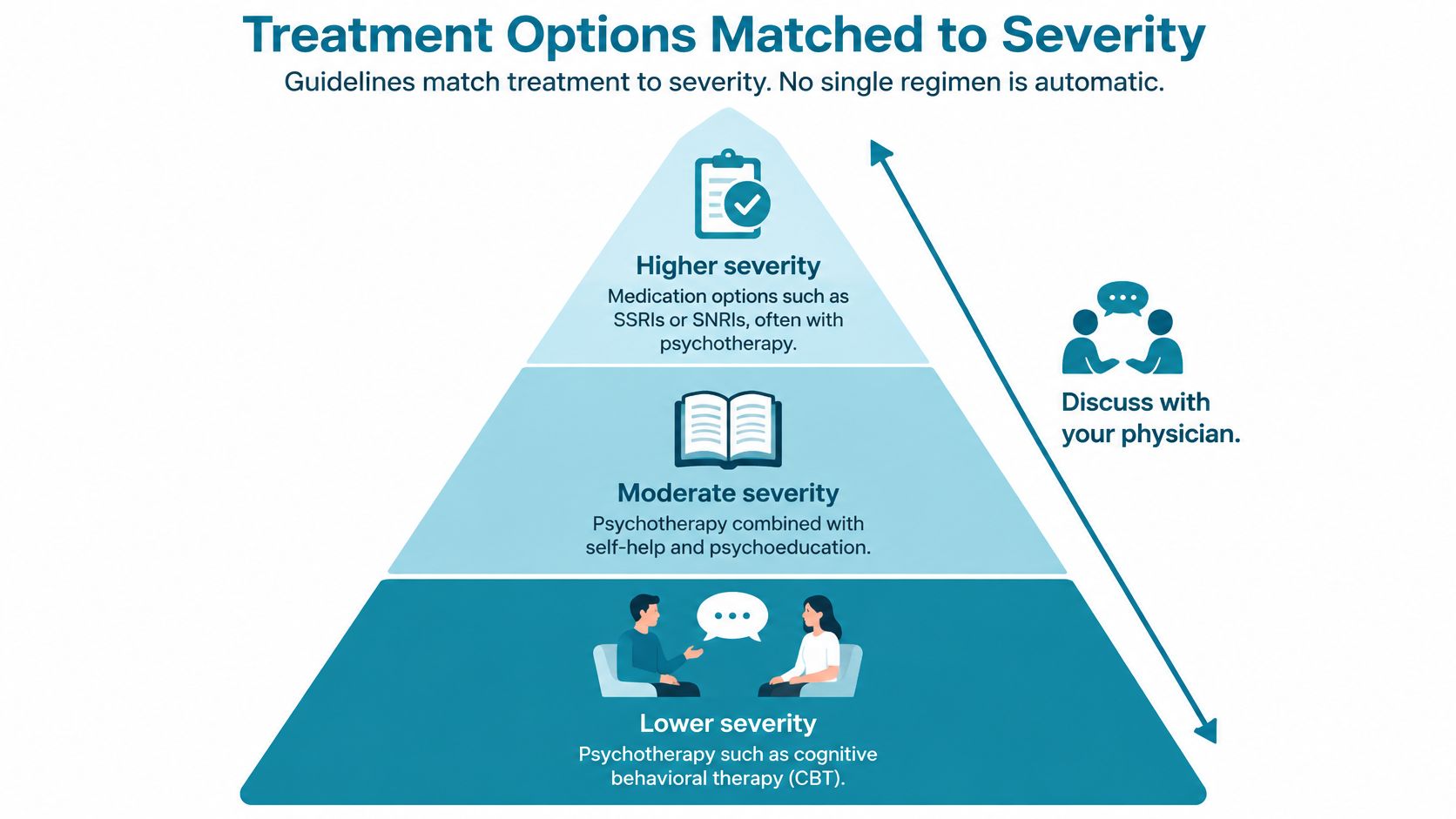
The graphic is a simplified orientation, not a prescribing ladder. Medication can be considered for moderate illness, and psychotherapy can remain relevant at higher severity.
Understanding the options
Cognitive behavioral therapy (CBT) is structured psychological treatment that addresses worry patterns, avoidance, and responses to uncertainty. Mentioning CBT as an evidence-based option doesn't establish that a medical practice provides psychotherapy.
SSRIs, selective serotonin reuptake inhibitors, and SNRIs, serotonin-norepinephrine reuptake inhibitors, are antidepressant classes also used for anxiety. Their names describe effects on chemical signaling, not a requirement that someone have depression.
Medicines with FDA-labeled GAD indications include escitalopram, paroxetine, extended-release venlafaxine, duloxetine, and buspirone. Current Drugs@FDA labeling should be checked for the particular product, indication, warnings, and patient population.
Pregabalin isn't FDA-approved for GAD in the United States; its use for GAD is off-label. Off-label means use outside the FDA-approved indication, and other medicines may also be used this way. Pregabalin evidence doesn't establish that it should replace SSRIs or SNRIs: sedation, dizziness, misuse risk, kidney-related dosing, and interactions require consideration.
Benzodiazepines aren't routine long-term GAD treatment because tolerance, dependence, and withdrawal create separate safety concerns. Medicines shouldn't be treated as interchangeable merely because they can reduce anxiety.
Early symptom improvement isn't the same as remission, and a lower symptom score doesn't necessarily mean daily functioning has recovered.
A discussion of anxiety-medication options should therefore include goals, tradeoffs, and monitoring, without assigning a drug solely from a severity label.
Monitoring Progress and Deciding When to Adjust or Stop
Real-world care may involve switching, combining, stopping, or restarting treatment. A first option isn't always the endpoint, and a change doesn't automatically mean treatment has failed.
The U.S. study Treatment instability in generalized anxiety disorder, published in CNS Spectrums, reported that 83% of patients experienced a treatment change within 12 months, including 55% who discontinued and 28% who modified therapy through switching or combination treatment. These findings describe the study population, not an individual prognosis.
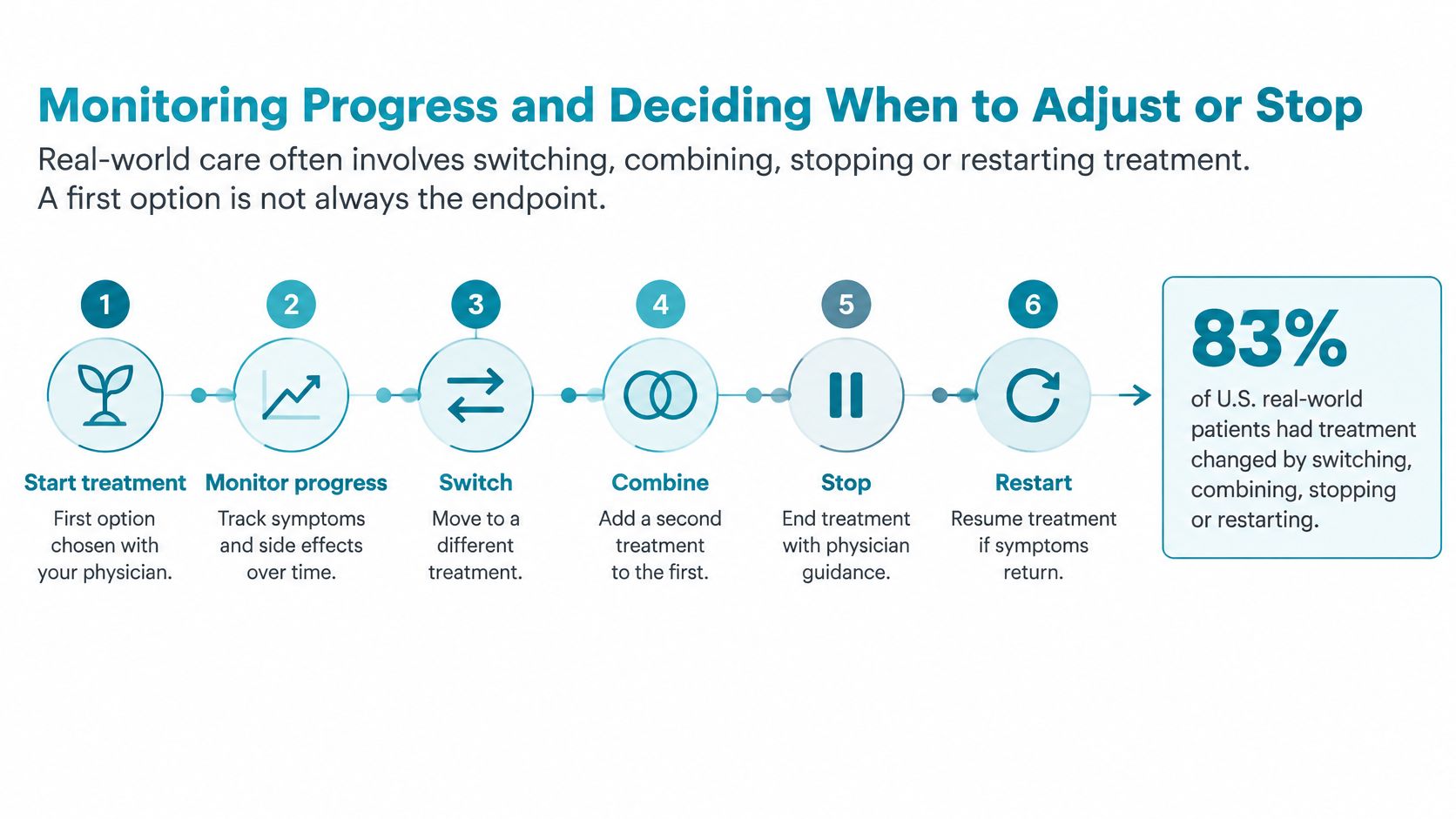
The graphic depicts possible treatment events, not a sequence every patient should follow. Discontinuation can reflect adverse effects, access barriers, preference, or improvement rather than ineffectiveness.
What follow-up should examine
The U.K. guideline NICE CG113 recommends medication reviews every two to four weeks during the first three months. Individual clinicians should also explain the expected trial period and circumstances requiring earlier review.
Useful review topics include:
- Worry burden: Frequency, intensity, and ability to redirect attention.
- Sleep and function: Rest, task completion, relationships, and avoidance.
- Adverse effects: New difficulties and their effect on daily life.
- Personal goals: Progress toward the activities that matter to the patient.
The GAD-7, a symptom questionnaire, and HAM-A, a clinician-rated anxiety scale, can support assessment. Neither replaces the clinical interview or reliably guarantees long-term success.
Before changing treatment for apparent nonresponse, clinicians review diagnosis, adherence, dose and duration, tolerability, co-occurring conditions, and current stressors. A mental-health medication review can organize those questions without assuming that increasing or replacing medication is necessarily the answer.
Continuing and stopping treatment
The Agency for Care Effectiveness GAD guideline advises continuing an effective SSRI or SNRI for at least six months after remission, while noting that some guidance recommends longer continuation and evidence beyond one year remains limited.
Stopping requires an individualized prescriber discussion. Gradual tapering is generally recommended because abrupt reductions can cause discontinuation symptoms, including dizziness or electric-shock sensations. Those symptoms aren't automatically a return of GAD, although distinguishing withdrawal from recurrence may require careful follow-up.
Choosing Your Next Step and When to Get Urgent Help
A useful next step is the one that matches the level of risk in front of you. Some situations call for emergency action first, while others call for a scheduled outpatient evaluation where the pattern can be reviewed carefully.
Use this checklist to choose the door that fits the moment:
- Persistent interference: Worry present on most days for months and affecting work, sleep, or relationships warrants a physician-led outpatient evaluation.
- Possible medical emergency: Sudden chest pain, severe shortness of breath, or fainting warrants calling 911, rather than assuming panic.
- Mental-health crisis: Thoughts of suicide, self-harm, or a mental-health crisis warrant calling or texting 988. Immediate danger warrants 911.
- A new contributing factor: Symptoms beginning after a medication change, substance-use change, or illness warrant prompt contact with the prescriber or primary care clinician.
- Considering discontinuation: A prescriber discussion should come before medication changes, including planning a gradual taper when appropriate.

Illustrative image, not an identified practice patient.
Matching the setting to the need
Outpatient evaluation provides space for diagnostic clarification, treatment discussion, and ongoing monitoring. It is not emergency care, so safety problems come first: chest pain, fainting, severe breathing trouble, suicidal thoughts, or immediate danger belong with 911 or 988 before any routine appointment.
Someone seeking help does not need a completed diary, a screening score, or certainty about the diagnosis before arranging an assessment. If notes exist, bring them. If they do not, a clinician can still ask when the worry began, what it disrupts, what makes it better or worse, and whether anything changed in medications, substances, sleep, or health.
The practice provides physician-led outpatient adult mental-health care, including evaluation and medication management. An assessment can clarify whether the pattern fits GAD, another condition, a medical contributor, or a mix that needs coordinated care.
This article is educational and isn't personal medical advice. Diagnosis and treatment decisions require an individual assessment by a qualified clinician.
For adults seeking clarification about persistent worry, Empire Medical Wellness offers physician-led outpatient mental-health evaluation and medication management. To take the next step, visit the practice website and request a 50-minute initial evaluation.