
Anaerobic exercise can help with weight loss, but the scale change is often modest. The bigger benefit is usually better body composition: exercise training has been associated with weight loss ranging from 1.5 kg to 3.5 kg and fat loss ranging from 1.3 kg to 2.6 kg, while resistance-based training can help preserve lean mass during weight loss.
If you've ever wondered why lifting weights or doing short hard intervals can feel effective even when the number on the scale moves slowly, that's the right question. In obesity medicine, the more useful goal often isn't just losing weight. It's losing fat while keeping as much muscle and function as possible.
That distinction matters. Two people can lose the same amount of body weight and have very different outcomes if one loses more lean tissue and the other preserves it. Lean mass means muscle and other non-fat tissue. Preserving it supports strength, mobility, daily function, and long-term weight maintenance.
Anaerobic exercise for weight loss fits best into a broader plan. That plan may include nutrition changes, aerobic activity, daily movement, sleep, medication when clinically appropriate, and follow-up that adjusts to how your body responds. If you're looking into physician-led care, Empire's overview of medical weight loss care is one place to see how exercise fits into a larger obesity-medicine plan.
Table of Contents
- Anaerobic Exercise for Weight Loss What to Expect Right Away
- Understanding How Anaerobic Exercise Works in the Body
- What the Evidence Shows About Fat Loss and Muscle Preservation
- Comparing Anaerobic Options for Weight Management Goals
- Beginner Friendly Anaerobic Exercises and Sample Weekly Plans
- Safe Progression Monitoring and When to Seek Care
- Building a Sustainable Plan and Next Steps With Physician Led Support
- FAQ
- Sources
Anaerobic Exercise for Weight Loss What to Expect Right Away
Anaerobic exercise refers to short, harder efforts that rely heavily on energy already stored in muscle. Common examples include resistance training, sprint intervals, and some forms of high-intensity interval training, often called HIIT.
What should you expect at first?
Usually, not dramatic scale changes from anaerobic work alone. That doesn't mean it's failing. It often means you're looking at the wrong marker. Early changes may show up as better strength, easier stairs, less fatigue with daily tasks, firmer movement patterns, or clothing fitting differently before body weight shifts much.
Why the scale can be misleading
Body weight is a rough measure. It combines fat, muscle, water, food in the digestive tract, and more. A plan that improves fat loss quality may not produce fast scale drops every week.
A 2021 systematic review and meta-analysis reported significant weight loss across reviews, with reductions ranging from 1.5 kg to 3.5 kg, and fat loss ranging from 1.3 kg to 2.6 kg. That helps set expectations. Exercise can contribute meaningfully, but it usually works best as one part of a bigger strategy rather than a stand-alone shortcut.
A practical way to think about it: anaerobic exercise often helps you lose weight better, not just faster.
What this guide will and won't promise
This article won't promise rapid results, a universal workout formula, or a specific amount of weight loss for any one person. Those claims wouldn't be accurate or responsible.
It will explain:
- What anaerobic exercise is and how it differs from steady cardio
- Why it may help preserve muscle during weight loss
- What the research supports, and where the evidence is mixed
- How to start safely from your current capacity
- What to monitor if you're also working with a physician on nutrition or medication
You'll also find a comparison table and a beginner progression grid. Those tools are meant to help you judge whether a plan is realistic, sustainable, and matched to your current function.
Understanding How Anaerobic Exercise Works in the Body
Why can two people do very different workouts and still burn energy, yet get different body-composition results?
The answer starts with fuel use and muscle demand. Aerobic exercise depends more on oxygen to support longer efforts, such as brisk walking or steady cycling. Anaerobic exercise depends more on fast, stored energy for short, harder efforts, such as lifting, carrying, hill climbing, or sprint intervals.
These are not separate on-off switches. Your body uses both systems at the same time. The difference is which system does more of the work during that effort.
What muscle is doing during harder efforts
During resistance training, muscle has to create force against a challenge. That challenge might be your body weight, a band, a machine, or free weights. During intervals, muscle has to produce force quickly, recover briefly, and do it again.
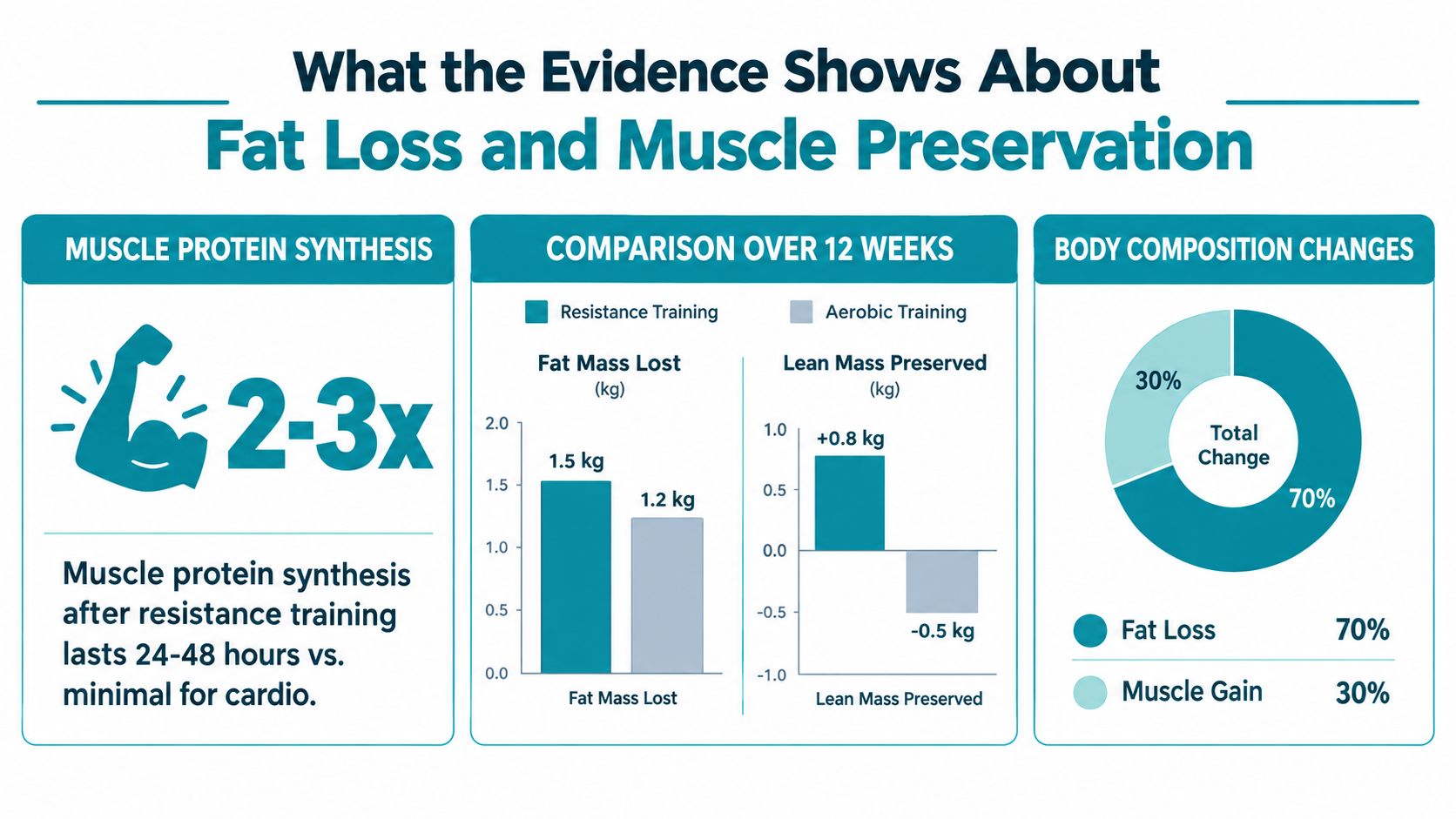
That signal matters during weight loss. Muscle is not just cosmetic tissue. It helps you stand up, climb stairs, carry groceries, protect joints, and keep up with daily tasks. It also gives your body a reason to hold on to lean tissue while you are trying to lose fat.
Losing too much muscle is like selling the ladder and the toolbox to cut expenses. The numbers may look better, but daily life gets harder.
Why this matters in obesity medicine
In obesity medicine, the goal is usually not just a lower scale number. The better goal is high-quality fat loss with muscle preservation. That is why anaerobic exercise can be useful even when the scale changes slowly.
Muscle-preserving exercise also fits the bigger care picture. The federal Physical Activity Guidelines for Americans recommend muscle-strengthening activity for all major muscle groups on at least 2 days each week, along with regular aerobic activity. Strength work is part of standard health guidance.
For people dealing with fatigue after meals, reduced stamina, or insulin resistance and muscle-related metabolic health, stronger muscle can support function while nutrition and medical treatment address the rest of the plan. Anaerobic training does not replace food intake changes, sleep, medication, or clinician-guided care. It adds a different tool.
The practical takeaway: anaerobic exercise often improves the quality of weight loss by helping your body keep useful muscle while you work on reducing fat.
Harder exercise is not automatically better. The right dose is the dose you can recover from, repeat next week, and build on safely.
What the Evidence Shows About Fat Loss and Muscle Preservation
The strongest case for anaerobic exercise in weight management isn't that it crushes aerobic exercise on the scale. It usually doesn't. The stronger case is that it can improve the quality of weight loss by shifting body composition in a better direction.
Resistance training and body composition
A 2022 meta-analysis in Medicine & Science in Sports & Exercise found that resistance-based exercise programs reduced whole-body fat mass by 1.6 kg versus baseline and by 2.2 kg versus control groups in adults with overweight or obesity, while also increasing lean mass by 0.8 kg.
That combination is why many obesity-medicine clinicians care so much about resistance work. Losing fat while gaining or preserving lean tissue is very different from seeing body weight go down.
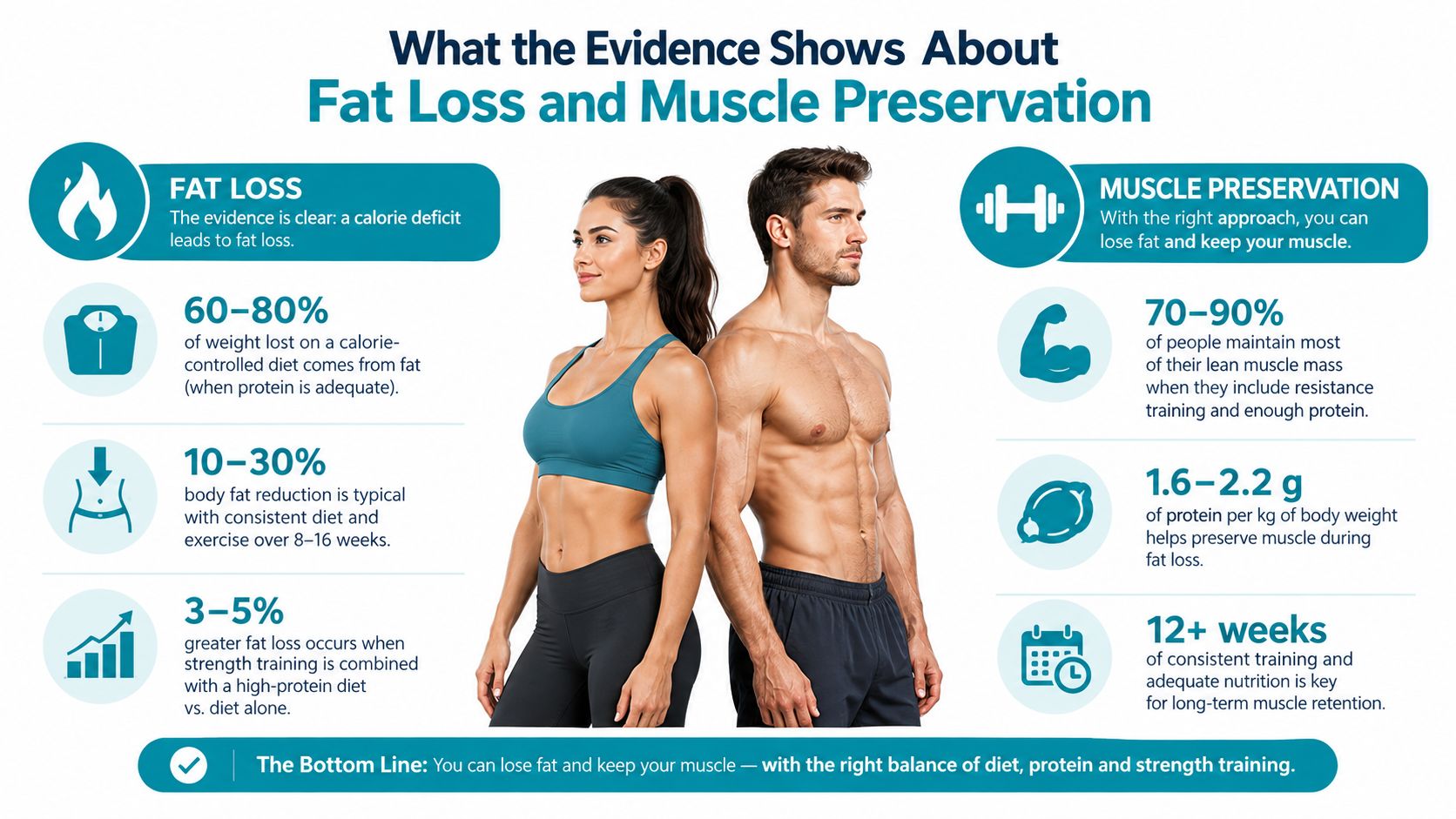
Another systematic review and meta-analysis in adults with overweight or obesity found that supervised resistance training reduced body fat percentage by −3.8% when combined with caloric restriction, reduced whole-body fat mass by −5.3 kg, and reduced body weight by −5.3 kg versus controls. Resistance training alone still reduced body fat percentage by −1.6% and fat mass by −1.0 kg.
If you're trying to understand what this means in practice, the key message is simple. Resistance training tends to work best when paired with an energy deficit, not as a replacement for it. If you'd like a separate explanation of how diet patterns can support that process, Empire has a guide to calorie deficit diets.
What happens during active weight loss
Evidence also suggests that adding resistance exercise during weight loss may improve fat loss, fat-free mass preservation, and strength, even when total body mass doesn't change much. That distinction often confuses people, because they expect the scale to reflect every useful change.
If your strength is improving, your daily function is improving, and you're losing fat, the plan may be working even if the scale isn't dramatic.
HIIT and time efficiency
For people who dislike long exercise sessions, HIIT can be appealing. A systematic review and meta-analysis on HIIT reported significant reductions in whole-body fat mass and waist circumference, with no significant difference versus moderate-intensity continuous training, while requiring about 40% less training time.
That doesn't mean HIIT is superior for everyone. It means shorter hard sessions can be a useful option if time is the main barrier and the person can tolerate that intensity safely.
Comparing Anaerobic Options for Weight Management Goals
Different kinds of anaerobic exercise solve different problems. Some are better for building strength. Some are better for fitting into a busy schedule. Some are easier to recover from. The best choice is often the one you'll continue.
Anaerobic exercise options compared for body composition and time
| Exercise Approach | Primary Body Composition Effect | Time and Adherence Notes |
|---|---|---|
| Resistance training | Best supported for improving fat loss quality by reducing fat while preserving or increasing lean mass | Often easier to scale for beginners because load, range of motion, and exercise choice can be adjusted |
| HIIT or sprint-style intervals | Can reduce fat mass and waist circumference, with outcomes broadly comparable to moderate continuous exercise | A major review of HIIT found similar fat-loss outcomes to moderate-intensity continuous exercise while requiring about 40% less training time. Harder sessions may still be too intense for some beginners |
| Combined anaerobic plus aerobic plan | Supports both body composition and cardiovascular fitness | Often the most practical long-term structure because it spreads benefits across strength, stamina, and daily energy expenditure |
How to use this table
If your main goal is muscle preservation during weight loss, resistance training usually deserves priority.
If your main barrier is time, interval work may be attractive. But time efficiency only helps if you can recover well enough to repeat the sessions consistently. If hard intervals leave you wiped out for days, they aren't efficient for you.
If your goal is broad health support, a combined plan usually makes more sense than arguing over whether anaerobic or aerobic training is "best."
A food plan also matters here. Exercise doesn't replace nutrition structure. Some adults find that choosing a weekly meal planner helps them stay more consistent with meals and recovery, especially when adding resistance sessions that increase appetite or expose how under-fueled they were before.
The benchmark most adults can use
The Physical Activity Guidelines for Americans give a simple framework: muscle-strengthening work for all major muscle groups on at least 2 days each week, plus 150 to 300 minutes a week of moderate-intensity aerobic activity or 75 to 150 minutes a week of vigorous-intensity aerobic activity.
Those numbers are population guidance, not a personal prescription. A beginner may need to build toward them gradually.
Beginner Friendly Anaerobic Exercises and Sample Weekly Plans
You don't need a complicated program to start. Most beginners do well with basic patterns that train major muscle groups safely and repeatably.
Simple exercise choices
A beginner-friendly anaerobic plan might include:
- Chair squats or sit-to-stands for legs and hips
- Wall push-ups or counter push-ups for chest, shoulders, and arms
- Band rows for upper back
- Glute bridges for hips
- Step-ups on a low step
- Dumbbell or kettlebell deadlift patterns with light resistance
- Farmer carries with manageable weights
- Short bike, rowing, or incline walking intervals if tolerated
The Physical Activity Guidelines for Americans recommend muscle-strengthening activities involving all major muscle groups on at least 2 days each week, alongside 150 to 300 minutes a week of moderate-intensity or 75 to 150 minutes a week of vigorous-intensity aerobic activity.
Empire also has a separate article on strength exercise for weight loss if you want a more focused look at the resistance-training side.
Two sample weekly templates
These are examples, not individualized treatment plans.
Template A for lower starting capacity
- Day 1: Short full-body resistance session
- Day 2: Brisk walk or easy bike ride
- Day 3: Rest or light daily movement
- Day 4: Short full-body resistance session
- Day 5: Walking or another moderate aerobic session
- Day 6: Light movement such as errands, stairs, or an easy walk
- Day 7: Rest
Template B for someone already walking regularly
- Day 1: Full-body resistance session
- Day 2: Moderate aerobic session
- Day 3: Brief interval session, if tolerated
- Day 4: Recovery walk or rest
- Day 5: Full-body resistance session
- Day 6: Moderate aerobic session
- Day 7: Rest or easy movement
Recovery is part of training. If every session leaves you drained, the plan is probably too aggressive.
A short demonstration can help some readers visualize effort and pacing:
Pair exercise with recovery
A stronger plan isn't just more exercise. It also includes enough nutrition, especially adequate protein intake if appropriate for your health needs, plus sleep and recovery time. Rapid increases in training without enough recovery can raise injury risk and make the plan hard to sustain.
Safe Progression Monitoring and When to Seek Care
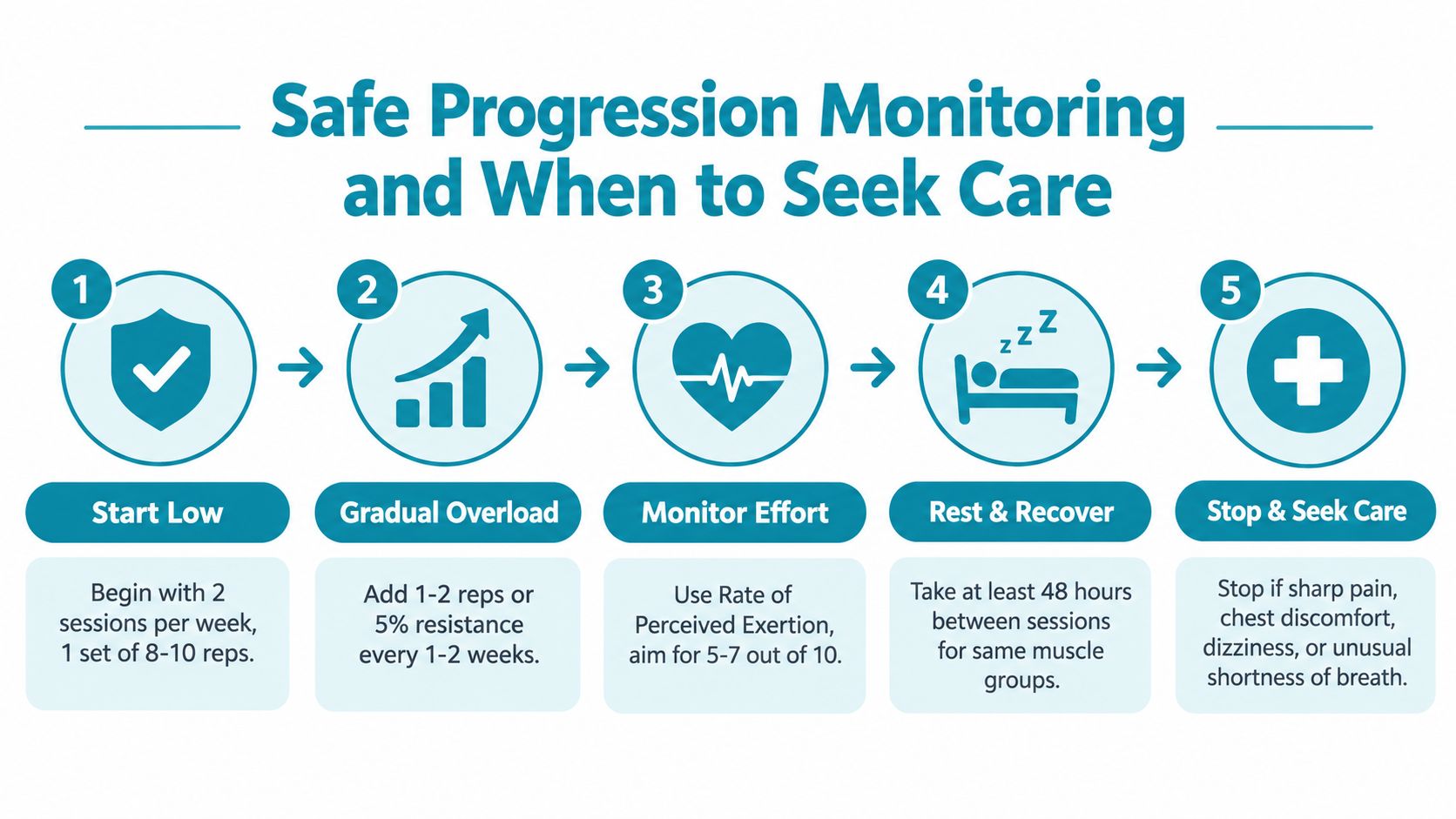
Starting low and progressing gradually usually works better than swinging between overexertion and quitting. A useful rule is to change one variable at a time. Increase either frequency, or sets, or repetitions, or resistance. Not all of them at once.
Beginner progression grid
| Phase | Frequency | Sets and Repetitions | Effort | Recovery | Stop Signs |
|---|---|---|---|---|---|
| Getting started | 2 sessions weekly | 1 set of a manageable number of repetitions for a few basic movements | Moderate effort. You should feel challenged but still in control of form | Leave recovery days between training the same muscle groups | Stop for sharp pain, chest discomfort, dizziness, faintness, or unusual shortness of breath |
| Building consistency | Continue regular sessions | Add repetitions first, then consider another set if recovery is good | Moderate to somewhat hard effort | Keep rest days and watch for unusual soreness that doesn't settle | Stop if symptoms feel out of proportion or technique breaks down repeatedly |
| Progressing load | Add only if the routine feels repeatable | Increase resistance in small steps after form is stable | Harder effort is reasonable for some exercises, but not at the cost of safe movement | Recovery, sleep, and nutrition become more important as load rises | Stop and seek care if new concerning symptoms appear during or after exercise |
A recent meta-analysis on resistance exercise during weight loss reported that adding resistance exercise had no effect on total body mass change, but did produce greater fat loss, better preservation of fat-free mass, and greater muscle strength. That's a useful reminder to monitor more than body weight alone.
What to monitor besides the scale
Track signs that your plan is helping function:
- Strength markers: Are daily tasks easier?
- Movement tolerance: Can you walk farther or climb stairs with less strain?
- Recovery: Do you bounce back between sessions?
- Symptoms: Any joint pain, dizziness, chest symptoms, or unusual fatigue?
- Nutrition fit: Are you eating enough to support training and recovery?
A hypothetical composite example
Hypothetical composite: an adult has already lost some weight but starts noticing weakness, lower exercise tolerance, and difficulty carrying groceries. Instead of pushing for faster scale loss, the plan shifts toward progressive resistance training, adequate protein intake, and less aggressive restriction. The main target becomes better function and lean-mass preservation. The scale may slow, but the person may feel stronger and more capable.
That pattern fits what many adults miss. A plateau on the scale isn't always a signal to do more and eat less. Sometimes it's a signal to improve the quality of the plan.
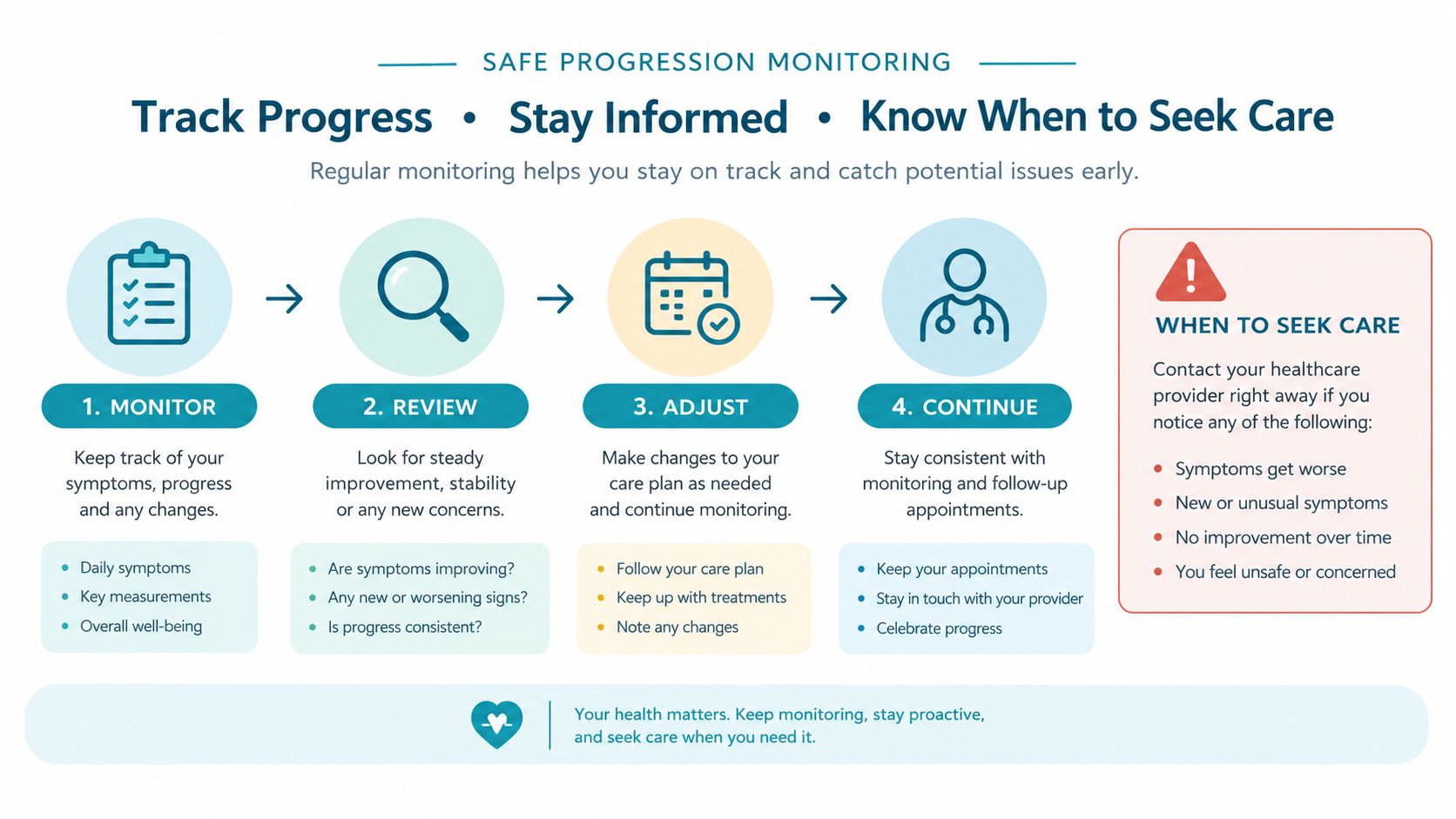
Bring follow-up questions to a physician if you're noticing weakness, poor recovery, intolerance of activity, or uncertainty about how your exercise plan fits with nutrition, medication, or other health conditions.
For routine follow-up, useful topics include current capacity, symptoms during exercise, strength changes, and whether the plan is realistic enough to continue. For urgent symptoms such as chest pain, fainting, or severe shortness of breath, seek immediate medical care.
Building a Sustainable Plan and Next Steps With Physician Led Support
How do you know if your plan is built to last next month, not just this week?
Use this quick self-check:
- Are you able to train your major muscle groups at least twice most weeks?
- Can you recover between sessions without lingering exhaustion or worsening pain?
- Does your eating pattern support training, especially enough protein and overall intake to avoid feeling depleted?
If you can answer yes to all three, your plan is probably sustainable. If one answer is no, that points to the first lever to adjust. Training frequency, recovery, or nutrition.
A good plan also needs an interruption plan. Life changes routines. Travel, illness, a pain flare, poor sleep, or a busy work stretch can break momentum fast. That does not mean the plan failed. It means the plan needs a restart rule.
A simple restart rule works like a dimmer switch, not an on and off button. After a break, return at a lower setting for one to two weeks. Use fewer sets, lighter resistance, or shorter intervals. Focus on showing up consistently before trying to regain prior performance. If symptoms feel different than usual, or your capacity drops sharply, check in with a clinician before pushing harder.
Physician-led care can help when the exercise piece is only one part of the problem. Some adults are also sorting through appetite changes, medication effects, joint pain, blood sugar concerns, or uncertainty about how much food supports training without slowing fat loss too much. In that setting, physician-led weight-loss care at Empire Medical Wellness includes medical and metabolic assessment, individualized planning, anti-obesity medication when clinically appropriate, and follow-up. Empire is a private-pay practice. Current standard appointments are a 50-minute initial evaluation for $350 and a 25-minute follow-up for $225. Telemedicine for adults is available when the patient is physically located in New York, New Jersey, Connecticut, Pennsylvania, or Virginia, and in-person visits are also available.
This article is educational and is not personal medical advice. Seek immediate medical care for urgent symptoms during exercise, such as chest pain, fainting, or severe shortness of breath. Use routine follow-up for non-urgent questions about weakness, poor recovery, or how to fit exercise into a broader medical weight-management plan.
FAQ
Does anaerobic exercise burn fat or just build muscle?
It can do both. The better-supported effect is improved body composition, meaning fat loss with better preservation of lean mass, especially when paired with an energy deficit.
Why am I stronger but not much lighter?
Because body weight and body composition aren't the same thing. You may be losing fat, preserving muscle, and improving strength without a dramatic change on the scale.
Is HIIT better than steady cardio for weight loss?
Not necessarily. Research supports fat-loss outcomes that are broadly comparable when total energy expenditure is similar. HIIT may be useful because it can take less time, but it isn't automatically better for every person.
Can I do anaerobic exercise while taking anti-obesity medication?
Many adults can include resistance exercise while using anti-obesity medication, but the details should be individualized. The main concerns are starting from current capacity, progressing gradually, and making sure nutrition and recovery still support function.
What are good beginner signs that my plan is working?
Look for better strength, easier daily tasks, improved exercise tolerance, and stable recovery between sessions. Those changes may appear before major scale changes do.
Sources
- Physical Activity Guidelines for Americans, 2nd edition
- Systematic review and meta-analysis on exercise training and weight loss
- Resistance training effects in adults with overweight or obesity
- Systematic review on resistance training and adiposity in adults with overweight or obesity
- Systematic review and meta-analysis on HIIT and body fat
- Meta-analysis on resistance exercise during weight loss
If you're considering a physician-led approach to weight management, Empire Medical Wellness offers private-pay obesity-medicine care for adults, including medical assessment, individualized planning, anti-obesity medication when appropriate, and follow-up focused on sustainable progress. If this article raised questions about preserving strength and function during weight loss, visiting the practice website can help you see whether that model of care fits your needs.