
Methadone drugs are long-acting, full opioid agonists approved for opioid use disorder and chronic pain under medical supervision. For opioid use disorder, methadone is dispensed through SAMHSA-certified opioid treatment programs, where it binds to mu-opioid receptors to reduce cravings and withdrawal while requiring careful monitoring.
Why does a medication related to heroin and fentanyl help some people move toward stability, yet also carry serious overdose and heart-rhythm risks? The answer depends less on the word “opioid” than on how methadone is started, monitored, dispensed, and coordinated with other care.
Opioid use disorder is a treatable medical condition, not a moral failure. Methadone can be part of evidence-based addiction medicine, but it isn't a self-detoxification tool and shouldn't be started, stopped, or adjusted without qualified medical oversight. This guide focuses on what methadone drugs are, how care works, how methadone compares with other medications, and which symptoms require emergency action.
Table of Contents
- What Methadone Drugs Are and Who They Are For
- How Methadone Works in the Body
- FDA Approved Uses and What Evidence Shows
- Side Effects Risks and Safety Monitoring
- Comparing Methadone With Buprenorphine and Naltrexone
- Treatment Pathways Monitoring and Coordinated Care
- When to Seek Help and Next Steps With Empire Medical Wellness
What Methadone Drugs Are and Who They Are For
Methadone is a long-acting, full opioid agonist. “Full opioid agonist” means it activates the same mu-opioid receptors involved in the effects of heroin, fentanyl, and other opioids. By occupying those receptors in a controlled treatment setting, methadone can reduce withdrawal symptoms and cravings. NIDA explains methadone's receptor activity and role in opioid use disorder treatment.
Methadone is also a Schedule II controlled medication. Its approved uses differ by formulation and clinical purpose. In the United States, methadone products include methadone hydrochloride tablets for oral suspension and methadone hydrochloride oral concentrate. A formulation used in opioid treatment isn't automatically interchangeable with every product used for pain.
For opioid use disorder, methadone is generally dispensed through a SAMHSA-certified opioid treatment program, or OTP. It isn't handled like a routine prescription that a patient can take to any retail pharmacy. Federal rules and program oversight shape how treatment is initiated, monitored, and, when appropriate, provided with take-home flexibility. CDC guidance describes methadone as a long-acting full opioid agonist and explains its OTP setting.
Practical rule: Methadone treatment is a structured care relationship, not just a medication transaction.
FDA labeling states that methadone maintenance or detoxification for opioid addiction should be provided with appropriate medical and social services through certified programs. That can include medical review, counseling, recovery planning, medication safety education, and coordination with outside clinicians when the patient authorizes it. Adults researching care may also find broader addiction-treatment information through Wald Behavioral Health services, while Empire Medical Wellness addiction medicine describes confidential outpatient assessment and coordination as part of its addiction medicine model.
Methadone is intended for a specific clinical purpose. It doesn't treat every substance-use problem, and the presence of cravings or opioid use alone doesn't tell a reader which medication or setting is appropriate. A qualified clinician needs to assess the person's history, current safety risks, treatment goals, and access to an appropriate program.
How Methadone Works in the Body
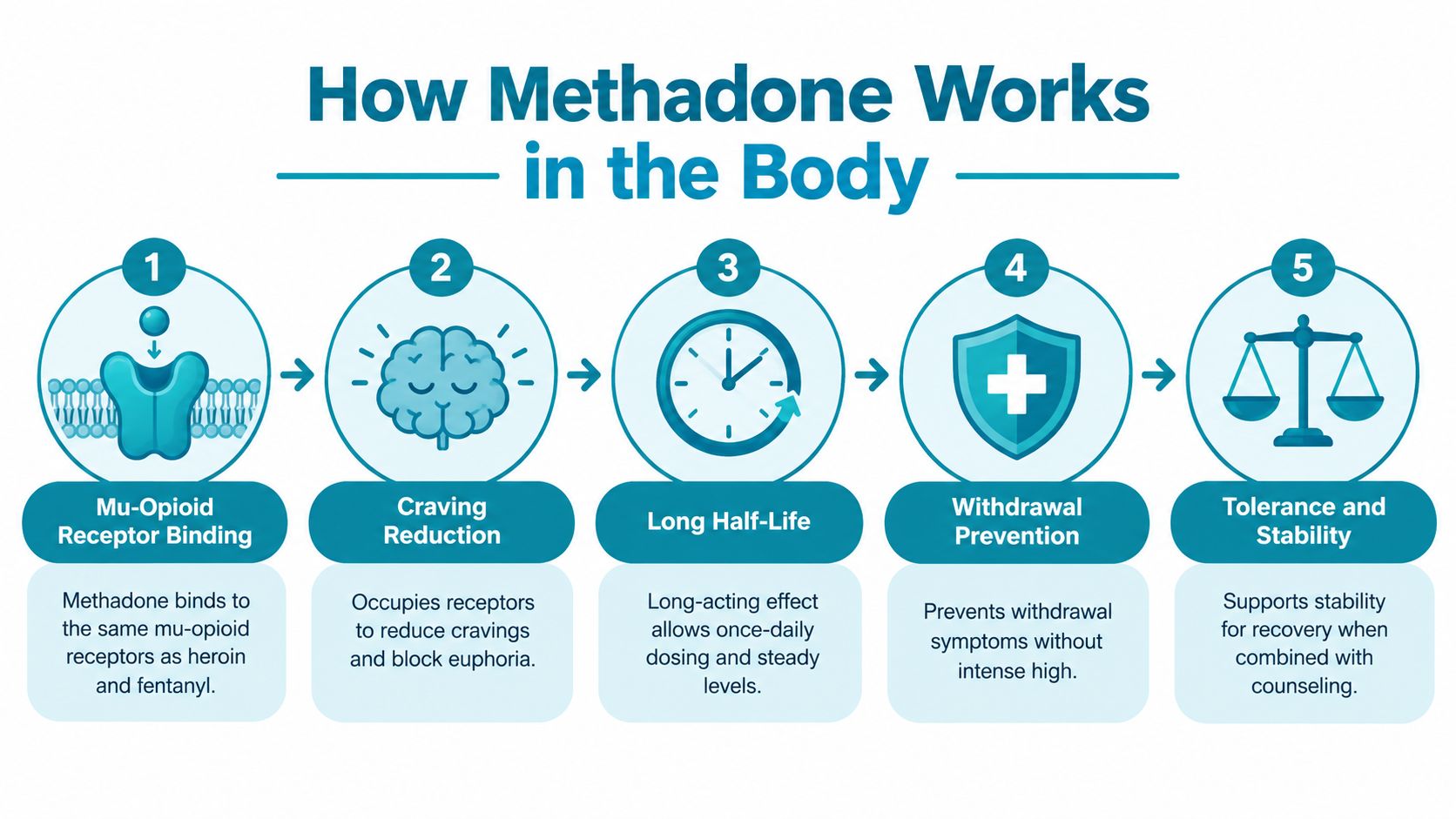
Methadone works at the same mu-opioid receptors targeted by heroin and fentanyl. That receptor binding can reduce withdrawal and cravings, helping create a steadier physiological state. The medication doesn't erase the need for follow-up. Because it remains in the body for a long and highly variable period, clinicians must account for accumulation and delayed effects.
A useful analogy is a dimmer switch rather than a series of bright flashes. Short-acting opioids can produce rapid changes in effect. Methadone is designed to provide a longer-lasting opioid effect, which can reduce the repeated peaks and troughs associated with withdrawal and craving. The analogy doesn't mean methadone is risk-free or that its effects are identical for every patient.
Why the early treatment period needs attention
SAMHSA reports that methadone's elimination half-life can range from 8 to 59 hours, depending on the patient. The half-life is the time required for the body to reduce the medication's concentration by half. A longer or more variable half-life means that the amount in the body can keep changing after the noticeable pain-relieving or withdrawal-relieving effect has shifted. SAMHSA's methadone safety guidance explains the variable half-life and accumulation concern.
This creates a clinically important mismatch. A person may feel that an effect has worn off before the medication has fully cleared. If treatment changes occur too quickly, plasma concentrations can continue rising for several days. That's why clinicians use slow titration and reassessment rather than relying only on how someone feels at one moment.
Other medicines and health conditions can further change exposure. Sedatives, alcohol, liver impairment, and drug interactions may increase sedation or respiratory risk. Patients should give the treatment team a complete medication and substance-use history, including over-the-counter products and prescribed sedatives.
A person experiencing severe sleepiness, slowed or absent breathing, blue or gray lips, or inability to wake needs emergency help, not routine medication counseling. If opioid withdrawal, cravings, or side effects are uncomfortable but there are no emergency signs, the appropriate next step is prompt contact with the treating clinician or program.
For a plain-language overview of symptoms that can occur when opioid effects decline, readers can review opioid withdrawal manifestations. That information can't replace an assessment or provide a personal treatment plan.
FDA Approved Uses and What Evidence Shows
Methadone has two major approved clinical roles in the United States. It is used for opioid use disorder treatment, including maintenance and detoxification within regulated programs, and it is used for certain forms of severe pain when a clinician determines that an opioid analgesic is appropriate. These uses involve different formulations, monitoring expectations, and clinical decisions. FDA information on medications for opioid use disorder distinguishes methadone from other approved treatment medications.
Methadone has a long regulatory history. It was first approved in the United States in 1947 as an analgesic and antitussive. By the mid-1960s, clinicians and researchers were studying and adopting it for opioid addiction treatment, and FDA approval for that use followed in late 1972. Its treatment role therefore dates back more than 50 years. The National Academies review documents this history.
The historical record supports describing methadone as an evidence-based medication, not as a wellness product or a general solution for substance use. NIDA identifies methadone as one of only three FDA-approved medications for opioid use disorder in the United States, alongside buprenorphine and naltrexone. The other two medications work differently, which matters when clinicians compare initiation requirements, risks, and treatment settings.
What “effective” means in real care
Evidence doesn't mean that every patient has the same response or that medication alone resolves every challenge. Methadone treatment is delivered within a care system that may include medical monitoring, counseling, social services, recovery planning, and follow-up. Outcomes can also be shaped by access to an OTP, transportation, payer rules, housing stability, mental-health needs, and exposure to illicitly manufactured fentanyl.
Methadone is not a treatment for every type of pain, and its use for pain should be distinguished from its use in an OTP for opioid use disorder. Product labeling and clinical purpose matter. Readers shouldn't infer that one methadone formulation, schedule, or care setting is appropriate for another purpose.
The practical question isn't just whether methadone “works.” It's whether a qualified team can provide the right medication, in the right setting, with enough monitoring and continuity to address safety and treatment goals. That assessment belongs with a clinician and, for opioid use disorder methadone treatment, an authorized OTP.
Side Effects Risks and Safety Monitoring
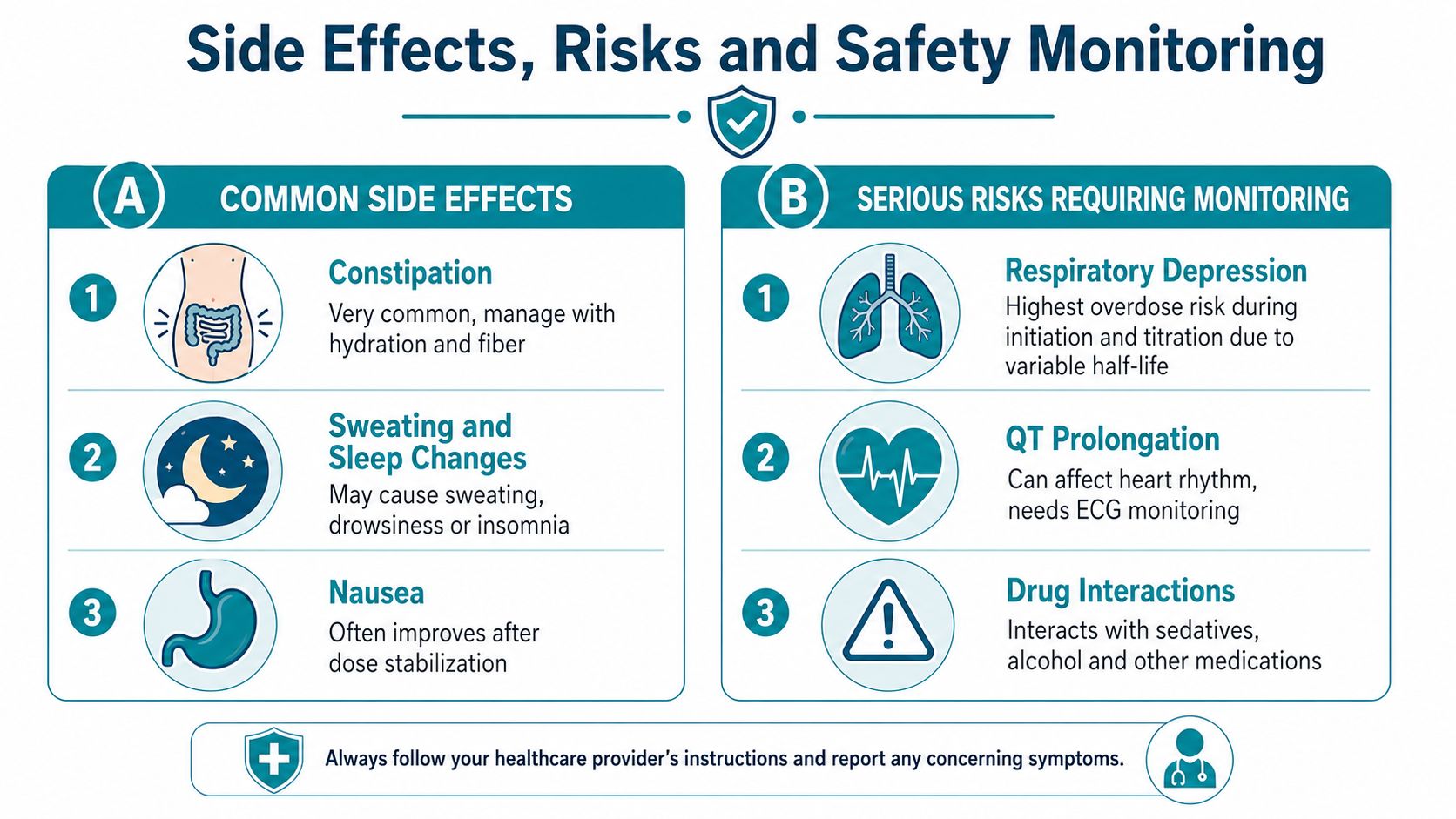
Methadone can cause opioid-related side effects such as constipation, sweating, nausea, drowsiness, or sleep changes. Some effects may change as the body adapts, but a patient shouldn't assume that increasing sleepiness is harmless. Sedation can be an early warning sign of excessive opioid effect, especially when methadone is combined with alcohol, benzodiazepines, sleep medicines, or other sedating substances.
The main risks clinicians watch
The most urgent risk is respiratory depression, meaning breathing becomes dangerously slow, shallow, or stops. The danger can be greatest during initiation and titration because methadone's half-life varies widely and drug levels may continue rising after a treatment change. Never attempt a personal taper, dose change, or self-detoxification protocol based on general online information.
Methadone also has a documented cardiac risk. FDA labeling states that QT interval prolongation and torsades de pointes, a potentially dangerous abnormal rhythm, have occurred during treatment. Reports are more commonly associated with doses above 200 mg per day, although events have also occurred at doses used for opioid maintenance treatment. The FDA methadone label describes QT effects, cardiac potassium-channel inhibition, and reported arrhythmias.
Clinicians may consider ECG-based risk review when a patient has relevant cardiac risk factors. They may also review potassium and magnesium levels, liver function, and other medicines that prolong the QT interval or alter methadone metabolism. These are clinician-led safety decisions, not tests or medication changes readers should arrange independently.
Methadone safety monitoring checklist
| Risk area | What to review with a clinician | Why it matters |
|---|---|---|
| Breathing and sedation | Unusual sleepiness, slowed breathing, alcohol, benzodiazepines, sleep medicines, and other sedatives | Combined effects can increase respiratory-depression risk |
| Treatment changes | Recent initiation, missed treatment, changes in medication, and delayed sedation | Methadone levels may accumulate after an apparent effect has worn off |
| Heart rhythm | Personal cardiac history, fainting, palpitations, ECG findings, and QT-prolonging medicines | Methadone can prolong the QT interval and contribute to dangerous rhythms |
| Electrolytes and liver health | Conditions or medicines affecting potassium, magnesium, or methadone metabolism | Modifiable factors can increase cardiac or medication exposure risk |
| Access and take-home decisions | Transportation, storage safety, stability, and program instructions | Take-home flexibility must be individualized and managed by the OTP |
SAMHSA issued Methadone Take-Home Flexibility Guidance for OTPs in December 2025, reflecting a policy shift toward more flexible access while preserving clinical judgment and safety review. Flexibility doesn't mean unsupervised self-management. Patients should follow the dispensing program's directions and contact the program about missed doses or unexpected symptoms.
Naloxone can temporarily reverse an opioid overdose. It doesn't treat opioid use disorder, and emergency evaluation is still needed after suspected overdose. The naloxone drugs overview explains its role in an emergency without replacing local emergency instructions.
Comparing Methadone With Buprenorphine and Naltrexone
Methadone, buprenorphine, and extended-release naltrexone are all used in evidence-based opioid use disorder care, but they aren't interchangeable. The three practical comparison criteria are initiation requirements, treatment setting, and risk profile. A clinician may also consider pregnancy, prior treatment experience, opioid exposure, withdrawal status, sedative use, access, and the patient's goals.
| Medication | Pharmacology | Initiation and setting | Key safety or access considerations |
|---|---|---|---|
| Methadone | Full opioid agonist | For opioid use disorder, dispensed through a SAMHSA-certified OTP | Requires careful monitoring because of respiratory-depression, accumulation, interaction, and QT risks |
| Buprenorphine | Partial opioid agonist | Often provided through office-based care, subject to current federal, state, and clinical requirements | Initiation requires careful attention to current opioid exposure and withdrawal timing, with individualized clinical guidance |
| Extended-release naltrexone | Opioid antagonist, meaning it blocks opioid-receptor activation | Requires that a person be free of opioids before initiation, according to product labeling and clinical assessment | Starting too soon can precipitate withdrawal, and opioid tolerance changes after treatment interruption |
Methadone and buprenorphine activate opioid receptors, but buprenorphine is a partial agonist. Extended-release naltrexone works differently because it blocks opioid effects rather than replacing them. The choice isn't a contest with one universal winner. It depends on eligibility, safety, setting, continuity, and what the patient can realistically access.
Naloxone belongs in the safety plan, not in the same comparison row. It is an overdose-reversal medication. It can restore breathing temporarily in a suspected opioid overdose, but it does not treat the underlying disorder and doesn't replace ongoing medication treatment.
Why tolerance and fentanyl exposure matter
A period without opioids can reduce tolerance. If someone returns to a previously familiar amount afterward, the body may not tolerate it as before. Illicitly manufactured fentanyl and contamination of other drug supplies add uncertainty because a person may not know which opioid, or how much of it, is present.
A lower-tolerance relapse-safety plan should include naloxone access, trusted-person awareness when feasible, and a prompt return to medical follow-up. It shouldn't include instructions for using illicit drugs or a self-managed opioid protocol. For additional plain-language context, readers can review understanding methadone addiction, while buprenorphine drugs offers a separate overview of that medication.
Treatment Pathways Monitoring and Coordinated Care
Access to methadone depends on more than clinical need. Clinic geography, transportation, payer rules, and OTP availability can determine whether a person can start and remain in treatment. Recent policy analyses found that methadone is the least consistently covered MOUD in private insurance, and in 2022 to 2023, 61% of Medicaid fee-for-service programs and 68% of Medicaid managed care organizations with available data required prior authorization for methadone. The Medicaid access analysis describes these coverage and OTP availability barriers.
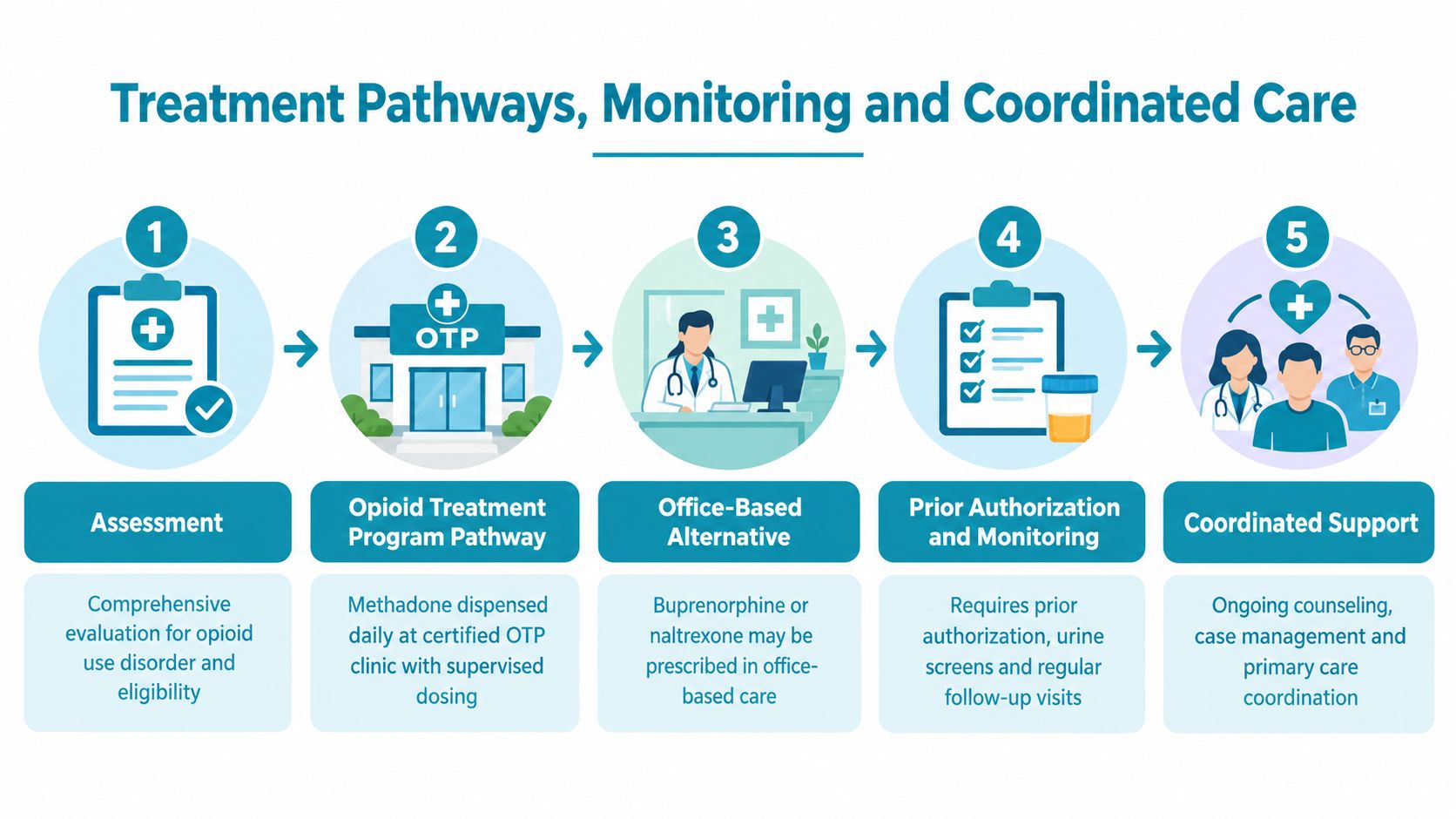
A physician-led assessment typically considers the person's opioid type and route, last use, tolerance, withdrawal, prior overdose, sedative exposure, pregnancy status, other health concerns, and treatment goals. The next step is to compare eligible medications and settings, then establish harm-reduction support, behavioral care when useful, and follow-up. No single appointment can replace coordination with an OTP when methadone for opioid use disorder is involved.
A practical care sequence
Start with immediate safety. Check responsiveness and breathing. If an overdose is suspected, administer naloxone if available, call 911, and follow the dispatcher's instructions. Stay with the person and provide rescue support only if trained and able.
Assess without stigma. A clinician gathers information about opioid exposure, withdrawal, tolerance, previous overdose, sedatives, pregnancy, medical conditions, and goals. The purpose is safer care, not punishment.
Match medication to eligibility and setting. Methadone generally requires an OTP. Buprenorphine or naltrexone may fit other pathways, depending on clinical assessment and product requirements.
Build continuity. Follow-up can include medication review, side-effect monitoring, mental-health assessment, primary-care coordination, counseling, and case-management support.
Coordinate with authorization. If a patient already receives methadone through an outside OTP, another clinician can coordinate information and follow-up when the patient authorizes communication. The goal is continuity, not competing instructions.
Composite example, clearly hypothetical: An adult returns to opioid use after a period of abstinence. The care plan treats reduced tolerance as an overdose risk, restores access to naloxone, reviews medicines and sedatives, reconnects the person with medication follow-up, and revises triggers without treating the return to use as a reason for automatic discharge.
Routine follow-up is appropriate for cravings, side effects, missed treatment, changing goals, or difficulty reaching an OTP. Emergency symptoms require 911 and overdose response. These pathways are not interchangeable.
When to Seek Help and Next Steps With Empire Medical Wellness
Call 911 immediately if someone is unresponsive, breathing slowly or not breathing, making choking or gurgling sounds, or showing blue or gray lips or fingertips. Give naloxone if it's available, call 911, stay with the person, and follow emergency-dispatch instructions. A suspected methadone overdose needs emergency evaluation even if the person temporarily appears better.
Contact the treating clinician or OTP promptly for increasing sedation, troubling side effects, cravings, withdrawal symptoms, a missed dose, a medication interaction, or a return to opioid use. Don't double a missed dose or make a personal medication change unless the treating program gives specific instructions.
Adults seeking confidential outpatient addiction medicine can review Empire Medical Wellness appointment options. Empire Medical Wellness is a private-pay, physician-led outpatient practice. Its addiction medicine care may include medical assessment, evidence-based treatment when clinically appropriate, monitoring, recovery planning, and authorized coordination with outside clinicians or treatment programs. It doesn't provide emergency or inpatient care.
This article was published on September 23, 2026, and updated on September 23, 2026.
Sources
- NIDA medications for opioid use disorder
- CDC clinical care for opioid use disorder
- SAMHSA methadone safety guidance
- FDA methadone labeling
- National Academies history of methadone
Byline: Empire Medical Wellness Editorial Team
This article is educational and isn't personal medical advice.
Empire Medical Wellness offers private-pay, physician-led addiction medicine assessment, monitoring, recovery planning, and authorized coordination with outside treatment programs when clinically appropriate. Visit Empire Medical Wellness to learn about outpatient care and request an appointment.