
Compounded semaglutide isn't reviewed or approved by the FDA for safety, effectiveness, or quality, and the FDA has received 990 adverse-event reports associated with compounded semaglutide. The agency has also warned about dosing errors, hospitalizations, sterility concerns, and products that may contain unapproved salt forms.
You may be considering it after seeing an online offer, discussing access with a clinician, or finding that an approved GLP-1 medication is difficult to obtain or afford. The practical question is not just whether a vial contains something called semaglutide. It's whether the exact product, formulation, source, labeling, and clinical plan can be evaluated responsibly.
A compounded product isn't the same as an FDA-approved medication, even when marketing suggests otherwise. The distinction affects quality review, labeling, dosing instructions, evidence, and the information available to your prescriber.
Table of Contents
- What Compounded Semaglutide Actually Is
- FDA Safety Warnings and Regulatory Guidance
- How Compounded Semaglutide Differs from Approved Brand Formulations
- Clinical Monitoring and Dosing Considerations
- Questions to Ask Your Prescribing Physician
- Next Steps and When to Seek Medical Care
What Compounded Semaglutide Actually Is
A patient may encounter compounded semaglutide after an approved GLP-1 medication is unavailable, unaffordable, or unsuitable in its marketed form. The term compounding describes preparing a medication by combining, mixing, or altering ingredients for an individual medical need. In appropriate circumstances, that process can provide a formulation an approved product does not offer or avoid a specific ingredient problem. It is different from manufacturing an FDA-approved drug for general distribution.
Compounded semaglutide became more visible as supply constraints increased demand for alternatives. That market history does not establish that a particular preparation is safe, effective, legal, or appropriate for a given patient. The relevant questions concern the exact formulation, concentration, source, labeling, and prescribing plan.

Why FDA review matters
FDA-approved medications undergo agency review for safety, effectiveness, quality, manufacturing, and labeling. Compounded semaglutide does not receive that same premarket review. The FDA states that compounded semaglutide is not reviewed for safety, effectiveness, or quality, and warns that some products may contain semaglutide sodium or semaglutide acetate. These salt forms have not been shown to be safe or effective substitutes for the approved active ingredient. FDA guidance on unapproved GLP-1 drugs explains why the ingredient name alone does not establish equivalence.
A sterile process addresses contamination risk, not FDA approval or clinical equivalence. The Herbilabs Labware sterile compounding overview offers pharmacy-focused background on sterile preparation.
A safer starting question
Before discussing access, ask:
- What exact product is this? Confirm the active ingredient, formulation, concentration, and container.
- What is the clinical indication? Semaglutide products have product-specific FDA labeling.
- Who prescribed and compounded it? Identify both the prescribing clinician and dispensing facility.
- What evidence supports this exact product? Evidence for an approved drug does not automatically transfer to a compounded preparation.
- How will dosing be communicated? Vial concentrations and syringe measurements can create preventable errors.
An obesity-medicine evaluation should start with health history and treatment goals, not an assumption that a compounded vial is interchangeable with Wegovy, Ozempic, or Rybelsus. Patients can review information about medical and metabolic evaluation through Empire's GLP-1 care information.
FDA Safety Warnings and Regulatory Guidance
The FDA's warnings concern reported patient harm, especially dosing errors with injectable compounded semaglutide. On July 26, 2024, the agency issued a compounding risk alert after reports of adverse events, including hospitalizations, associated with overdoses caused by measurement mistakes. The FDA's compounding risk alerts outline these continuing safety concerns.
The error often occurs during dose conversion. Instructions may state the dose in milligrams, the vial may show a concentration, and the syringe may use units or milliliters. Confusing any of those measurements can change the injected amount. The FDA's specific alert on dosing errors with compounded semaglutide explains why the concentration, syringe type, and measurement must be confirmed before administration.
The adverse-event signal
Reporting that cited agency data described 288 reports of adverse reactions involving compounded semaglutide between August 2021 and mid-July 2024. It also identified 108 similar reports involving compounded tirzepatide during that period. These reports do not establish the risk for every preparation or patient, and they do show why a compounded GLP-1 product requires review of its exact formulation, instructions, and clinical context. Pharmaceutical Technology's report on FDA concerns provides that historical context.
The FDA has stated that compounded semaglutide is not reviewed for safety, effectiveness, or quality in the same manner as an approved drug. The agency has also reported 990 adverse-event reports associated with compounded semaglutide. An adverse-event report does not prove that the medication caused the event, but a cluster of reports warrants clinical attention.
Practical rule: Do not infer an injectable volume from a brand-name dose. Use the exact concentration and written instructions supplied by the prescribing clinician or dispensing pharmacist.
Marketing language can mislead
FDA enforcement actions in 2025 warned that claims equating compounded semaglutide with an FDA-approved product may be false or misleading under federal law. A preparation can contain semaglutide and still lack the approval, labeling, and product-specific review associated with Wegovy, Ozempic, or Rybelsus. This compounding pharmacy vs FDA approved overview explains the regulatory distinction.
Patients can review semaglutide side effects for practical symptom information. Common gastrointestinal symptoms may need routine discussion, while severe or rapidly worsening symptoms require prompt medical assessment.
How Compounded Semaglutide Differs from Approved Brand Formulations
Semaglutide and tirzepatide are different incretin medicines. They aren't interchangeable just because both are discussed as GLP-1 treatments. Product name, formulation, indication, and dose must stay connected to the medication's current FDA label.
A second distinction matters just as much. Wegovy, Ozempic, and Rybelsus are FDA-approved semaglutide products with product-specific labeling. A compounded preparation isn't FDA-approved, even if its marketing uses a familiar brand comparison or describes it as a generic. FDA enforcement actions have specifically warned against claims that imply equivalence.
| Product type | FDA approval status | Quality and safety review | Indication-specific labeling |
|---|---|---|---|
| FDA-approved semaglutide product | Reviewed and approved for its labeled uses | FDA review includes quality and manufacturing information | Yes, the product label defines indications, warnings, administration, and other prescribing information |
| Compounded semaglutide | Not reviewed or approved by the FDA for safety, effectiveness, or quality | The FDA hasn't conducted the same premarket review of the exact preparation | No equivalent FDA-approved product label for that compounded preparation |
| Tirzepatide product | Different incretin medicine with its own FDA-approved products and labeling | Must be evaluated according to its own product information | Yes, but it must not be substituted for semaglutide by name alone |
Why the label controls clinical decisions
The label connects the medicine to its approved indication, contraindications, warnings, administration instructions, and known adverse effects. A prescriber also needs to consider other glucose-lowering medicines, other incretin therapies, pregnancy plans, relevant medical history, and procedure timing.
That sequence prevents a common error: choosing a dose first and reviewing the patient later. The safer sequence is to identify the medication and indication, confirm the formulation, assess risks, then establish monitoring and follow-up.
What does not work
Several shortcuts create confusion:
- Treating a compounded product as a generic. FDA-approved generic drugs undergo FDA review. Compounded drugs aren't automatically generic equivalents.
- Using a brand dose with a different preparation. Concentration and delivery device can differ.
- Assuming a familiar name guarantees quality. Marketing language doesn't replace regulatory review.
- Comparing outcomes casually. Without reliable evidence for the exact preparation, a clinician shouldn't promise that compounded and approved products produce the same results.
Patients researching approved semaglutide treatment can review Empire's semaglutide information, while keeping in mind that a webpage cannot determine personal eligibility or replace a licensed prescriber's evaluation.
Clinical Monitoring and Dosing Considerations
A careful medication visit is more than selecting a product. It connects the indication, formulation, medical history, risk review, titration plan, symptom monitoring, and follow-up schedule.
The first step is to name the exact product. “Semaglutide” alone isn't enough. The clinician should confirm whether the medication is an approved product or a compounded preparation, identify the formulation, and verify the concentration and instructions supplied by the pharmacy.
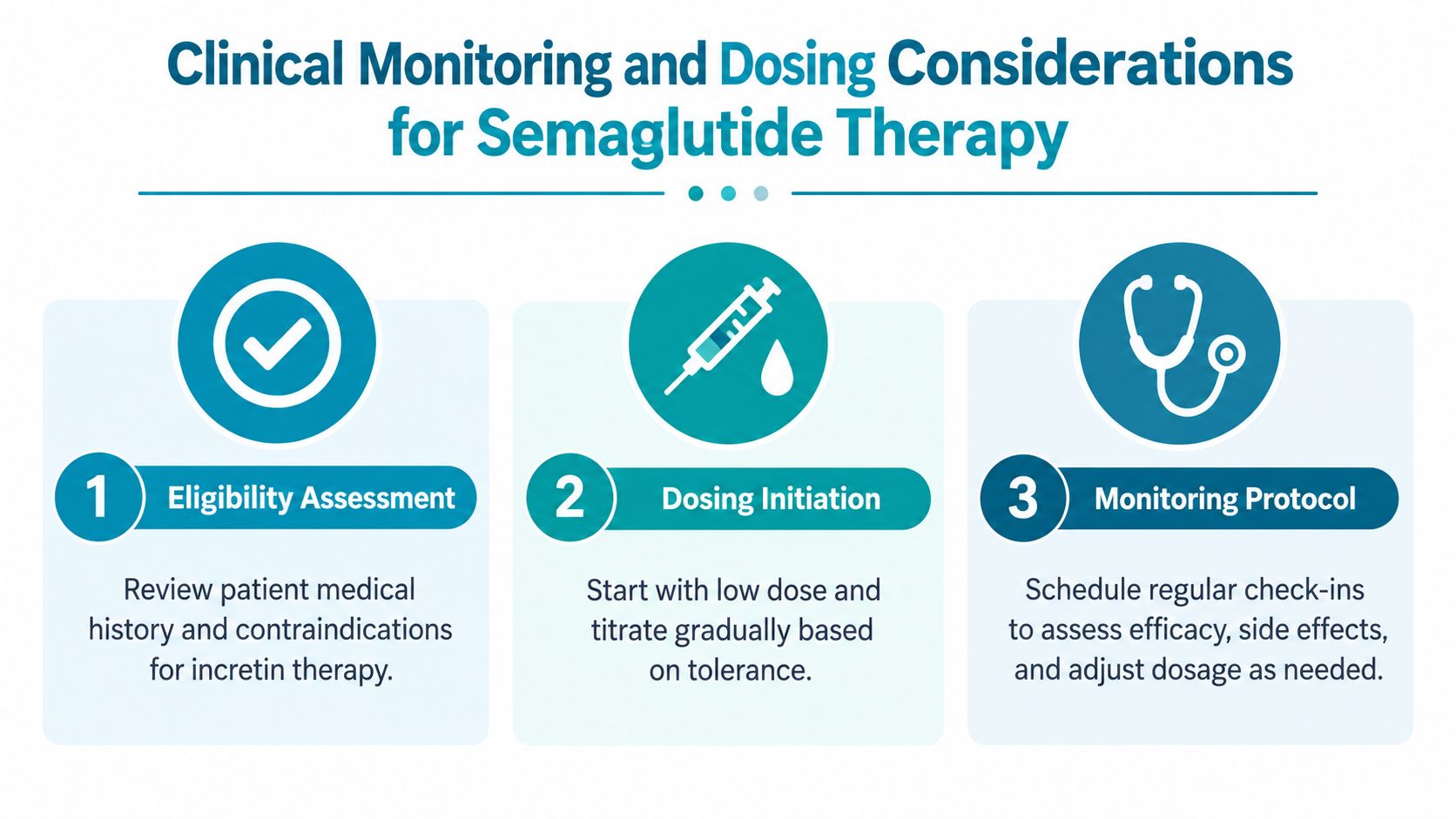
A practical clinical sequence
Eligibility assessment. Review the medical history, current medicines, relevant contraindications, pregnancy plans, and the reason treatment is being considered. Obesity-medicine decisions should reflect health factors and treatment goals, not appearance alone. The NIDDK guide to prescription medications for weight management provides general patient education about how clinicians approach this category of care.
Product and formulation confirmation. Establish the exact product, indication, formulation, concentration, prescriber, and compounding source. If a pharmacy uses semaglutide sodium or semaglutide acetate, that difference should be addressed directly because the FDA hasn't established those salt forms as safe or effective substitutes for the approved active ingredient.
Label-based titration. For an FDA-approved medicine, the prescriber follows the current product label. A compounded product doesn't carry an equivalent FDA-approved label. Patients shouldn't convert, improvise, or change injectable measurements independently.
Response and tolerability monitoring. Follow-up should address symptoms, treatment response, other glucose-lowering or incretin medicines, and whether the plan remains appropriate. The right monitoring interval depends on the medication and the person's clinical situation.
The accompanying video offers general educational context, but it doesn't provide individualized dosing instructions.
Common symptoms versus urgent warning signs
Gastrointestinal symptoms can occur with incretin medicines and should be discussed during routine follow-up, especially when they persist or interfere with hydration or daily function. Urgent symptoms require a different response.
| Symptom pattern | Appropriate next step |
|---|---|
| Nausea, vomiting, diarrhea, constipation, or reduced appetite that is mild or manageable | Document the symptom and discuss it with the prescribing clinician during follow-up |
| Persistent vomiting, inability to keep fluids down, or signs of dehydration | Contact a clinician promptly for assessment |
| Severe or persistent abdominal pain, especially with vomiting | Seek urgent medical evaluation |
| Trouble breathing, facial or throat swelling, fainting, or signs of a severe allergic reaction | Seek emergency care |
| Suspected overdose or a dose-measurement error | Contact a clinician, poison control, or emergency services based on severity and local guidance |
A patient should also tell the prescriber about planned procedures, pregnancy or plans to become pregnant, and all glucose-lowering or incretin medicines. These details can change the risk assessment and timing of care. Empire's physician-led weight-management information can help readers understand the broader context of obesity care without offering a personal treatment decision.
Questions to Ask Your Prescribing Physician
Bring the vial, packaging, prescription, and written instructions to the appointment if you're already using a compounded product. The goal isn't to defend or reject a treatment in advance. It's to make sure everyone is discussing the same medicine and the same risks.
Product and source questions
Ask:
- What is the exact product and indication? Ask whether it's intended for diabetes treatment, chronic weight management, or another use, and whether that use matches an FDA-approved label.
- Is this an FDA-approved product or a compounded preparation? Request the precise name, formulation, concentration, and dispensing information.
- What active ingredient form does it contain? Ask directly about semaglutide base versus a salt form.
- Who compounded it? The facility and applicable oversight should be identifiable.
- What instructions apply to this exact container? Don't rely on a brand-name dose or an online conversion chart.
The FDA warns that vial concentration differences can lead to incorrect calculations. A qualified clinician or pharmacist should resolve any uncertainty before an injection is administered.
Safety and follow-up questions
A useful consultation should also address:
- Which medical conditions or medicines affect eligibility?
- What are the relevant contraindications and warnings?
- What should I do if I'm planning a pregnancy or procedure?
- Which symptoms are expected enough for routine follow-up, and which require urgent care?
- When should response and tolerability be reassessed?
- What is the plan if the product is unavailable, mislabeled, poorly tolerated, or no longer legally appropriate?
Ask how the clinician will distinguish a medication side effect from another medical problem. Severe abdominal pain, serious allergic symptoms, dehydration, or a suspected dosing error shouldn't wait for a routine appointment.
Comparing alternatives
Semaglutide and tirzepatide shouldn't be compared as interchangeable versions of one medicine. They have different active ingredients, product labels, formulations, and clinical considerations. Empire's semaglutide versus tirzepatide guide may help you prepare questions, but your prescriber must determine which options are clinically appropriate.
Bring questions, not assumptions. A careful clinician should be able to explain what the product is, what is known about it, what remains uncertain, and how follow-up will work.
Next Steps and When to Seek Medical Care
If you're considering compound semaglutide, start by identifying the exact product rather than relying on a brand comparison or a social-media description. Confirm whether it's FDA-approved, clarify the formulation and concentration, review other medicines and pregnancy plans with a licensed clinician, and ask how routine symptoms and urgent complications will be handled.
If you're already using a compounded preparation, don't change the dose based on this article. Contact the prescriber or dispensing pharmacist when the label, concentration, syringe markings, or instructions are unclear. Seek urgent medical care for severe abdominal pain, inability to keep fluids down, serious allergic symptoms, fainting, or a suspected overdose.
Semaglutide and tirzepatide are different incretin medicines. A physician-led obesity-medicine evaluation can place medication decisions within a broader review of health history, treatment goals, tolerability, and long-term follow-up.
This article is educational and isn't personal medical advice. It doesn't diagnose a condition or tell you to start, stop, or change medication.
Empire Medical Wellness provides physician-led obesity medicine care that can include medical and metabolic assessment, individualized weight-management planning, medication review when clinically appropriate, and follow-up based on response and tolerability. Visit Empire Medical Wellness to learn more and decide whether a private consultation is appropriate for your questions about semaglutide and compounded products.
Byline: Empire Medical Wellness Editorial Team
Published: September 24, 2026
Updated: September 24, 2026
Sources
- FDA compounding risk alerts
- FDA concerns about unapproved GLP-1 drugs
- FDA alert about dosing errors with compounded semaglutide
- FDA warning letter concerning compounded semaglutide marketing
- NIDDK prescription medications for weight management