
Buprenorphine drugs are FDA-approved medicines for opioid use disorder that reduce withdrawal and craving, and their core pharmacology includes a ceiling effect on respiratory depression that makes them safer than full opioid agonists in an important way. In the U.S., buprenorphine for opioid use disorder entered the market on October 8, 2002, and the FDA-approved target dose reported by NIDA in 2024 is 16 mg per day, although dose optimization is still an active area of study.
A lot of people start with the wrong question. They ask which buprenorphine drug is “best,” when the more useful question is often: Which medication pathway fits the person's opioid exposure, overdose risk, treatment setting, and follow-up plan?
That matters because opioid use disorder is a treatable medical condition. It also matters because naloxone reverses an overdose but does not treat the underlying disorder, and because fentanyl contamination and lost tolerance after abstinence can sharply raise risk if someone returns to opioid use. Good care usually combines medication, harm reduction, follow-up, and practical planning for emergencies.
Byline: Empire Medical Wellness Editorial Team
Published: September 19, 2026
Updated: September 19, 2026
Table of Contents
- What Buprenorphine Drugs Are and Who They Help
- How Buprenorphine Works in the Body
- Comparing Medication Options for Opioid Use Disorder
- Available Forms and How They Are Taken
- Safety Side Effects Interactions and Risk Factors
- Starting Care Monitoring and Staying Connected
- Getting Help Accessing Care and When to Seek Urgent Help
- Sources
What Buprenorphine Drugs Are and Who They Help
What does it mean when a clinician says buprenorphine is one option for opioid use disorder, not the only option?
Buprenorphine drugs are medications used to treat opioid use disorder, or OUD. OUD is a medical condition in which opioid use becomes hard to control and continues even when it is causing harm. People with OUD need treatment options, follow-up, and overdose protection. They do not need blame.
A practical way to place buprenorphine is to see it as part of a full medication decision framework, not as a stand-alone answer. For routine treatment, the main FDA-approved medication paths for OUD are methadone, buprenorphine, and naltrexone. For emergencies, naloxone is separate. Naloxone reverses an opioid overdose. It does not treat OUD itself.
That distinction prevents a lot of confusion.
A plain-language definition
Buprenorphine is an opioid medication used in addiction treatment, but it is not used in the same way as full opioid agonists such as heroin, fentanyl, or oxycodone. It can help people feel stable enough to stay engaged in care by reducing withdrawal symptoms and cravings. The details of how it acts at the receptor level matter, but the big picture is simpler. It is one of the standard medication choices for OUD described in SAMHSA TIP 63, the federal treatment guideline for medications for opioid use disorder, and in FDA labeling for approved products.
Who it may help
Buprenorphine often fits people who want treatment that can be managed in regular medical care with follow-up, counseling support when available, and a plan for missed appointments or return to use. It may be considered for adults who are trying to stop nonmedical opioid use, re-entering care after a return to use, or leaving an emergency department or hospital and need ongoing outpatient treatment.
The key question is not which medication sounds strongest. The better question is which option matches the person's current opioid exposure, overdose history, tolerance, treatment setting, and ability to follow through with routine care.
How it compares with the other medication paths
Each medication pathway solves a different problem.
- Methadone may be a better fit for some people who need the structure of an opioid treatment program or who have not done well with other options.
- Buprenorphine may fit people who want office-based care and a medication that can reduce withdrawal and craving while supporting day-to-day functioning.
- Extended-release naltrexone blocks opioid effects rather than activating the receptor. It requires full opioid abstinence before starting, which can make initiation harder for some patients.
- Naloxone belongs in the emergency plan for anyone at risk of overdose, including people in treatment and people not in treatment.
A seat belt is a useful comparison. Medication for OUD helps lower the chance of harm over time. Naloxone is the emergency tool you keep ready in case something goes wrong right now.
One safety point that changes decision-making
Lower tolerance after a period of abstinence can sharply raise overdose risk if a person returns to opioid use. That is one reason medication choice matters. It is also why families and patients are often advised to keep naloxone available even during treatment or after treatment changes. The FDA labeling for naloxone products explains overdose recognition and emergency use, while treatment guidance such as TIP 63 addresses routine medication care, monitoring, and follow-up.
Practical rule: If someone may be overdosing, focus first on responsiveness, breathing, naloxone if available, and calling 911. Decisions about methadone, buprenorphine, or naltrexone belong to routine medical care after the emergency is addressed.
Buprenorphine helps many people, but it is not automatically the right choice for every situation. The best fit depends on the full care plan, the overdose plan, and how routine treatment will be delivered.
How Buprenorphine Works in the Body
Why can one opioid medication reduce withdrawal and craving, yet still behave differently from heroin, fentanyl, oxycodone, or methadone? The answer comes down to how strongly it attaches to the opioid receptor, how much it activates that receptor, and how long it stays there.
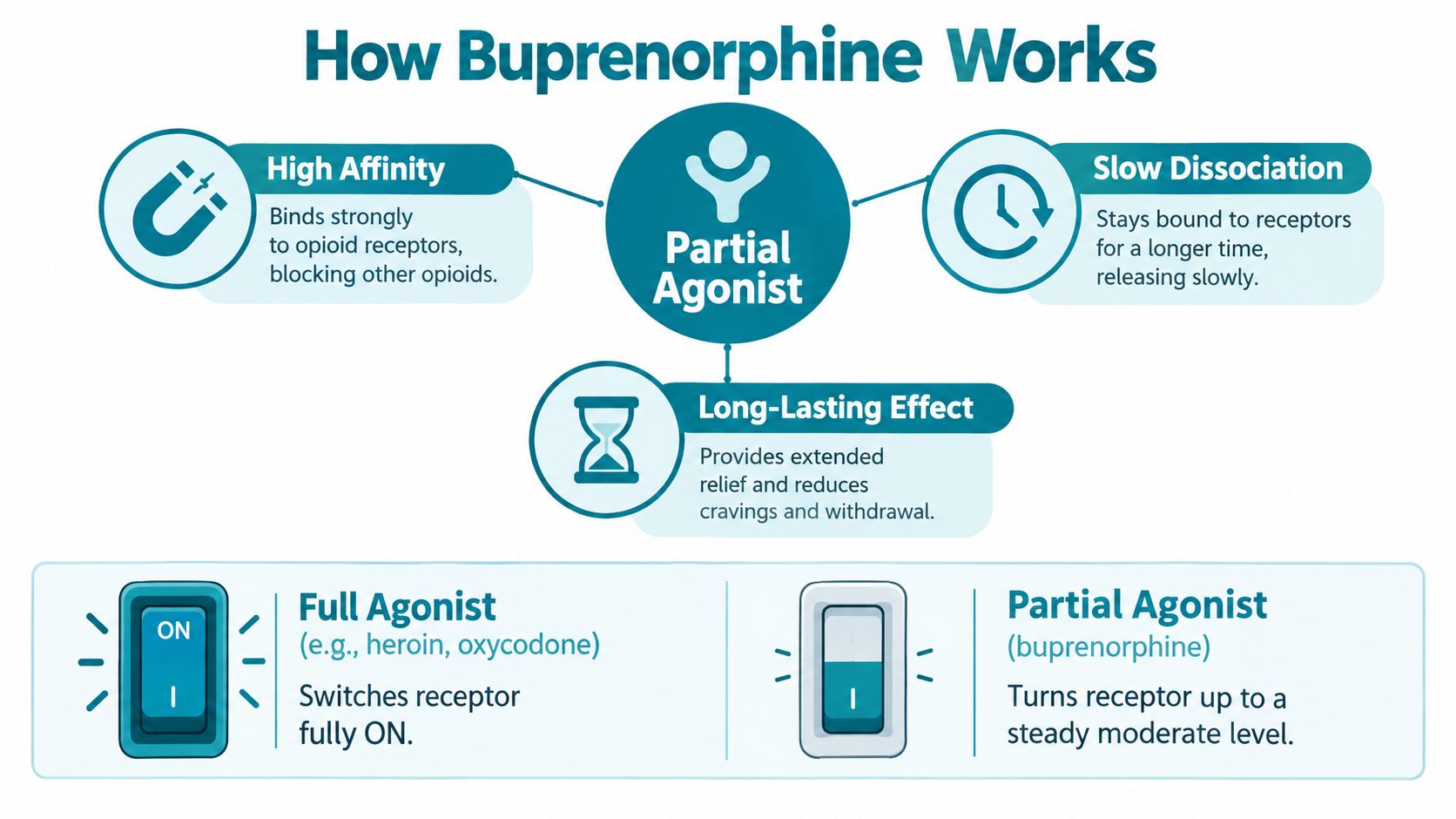
Partial agonist means limited receptor activation
Buprenorphine is a partial agonist at the mu opioid receptor. A receptor agonist turns a receptor on. A partial agonist turns it on only partway.
A dimmer switch is a useful comparison. Buprenorphine can create enough receptor activity to ease withdrawal symptoms and lower craving, but it does not drive receptor activation the same way a full agonist does. That difference helps explain why buprenorphine is used in routine treatment for opioid use disorder.
Its pharmacology also helps explain one safety point. Buprenorphine has a ceiling effect on respiratory depression, which means the breathing-slowing effect does not keep rising in the same way seen with full agonists, as described in this pharmacology review of buprenorphine. That does not make overdose impossible. It means risk works differently, especially when alcohol, benzodiazepines, or other sedating drugs are involved.
High affinity and slow dissociation
Two terms often cause confusion.
High affinity means buprenorphine binds very tightly to the receptor.
Slow dissociation means it lets go slowly.
Those properties matter in real life. If the receptor is like a parking space, buprenorphine parks firmly and tends to stay parked for a while. That can help steady symptoms across the day. It also helps explain why other opioids may have less effect if a person uses them on top of buprenorphine.
This same receptor behavior is one reason starting treatment needs careful timing. If a person still has a full agonist opioid strongly affecting the receptor, buprenorphine can displace it and cause precipitated withdrawal. That is routine-care territory, not an emergency self-treatment decision. SAMHSA TIP 63 and FDA labeling are used to guide those medication-start decisions.
Why the long half-life matters
A half-life is the time it takes for the amount of a drug in the body to drop by half. With buprenorphine, the long half-life helps medication levels change more gradually instead of rising and falling quickly.
For many patients, that supports steadier symptom control. It can also make treatment more practical because the medicine keeps working beyond a short window. The tradeoff is that changes, restarts, and transitions still need planning, especially after missed treatment or recent opioid use.
One more point helps place buprenorphine in the larger medication decision. Routine care asks, "Which medication fits this person's treatment setting, opioid exposure, and follow-up plan?" Emergency care asks, "Is the person breathing and responsive right now?" Those are different questions. Buprenorphine belongs to the routine treatment framework alongside methadone and naltrexone. Naloxone belongs in the overdose response plan because relapse after lower tolerance can become life-threatening fast.
Comparing Medication Options for Opioid Use Disorder
Choosing among medications for opioid use disorder isn't just about preference. It depends on setting, timing, recent opioid exposure, overdose history, pregnancy considerations, access, and whether a person can safely complete the steps needed to start a given medication.
If you want a broad nonpromotional overview of MAT medicine for recovery, that resource can help frame the larger conversation before a medical visit.
Methadone Buprenorphine and Naltrexone Comparison
| Feature | Methadone | Buprenorphine | Extended-Release Naltrexone |
|---|---|---|---|
| What it does | Opioid agonist medication used for OUD | Partial opioid agonist used for OUD | Opioid antagonist used for OUD |
| How treatment usually starts | Requires structured program-based initiation | Requires careful clinical assessment and timing | Requires full opioid abstinence before starting |
| Typical treatment setting | Opioid treatment program | Office-based care or opioid treatment program settings | Clinician-supervised treatment setting |
| Access model | More regulated dispensing structure | SAMHSA says it was the first OUD medication that could be prescribed or dispensed in physician offices | Often considered when a person wants a non-opioid maintenance option |
| Key practical advantage | Strong structure and frequent contact | Flexible treatment settings and several formulations | No opioid agonist effect |
| Key caution | Sedation and overdose risk need close supervision | Timing, interactions, and precipitated withdrawal risk require supervision | Starting too soon after opioid use can trigger abrupt withdrawal |
| Who may ask about it | People who need high structure or OTP-based care | People seeking office-based treatment flexibility | People who can complete abstinence before initiation |
What this means in practice
Methadone, buprenorphine, and extended-release naltrexone are all evidence-based treatment pathways. They are not interchangeable in a simple way.
Methadone is tightly structured and dispensed through opioid treatment programs.
Buprenorphine can be used in office-based settings, which can widen access.
Extended-release naltrexone requires full opioid abstinence first, which is a major practical difference.
For people comparing office-based options, Empire's methadone information page can help clarify how methadone differs from buprenorphine and why treatment setting matters.
The hidden risk after abstinence
People often assume that any period of abstinence makes them safer. It can lower ongoing exposure, but it can also lower tolerance. If someone later returns to opioid use, the dose they once survived may become much more dangerous.
That risk is one reason treatment conversations should include:
- Overdose history
- Fentanyl exposure concerns
- Current sedative or alcohol use
- Pregnancy status
- What kind of follow-up the person can realistically maintain
Medication choice isn't just about symptom relief. It's also about how to lower overdose risk over time.
Available Forms and How They Are Taken
How can one medication come in so many forms, and why does that matter for treatment choice?
With buprenorphine, the form is part of the care plan. It affects where treatment happens, how often a person needs follow-up, who gives the medication, and what safety steps make sense. That is why form selection should connect back to the full medication decision framework discussed earlier. Methadone, buprenorphine, and naltrexone differ in setting, timing, and overdose protection. Naloxone rescue planning still matters with any opioid use disorder treatment path, especially because relapse after a period of abstinence can be more dangerous when tolerance has dropped.
SAMHSA TIP 63 and FDA labeling describe several ways buprenorphine may be used for opioid use disorder. Some forms are taken at home. Some are given by a clinician in routine care. Emergency care is a different situation. In an overdose or severe breathing problem, the urgent step is emergency response and naloxone, not choosing between tablet, film, or injection.
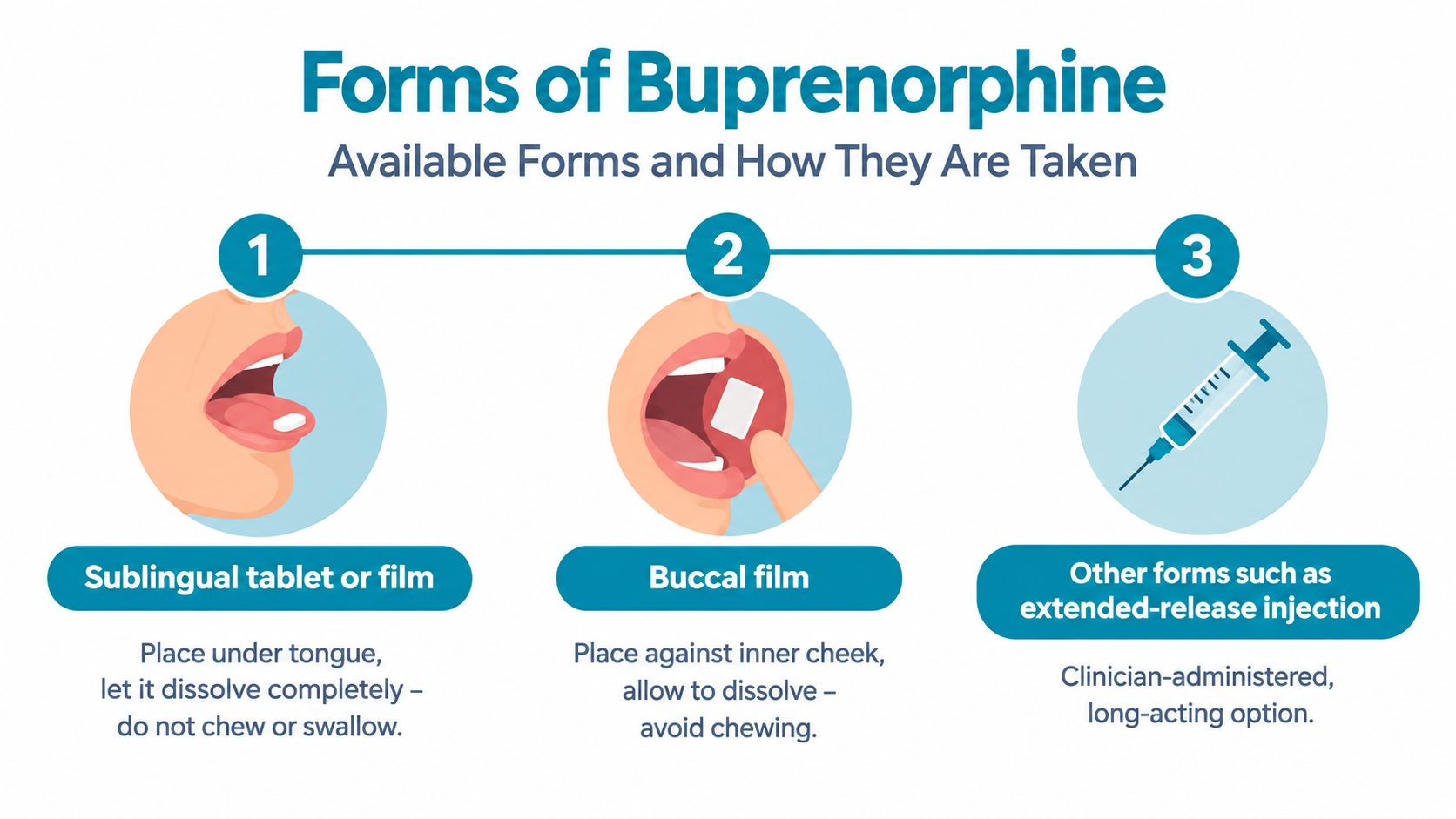
The main forms patients may encounter
Buprenorphine products for opioid use disorder are not all used the same way.
- Sublingual tablets. These dissolve under the tongue.
- Sublingual film. This also dissolves under the tongue.
- Buccal film. This is placed against the inside of the cheek.
- Extended-release injection. This is a long-acting form given by a clinician.
A simple way to sort these options is by who handles the medication day to day. Tablets, sublingual films, and buccal films rely more on home use. Long-acting injections rely more on scheduled clinical visits. That difference can matter for people who want fewer daily decisions, need more structure, or have concerns about medication storage at home.
For patients who want a simple explainer on sublingual use steps, this Suboxone medication guidance for patients offers practical orientation. It should not replace instructions from the prescribing clinician.
What “taken correctly” usually means
Placement matters. A sublingual product is meant to dissolve under the tongue. A buccal product is meant to sit against the cheek. If a product is swallowed too quickly, the body may not absorb it the intended way.
That can confuse people because these medicines do not work like a regular pill you swallow with water.
The practical lesson is simple. Follow the product-specific instructions on the FDA label and the clinician's directions for the exact form prescribed. Do not switch between forms, cut products, or change the route of use unless the prescriber says to.
Why one form may fit better than another
Form choice is less about preference alone and more about treatment fit.
A clinician may review questions like these:
- Can the person manage a daily home medication routine?
- Would clinic-based administration improve consistency?
- Are there concerns about medication storage, loss, or sharing?
- Is the person comparing office-based treatment with more structured OTP care?
- What follow-up schedule is realistic for routine care?
Those questions connect back to the larger medication decision. A person choosing between methadone, buprenorphine, and naltrexone is not only choosing a molecule. They are also choosing a treatment setting, a monitoring pattern, and a safety plan that should include naloxone availability and relapse-risk counseling after lower tolerance.
If you're comparing outpatient buprenorphine products, Empire's Suboxone guide explains buprenorphine/naloxone in plain language and how it fits into office-based addiction treatment.
Safety Side Effects Interactions and Risk Factors
What makes buprenorphine safer for one person and riskier for another? The answer is usually not one side effect in isolation. It is the full safety picture. Recent opioid use, other sedating substances, medical conditions, pregnancy, overdose history, and access to naloxone all shape the plan.
That broader view matters because medication choice for opioid use disorder is never only about buprenorphine. Clinicians often compare methadone, buprenorphine, and naltrexone within the same decision framework, then separate routine treatment questions from emergency overdose response. SAMHSA TIP 63 and FDA labeling support that kind of step-by-step review, especially when relapse risk is higher after tolerance has dropped.
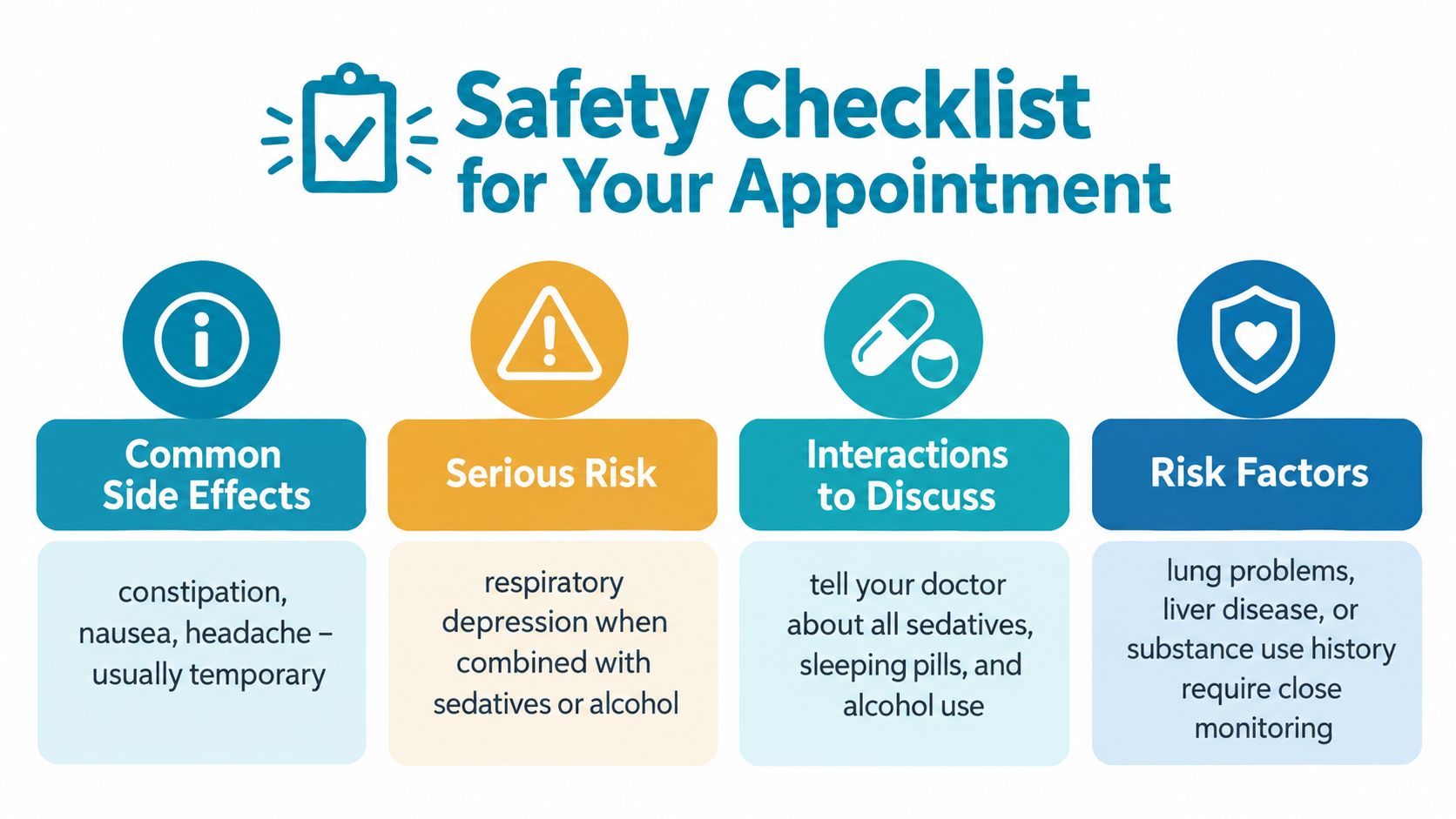
A checklist to bring to an appointment
Use this as a discussion guide.
- Alcohol, benzodiazepines, sleep medicines, or other sedatives. Combining these with buprenorphine can increase sedation and breathing risk.
- Recent opioid use details. Timing and opioid type matter because buprenorphine can displace other opioids at the receptor and trigger precipitated withdrawal if started under the wrong conditions.
- Past overdose or periods of abstinence. Lower tolerance after time away from opioids can make relapse more dangerous, even if a prior amount once felt familiar.
- Breathing problems. Asthma, COPD, sleep apnea, or other lung conditions can affect monitoring and safety planning.
- Liver disease or hepatitis. These may change product selection, lab follow-up, or both.
- Pregnancy or possible pregnancy. Pregnancy can affect which medication and treatment setting fit best.
- HIV care, hepatitis care, or other ongoing treatment. Coordination matters when several clinicians and medicines are involved.
Common concerns readers ask about
Common side effects can include constipation, nausea, headache, sleepiness, sweating, or mouth irritation with some forms. Side effects do not always mean the medication is unsafe. They do mean the prescriber needs the full picture.
A point that confuses many readers is precipitated withdrawal. Buprenorphine binds strongly to opioid receptors. A useful analogy is a key that grabs the lock firmly but only turns it partway. If a full-agonist opioid is still strongly active, buprenorphine can push it off the receptor and cause a sudden drop in opioid effect. That is why clinicians pay close attention to recent use, current withdrawal, and product-specific instructions.
The most serious interaction concern is slowed or suppressed breathing when buprenorphine is combined with alcohol or other sedatives. Buprenorphine has a ceiling effect for respiratory depression, but that ceiling is not a guarantee of safety, especially in mixed-drug use or in people with lung disease.
Emergency safety is a separate question from routine side effect management. If overdose risk is part of the household picture, Empire's naloxone information page for overdose response planning explains where naloxone fits and why lower tolerance after a return to opioid use can raise overdose danger.
Dose, monitoring, and product labels
Readers often want one fixed “safe dose” answer. Care is more individual than that. FDA labeling for transmucosal buprenorphine products has long described a commonly referenced maintenance target of 16 mg per day for many patients, but the right dose and the right medication option still depend on clinical assessment, response, and safety factors.
That is one reason follow-up matters. A clinician may monitor side effects, sedation, cravings, continued opioid use, liver concerns, and whether buprenorphine remains the best fit compared with methadone or naltrexone.
Bring a full medication list, including alcohol use, over-the-counter sleep aids, and any nonprescription sedatives. Accurate details help clinicians choose a safer plan.
Starting Care Monitoring and Staying Connected
What happens after someone decides, or agrees, to get help for opioid use disorder?
The next steps work best when they are organized into two lanes. One lane is emergency care for overdose or severe breathing problems. The other is routine treatment planning for choosing and monitoring medication. Keeping those lanes separate reduces confusion and helps families know what to do first.
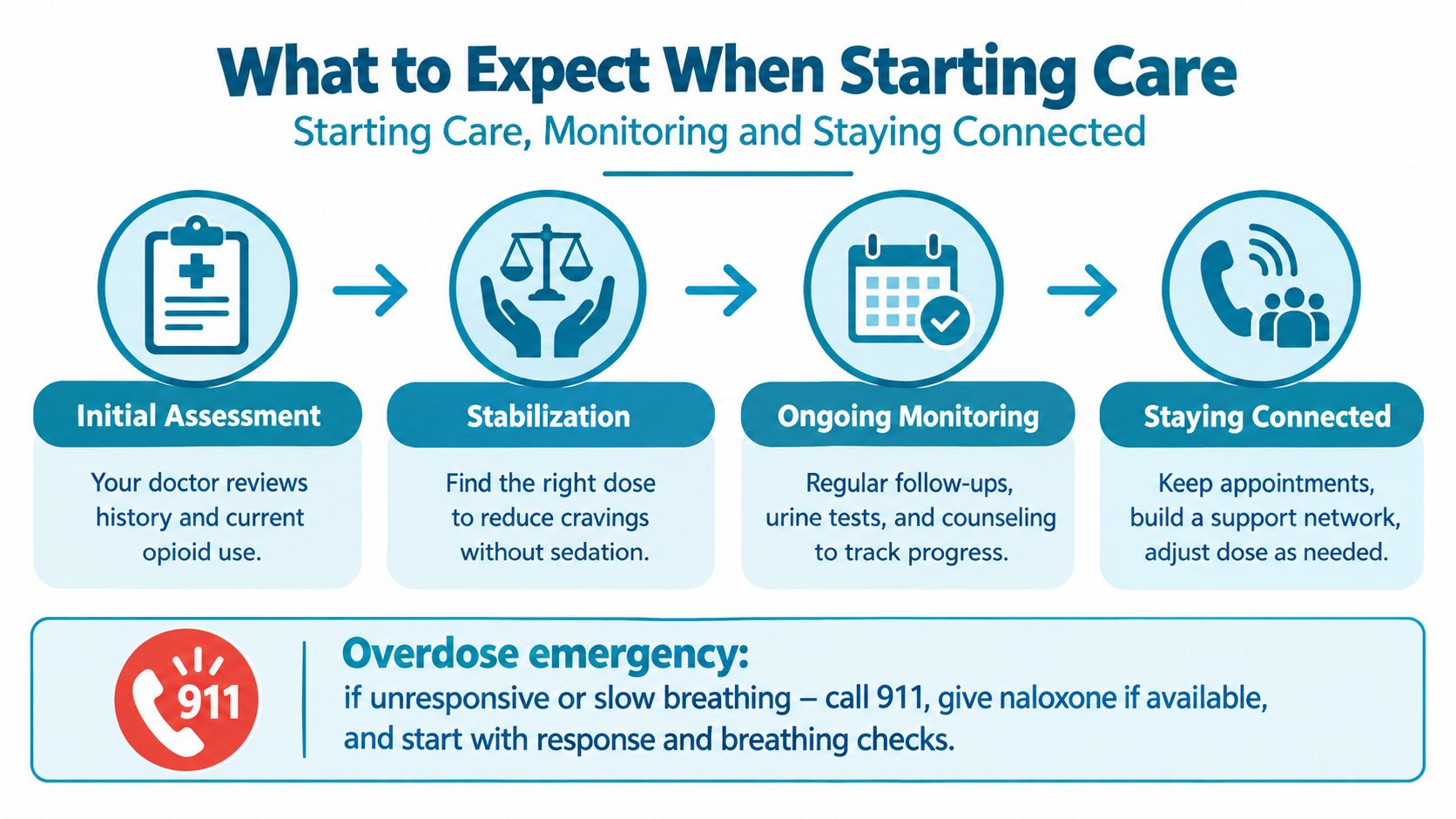
If the person is unresponsive, breathing very slowly, or may be overdosing, call 911, give naloxone if available, and stay with the person while watching breathing and responsiveness. Emergency response comes before any discussion about buprenorphine, methadone, or naltrexone.
For routine care, clinicians often use a decision framework similar to the one described in SAMHSA TIP 63 and FDA product labeling. The goal is not only to start a medication. It is to match the person, the treatment setting, and the safety plan.
A practical evaluation often includes these questions:
What is happening right now?
Is there active withdrawal, recent opioid use, intoxication, sedation, or a need for urgent medical care?Which medication fits best?
Buprenorphine, methadone, and naltrexone each have different requirements, benefits, and limits. The choice depends on factors such as recent opioid use, tolerance, treatment access, prior response, and whether a structured opioid treatment program is needed.What lowers overdose risk outside the clinic?
Naloxone access, household education, and a plan for periods of lower tolerance all matter. This is especially important after time away from opioids, because a return to use can become more dangerous even if the amount used feels familiar to the person.How will follow-up happen?
Early check-ins help clinicians review cravings, side effects, ongoing opioid use, missed doses, alcohol or sedative exposure, and whether the current medication still makes sense.
Here is a short patient education video that may help some readers understand the treatment process in a more visual way.
Staying connected to care can be harder than starting care. Pharmacy access, transportation, scheduling, stigma, cost, and sudden life stress can all interrupt follow-up. Earlier in the article, a CDC report was cited showing gaps between growing emergency department use of buprenorphine and the ongoing challenge of maintaining access in the community. That gap matters because opioid use disorder treatment usually works best as an ongoing process, not a one-time event.
A return to opioid use should be treated as a safety signal, not a moral failure. A calmer and safer response is to reconnect quickly, review what changed, confirm naloxone access, and reassess whether buprenorphine is still the best fit or whether methadone or naltrexone should be reconsidered. That lower-tolerance relapse planning is part of good monitoring, not an extra topic.
For adults seeking physician-led outpatient evaluation and follow-up, Empire's addiction medicine specialist page explains the type of confidential assessment and care coordination that may be relevant when ongoing monitoring is needed.
Getting Help Accessing Care and When to Seek Urgent Help
What kind of help is needed right now: emergency help, or routine treatment follow-up? That question can make the next step much clearer.
With opioid use disorder, it helps to keep two separate plans. One plan is for urgent danger, such as an overdose. The other is for ongoing care, such as choosing between methadone, buprenorphine, or naltrexone, arranging follow-up, and making sure naloxone is on hand. SAMHSA TIP 63 and FDA labeling support that split approach because overdose response and long-term treatment are related, but they are not the same task.
When urgent help is needed
Call 911 right away if a person is hard to wake, is not breathing normally, has blue or gray lips, or may have overdosed. Give naloxone if you have it. Stay with the person and watch breathing until emergency responders arrive.
Naloxone is the rescue medication. It does not replace treatment for opioid use disorder. Its job is to reverse opioid overdose in an emergency.
Getting routine help and finding care
Routine care usually starts with an assessment. The goal is not just to pick a medication. The goal is to match the treatment setting and medication to the person's pattern of opioid use, overdose risk, daily schedule, other substances, and follow-up needs.
For some people, buprenorphine fits well in office-based care. For others, methadone may be a better match when daily structure or closer supervision is needed. Naltrexone can also be an option for some patients, but it follows a different start process and is not used for overdose reversal. If buprenorphine is not working well enough, the next step is often to reassess the full medication plan rather than to stop care altogether.
A lower-tolerance relapse safety plan
Tolerance can drop quickly after a period of abstinence or reduced use. A return to opioid use after that can be much more dangerous, even if the amount used seems familiar. A simple way to understand this is that the body loses some of its previous opioid "buffer."
A practical safety plan can include:
- Naloxone access. Keep it available and make sure family, friends, or other nearby people know where it is and how to use it.
- Avoiding use when alone. Isolation raises the chance that no one will respond to an overdose.
- Watching for sedatives. Alcohol, benzodiazepines, and other sedating drugs can increase overdose risk when combined with opioids.
- Fast return to care. A return to use is a signal to reconnect with treatment and review whether methadone, buprenorphine, or naltrexone is the better fit now.
- Medical guidance for withdrawal concerns. Questions about opioid withdrawal symptoms and manifestations are common, but trying to manage withdrawal alone can become unsafe.
FAQ
Are buprenorphine drugs the same as naloxone?
No. Buprenorphine is used to treat opioid use disorder. Naloxone is used to reverse an opioid overdose.
Which medication has the best adherence?
There is no single best choice for every person. Adherence depends on factors like access, treatment setting, side effects, transportation, cost, and whether the medication fits daily life. That is one reason the treatment decision often includes methadone, buprenorphine, and naltrexone in the same conversation.
Can younger people receive buprenorphine treatment?
Sometimes, yes, but access can be uneven and age-specific care matters. Earlier in the article, CDC data were cited showing ongoing concerns about treatment access for adolescents and young adults. For younger patients, evaluation by a clinician with experience in addiction care is especially important.
Is emergency department treatment enough on its own?
Emergency care can save a life and start the treatment process. Ongoing follow-up still matters. Many people need a handoff from emergency treatment to outpatient or program-based care so medication, safety planning, and follow-up do not stop after the crisis passes.
Sources
- Peer-reviewed review of buprenorphine history and formulations
- Peer-reviewed review of buprenorphine pharmacology
- SAMHSA buprenorphine treatment overview
- SAMHSA guide on buprenorphine forms and treatment settings
- NIDA update on buprenorphine dose optimization
- CDC report on pharmacy dispensing and emergency department adoption
- CDC report on adolescents, young adults, and complex coexisting conditions
Empire Medical Wellness offers private-pay, physician-led outpatient care for adults seeking addiction medicine evaluation, follow-up, and treatment planning when clinically appropriate. If you want a careful next-step conversation about opioid use disorder treatment, overdose safety planning, or office-based medication options, visit Empire Medical Wellness. This article is educational and is not personal medical advice.