
Does a successful conversation about alcohol treatment have to end with a promise to stop drinking? Judge this first talk by the next concrete step. Agreement to a confidential medical evaluation is enough. At that visit, the physician reviews the person's situation, medical risks, previous treatment, medications, and goals, then explains appropriate options and next steps. The conversation asks for a medical look, not a specific treatment and not immediate abstinence.
Empire Medical Wellness Editorial Team
Publication date: October 8, 2026
Updated: October 8, 2026
Table of Contents
- A Six-Step Plan for the First Conversation
- When Waiting Is Not Safe
- Preparing a Timeline and Questions Before You Talk
- Words That Open the Conversation and Words That Close It
- Responding to Refusal, Ambivalence and Delayed Visits
- What Happens After the First Talk and Setbacks
- Schedule a Confidential Evaluation When Your Loved One Agrees
A Six-Step Plan for the First Conversation
A family member doesn't need a diagnosis or a perfectly rehearsed speech to express concern. A calm opening, careful listening, and a concrete offer of help provide a practical starting point.
If an emergency sign is present, the conversation should stop. Medical emergencies require 911. People needing crisis support in the United States can call or text 988, with 911 used for immediate danger.
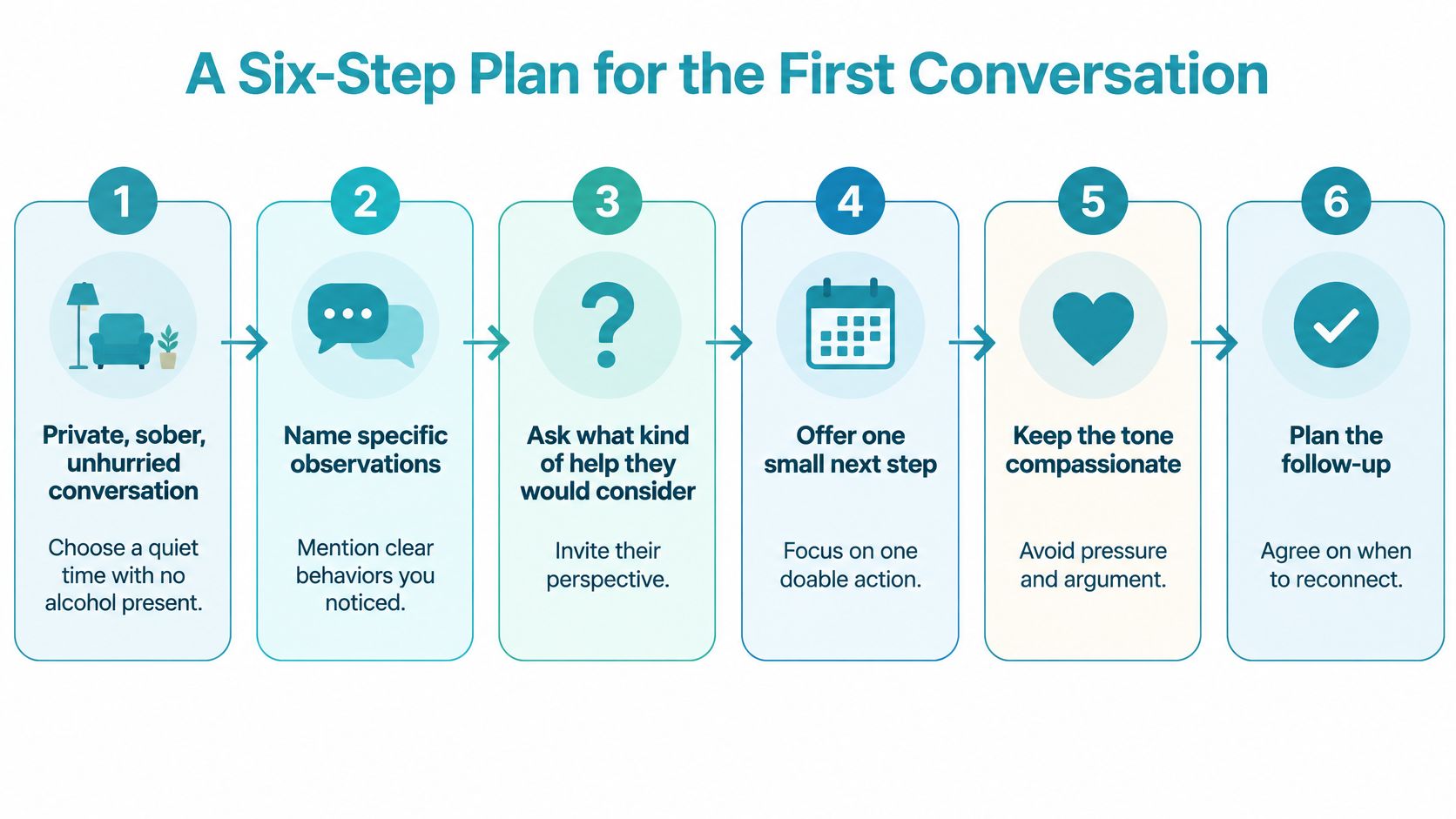
Prepare the Setting and Opening
The SAMHSA conversation guide emphasizes listening without judgment, offering practical support, and allowing for repeated conversations rather than expecting immediate agreement.
Choose a private, sober, unhurried moment. A quiet setting limits distractions and protects dignity. A discussion during intoxication, an argument, or a rushed departure leaves little room for thoughtful responses.
Name specific observations. A missed shift, a fall, or a worrying remark offers a clearer starting point than a label such as alcoholic. A concise example also avoids turning the discussion into a debate over a long list of accusations.
Ask open questions. Questions about drinking's effects on health, relationships, work, or safety invite the person's perspective. A family member can ask which effects concern the person most, rather than supplying every answer.
Listen Before Offering Solutions
Reflect what was heard. Acknowledging that the person feels frightened, embarrassed, or unconvinced doesn't mean agreeing that drinking is harmless. It shows that the family member is listening rather than preparing the next argument.
Offer concrete help. Useful offers include identifying a physician, arranging transportation, or attending an appointment with permission. The person should retain a choice about what help is welcome.
Leave room for another conversation. A refusal today doesn't require an escalating confrontation. Supportive contact can continue, with a mutually acceptable opportunity to revisit the concern.
Practical benchmark: A specific next step matters more than an immediate promise. Agreement to request a confidential assessment can be meaningful progress.
A family member can prepare a short opening and then leave space for a response. Silence doesn't always need filling, and disagreement doesn't require an immediate rebuttal. Preserving future dialogue is part of the work.
When Waiting Is Not Safe
An emergency overrides conversation planning. Confusion, seizures, severe symptoms, or immediate danger require emergency assistance, not negotiation about treatment.
According to NIAAA's treatment guidance, about half of patients with alcohol use disorder experience some withdrawal symptoms when they stop drinking. Withdrawal after heavy, prolonged drinking can be life-threatening, and some people need intensive medical care.
Routine Follow-Up Versus Urgent Care
| Situation | Action | Urgency |
|---|---|---|
| Ongoing drinking concern, no immediate danger | Schedule an evaluation with a physician or addiction clinician | Routine follow-up |
| Heavy drinking has recently stopped, or stopping abruptly is being considered | Contact a physician promptly for medical guidance before stopping; don't attempt unsupervised withdrawal at home | Same-day clinician contact |
| Confusion, seizure, severe tremor, hallucinations or fainting | Call 911 or the local emergency number | Emergency |
| Injury after drinking, or drinking and driving | Call 911 if the person is hurt, unresponsive, or in immediate danger; an impaired person must not drive | Emergency |
| Thoughts of self-harm or an immediate safety risk | Call or text 988 in the United States for crisis support; call 911 for immediate danger | Crisis |
A family member shouldn't provide a detox plan or instruct someone to stop abruptly without professional guidance. Information about alcohol withdrawal effects can help prepare questions, but it can't establish whether withdrawal at home would be safe.
When a safety concern appears, the conversation pauses. A scheduled appointment never replaces emergency care.
Preparing a Timeline and Questions Before You Talk
A short, factual record can help a clinician understand the concern without turning the appointment into a family argument. The record should support the person's account, not replace it.
SAMHSA's clinical guidance on alcohol treatment describes assessment of medical and psychiatric history, alcohol and other substance use, and family and social supports. It also explains that treatment goals should be negotiated and revisited as care progresses.
Planning Record for the First Appointment
This template can be copied into a private document, with space beneath each category for notes.
| Category | What to write down | Why a clinician needs it |
|---|---|---|
| Drinking pattern | Typical amount, frequency and time of day, based on observations | Helps assess current use and risk |
| Injuries or medical events | Falls, accidents, emergency visits, bleeding or other complications, with approximate dates | Medical history shapes the assessment |
| Withdrawal signs witnessed | Shakiness, sweating, sleep changes or other symptoms, and when they occurred | Withdrawal risk is assessed by a clinician |
| Prior treatment | Past programs, medications and what happened with each | Shows what has and hasn't been tried |
| Current medications | Names as reported, with any alcohol use alongside them; never change or adjust them | Relevant to safety and interactions |
| Safety concerns | Driving after drinking, unsafe behavior, or children in the home | Immediate risks take priority |
| Goals in the person's words | What the person says they want, recorded without editing | Goals are negotiated, not assumed |
Entries should distinguish direct observations from information someone reported. Approximate dates are useful when exact dates aren't known. Descriptions such as a missed workday after drinking are more helpful than interpretations about motivation or character.
Questions Worth Preparing
- Assessment: What information would help clarify the drinking concern and medical risks?
- Level of care: Is outpatient assessment appropriate, or is more intensive support needed?
- Goals: How should safety, readiness, and the person's priorities shape the initial plan?
Reduction may be an interim goal for someone not ready for abstinence, meaning not drinking alcohol. SAMHSA describes abstinence as the safer strategy with a greater likelihood of long-term success, while recognizing that goals may evolve.
Preparation for a first addiction medicine appointment should leave room for the person to speak freely. The completed record should be shared with permission and treated as supporting information, not a diagnosis.
Words That Open the Conversation and Words That Close It
In the United States, 10.2% of people aged 12 or older had past-year alcohol use disorder in 2023, while 1.9% of people with past-year AUD received medication-assisted treatment for alcohol use, according to SAMHSA's 2023 National Survey on Drug Use and Health.
Alcohol use disorder, or AUD, is a medical condition involving difficulty controlling alcohol use despite harmful consequences. A loved one can raise concerns, but can't establish that diagnosis. An invitation to evaluation also doesn't assume that residential treatment is necessary.
Opening Phrases Compared With Phrases to Avoid
These are adaptable prompts, not quotations from patients or a script to memorize.
| Situation | Helpful opening | Phrase to avoid | Why it matters |
|---|---|---|---|
| Noticing a pattern | I have noticed you have had a drink most evenings this month | You are always drunk | Specific observations are harder to dispute and less likely to trigger defensiveness |
| Naming a health concern | I am worried about the bruises and the stomach pain you mentioned | You are killing yourself | Links concern to observable events rather than a judgment of character |
| Inviting a next step | Would you be willing to talk with a doctor about how drinking is affecting you? | You need to go to rehab | Offers a choice and leaves the person room to respond |
| Asking about goals | What would you like to change, if anything? | You have to stop drinking today | Lets the person state their own goal |
| Responding to a no | Thank you for telling me. Can we talk again next week? | If you refuse, I am done helping | Keeps the door open for future conversations |
The useful distinction is observation versus accusation. Naming a pattern or health concern explains why the conversation is happening. Asking about goals and willingness leaves space for an honest answer.
A prepared opening should sound like the family member's ordinary voice, not a speech delivered to secure a confession.
Practicing the opening aloud can reveal language that sounds judgmental or unnatural. If agitation increases, pausing is more useful than delivering the rest of a prepared message.
Responding to Refusal, Ambivalence and Delayed Visits
A person may say nothing is wrong, reject every proposed option, or repeatedly postpone an appointment. Escalating pressure can feel like the only remaining choice, but concern doesn't require a confrontation.
NIAAA's guidance on starting the conversation recommends involving the person in choosing how to begin. When proposed options aren't acceptable, the next question is what form of help the person might consider.

Match the Response to the Obstacle
- The person says everything is fine. A family member can acknowledge that they see the situation differently, briefly restate the concern, and avoid debating every event.
- Every option is rejected. Asking permission before offering information may help distinguish unwanted advice from an option the person might consider.
- The appointment keeps moving. The discussion can focus on the obstacle, such as uncertainty, privacy concerns, or scheduling, rather than demanding another broad promise.
An invitation offers a choice. An ultimatum attempts to force a decision through a threatened consequence. A boundary is different again: it states what the family member will do to protect safety or well-being.
Boundaries Without Threats
Community Reinforcement and Family Training, or CRAFT, teaches family members to encourage positive behaviors and change their responses to drinking-related situations. NIAAA's review of family involvement reports that CRAFT has been more effective than confrontation-based intervention in helping someone accept treatment.
Boundaries can address money, transportation, children, and drinking in the home. Examples include declining to purchase alcohol, refusing to ride with an impaired driver, or arranging another safe caregiver when impairment is present. These are actions the family member controls, not promises to control another adult's recovery.
A workable limit: A boundary should be specific, realistic, and enforceable without an argument.
Threats that won't be carried out undermine clarity. If stating a boundary could trigger violence, safety planning and professional support should come before a private confrontation.
Family members can also seek support independently of the loved one's decision. Information about Al-Anon and family support can provide a starting point without making the family responsible for managing treatment.
What Happens After the First Talk and Setbacks
A conversation can be useful even when it doesn't produce immediate abstinence or program enrollment. Agreement to discuss options, request an evaluation, or identify a safety plan is a concrete outcome.
NIAAA's guide to finding and getting help describes treatment as an ongoing process that can include setbacks. It also emphasizes that the person remains responsible for managing the illness and that family members need support of their own.
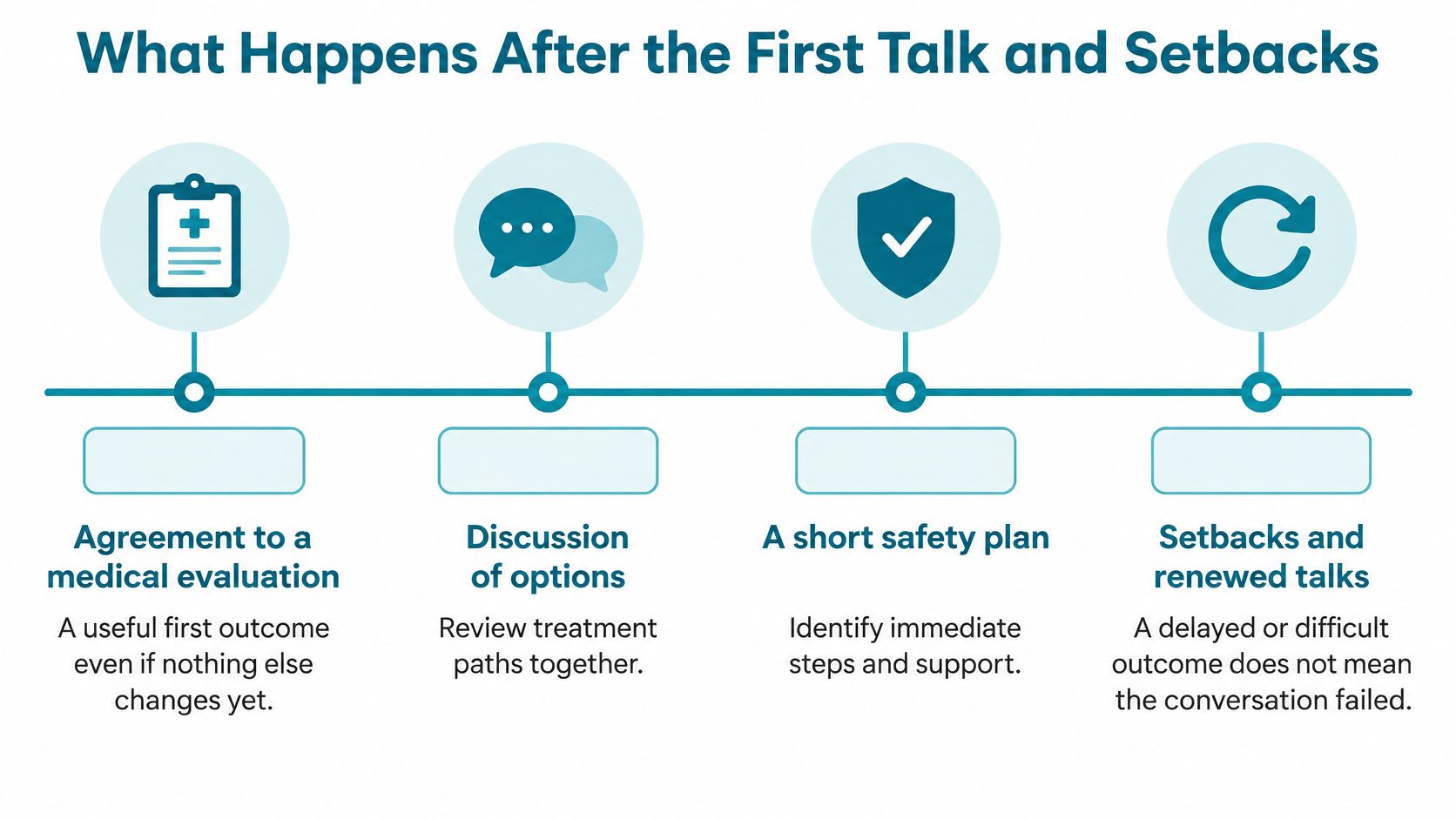
From Agreement to the Visit
On the day of the conversation, the family can clarify the agreed action and what help is welcome. Before the appointment, practical assistance might include transportation or organizing the medication list, with permission.
At the visit, the person should have space to describe concerns privately. Empire Medical Wellness begins addiction medicine care with a confidential assessment of the patient's current situation, medical risks, previous treatment, medications, and goals.
- Family involvement: The person can identify whether attendance, reminders, or help with questions would be useful.
- Information sharing: Clinics generally need authorization before discussing care with relatives. Privacy rules have exceptions, so the clinic should explain how sharing works.
- Coordination: When appropriate and authorized, Empire Medical Wellness can coordinate with therapists, primary care clinicians, treatment programs, and other professionals involved in care.
Follow-Up Without Policing
A lapse calls for attention to safety and the treatment plan, not a moral judgment. Discussion can focus on what happened, what support was missing, and whether the treating clinician needs an update. Understanding what relapse means can help families avoid treating a setback as proof that care is pointless.
Family members also need room to describe their own exhaustion, fear, or resentment. Friends, counseling, community resources, and support groups may help. A physician can help a caregiver recognize when anxiety, depression, or ongoing strain warrants personal care.
Schedule a Confidential Evaluation When Your Loved One Agrees
When the person agrees to seek care, the decision to book belongs to that person. An appointment request involves selecting the service, preferred visit format, and contact information through the appointment scheduling page.
Empire Medical Wellness provides private-pay, physician-led outpatient addiction medicine care. The initial evaluation includes an explanation of appropriate treatment options and next steps. Medication may be part of care when clinically appropriate, but an appointment doesn't guarantee a prescription.
Questions to Bring to the Evaluation
- Safety and setting: Is outpatient care appropriate, and what findings would require another level of care?
- Medication options: Which FDA-approved medicines for alcohol use disorder might be relevant, and what do current FDA labeling and MedlinePlus say about their use?
- Off-label treatment: Would any proposed use be off-label, meaning outside the FDA-approved indication, and why is it being considered?
- Follow-up: What should prompt a routine message, a prompt assessment, or emergency care?
The addiction medicine service page describes the area of care. The addiction medicine specialist page provides additional practice information, while fees and how care works explains practical arrangements. Information about outpatient alcohol treatment can support preparation without replacing clinical assessment.
Sources
Key references include SAMHSA's conversation guide, clinical alcohol-treatment guidance, and national survey report, plus NIAAA's guidance on treatment options, family involvement, starting conversations, and ongoing support. Each is linked where its findings are discussed.
This article is educational and isn't personal medical advice. Routine scheduling must never delay emergency care.
Empire Medical Wellness offers confidential, physician-led outpatient addiction medicine assessment, individualized planning, and follow-up. When a loved one is ready to consider help, a medical evaluation can clarify risks and appropriate next steps without requiring a predetermined treatment decision. Visit Empire Medical Wellness to learn about the practice and appointment process.