You may be looking at your phone right now, comparing a few GLP-1 options, trying to figure out whether the numbers make sense without insurance. The short answer is yes, GLP-1 medications online without insurance are legally obtainable in the United States, but every legitimate path still requires a prescription from a licensed clinician, and the monthly cost is usually higher than the headline price you see on a landing page. The smarter question isn't “Can I get it online?” It's “What will I pay, who is overseeing my care, and what happens after the first refill?”
Table of Contents
- Where Most Adults Start When They Search for GLP-1 Online Without Insurance
- The Four Main Pathways to Access GLP-1 Without Insurance
- What a Legitimate Evaluation Looks Like Without Insurance
- Reading the Real Price of GLP-1 Care Without Insurance
- Safety Signals and Red Flags in Online GLP-1 Prescribing
- Maintenance, Refills, and What Changes After Month One
- Choosing the Right Path and Next Steps
Where Most Adults Start When They Search for GLP-1 Online Without Insurance
You've tried diet changes, maybe exercise too, and now you're staring at a medication search because the usual advice hasn't produced durable results. If you don't have coverage for obesity medication, the first decision is not which brand sounds best. It's whether the online path you're looking at is legitimate, supervised, and financially sustainable.
GLP-1 access without insurance is legal, but the medication still needs a prescription from a licensed clinician. That matters because online access has widened a lot, and the market now includes everything from real physician-led care to thinly supervised sites that are mainly moving product. A recent Yale Medicine report on a secret-shopping study found that 92% of websites prescribed GLP medications and 69% mailed them, often with little to no clinician oversight. That's convenient, but it's not the same thing as thoughtful obesity medicine care. The same report also sits in the context of broader telehealth growth and manufacturer-direct channels that lowered the monthly cash burden for some patients who don't use insurance, which is exactly why careful comparison matters. See Yale Medicine's discussion of online GLP-1 prescribing and oversight concerns.
Start with the real question
A lot of adults begin by comparing medication sticker prices, then discover the bigger issue is the total cost of getting and staying on treatment. That total includes the visit, the prescription path, follow-up, and whether the price stays stable after the first month. In practice, you're choosing a care model as much as a drug.
Practical rule: If a site won't tell you who reviews your history, how refills work, and what follow-up looks like, it's not a serious medical pathway.
That's why this topic is better treated as a decision map than a list of vendors. A good decision leaves you knowing the main access routes, the documentation you'll need, and the safety questions to ask before you pay.
The Four Main Pathways to Access GLP-1 Without Insurance
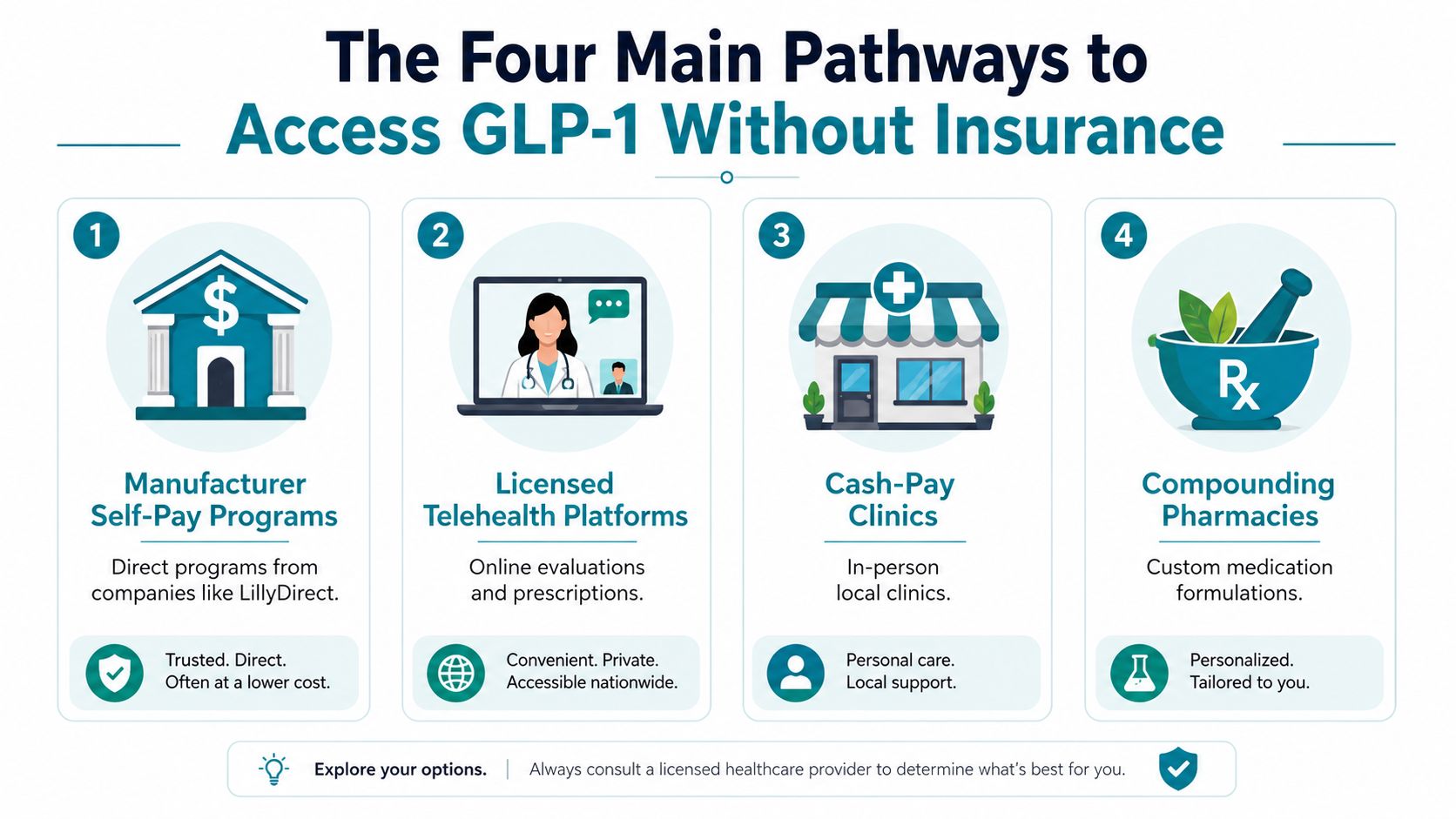
The market looks messy because people keep lumping very different options into one phrase, “online GLP-1.” That's a mistake. Manufacturer-direct programs, licensed telehealth, cash-pay pharmacies, and physician-led private practices all work differently, and the monthly bill can vary sharply because of it.
Manufacturer-direct self-pay channels are the most visible example of price compression. In the current U.S. market, brand-name GLP-1 drugs often run about $900 to $1,400+ per month without insurance, while one 2026 review reports Wegovy starter doses at $149 per month, injectable pens capped at $349 per month, and Zepbound vials at $299 to $399 per month through self-pay programs. Those lower figures usually reflect direct-pay programs, limited dose options, or separate clinician fees rather than full retail pharmacy pricing. Read the pricing overview for uninsured GLP-1 access.
Who evaluates, who prescribes, who dispenses
Licensed telehealth platforms usually bundle the evaluation and the prescription in one visit flow. Some are legitimate and some are paper-thin, so the quality of the clinician review matters more than the slickness of the website. Cash-pay retail and specialty pharmacies are straightforward on the dispensing side, but they don't replace clinical oversight. A physician-led private practice can do the evaluation and monitoring while you source medication through a transparent pharmacy channel, which is often the cleanest model if you want accountability rather than speed alone.
The main friction point is eligibility. A 2026 review noted that some manufacturer-direct programs exclude government beneficiaries and may require diagnosis-specific documentation such as an ICD-10 code like E66.01 rather than a vague “weight loss” goal. That kind of paperwork sounds bureaucratic, but it's what supports legal prescribing, continuity, and later appeals if access changes. The GLP-1 access guide without insurance also describes manufacturer-direct pathways as taking about 1 to 2 weeks to start, which is operationally useful if you're trying to avoid refill gaps.
Bottom line: Don't ask which pathway is “cheapest.” Ask which pathway gives you a fair total price, valid prescribing, and a plan for the next refill.
For a practical comparison with another obesity medication approach, see GLP-1 versus phentermine in obesity care.
What a Legitimate Evaluation Looks Like Without Insurance
A real evaluation starts before anyone talks about a prescription. It should include a medical and metabolic history, weight history, relevant health conditions, current medications, and a discussion of whether anti-obesity medication is appropriate for you. If the only thing a website asks is your height and a credit card, that's not a proper obesity medicine intake.

What good screening should cover
A responsible clinician should ask about prior weight-loss efforts, gastrointestinal symptoms, gallbladder disease history, pancreatitis history, diabetes medications, and other factors that affect safety. That review matters because GLP-1 medicines can cause side effects and aren't right for everyone. It also helps separate a true obesity-medicine conversation from a generic sales funnel.
Documentation matters just as much as the conversation. A diagnosis-specific code, such as ICD-10 E66.01 when appropriate, gives the chart a clinical anchor. It helps with refills, continuity, and later insurance appeals if your situation changes, which is one reason vague “weight loss” language is a weak substitute for a documented medical assessment. See Empire's medication evaluation resources for the kind of documentation-focused visit most adults should expect from a real clinician.
Ask any prospective provider these questions before you pay:
- Who reviews the intake form? A clinician should review it, not software alone.
- What measurements or labs are requested? The answer should fit the medicine, not a sales script.
- How is follow-up scheduled? You need a defined plan, not a promise to “reach out if needed.”
- What happens if side effects show up? A real prescriber should have a way to respond.
If the answers are vague, keep looking. A legitimate evaluation may be online, but it still has to feel like medicine.
Reading the Real Price of GLP-1 Care Without Insurance
Many underestimate the total cost because they focus on the drug label, not the care pathway. The right comparison is medication price plus clinician fee plus monitoring, because those pieces are often billed differently from one option to the next. That's especially true in month one, when intake and setup costs usually make the first bill look very different from later refills.
| Realistic Monthly Cost of GLP-1 Care Without Insurance | Medication price band | Clinician fee pattern | Monitoring and labs | Realistic monthly total |
|---|---|---|---|---|
| Manufacturer-direct self-pay | About $149 to $399 for some pathways | May be bundled or may be separate | Often limited, with eligibility and documentation rules | Lower at entry, but can rise with standard pricing or added clinical fees |
| Licensed telehealth platform | Variable, often below retail cash pricing | Visit or membership fee may be separate | Usually included in a care bundle or charged in part | Depends on whether the program bundles follow-up |
| Cash-pay retail or specialty pharmacy | About $900 to $1,400+ for brand-name retail cash pricing | Clinician fee separate | Monitoring billed separately | Highest out-of-pocket total in many cases |
| Physician-led private practice with pharmacy channel | Depends on the medication source | Visit fee separate from medication | Monitoring and follow-up are usually structured | Total is clearer, but not always the cheapest headline price |
The table makes one thing obvious. A lower medication price doesn't automatically mean a lower monthly cost. The source on self-pay pricing notes that medication cost is separate from clinician visits, and the broader access problem is bigger than list price alone. See the Walgreens discussion of total weight-loss medication costs for the reminder that medication-only pricing leaves out the rest of care.
Month one and month six are not the same bill
Starter pricing can be a teaser. Dose escalation can change what you pay, and some pathways bundle oversight only at the beginning. That's why a patient budget should include the likely costs of follow-up visits, lab work if ordered, and the chance that you'll need to switch pharmacies or providers later.
For a physician-led model, you should want to know the cost of each piece before you start. See Empire's fees and how it works overview and compare it against any online offer that hides the clinician fee in small print.
Safety Signals and Red Flags in Online GLP-1 Prescribing
A fast prescription is not automatically a safe prescription. The Yale Medicine secret-shopper finding is the warning sign here, because it showed how easy it is for websites to prescribe and mail GLP medications with thin oversight. The legal requirement for a licensed prescriber doesn't disappear just because the visit happened on a screen. GoodRX makes that plain for GLP-1 medications such as Wegovy, Zepbound, and others, and legitimate telehealth still requires a real prescription from a licensed clinician. See GoodRx's overview of getting GLP-1 medications online.
Five-minute screening test
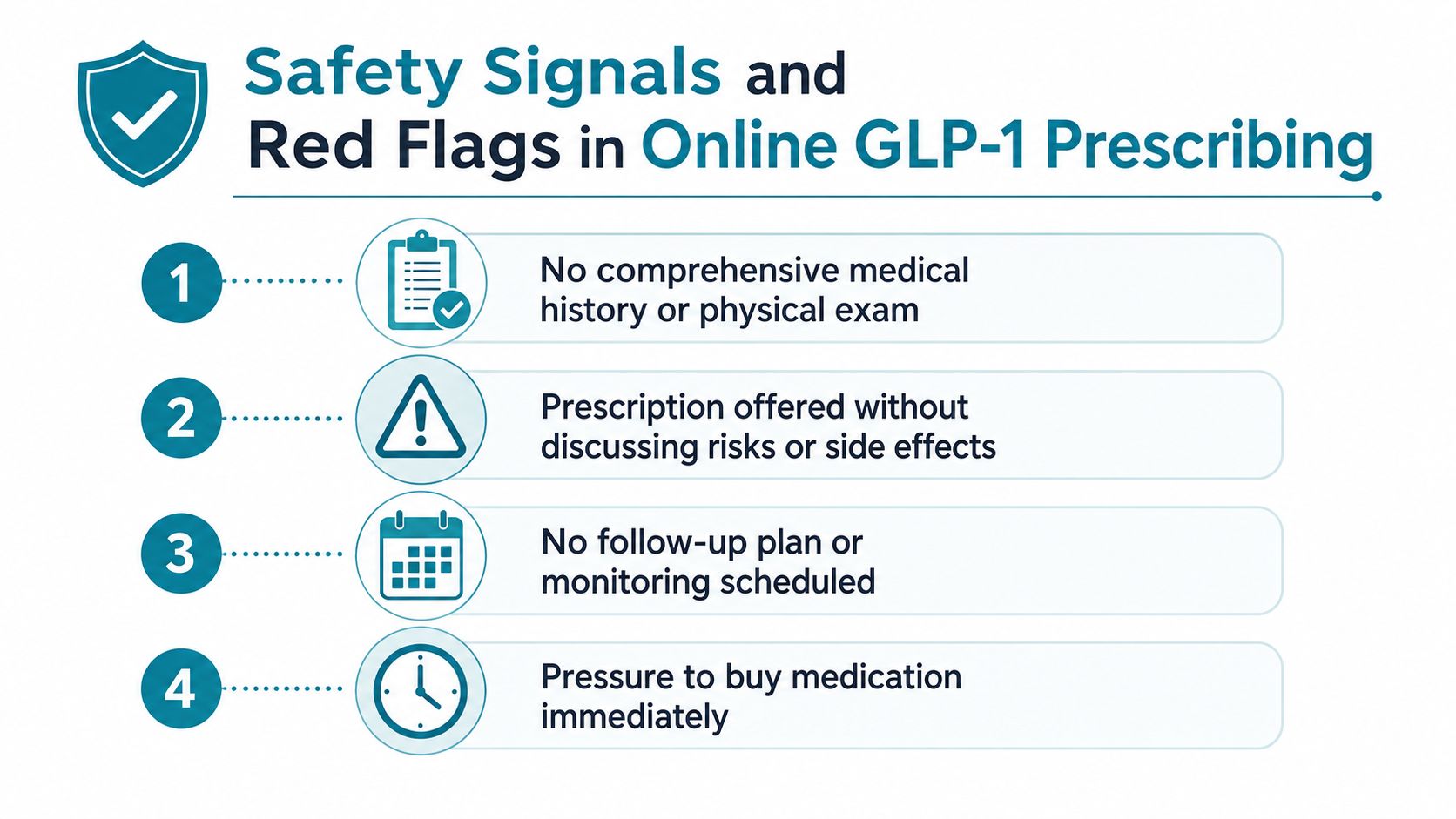
If you can't answer these in five minutes, walk away.
- No medical history collected. If the site skips past your conditions, medications, and prior treatment history, it's not doing real screening.
- No risks or side effects discussed. A prescriber who rushes straight to checkout is selling convenience, not care.
- No follow-up plan scheduled. You need a plan for dose review, refill timing, and side-effect concerns.
- No named clinician. If you can't tell who is prescribing, accountability is weak.
- Pressure to buy immediately. Real care doesn't rely on artificial urgency.
Positive signs are easy to spot too. A responsible program has a licensed clinician review the chart, documents the diagnosis, explains side effects plainly, and tells you how to reach the prescriber if something changes. That's the standard adults should expect.
The article on online access without insurance also highlights a key point that gets ignored too often, prescription medication is still prescription medication. If a site is willing to ship without any meaningful clinical review, it's not saving you time, it's offloading risk onto you. See physician-led care standards in obesity medicine for the kind of oversight that should be normal, not exceptional.
Maintenance, Refills, and What Changes After Month One
Starting treatment is the easy part. Staying on it safely, affordably, and legally is the core issue. Access can change, a manufacturer program can adjust terms, a telehealth platform can close, or a pharmacy source can run into disruptions. People searching for GLP-1 care online often learn that getting started is simpler than keeping continuity.
Build a continuity plan before you pay
A sensible plan should answer three questions. Who owns the next refill, what happens if your medication source changes, and how will side effects be handled between visits? If those answers aren't clear, the pathway is fragile.
Practical rule: Don't start a medication you can't reasonably keep monitoring.
A follow-up cadence should be clear from day one, especially when dose titration is involved. Titration means the clinician adjusts the dose over time to improve tolerability and effectiveness, and that process is one reason month six may look very different from month one. If your access pathway doesn't explain refill timing, escalation, or who answers questions between visits, you're not buying a care plan. You're buying a shipment.
The broader access problem also includes the exit plan. Recent reporting describes adults losing access and needing to switch, appeal, or consider alternatives. That is why a responsible obesity medicine program should discuss what happens if access ends, rather than pretending continuity is automatic. See the Everyday Health coverage of lost GLP-1 access for the real-world continuity problem patients run into.
What to confirm in writing
- Next refill ownership so you know who writes the prescription.
- Follow-up timing so you know when your next review happens.
- Lab or measurement plan if your clinician wants ongoing monitoring.
- Escalation path for side effects so you're not left guessing.
- Transition plan in case pricing, supply, or eligibility changes.
That's the difference between a purchase and ongoing care. Adults paying cash deserve both transparency and a real plan for what comes next.
Choosing the Right Path and Next Steps
The right choice usually comes down to three plain questions. Who evaluates you? What is the true monthly total, including clinician fees and follow-up? How is continuity handled if the first source changes? If a program can't answer those clearly, it's not the right fit.
For many adults, physician-led care is the better filter than the cheapest headline price, because it makes the pathway clinically sound instead of merely legal. If you want a private-pay model with structured follow-up, the Empire Medical Wellness fees and how it works page is the most relevant place to start if you're in New York, New Jersey, Connecticut, Pennsylvania, or Virginia and want clear fees plus telemedicine access.
The main takeaway is simple. GLP-1 care online without insurance can work, but only if you treat it like medical care, not retail shopping. Ask the hard questions, verify the clinician, and budget for the full pathway, not just the medication label.
Empire Medical Wellness offers private-pay, physician-led obesity medicine with clear fees, telemedicine for eligible adults in supported states, and structured follow-up that fits the realities of cash-pay GLP-1 care. If you want a careful, medically supervised path instead of a sales funnel, visit Empire Medical Wellness to review the obesity medicine service page and see whether it fits your situation.
This article is educational and not personal medical advice.