
Benadryl, whose active ingredient is diphenhydramine, has been linked to higher body weight measures, especially with regular or long-term use. In one observational study, users averaged about 30 BMI versus roughly 28 to 29 in nonusers, and men using antihistamines averaged 214 pounds compared with 192 pounds in nonusers, while women averaged 176 pounds versus 166 pounds in nonusers.
What matters next is the difference between a real signal and a guaranteed outcome. Benadryl can make this question confusing because the evidence points to an association, not proof that it causes weight gain in every person, and because short-term use does not carry the same concern as repeated use.
Table of Contents
- Can Benadryl Make You Gain Weight
- What Diphenhydramine Is and Where It Fits
- Proposed Mechanisms Behind the Link
- What the Research Actually Shows
- Practical Talking Points With Your Clinician
- Common Misconceptions Worth Clearing Up
- A Hypothetical Reader's Way Through the Question
Can Benadryl Make You Gain Weight
Yes, Benadryl (diphenhydramine) has been associated with weight gain, especially with regular or long-term use. The evidence is observational, so it does not prove that every person who takes it will gain weight.
That answer is more precise than a simple yes or no. Some people use Benadryl once in a while and never notice a weight change. Others take it often enough that appetite, sedation, or other medication effects may become part of the picture.
Practical rule: the more often a medicine is used, the more important it is to ask whether a side effect could be adding up over time.
The research on this topic is strongest for the H1 antihistamine class as a whole, not for Benadryl alone. That matters because people often ask the question after noticing a change in weight, but the issue is usually whether diphenhydramine exposure is frequent enough to matter, and whether something else is also contributing.
There's also a common misunderstanding here. Benadryl is not a guaranteed cause of weight gain, and the science does not support blaming every pound of change on the drug. The better way to think about it is that Benadryl belongs to a medication class that has been linked to higher weight-related measures in some adults, particularly with chronic exposure, and that makes it reasonable to look at the pattern of use carefully.
This article is educational and not personal medical advice.
What Diphenhydramine Is and Where It Fits
Diphenhydramine is the active ingredient in Benadryl. It is a first-generation H1 antihistamine, which means it's an older antihistamine that crosses into the brain more readily than newer options. That's a major reason it can cause drowsiness and other central nervous system effects.
Benadryl is commonly used for allergy symptoms, and diphenhydramine also appears in many combination cold and nighttime products. People sometimes miss that point because the brand name changes, but the ingredient may be the same. That's one reason it helps to read the label, not just the front of the box.
The weight question matters most when a medication is used in patterns that go beyond its usual short-term role. Diphenhydramine is often taken for brief relief, but the weight-related research generally reflects more repeated exposure, not occasional use. That distinction helps explain why one person may notice nothing while another sees a change after months of regular use.
Benadryl's place in the antihistamine family also matters because class effects can be easier to spot in research than brand-by-brand effects. If you're trying to understand the evidence, it helps to keep two ideas separate. One is what the drug is approved to do. The other is what may happen when people use it often enough for side effects to show up.
Proposed Mechanisms Behind the Link
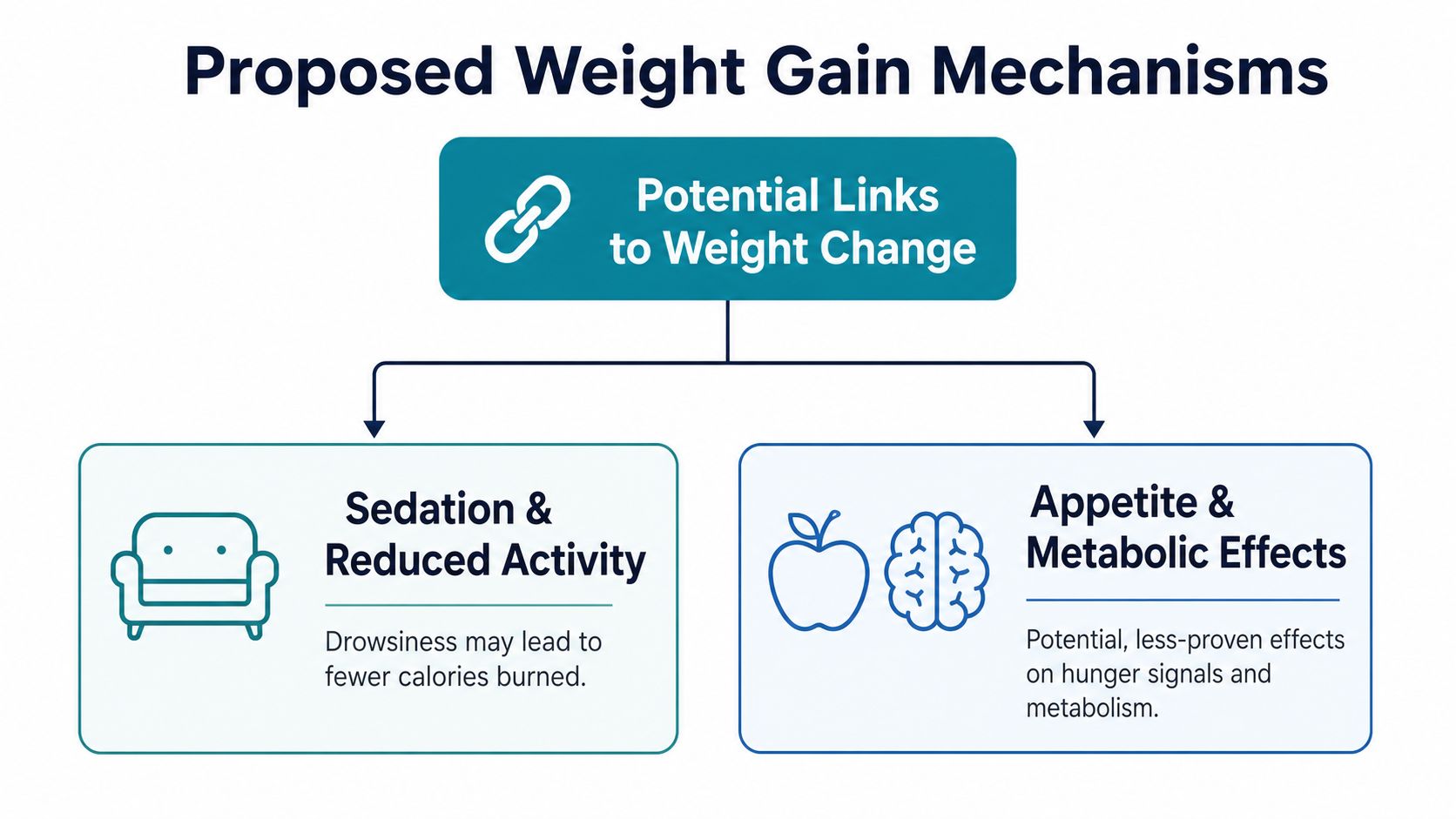
There are a few reasons scientists think Benadryl could be linked with weight gain, but they are not equally proven. The most straightforward idea is sedation. If a medicine makes someone sleepy, they may move less during the day, and less movement can mean fewer calories burned over time. That is a plausible pathway, but it is not direct proof that the medication itself changes body fat.
Sedation and activity level
This mechanism is the easiest to understand because drowsiness is a well-known effect of diphenhydramine. If a person takes it at night and feels groggy the next day, daily activity may drop in small ways that add up. That does not mean the drug causes inactivity by itself in every user, only that sedation can make a lower-activity pattern more likely.
Benadryl's drowsiness is real. The weight question is whether that drowsiness becomes part of a longer behavioral pattern.
Appetite signaling and metabolic effects
A second idea is that histamine pathways may influence hunger signaling. H1 antihistamines may interfere with that signaling, which could make appetite feel stronger in some people. Human data on this specific mechanism are limited, so this remains a biologically plausible hypothesis rather than a confirmed explanation.
A third idea involves possible metabolic effects. In the observational study discussed later, antihistamine users had higher waist circumference and insulin concentration than matched controls, which suggests more than a simple “I feel hungrier” story. Still, those findings do not prove that diphenhydramine directly changes metabolism. They show an association between antihistamine use and less favorable body-related measures.
The most careful conclusion is also the most honest one. Sedation has the clearest practical pathway, appetite signaling is plausible but incompletely proven, and metabolic effects are suggestive rather than settled science. That combination is enough to take the topic seriously without overstating what's known.

For a related medication review topic, see psychiatric medication guidance.
What the Research Actually Shows
The best-known human evidence comes from an observational study published in Obesity in 2010, which analyzed 867 U.S. adults from the CDC's NHANES 2005 to 2006 survey. After adjustment for age and sex, prescription H1 antihistamine users had an average BMI of about 30 versus roughly 28 to 29 in nonusers, and the differences in body weight were similar in men and women.
| Measure | Users | Nonusers |
|---|---|---|
| BMI | about 30 | roughly 28 to 29 |
| Men, body weight | 214 pounds | 192 pounds |
| Women, body weight | 176 pounds | 166 pounds |
Those numbers are important, but the design matters even more. This was an association study, not a randomized trial. It can show that antihistamine users and nonusers looked different, but it cannot prove that Benadryl caused the difference. People taking antihistamines may differ in many other ways, including underlying allergies, sleep habits, or other health factors.
The AAAAI has pointed out that there is data supporting weight gain in a subset of patients taking H1 antihistamines, while also noting the lack of large, well-powered randomized trials focused on this exact question. A 2024 AAAAI summary also states that antihistamines are more likely to cause weight gain than weight loss. That's a useful clinical takeaway, because it tells readers the signal is not imaginary, even if it's not definitive for every person. See the AAAAI discussion of antihistamines and obesity for context.
For readers who want a medication-focused review, the evidence is strongest when Benadryl is used repeatedly or over time, not just once in a while. A thoughtful way to read the research is this, the class has a real signal, the signal is not proof of causation, and the risk seems more relevant with chronic exposure than with occasional use.
For broader medication evaluation support, see medication evaluation resources.
Practical Talking Points With Your Clinician
The most useful question is not “Can this drug cause weight gain in general?” It's “Is my pattern of use enough that Benadryl could be part of what I'm seeing?” That starts with an honest look at how often you take it. Nightly use for sleep, several days a week for allergies, and occasional PRN use are very different situations.
What to bring up
A few details make the conversation more productive:
- How often you take it: nightly, most weeks, or only sometimes.
- Why you take it: sleep, allergies, cold symptoms, or something else.
- Which products you use: many cold and nighttime products contain diphenhydramine, so the total exposure may be higher than it first appears.
- What else has changed: sleep, activity, appetite, stress, and other medications can all affect weight too.
If Benadryl is being used mainly as a sleep aid, ask about non-pharmacologic sleep strategies rather than assuming a sedating antihistamine is the best long-term tool. If it's being used for chronic allergy symptoms, ask whether a non-sedating antihistamine might fit better for your situation. That question is especially reasonable when the medication is being used often enough to matter.
Do not stop a prescribed medication on your own. Bring the issue to the clinician who recommended it, and explain what you've noticed. That keeps the conversation focused on the full picture instead of one side effect in isolation.
The best medication review is specific. “I've been taking this most nights” is more useful than “I think my weight changed.”
For a broader conversation about medication changes and mental health prescriptions, see mental health medication review guidance.
Common Misconceptions Worth Clearing Up
One misconception is that occasional Benadryl use must cause weight gain. The evidence does not support that conclusion. The concern is stronger when use is repeated or long-term, which is a very different pattern than an occasional dose.
Another misconception is that only the Benadryl brand matters. It doesn't. Diphenhydramine also appears in other products, so the relevant question is often total diphenhydramine exposure across everything you're taking.
A third misconception is that all antihistamines carry the same weight risk. They don't appear to. The signal is stronger and better studied for sedating, first-generation antihistamines like diphenhydramine, while newer second-generation antihistamines have less evidence tying them to weight gain.
A final point is easy to miss. If weight changes while taking Benadryl, the drug may be part of the story, but it may not be the whole story. Sleep disruption, illness, and other medications can all affect weight, which is why self-blame usually gets in the way of a useful review.
For readers comparing medication choices, the weight question belongs in the same conversation as other tradeoffs, not in isolation. If you're sorting through options, this comparison of GLP-1 medicines and phentermine may help frame how clinicians think about medication effects more generally.
A Hypothetical Reader's Way Through the Question
A person who has been taking Benadryl a few nights a week for sleep and then notices gradual weight gain over several months may want a careful review rather than a quick conclusion. The first question is timing, because repeated use fits the pattern that researchers have looked at more closely than an occasional dose.
The next step is to check whether diphenhydramine is showing up in other products, such as nighttime cold formulas. Extra exposure can make the medication question more relevant, especially if the total amount is higher than the person realized. If sleep is the main reason for taking it, the conversation can shift toward what is keeping sleep difficult in the first place.
If the medicine is being used for allergies, a clinician may look at whether a different antihistamine approach makes sense for that symptom pattern. If it is being used for sleep, the discussion may focus more on the insomnia itself than on the pill used to treat it. The goal is not to guess alone, it is to make the medication review specific enough to be useful.
A hypothetical example like this is only a model. It does not identify a real person, and it is meant to show how a careful conversation with a clinician can separate Benadryl from other possible reasons for weight change. Readers who want to explore the broader question of the true cost of weight in a structured medical setting can bring that concern into the same discussion.
For adults who want physician-guided care for weight-related concerns, Empire Medical Wellness offers obesity medicine care that focuses on careful evaluation and long-term planning. A visit can also help sort out whether medication effects, sleep issues, or something else is playing the larger role.