
Benzodiazepine withdrawal can cause anxiety, restlessness, insomnia, tremor and stomach upset, and stopping a regular benzodiazepine abruptly is unsafe. Seizures, hallucinations, delirium, marked confusion or suicidal thoughts need emergency care now, not a scheduled appointment.
Read enough symptom lists and something counterproductive happens. The lists get longer, and the reader gets less certain. Anxiety, insomnia, dizziness, tingling, ringing in the ears, stomach upset: nearly every entry also belongs to a dozen other explanations.
That's the difficulty with benzo withdrawal symptoms. Recognition is rarely the hard part. Attribution is. A symptom that shows up three weeks after a dose reduction means something different from the identical symptom that shows up three months later, and different again from a symptom that was already there before the first prescription was written. Most online lists collapse those three situations into one column.
This guide follows the order a clinician would: what needs emergency care first, how symptoms group by body system, which factors change severity, how timing changes the interpretation, and what supervised care looks like. None of it is a taper plan, and none of it is a reason to change a dose without a physician.
Table of Contents
- When Benzo Withdrawal Symptoms Need Urgent Care
- Common and Severe Symptoms Grouped by Body System
- Risk Factors That Change Symptom Severity
- Timing, Protracted Symptoms and Other Explanations
- Why Abrupt Stopping Is Unsafe and How Supervised Care Works
- Prepare Questions and Arrange a Supervised Assessment
- Sources
When Benzo Withdrawal Symptoms Need Urgent Care
The first decision isn't which symptom you have. It's how fast that symptom needs a clinician. Three questions sort almost every situation: is this dangerous right now, is it escalating quickly, or is it stable enough to plan around?
Use the table below as a triage step, not a diagnosis.
| Situation | Level of care | First action |
|---|---|---|
| Seizure, convulsion or loss of consciousness | Emergency | Call 911 or the local emergency number now |
| New hallucinations, severe confusion or delirium | Emergency | Call 911 or the local emergency number now |
| Suicidal thoughts or self-harm | Emergency | Call 911 now, or call or text 988 for crisis support |
| Rapidly worsening symptoms that feel unsafe | Urgent | Contact a clinician the same day; seek emergency care if severe |
| Persistent anxiety, insomnia, tremor or stomach upset that is manageable | Routine | Arrange a physician-led medical assessment |
| Questions about changing, stopping or substituting a prescribed medication | Prompt, not emergency | Contact the prescribing clinician before any change |
If a row in the emergency band matches what you're seeing, call for emergency help. Don't drive yourself to an emergency department when a seizure is a possibility, and don't wait to see whether the symptom passes on its own.
For suicidal thoughts, the 988 Suicide and Crisis Lifeline is available in the United States by call or text, and 911 is the right call when there's immediate danger.
If a symptom is severe but doesn't clearly match an emergency row, contact the prescribing clinician the same day. Severe but ambiguous deserves respect. Rapidly escalating confusion or a new visual disturbance may not look like a textbook seizure, and it still warrants a same-day conversation rather than a wait-and-see week.
When symptoms are manageable, the useful step is a physician-led assessment. Persistent tremor, broken sleep or appetite loss can be tolerated for a while, but they still need a clinician's read on the cause.
Withdrawal from other sedatives follows similar safety logic, and the guide to alcohol withdrawal effects covers that pattern in detail.
Practical rule: when you're unsure which row fits, treat the symptom as urgent and ask for guidance. A same-day call that turns out to be unnecessary costs far less than a delayed one.
Common and Severe Symptoms Grouped by Body System
Grouping symptoms by body system does what a flat alphabetical list can't: it gives you language a clinician can act on. "I feel strange" is hard to evaluate. "Tremor in both hands that starts about two hours after my evening dose and lasts roughly ninety minutes" is a clinical clue.
U.S. Food and Drug Administration labeling for the benzodiazepine drug class lists the acute effects reported during withdrawal. Reading them by system makes the pattern legible.
- Psychological: anxiety, irritability, panic attacks and restlessness. Note when each began and whether it resembles the anxiety that led to the prescription.
- Sleep: insomnia and nightmares. Sleep loss amplifies mood changes and daytime impairment, so it's worth reporting early rather than at the end of a taper.
- Neurological: tremor, dizziness, headache, memory impairment and blurred vision. Any new or unusual sensory or motor change should be reported rather than monitored alone.
- Muscular: muscle pain, stiffness, weakness and twitching. Location, timing and whether the symptom is worsening all matter.
- Autonomic: tachycardia (a fast heartbeat) and hypertension (raised blood pressure). Persistent readings need clinician review.
- Gastrointestinal: nausea, vomiting, diarrhea, and appetite or weight change. Ongoing vomiting or diarrhea can cause dehydration, which adds its own symptoms.
The same labeling documents a less common group that is never a wait-and-see category: seizures, convulsions, hallucinations, psychosis, delirium tremens, mania, catatonia and suicidality. Those belong in the emergency rows of the first table.
One point in that labeling is worth separating from the noise. Physical dependence isn't the same thing as misuse or a substance use disorder. The FDA describes withdrawal as possible even when a medication is reduced gradually, which means someone who took a prescribed dose exactly as directed can still be physically dependent. That's pharmacology, not character.
A list can't diagnose anyone. Anxiety, dizziness, headache and fatigue each have many possible causes, and the same symptom in two people can have two different origins. The list's job is to help you describe what's happening. The clinician's job is to weigh it.
Risk Factors That Change Symptom Severity
Two people with the same prescription can have completely different experiences, and the difference isn't random. It follows a set of factors a clinician reviews at the start of an evaluation.
The physiology explains why. Benzodiazepines enhance the effect of GABA at GABA-A receptors, the brain's main inhibitory system. With regular use, the nervous system adapts to that extra inhibition. When the drug is reduced, the balance tips toward excitation until the system readjusts. The high-risk populations chapter of the 2025 benzodiazepine tapering guideline describes withdrawal in those terms and notes that symptoms can emerge after approximately 4 to 6 weeks of continuous use, and that abrupt discontinuation is medically unsafe after more than a month of use.
| Factor | Why it matters | What to share with the clinician |
|---|---|---|
| Dose | Higher or recently changed doses can alter symptom intensity | Current prescribed amount and recent changes |
| Duration of use | Longer continuous use is associated with more pronounced physical dependence | Approximate start date and any previous breaks |
| Half-life and potency | Shorter-acting or higher-potency medications change drug levels faster | Exact medication name, form and timing |
| Speed of reduction | Faster changes generally carry more risk | Any unplanned changes, including missed or extra doses |
| Reason for prescribing | The original indication shapes the monitoring plan | Original condition and previous treatments |
| Individual vulnerability | Health conditions and past withdrawal experiences vary | Medical history and any prior withdrawal episodes |
| Other substances | Alcohol and other sedating substances can add to overall risk | Complete list, including supplements and over-the-counter products |
Read that table as a disclosure list rather than a risk score. It tells you what to bring to an appointment, not what will happen to you.
For a first visit, bring an updated medication list, including supplements and any side effects you've noticed. Empire Medical Wellness asks for exactly that, because a supplement or an over-the-counter sleep aid can change the picture as much as a prescription can.
Physical dependence and addiction are separate questions, and the explainer on prescription drug dependence versus addiction walks through the difference. Report alcohol or other sedating substances. Nothing about that disclosure is used to judge the reader; it changes what monitoring is appropriate.
Symptom lists can't predict how one person will respond. That limitation belongs with a clinician, who can review dose, duration, half-life, potency, indication and history together rather than one at a time.
Timing, Protracted Symptoms and Other Explanations
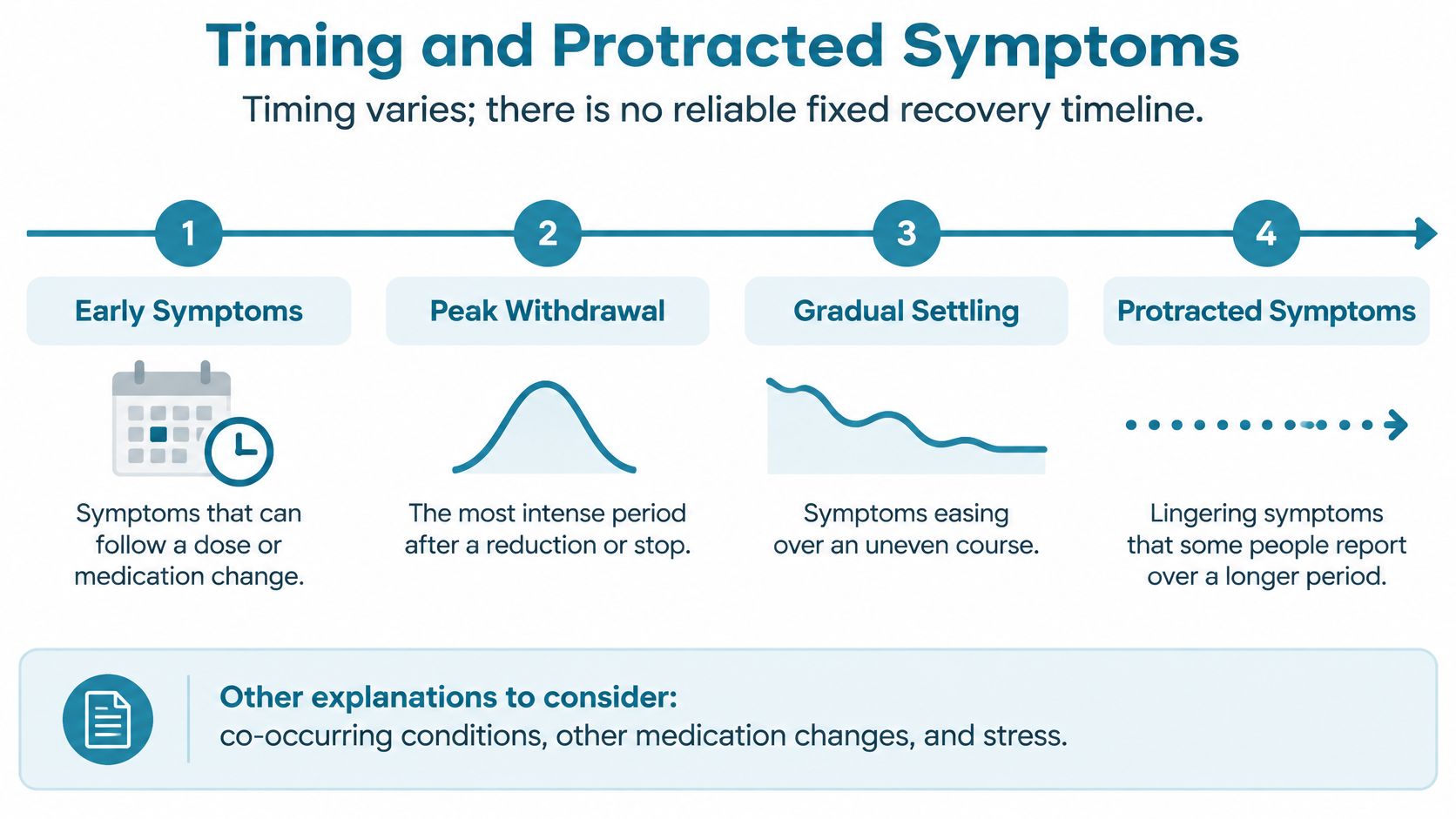
Timing is the part of benzo withdrawal symptoms that people most want pinned down and the part that resists it. There's no reliable fixed recovery timeline, and anyone who offers one is describing an average rather than a person. What can be described is the shape of the course and the questions that separate one explanation from another.
Four stages cover the outline, in the order they usually appear.
The first weeks after a change
Early symptoms tend to follow a dose reduction, a missed dose or a switch to a different medication. The interval between the change and the first symptom is itself information: it tells a clinician how quickly drug levels are moving for this particular medication. Symptoms appearing within hours of a reduced or missed dose point one way. Symptoms appearing two weeks later point another.
The peak period comes next, and it's usually the most intense stretch after a reduction or a stop. It isn't a smooth curve. People often describe waves, with better days in between.
When symptoms outlast the drug
Most acute symptoms settle once the medication has cleared, but not all do. FDA prescribing information describes protracted withdrawal as symptoms continuing beyond 4 to 6 weeks after initial withdrawal. The listed possibilities include ongoing anxiety, depression, insomnia, cognitive impairment, weakness, tremor, muscle twitches, abnormal skin sensations and tinnitus. The labeling also notes that this pattern doesn't occur in everyone, and that persistent or worsening symptoms need clinical assessment rather than self-directed medication changes.
The longer horizon matters too. The 2025 joint clinical practice guideline on benzodiazepine tapering defines protracted withdrawal as symptoms persisting beyond the expected drug-elimination period, commonly beyond 4 to 6 weeks, and notes that some cases last months or years.
That range is wide enough that a countdown becomes unhelpful. A record helps more.
Withdrawal, rebound, or the original condition
This is the question symptom lists handle worst. Anxiety, insomnia, panic, depression, dizziness, cognitive problems, sensory changes and stomach symptoms appear on withdrawal lists, on rebound lists, and on the symptom lists of the conditions the medication was originally prescribed for.
The same guideline is candid about the difficulty: clinicians may struggle to distinguish protracted withdrawal from worsening or newly emerging anxiety, sleep, neurologic or other medical conditions. Symptoms unlike the person's original condition, especially tinnitus, paresthesia (tingling or prickling), formication (a sensation of insects crawling on the skin), unusual sensory symptoms, marked cognitive changes or motor disturbances, may point toward protracted withdrawal, though overlap remains substantial.
| Possible explanation | Clues that point toward it | Question for the clinician |
|---|---|---|
| Early withdrawal | Symptoms began after a recent dose change and match the FDA-listed effects | When did symptoms start relative to the change? |
| Protracted withdrawal | Symptoms persist beyond about 4 to 6 weeks, including unusual sensations or tinnitus | Could these be withdrawal, and what monitoring is appropriate? |
| Return of the original anxiety or insomnia | Resembles the pre-treatment pattern and returns gradually | How does this compare with my original symptoms? |
| New or unrelated medical condition | Dizziness, fatigue or other symptoms with no clear link to the medication | Which evaluations or tests are needed? |
| Medication interaction or side effect | Symptoms follow a new prescription, supplement or over-the-counter product | Which medications and supplements could contribute? |
When a new symptom appears after a new prescription, a supplement or an over-the-counter sleep aid, a medication review comes before any assumption about withdrawal. The guide to psychiatric drug interactions explains why timing and metabolism matter in that review.
A useful distinction: a symptom that arrives on a schedule tied to dose timing is telling you something different from a symptom with no relationship to the medication at all.
A log that keeps several explanations open
Here's a hypothetical, clearly labeled as one. A reader notices ringing in the ears about eight weeks after a medication change. Two unhelpful conclusions are available: it must be withdrawal, or it must be unrelated. The useful move is to write down the date the ringing started, the dates of every dose change before it, and whether anything else changed that month, then bring the record to a clinician.
What a clinician reads from a pattern:
- Interval: how long after a change the symptom appears, which speaks to how fast drug levels move for this medication.
- Rhythm: whether the symptom tracks dose timing, follows a random pattern, or has no relationship to the medication.
- Trajectory: whether it's improving, plateauing or worsening across weeks.
- Function: what it costs in sleep, work, driving, exercise or daily tasks, which is the part symptom severity scales miss.
- Red flags: any new confusion, hallucination, seizure activity or suicidal thinking, which ends the tracking exercise and starts an urgent call.
Two failure modes are worth naming. Dismissing symptoms as "just anxiety" leaves a real problem untreated. Attributing every symptom to withdrawal, without evaluation, can miss a separate medical condition. Persistent or unusual symptoms warrant clinician review, especially because severe withdrawal can include hallucinations, psychosis or seizures.
Why Abrupt Stopping Is Unsafe and How Supervised Care Works
Stopping a benzodiazepine abruptly after regular use is unsafe, and that holds even when the person has never misused the medication. The reason is physiological: the nervous system adapted to the drug's presence, and it needs time to readapt.
Withdrawal can occur even during a gradual reduction, which is why tapering is individualized rather than run on a fixed schedule. The 2025 joint clinical practice guideline announcement from the American Society of Addiction Medicine describes clinicians commonly beginning with a 5 to 10 percent reduction in total daily dose every 2 to 4 weeks, then adjusting or pausing according to symptom burden and clinical response. A slow taper over roughly 3 to 6 months is often preferred in appropriate patients, and some require substantially longer plans.
Those figures are reference points a prescriber uses. They aren't instructions, and they don't transfer between medications or between people.
The process itself is easier to follow as a sequence.
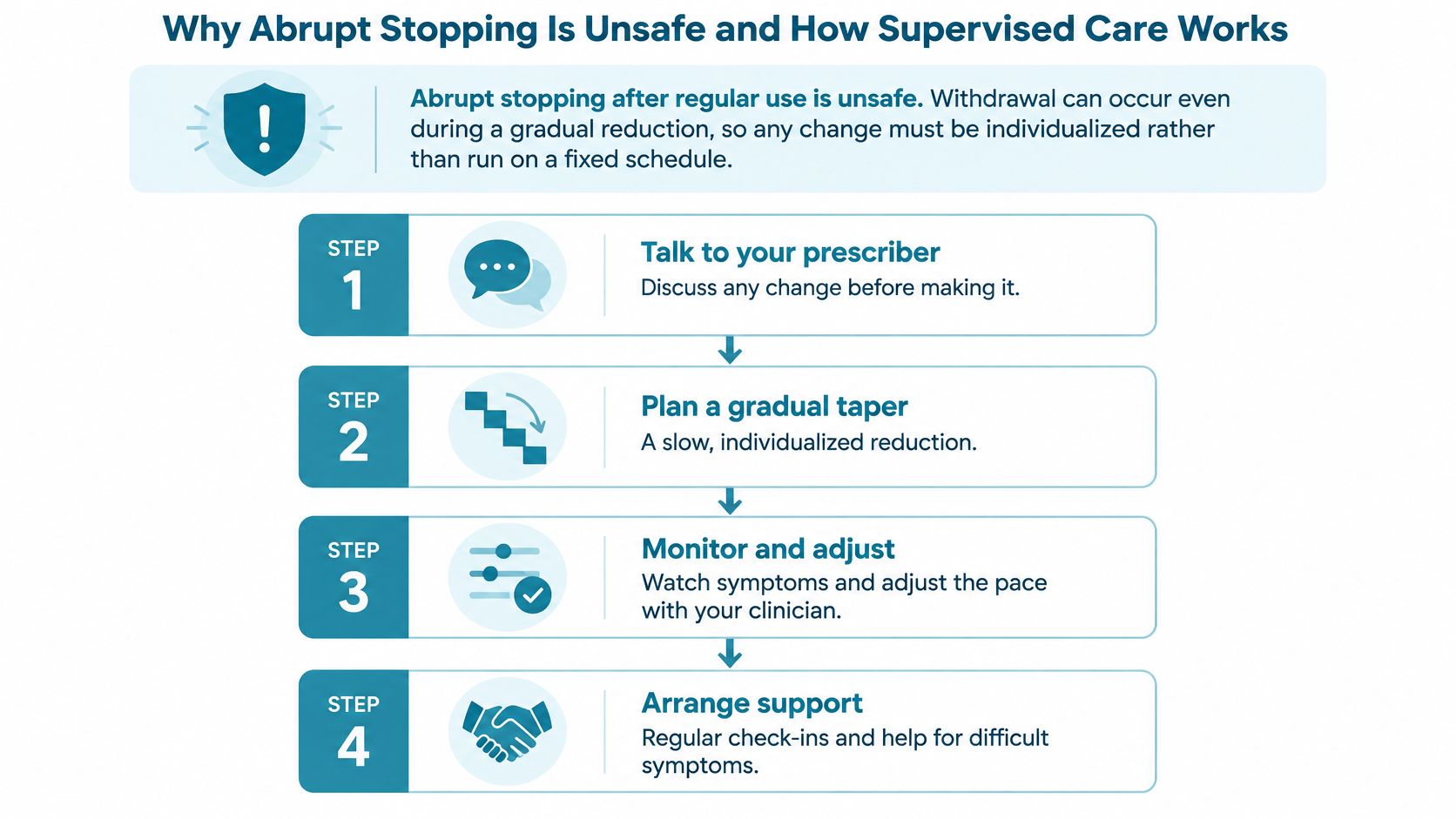
- Reconcile the medication list, including supplements and over-the-counter products. Interactions and duplicate sedatives hide here.
- Complete a confidential assessment of the current situation, medical risks, previous treatment, medications and goals. The factors in the severity table are reviewed together rather than guessed at.
- Review symptoms, sleep, functioning and warning signs so the starting point is documented before anything changes.
- Discuss treatment options, monitoring and follow-up, including what each option involves and what would prompt a change in course.
- Build a clinician-led plan that gets reviewed after every change, not one set at the start and left alone.
- Track symptoms between visits and report changes promptly rather than saving them for the next appointment.
For readers, the operative sentence is this: patients should not independently stop, substitute or accelerate dosing changes.
Monitoring after each reduction covers sleep, anxiety, autonomic symptoms, cognition, balance, mood, cravings or rebound symptoms, and any neurological change. Separating withdrawal from a recurrence of an underlying anxiety or sleep disorder takes ongoing review, not a single visit. Levels of care differ as well, and the comparison of medical detox and rehab explains which setting does what.
Prepare Questions and Arrange a Supervised Assessment
Preparation changes the quality of a first appointment more than expected. Six questions cover the ground.
- Which of my symptoms could be withdrawal, which could be rebound, and which could be the original condition returning?
- What monitoring is appropriate for my situation, and how often should it happen?
- What should I do if a symptom becomes urgent, and where should I go?
- Which of my medications and supplements should be reviewed together?
- What changes, if any, are being considered, and what would make us pause?
- How will follow-up be scheduled, and who do I contact between visits?
Bring a written log. The table below is an organizing aid, not a diagnosis, and it takes about a minute per entry.
| Date and time | Symptom and body system | Severity (0 to 10) | Medication timing as prescribed | Effect on daily tasks | Urgent sign present |
|---|---|---|---|---|---|
| Entry 1 | |||||
| Entry 2 | |||||
| Entry 3 |
Empire Medical Wellness provides private-pay, physician-led outpatient addiction medicine evaluations, and an appointment does not guarantee a prescription. Care starts with a confidential assessment of the current situation, medical risks, previous treatment and goals, and the initial evaluation includes an explanation of appropriate treatment options and next steps. Appointment requests go through scheduling, and the addiction medicine service page describes what the evaluation covers. The walkthrough of a first addiction medicine appointment explains what to expect before you arrive.
When detoxification, residential treatment, partial hospitalization, intensive outpatient treatment or another level of support is clinically appropriate, the practice can help coordinate the next step with trusted treatment partners.
Emergency guidance stays in force regardless of the calendar. If any red-flag symptom from the first section is present, call 911 or the local emergency number instead of waiting for an appointment.
Sources
This article draws on U.S. Food and Drug Administration benzodiazepine class labeling and the boxed warning update, FDA prescribing information for a benzodiazepine product, the 2025 joint clinical practice guideline on benzodiazepine tapering from the American Society of Addiction Medicine and partner organizations, the AAFP 2023 review of benzodiazepine use disorder, and a peer-reviewed review of benzodiazepine discontinuation indexed in PMC. Each was checked against its current version before publication.
Byline: Empire Medical Wellness Editorial Team. Published October 8, 2026. Updated October 8, 2026.
This article is educational and isn't personal medical advice. It doesn't replace an evaluation with a qualified clinician, and it isn't a taper plan or a reason to change a medication dose.
Empire Medical Wellness provides private-pay, physician-led outpatient addiction medicine evaluations for adults who want a careful, confidential review of withdrawal concerns and medication questions. When a higher level of support such as detoxification or intensive outpatient care is clinically appropriate, the practice can help coordinate the next step with trusted treatment partners. Visit Empire Medical Wellness to see how an evaluation works and to request an appointment.