
Which medicine on a mood stabilizers list is the right one? The list itself can't answer that, and any page that ranks these drugs from best to worst skips the question that guides treatment. Mood stabilizers are a small group of medicines used mainly in bipolar disorder: lithium, valproate (divalproex sodium and valproic acid), lamotrigine, carbamazepine, and several second-generation antipsychotics, including quetiapine, olanzapine, aripiprazole, and lurasidone. They're grouped together because each can reduce how often or how severely mood episodes occur. They don't work alike, they aren't approved for the same phases of illness, and they ask different things of the people who take them.
Scale explains why the distinctions matter. The World Health Organization estimated that about 36 million people worldwide were living with bipolar disorder in 2023, roughly 0.4% of the global population (WHO fact sheet on bipolar disorder).
Two terms are worth settling first. FDA-approved means the agency reviewed evidence for a specific use and the manufacturer may market the drug for it. Off-label means a clinician prescribes a medicine for a use the FDA hasn't approved, which is legal, common, and sometimes supported by solid trial evidence. This overview is educational. It isn't a recommendation to start, stop, or change any medication, and drug-specific details belong with FDA prescribing information and MedlinePlus rather than a general list.
Table of Contents
- 1. Lithium
- 2. Valproate (Divalproex Sodium and Valproic Acid)
- 3. Lamotrigine
- 4. Carbamazepine (Including Extended-Release Carbamazepine Capsules for Bipolar Disorder)
- 5. Quetiapine (Second-Generation Antipsychotic)
- 6. Olanzapine (Second-Generation Antipsychotic)
- 7. Aripiprazole (Second-Generation Antipsychotic)
- 8. Lurasidone (Second-Generation Antipsychotic)
- Common Mood Stabilizers at a Glance
- Questions to Bring to Your Clinician, and How Empire Medical Wellness Can Help
1. Lithium
Lithium is the oldest entry on the mood stabilizers list, and the standard later drugs were measured against. Australian physician John Cade published his report on lithium salts for psychotic mania in 1949, and controlled trials over the next two decades confirmed both the antimanic effect and the ability to prevent recurrences (NIH Intramural Research Program).
It remains common. A 2025 systematic review put lithium use at 54.4% in bipolar I disorder, 38.0% in bipolar II disorder, and 47.0% across bipolar disorder overall (International Journal of Bipolar Disorders).
Why the Blood Test Is Part of the Treatment
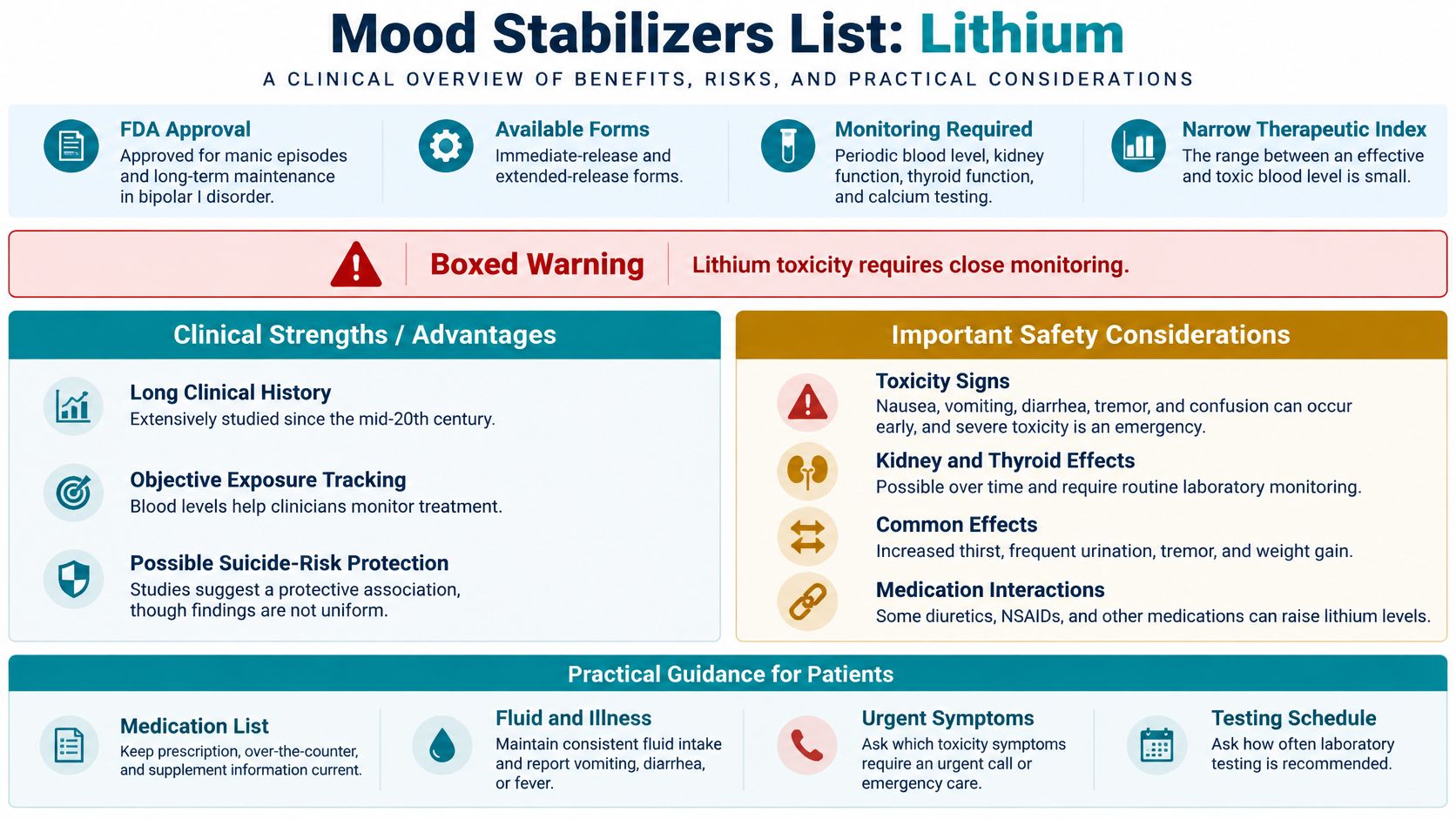
Lithium is a naturally occurring element. How it steadies mood is still not fully understood. It is thought to act on several signaling pathways inside brain cells. What is well characterized is its narrow therapeutic index, the small gap between a helpful concentration and a harmful one. A dose that helps and a dose that harms sit close together, which is why the blood test is part of the treatment rather than an optional extra.
The FDA label calls for a serum concentration three days after starting, 12 hours after the last oral dose, and repeated regularly until the patient stabilizes, with a range of 0.8 to 1.2 mEq/L for acute manic or mixed episodes and 0.8 to 1 mEq/L for maintenance in patients aged 7 and older (FDA prescribing information for lithium). The label carries a boxed warning about lithium toxicity.
- Bring every bottle to visits. Prescription drugs, over-the-counter pain relievers, supplements, and anything prescribed elsewhere can shift lithium levels.
- Learn the toxicity warning signs. Severe tremor, vomiting, diarrhea, unsteady walking, confusion, or slurred speech are reasons to call right away rather than wait.
- Protect hydration. Steady fluid intake matters, and fever, vomiting, or diarrhea can move a level within days.
- Ask when the next level is due and what the last result was.
Someone who has been stable for two years picks up a stomach bug over a weekend and cannot keep fluids down. That is a call-the-prescriber situation, not a wait-for-Monday one, because dehydration can push a level upward.
Before a first visit about bipolar disorder, bring an updated list of medicines and supplements, plus any side effects already noticed. A physician reviews symptoms, history, other medicines, and safety, then decides whether lithium, or any medication, fits.
2. Valproate (Divalproex Sodium and Valproic Acid)
Three names describe one active medicine, and the overlap confuses nearly everyone. Valproic acid is the parent drug. Divalproex sodium combines valproic acid and sodium valproate in a form that's gentler on the stomach. Depakote is a common brand. The FDA has approved divalproex for manic or mixed episodes in bipolar disorder, and valproate products are also approved for epilepsy and migraine prevention, which is why the same molecule turns up in neurology clinics.
NIMH lists lithium and valproate as examples of mood stabilizers that can help prevent mood episodes or reduce their severity, and notes that some anticonvulsants serve particular illness patterns, including mixed symptoms and rapid cycling (NIMH publication on bipolar disorder). Mixed features means mania and depression showing up in the same stretch of days rather than in separate phases.
Why the Safety Review Comes Before the First Dose
Valproate's labeling carries boxed warnings for liver injury, pancreatitis, and harm to a developing fetus, and the fetal warning is the one that shapes prescribing most often, because the risk exists whether or not a pregnancy is planned. The medicine is thought to work partly by raising levels of GABA, an inhibitory brain chemical, along with effects on other pathways.
- Say the pregnancy answer out loud, even when it seems obvious, because the warning applies to planning as much as to pregnancy.
- Report stomach pain, persistent vomiting, yellowing of the skin or eyes, or unusual bruising the same day.
- Ask which labs are scheduled and what each one checks, so a missed draw never gets mistaken for a normal result.
A hypothetical worth rehearsing: someone taking valproate develops steady nausea with pain under the ribs. That's a same-day call, because pancreatitis and liver problems can both present this way.
For anyone planning a pregnancy or already pregnant, Empire Medical Wellness's guide to psychiatric medications during pregnancy is a reasonable starting point before that conversation.
3. Lamotrigine
Lamotrigine has the narrowest labeled job among the anticonvulsant mood stabilizers, and that precision is the useful part. The FDA has approved it, sold as Lamictal among other brands, for maintenance treatment of bipolar I disorder to delay new mood episodes. It isn't approved for acute mania or for an acute depressive episode, and recent VA/DoD guidance suggests against relying on it alone to treat mania (review of mood stabilizer evidence).
Use has grown faster than the label changed. An analysis of prescribing trends reports lamotrigine treatment rates approximately doubled, from 25 to 50 per 1,000, during the study period (BJ Psych Open analysis of mood stabilizer prescribing trends). Adoption patterns like that reflect monitoring barriers, reproductive-safety restrictions, and clinician preference as much as they reflect comparative effectiveness.
Why the Slow Start Isn't Optional
Lamotrigine is titrated gradually because rapid escalation raises the risk of serious skin reactions, including Stevens-Johnson syndrome, and the label carries a boxed warning for that reason. The mechanism is thought to involve sodium channels and reduced glutamate release, a calmer signaling pattern rather than sedation.
A new rash in the first weeks of treatment is a call-the-prescriber-today problem, not a wait-and-see one.
- Report rash, blistering, mouth sores, fever, or swollen glands immediately.
- List hormonal medications, since some interact and affect lamotrigine levels.
- Ask for the adjustment schedule in writing, including what to do about a missed dose.
Suppose someone starts lamotrigine in March and is still climbing the schedule in May. That pace is the safety feature working as designed, not a sign the plan has stalled.

4. Carbamazepine (Including Extended-Release Carbamazepine Capsules for Bipolar Disorder)
Carbamazepine is the entry whose bipolar approval is narrower than its reputation suggests. The FDA approved an extended-release capsule form, sold as Equetro, for acute manic or mixed episodes in bipolar I disorder. Under the Tegretol name, the same active drug is approved for epilepsy and for trigeminal neuralgia.
The Interaction List Usually Decides
Carbamazepine accelerates liver enzymes that clear many other drugs, so the practical question isn't only whether it might help mood but whether it fits alongside everything else someone takes. Its label carries boxed warnings for serious skin reactions, aplastic anemia, and agranulocytosis, and it notes the HLA-B*1502 allele, a genetic marker for severe skin reactions found in some people of certain Asian ancestries.
Monitoring is the fragile part across bipolar care. A recent review reported compliance rates of 65% for lithium levels, 73% for creatinine, and 54% for thyroid-stimulating hormone, with only 16% of patients meeting all guideline monitoring measures (NCBI Bookshelf review of bipolar disorder). A lab schedule that slips by a few months is common, which is why a prescriber asks about follow-through before choosing a drug with this much monitoring attached.
Before the first dose: bring the pharmacy printout, not a memory-based list. This is a medication that changes how other drugs behave.
- Ask whether HLA-B*1502 testing applies to you, given the label's note on ancestry.
- Report fever, sore throat, mouth ulcers, bruising, or rash without waiting.
- Put lab dates on a calendar and treat them as part of treatment rather than paperwork.
Take a hypothetical patient on three other daily medicines, including hormonal contraception. The interaction picture, not the mood diagnosis alone, often decides whether carbamazepine is workable.
Empire Medical Wellness's guide to psychiatric drug interactions explains why the full list matters at every visit.
5. Quetiapine (Second-Generation Antipsychotic)
Quetiapine doesn't carry "mood stabilizer" in its name, yet it sits near the top of most current mood stabilizers lists. It's a second-generation antipsychotic approved for schizophrenia, for acute depressive episodes in bipolar I and bipolar II disorder, for acute manic episodes, and for maintenance treatment of bipolar I disorder.
Why an Antipsychotic Belongs on This List
"Mood stabilizer" describes a job, not a chemical family. Guideline evidence separates recommendations by phase: lithium, quetiapine, divalproex, asenapine, aripiprazole, paliperidone, risperidone, and cariprazine appear among first-line options for acute mania, while bipolar I depression follows a different hierarchy of quetiapine, lurasidone with or without lithium or divalproex, lithium, and lamotrigine (PMC review of guideline evidence). A drug that controls activation may have thinner evidence for depression, and the reverse also holds.
Quetiapine works mainly by blocking certain dopamine and serotonin receptors, and it's one of the more sedating options in the group. Its label carries boxed warnings about increased mortality in older adults with dementia-related psychosis and about suicidal thoughts and behaviors, particularly in younger patients.
Sedation is the effect people tend to mention first, and it shapes when a dose gets taken.

- Ask for baseline and follow-up metabolic testing covering weight, blood pressure, glucose, and lipids.
- Rise slowly from lying or sitting, because dizziness is common early on.
- Report new or worsening self-harm thoughts immediately, and call or text 988 in a crisis.
One hypothetical example: a manic episode that includes severe insomnia and agitation. Sedation that's a nuisance in ordinary times can be a deliberate part of the plan during an episode, and that reasoning deserves to be stated out loud rather than assumed.
Empire Medical Wellness reviews the pros and cons of medication for mental illness as a framework for weighing benefits against side effects.
6. Olanzapine (Second-Generation Antipsychotic)
Olanzapine is approved for bipolar I disorder, including acute manic or mixed episodes and maintenance treatment, and a combination product containing olanzapine and fluoxetine is approved for depressive episodes associated with bipolar I disorder. It acts on dopamine and serotonin receptors along with other pathways.
Combination treatment is the norm rather than the exception. In a 2024 study of 107 clinically stable bipolar-disorder outpatients, 87.9% received mood stabilizers and 92.5% received polypharmacy (Bipolar Disorders study). That second figure is why a single-drug list misleads: patients typically run a regimen, and every drug in it carries its own monitoring.
Why Weight and Glucose Get Measured
Olanzapine is associated with notable weight gain and metabolic change, so baseline and periodic weight, waist measurement, blood pressure, glucose, and lipids belong in the plan rather than in a footnote. Its label carries a boxed warning about increased mortality in older adults with dementia-related psychosis.
A patient who stops raising weight concerns because visits feel rushed is a patient the plan has already lost.
- Track sleep, appetite, and energy between visits, since patterns are easier to act on than single readings.
- Ask for the numbers instead of accepting "your labs look fine."
- Raise weight concerns early, because dose selection and monitoring can both be revisited.
Consider a hypothetical adult who gains weight steadily over six months and says nothing. The side effect isn't the failure there; the silence is, and a two-minute conversation at a follow-up visit is usually enough to reopen it.
Empire Medical Wellness discusses psychiatric medication and weight gain as a routine part of follow-up care.
7. Aripiprazole (Second-Generation Antipsychotic)
Aripiprazole behaves differently at the receptor from most of its neighbors. It's a partial agonist at dopamine D2 and serotonin 5-HT1A receptors and an antagonist at serotonin 5-HT2A, which in plain language means it turns dopamine signaling partway up rather than blocking it flat. The FDA has approved it for schizophrenia, for manic or mixed episodes in bipolar I disorder, for maintenance treatment of bipolar I disorder, and as an add-on for major depressive disorder.
Phase-specific guidance supports that maintenance role. Current CANMAT/ISBD recommendations list lithium, quetiapine, divalproex, lamotrigine, asenapine, and aripiprazole among first-line maintenance monotherapies, while acute bipolar depression has its own list led by quetiapine, lithium, lamotrigine, and lurasidone (CANMAT/ISBD guidance summary). A first-line listing isn't a match for every patient, and an off-label use isn't the same thing as an approved indication.
What Akathisia Feels Like
Akathisia is an inner restlessness, a drive to move that isn't ordinary anxiety, and it's the effect most likely to be misread on this medication. People describe pacing, an inability to sit through a meeting, or a jittery feeling that arrived with the drug.
- Describe restlessness in your own words rather than calling it nerves.
- Ask why a particular form, including a long-acting injectable, may or may not fit your situation.
- Bring side-effect questions to every follow-up instead of changing anything on your own.
The label also carries boxed warnings about increased mortality in older adults with dementia-related psychosis and about suicidal thoughts and behaviors. A hypothetical patient who feels "wired but not anxious" two weeks in has a specific thing to report, and naming it accurately changes what happens next.
8. Lurasidone (Second-Generation Antipsychotic)
Lurasidone carries one of the most specific approvals in the group. The FDA has approved it for depressive episodes associated with bipolar I disorder in adults and in children and adolescents aged 10 and older, and for schizophrenia in adults and adolescents. It acts on dopamine and serotonin receptors, and its labeling states the medication should be taken with food.
Many patients don't take one medicine alone. In a 2024 German study covering 1,575 patients, 60.0% received at least one mood stabilizer during the study period (Frontiers in Psychiatry study), which is a useful reminder that an antipsychotic is often one component of a regimen built around a traditional mood stabilizer.
Why Food Is in the Label
Taking lurasidone with food changes how much of the drug is absorbed, which is why the instruction sits in the labeling rather than in a general tip sheet. The label also carries boxed warnings about increased mortality in older adults with dementia-related psychosis and about suicidal thoughts and behaviors.
- Ask how your prescriber wants it timed with meals, and why.
- Share every other medication, including supplements and anything from another prescriber.
- Report new restlessness, agitation, or thoughts of self-harm promptly, and call or text 988 in a crisis.
Suppose a hypothetical adult has bipolar I disorder with mostly depressive episodes and has already tried lithium. The phase of illness, not the drug category, is what makes one option worth discussing before another.
Common Mood Stabilizers at a Glance
Which labeled job is this medicine for? That question sorts a list faster than any ranking. Acute mania, bipolar depression, and maintenance (keeping new episodes from returning) are different assignments, even when the bottles sit on the same shelf.
Four of the medicines below are traditional mood stabilizers: lithium, plus the anticonvulsants valproate, lamotrigine, and carbamazepine. The other four are second-generation antipsychotics with their own bipolar indications. The nickname "mood stabilizer" covers both groups. The labs and the boxed warnings do not.
Blood-level drugs are watched the way a narrow bridge is watched: too little may not hold the mood, too much can injure. Lithium, valproate, and carbamazepine fall in that group, with kidney, thyroid, liver, or blood-count checks attached. Lamotrigine is watched mainly through a slow dose increase and a rash check. The antipsychotics are watched through weight, glucose, lipids, blood pressure, mood, and movement symptoms, because metabolic change and restlessness show up in the body before they show up in a single blood level.
The table is a side-by-side of FDA-labeled mood uses, the monitoring those labels imply, and the warnings serious enough to be boxed. It is a pre-appointment reference, not a preference order.
| Medication | FDA-Approved Mood Uses | Key Monitoring | Major Warnings |
|---|---|---|---|
| Lithium | Acute manic or mixed episodes; maintenance of bipolar I disorder | Blood lithium levels, kidney function, thyroid function, and calcium | Boxed warning for toxicity; narrow therapeutic index; kidney and thyroid effects |
| Valproate (Divalproex Sodium and Valproic Acid) | Manic or mixed episodes associated with bipolar disorder | Liver function, blood counts, and blood levels as clinically indicated | Boxed warnings for liver injury, pancreatitis, and fetal harm, including neural tube defects and reduced cognitive development; labeling advises against use in pregnancy unless other options are unsuitable |
| Lamotrigine | Maintenance treatment of bipolar I disorder to delay new mood episodes | Gradual dose increases; monitor for rash | Boxed warning for serious skin rash, including Stevens-Johnson syndrome |
| Carbamazepine (Including Extended-Release Carbamazepine Capsules for Bipolar Disorder) | Acute manic or mixed episodes in bipolar I disorder (extended-release capsules) | Blood counts, blood levels, skin reactions, and medication interactions; consider genetic risk noted in labeling | Boxed warnings for serious skin reactions, aplastic anemia, and agranulocytosis |
| Quetiapine (Second-Generation Antipsychotic) | Bipolar I and II depression; acute mania; bipolar I maintenance | Weight, blood pressure, glucose, lipids, and heart rhythm when indicated | Boxed warnings for suicidal thoughts and behaviors and increased mortality in older adults with dementia-related psychosis |
| Olanzapine (Second-Generation Antipsychotic) | Acute manic or mixed episodes and maintenance in bipolar I disorder; with fluoxetine for bipolar I depression | Weight, waist measurement, blood pressure, glucose, and lipids | Boxed warning for increased mortality in older adults with dementia-related psychosis; notable metabolic effects |
| Aripiprazole (Second-Generation Antipsychotic) | Manic or mixed episodes and maintenance in bipolar I disorder; adjunctive treatment for major depressive disorder | Monitor mood, thoughts, movement symptoms, and metabolic effects | Boxed warnings for suicidal thoughts and behaviors and increased mortality in older adults with dementia-related psychosis |
| Lurasidone (Second-Generation Antipsychotic) | Bipolar I depression in adults and in children and adolescents aged 10 years and older | Monitor mood, thoughts, movement symptoms, and medication interactions; take with food | Boxed warnings for suicidal thoughts and behaviors and increased mortality in older adults with dementia-related psychosis |
Valproate is the row where pregnancy risk is written into the boxed warning itself. A comparison of lamotrigine with quetiapine is a comparison of a maintenance anticonvulsant, watched for rash, with an antipsychotic labeled across depression, mania, and maintenance, watched for metabolic change. Phase of illness and the monitoring you can keep are what make one row worth raising with a prescriber before another.
Questions to Bring to Your Clinician, and How Empire Medical Wellness Can Help
A mood stabilizer list names classes and labels. Your appointment has a narrower job: turn one of those medicines into a plan you can follow, including what it is for, what it asks of your body, and who checks whether it is working.
A written list works like a packing checklist before a trip. You do not invent the destination in the waiting room. You arrive with the items already named so the physician can fill in the specifics from your history.
A Blank Planning Aid to Take Into Any Visit
Write the answers down while they are still clear. Details fade between visits.
- Which phase is this medicine for? Acute mania, acute depression, maintenance, or more than one.
- What monitoring does it need? Blood levels, kidney and thyroid tests, liver tests, complete blood counts, weight, glucose, or lipids, and how often each is due.
- Which symptoms mean call today? Ask for the short list that means phone the office, and the shorter list that means emergency care.
- What interacts with it? Include over-the-counter pain relievers, supplements, hormonal contraception, and anything another clinician prescribed.
- What does the titration schedule look like in writing? This matters most with lamotrigine and carbamazepine.
- What happens if a dose is missed or a lab is late?
- What would make us rethink the plan? Ask which outcomes, at which point, would trigger a change.
When to Call for Help Right Away
This article is educational. Starting, stopping, or changing a medication belongs with the prescriber who knows the full history. Routine questions, side-effect notes, and lab results can wait for the next visit. New mania with dangerous behavior, psychosis, a spreading rash with fever or blistering, and any thoughts of self-harm cannot. Call or text 988 for the Suicide and Crisis Lifeline, or call emergency services.
How Empire Medical Wellness Fits In
Empire Medical Wellness is a private-pay, physician-led outpatient practice. Mental health evaluation and medication management are offered for children aged 8 and up, adolescents, and adults. Telehealth visits are for adults who are physically located in New York, New Jersey, Connecticut, or Pennsylvania.
Medication may be included when a medical evaluation supports it. That work includes selecting an appropriate option, reviewing risks and interactions, explaining use, and monitoring response over time. Bring an updated medication list to a first visit, including supplements and any side effects you have noticed. At a review visit, you and the physician discuss whether current treatment is helping, any side effects, and concerns about the medication plan.
Standard appointments are a 50-minute initial evaluation for $350 and a 25-minute follow-up for $225. Empire does not bill insurance directly. An itemized receipt is available through the patient portal. The mental health medication management page explains what an evaluation covers. Medication review visits are built around the questions above. Fees and how it works lists current pricing, and appointments can be booked online.
A scheduled evaluation is where those list questions meet your own symptoms, treatment history, and the monitoring a medicine requires. Visit Empire Medical Wellness to learn more.