
What's the first step in how to stop drinking? A common answer is a quit date. A safer first step is a risk check, because for some adults the way alcohol stops matters as much as the decision to stop. Daily heavy drinking, a past withdrawal seizure, or a sedative prescription can turn a sudden stop into a medical event.
Stopping is still achievable for many people. The plan just needs the right order: a clinician's review of your pattern first, then a goal you can support medically, then medication questions, then a plan for the months that follow.
Table of Contents
- Check Your Withdrawal Risk Before You Change Anything
- Pick a Goal You Can Medically Support
- FDA-Approved Medications and What to Ask About Them
- How to Build a Relapse-Prevention Plan Step by Step
- Lapses, Warning Signs and When to Seek Urgent Care
- Questions to Bring to Your Clinician
- Book a Confidential Medical Assessment as Your Next Step
Check Your Withdrawal Risk Before You Change Anything
Before changing anything, have a clinician review three things: how much you drink in a typical week, when you last drank, and how your body has responded to a cutback before.
Alcohol is a major cause of preventable harm. The World Health Organization reported that alcohol consumption caused approximately 2.6 million deaths worldwide in 2019, representing 4.7% of all deaths that year, and identified alcohol as a contributor to more than 200 disease, injury and health conditions, including liver disease, cardiovascular disease, several cancers, injuries and infectious diseases. That scale is why quitting deserves real medical planning. It's also why a rushed stop can go wrong.
The specific danger is withdrawal, the cluster of symptoms that appears when a body used to alcohol suddenly doesn't get it. Withdrawal may include seizures, hallucinations, delirium and severe autonomic symptoms. Autonomic refers to the body's automatic controls, such as heart rate, blood pressure and sweating. A medical assessment matters most when there is a history of withdrawal, daily heavy drinking, prior seizures, serious medical illness, pregnancy, or use of sedatives, because each of those changes how the first days should be handled.
The first four steps, in order
- Record your typical week. Note how many drinks you have on each day, the type of alcohol, the days per week, and the date and time of your last drink. A phone note is enough.
- Describe any past withdrawal. Write down what you felt, how soon it started and whether you had a seizure, hallucination or a spell of confusion. Old episodes predict future ones better than any questionnaire.
- List every medicine you take. Include over-the-counter sleep aids, cold remedies and anything prescribed for anxiety or sleep. Some of these add risk when combined with alcohol or with withdrawal.
- Book the review before you choose a date. A quit date set before the safety check can pressure you into a stop your body isn't ready for.
| Factor | Why it matters | What to bring to the appointment |
|---|---|---|
| Daily or near-daily heavy drinking | Longer, heavier use is linked to higher risk of withdrawal | Typical amount, days per week and time of last drink |
| Past withdrawal, seizures or delirium | Earlier severe reactions help predict how the body may respond | Dates and a description of each episode |
| Sedative or other medication use | Some medicines add risk when combined with alcohol or withdrawal | Complete list of current medicines, including over-the-counter products |
| Liver, heart or kidney illness | Affects which medicines are appropriate and how closely to monitor | Recent lab results and notes from other clinicians |
| Pregnancy or possibility of pregnancy | Changes medication choices and monitoring | Pregnancy status shared directly with the clinician |
| Depression, anxiety or other mental-health conditions | Can affect cravings, sleep and safety planning | Current treatment and any past hospitalizations |
Emergency rule: a seizure, new confusion or hallucinations after stopping alcohol means call 911 now. That is not a wait-for-the-appointment symptom.
If you want to recognize your own episodes more accurately, read about alcohol withdrawal effects before the visit so you can describe timing and severity in plain words.
Pick a Goal You Can Medically Support
There are two broad goals, and they carry different levels of oversight. Abstinence means not drinking at all. A reduction goal means a specific limit, such as a set number of drinks per week with no heavy-drinking days, reviewed on a schedule.
A short, structured conversation can move drinking in the right direction. A Cochrane review of 34 randomized trials involving 15,197 participants found that, at one-year follow-up, people who received a brief alcohol intervention drank less per week than control participants. A related analysis reported an average reduction of about 20 grams of ethanol per week, with a 95% confidence interval from 12 to 28 grams, roughly 2.5 United Kingdom alcohol units weekly. Those interventions weren't intensive programs. They involved screening, personalized feedback, advice, motivational discussion, or a small number of counseling sessions.
What a short intervention can't do matters just as much. The same evidence found only small effects on binge-drinking frequency and drinking days, so one conversation isn't a substitute for ongoing care when drinking is severe, withdrawal risk is present, or earlier attempts didn't last.
When a reduction goal alone may not fit
Four situations usually point toward an abstinence-oriented plan with medical oversight:
- Alcohol use disorder, the clinical condition in which drinking becomes compulsive or hard to control.
- Repeated failed attempts to moderate, especially when limits slip within days each time.
- Withdrawal symptoms whenever you cut back.
- Alcohol-related medical or mental-health problems, such as abnormal liver tests or worsening anxiety.
Clinical reality: reduction goals are legitimate, but they aren't universally safe. The NIAAA's description of alcohol use disorder notes that for some patients who aren't ready to abstain, an individualized initial goal such as substantially reducing consumption and eliminating heavy-drinking days can be appropriate, with follow-up and eventual abstinence when clinically indicated.
Consider a hypothetical reader who drinks most evenings and has tried cutting back several times. The useful question for a clinician isn't whether that person has willpower. It's whether a reduction target is safe for that pattern or whether a full stop with monitoring is the better starting point.
Two questions worth asking out loud: is my current pattern suited to a reduction goal, and what result would tell us the goal should change? If ongoing visits and monitoring fit your situation, outpatient alcohol treatment describes how that care is structured.
FDA-Approved Medications and What to Ask About Them
Medication is the layer of medical oversight that sits between a reduction plan and a supervised stop. Three medications are approved by the U.S. Food and Drug Administration to help treat alcohol use disorder: naltrexone, acamprosate and disulfiram. Each works differently, and each is usually paired with counseling or other support rather than used alone.
These medicines reach few of the people they might help. SAMHSA's national survey reports that in 2024, 2.5% of the 27.9 million U.S. people aged 12 or older with past-year alcohol use disorder, or 697,000 people, received medication for alcohol use disorder.
A first visit is the right place to sort out whether medication fits your goal, your liver and kidney health, and your other prescriptions.

The NIAAA's medications development program describes each drug's role and the practical details a prescriber checks. Read this table as a question list for a clinician, not a menu to choose from on your own.
| Medication | How NIAAA describes its role | Key points for clinician review |
|---|---|---|
| Naltrexone | Can reduce alcohol craving; may be started while still drinking | Liver function, opioid use and current medicines |
| Acamprosate | Helps maintain abstinence by easing anxiety, restlessness, dysphoria and insomnia | Kidney function, current medicines and treatment goal |
| Disulfiram | Causes flushing and nausea if alcohol is consumed | Must not be given until at least 12 hours after last drink; heart and other medical conditions |
Notice how the three drugs map to different goals. Naltrexone comes as a daily pill or a long-acting injection and works partly by blocking opioid receptors, the sites in the brain involved in alcohol's rewarding effects. Because it can be started while a person is still drinking, it can fit a plan built around cutting down. Acamprosate is taken three times a day and is intended to help maintain abstinence by easing symptoms that can follow a stop, such as anxiety, restlessness, dysphoria (a low, unsettled mood) and insomnia. Disulfiram takes the strictest line. It interferes with alcohol metabolism and produces flushing and nausea if alcohol is consumed, so it only suits a full abstinence goal.
What a clinician weighs
Choice depends on the treatment goal, liver or kidney health, opioid use, pregnancy considerations, how reliably a person can take a daily medicine, and prior response. There is no single best drug. Some medicines are also used off-label for alcohol use disorder, which means outside the FDA-approved labeling, and that use needs its own conversation.
Three questions to bring: which approved medication fits my health and my goal, is any off-label option being considered and why, and how will we judge whether it is working? Ask how any recommended medication would be monitored and followed up. Reading an overview of how naltrexone works beforehand can make that conversation more specific.
How to Build a Relapse-Prevention Plan Step by Step
Detoxification is a beginning, not a treatment plan. The NIAAA's guidance on alcohol use disorder frames recovery as a months-to-years process of continuing care and periodic reassessment, with a written plan rather than a single quit date.
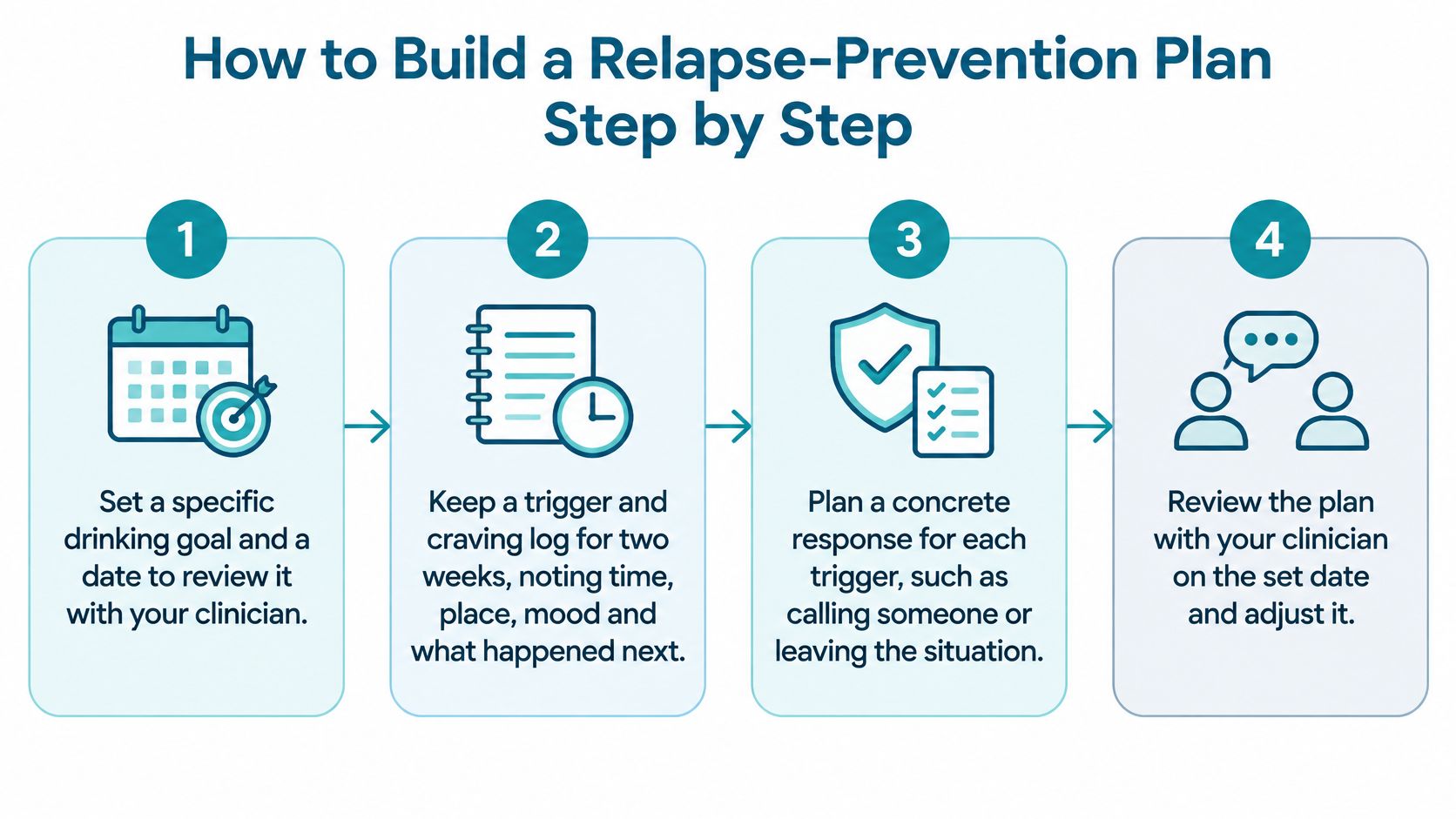
- Set a specific goal and a review date. Write the drinking goal in numbers and the date you'll review it with your clinician. A goal without a review date becomes permanent or disappears.
- Keep a trigger and craving log for two weeks. Record the time, place, mood and what happened next. Patterns show up fast, often around a specific hour or a specific room in the house.
- Plan two responses for each trigger. Calling someone, leaving the setting, or starting a fixed activity such as a walk or a shower gives you a script when judgment is weakest.
- Clear alcohol from your environment. Remove it from the home and decide in advance how you'll handle social events and offers to drink. Deciding at the table is too late.
- Schedule follow-up and put coordination in writing. Confirm who may be contacted, such as a therapist, primary care clinician or mutual-help contact. Empire Medical Wellness coordinates with outside clinicians when that is useful and authorized, and doesn't provide psychotherapy itself.
- Review any lapse within a few days. Look at what came before it, what changed and whether treatment should be more frequent. A lapse is information for adjusting care, not proof of failure.
Evidence-based psychological programs commonly run for 6 to 12 weeks or longer and may include cognitive behavioral therapy, motivational enhancement, contingency management, community reinforcement or family therapy. Medication, when a qualified clinician considers it appropriate, sits alongside that behavioral care rather than replacing it.
Plan for the second month, not just the first week. A short intervention can shift drinking early on, which is exactly why continuing care and a scheduled review matter more than the intensity of the first conversation.
Lapses, Warning Signs and When to Seek Urgent Care
Withdrawal symptoms commonly begin within hours of the last drink. They may include tremor, sweating, a higher pulse or blood pressure, nausea, insomnia and anxiety. Seizures can occur, and withdrawal delirium, a state of disorientation with hallucinations and altered consciousness, typically begins after 1 to 3 days. The NIAAA clinical guide on withdrawal reports that up to half of people with alcohol use disorder experience withdrawal symptoms when stopping, although only a smaller proportion require medical monitoring.
Benzodiazepines, a class of sedative medicines, are the established first-line medication class for medically managed withdrawal. That decision belongs to a clinician. Unsupervised detoxification and self-prescribed sedatives are how manageable withdrawal becomes a hospital admission.
Matching the symptom to the next step
| Situation | Next step | Timing |
|---|---|---|
| Cravings, mild sleep trouble or mild anxiety that is manageable | Routine follow-up with your clinician or plan review | As scheduled, or sooner if worried |
| Lapse with drinking but no withdrawal symptoms | Review what happened and adjust the plan with your clinician | Contact your clinician promptly |
| Shaking, sweating, racing heart or nausea after stopping | Contact your clinician or urgent care to be assessed | Same day |
| Seizure, confusion, hallucinations, fainting or severe vomiting | Call 911 or go to the nearest emergency department | Immediately |
| Thoughts of harming yourself or others | Call or text 988 Suicide and Crisis Lifeline, or call 911 | Immediately |
A lapse without withdrawal symptoms calls for a plan review, not self-blame. Symptoms that appear after stopping need a same-day assessment. Anything on the emergency row needs an emergency department, and a routine appointment never replaces that. If you're sorting out what a slip does and doesn't mean, what a relapse means in recovery is a steady place to start.
Questions to Bring to Your Clinician
A short, organized list gets more out of a visit than an hour of improvising. Group the questions by topic and add your own at the end of each group.
About your risk
Given my drinking pattern and any past withdrawal, is stopping at home appropriate, or is medical monitoring needed first? Ask this before any date gets set.
About your goal
Is a reduction goal reasonable for my pattern, and what results would tell us to change it? A clinician should be able to name the specific signal, such as returning heavy-drinking days or rising liver tests.
About medication
Which FDA-approved medication, if any, fits my liver and kidney health, my current medicines and my goal? Is any off-label use being considered, and why?
About monitoring and support
How often should we follow up, and which symptoms should prompt a call before the next visit? Which therapy, mutual-help or primary-care supports would you recommend, and what written permission do you need to coordinate with them?
About the level of care
Do I need a higher level of care than outpatient visits, and would you coordinate that or refer me to another program? Some people need withdrawal monitoring or a structured program first, and asking early is simpler than arranging it in a crisis. First-visit details for the initial addiction medicine appointment explain what the assessment covers.
Book a Confidential Medical Assessment as Your Next Step
If you have a seizure, confusion, hallucinations, fainting, severe vomiting or thoughts of harming yourself, call 911 or 988 now rather than waiting for any appointment.
For everything else, a confidential assessment is the practical next step. Addiction medicine care at Empire Medical Wellness begins with a review of your current situation, medical risks, previous treatment, medications and goals, and the initial evaluation includes an explanation of appropriate treatment options and next steps. That visit is a private-pay, physician-led outpatient appointment, and it doesn't guarantee a prescription.
Bring the risk-factor checklist, your drinking estimates, your medication list and the details of any past withdrawal. Care includes medical evaluation, evidence-based medication when clinically appropriate with monitoring and follow-up, recovery planning, and coordination with therapists or treatment programs when that is useful and authorized. The practice doesn't provide detoxification, residential, partial-hospitalization or intensive outpatient care, but it can discuss whether a higher level of care fits and help arrange the next step. More detail sits on the addiction medicine service page.
Empire Medical Wellness offers physician-led addiction medicine evaluation for adults who want a private, unhurried conversation about alcohol, including a review of withdrawal risk, treatment goals and whether medication is appropriate with monitoring. If the safety check is the part you've been putting off, that visit is where it gets done, with clear next steps and coordination with outside clinicians when you authorize it. Visit Empire Medical Wellness to see how assessment, follow-up and recovery planning fit together.