
A brain zap is a brief, shock-like sensation in the head or body that people report during antidepressant dose reduction, missed doses, or stopping, and it isn't generally understood as an actual electrical discharge in the brain.
But how can someone tell whether that startling sensation reflects medication withdrawal, returning depression or anxiety, or something that needs urgent medical attention? The most useful clues are timing, accompanying symptoms, and medication history, not the word zap alone.
Table of Contents
- What a Brain Zap Is and What It Feels Like
- How Brain Zaps Differ From Relapse and Other Causes
- Urgent Symptoms Versus Routine Follow-Up
- Why Brain Zaps Happen During Medication Changes
- How Common Brain Zaps Are and How Long They Last
- Questions to Bring to Your Prescriber
- Sources and Editorial Review
What a Brain Zap Is and What It Feels Like
Brain zap is a patient-described term for a sensory disturbance, not a formal diagnosis. People describe an internal jolt, buzzing, vibration, or sudden snap. The sensation may occur in the head, arms, or legs.
The Royal College of Psychiatrists' guidance on stopping antidepressants recognizes electric-shock sensations as withdrawal symptoms and notes that turning the head can sometimes make them worse. Dizziness, imbalance, nausea, irritability, anxiety, headache, and disrupted sleep may accompany them.

Hypothetical example: An adult notices a sudden buzzing jolt after a missed antidepressant dose, followed by a brief feeling of imbalance when turning their head. That pattern can fit discontinuation, but it doesn't establish the cause without a clinical assessment.
Brain zaps are most often discussed with selective serotonin reuptake inhibitors, or SSRIs, and serotonin-norepinephrine reuptake inhibitors, or SNRIs. These are antidepressant classes that affect chemical signaling between nerve cells. The practice's overview of antidepressants provides broader treatment context.
Practical rule: A recognized withdrawal symptom still deserves attention. Recognition isn't a reason to dismiss it or change medication without the prescriber.
The sensation can be unsettling even when it's brief. Describing its physical qualities, rather than only calling it anxiety or an electrical feeling, helps the prescriber understand what happened.
How Brain Zaps Differ From Relapse and Other Causes
Brain zaps compared with relapse and other causes
| Feature | Brain zap during discontinuation | Depression or anxiety relapse | Other medical causes |
|---|---|---|---|
| What it feels like | Brief shock-like jolt, buzz, or snap | Persistent low mood, worry, or tension | Headache, dizziness, weakness, or another symptom requiring assessment |
| Typical timing | Often shortly after stopping or a marked dose reduction | Usually develops more gradually | May start suddenly or develop gradually |
| Common triggers | Head or eye movement, missed doses, dose changes | Life stress, illness, or changes in treatment may be relevant | Infection, injury, blood pressure changes, or medicine effects may be considered |
| Accompanying signs | Dizziness, nausea, irritability, sleep disruption | Low interest, fatigue, concentration changes | Fever, numbness, vision change, or speech change may require a different evaluation |
| Next step | Contact the prescriber for review | Contact the prescriber for review | Contact a clinician; red-flag symptoms need urgent care |
The National Alliance on Mental Illness's medication guidance describes the relatively rapid onset of discontinuation symptoms compared with the more gradual return of depression or anxiety. The table is a discussion aid, not a diagnostic test. Individual symptoms overlap too much for a reliable self-diagnosis.
Timing helps, but doesn't settle the question
Discontinuation means symptoms associated with stopping or reducing a medication. Relapse means the return of the condition being treated. Someone can experience both, and withdrawal itself can include anxiety, irritability, and sleep problems.
A clinician therefore looks beyond whether the person feels anxious. A new physical sensation closely following a medication interruption raises a different question from a sustained return of the person's previous depressive symptoms. Background information about depression evaluation and care can help clarify that broader distinction.
The third column also matters. Dizziness or weakness shouldn't automatically be attributed to antidepressants because the person takes one. A clinician may need to consider another medicine, a physical illness, or a neurologic problem.
A medication change is a useful clue, not proof that every new symptom is withdrawal.
A sensation's description can't establish a specific biological mechanism or exclude another condition. An unclear, severe, sudden, or unfamiliar pattern needs clinical assessment, rather than a guess based on an online symptom list.
Urgent Symptoms Versus Routine Follow-Up
Emergency symptoms take priority over medication explanations. A brief zap that fits a medication change may be a routine prescriber question, but fainting, new weakness, or confusion shouldn't wait for a medication-review appointment.
A clinical summary in The Primary Care Companion for CNS Disorders describes movement-related sensations and their potential effect on daily life. A familiar-sounding zap doesn't make accompanying warning signs safe to ignore.
Brain zap symptoms: routine follow-up or urgent care
| Situation | What it may mean | What to do |
|---|---|---|
| Brief zaps with mild dizziness and no other concerns | Possible discontinuation symptom | Contact the prescriber for routine follow-up |
| Zaps that are persistent, severe, or getting worse | Needs prompt clinical assessment | Contact the prescriber promptly; if unavailable and symptoms are severe, seek urgent care |
| Fainting, seizure-like activity, or convulsions | Possible neurologic emergency | Seek emergency care now; call 911 for ongoing symptoms, injury, or impaired recovery |
| New weakness, numbness, trouble speaking, or facial drooping | Possible stroke or other neurologic emergency | Call 911 immediately and note when symptoms started |
| Sudden severe headache, confusion, or chest symptoms | Possible serious medical condition | Seek emergency assessment immediately; call 911 |
| Thoughts of harming oneself or ending one's life | Crisis requiring immediate support | In the United States, call or text 988; call 911 for immediate danger |
Choosing the right level of care
Routine follow-up doesn't mean the symptom is imaginary or unimportant. It means the reported pattern lacks the emergency features listed above. Difficulty sleeping, walking steadily, working, or managing daily responsibilities is still relevant and should be described to the prescriber.
For possible stroke symptoms, the time of onset can matter to emergency clinicians. Someone witnessing the symptoms can record when the person was last known to be well. An outpatient message shouldn't delay emergency assessment.
988 is the U.S. Suicide and Crisis Lifeline. It provides immediate crisis support, while 911 is appropriate for immediate danger or a medical emergency. Emergency services aren't a substitute for a routine appointment, and routine appointments aren't a substitute for emergency care.
The practice's explanation of when medication side effects can appear offers context for nonemergency discussions. When there's uncertainty about a possible emergency, emergency assessment comes first and the prescriber can be contacted afterward.
Why Brain Zaps Happen During Medication Changes
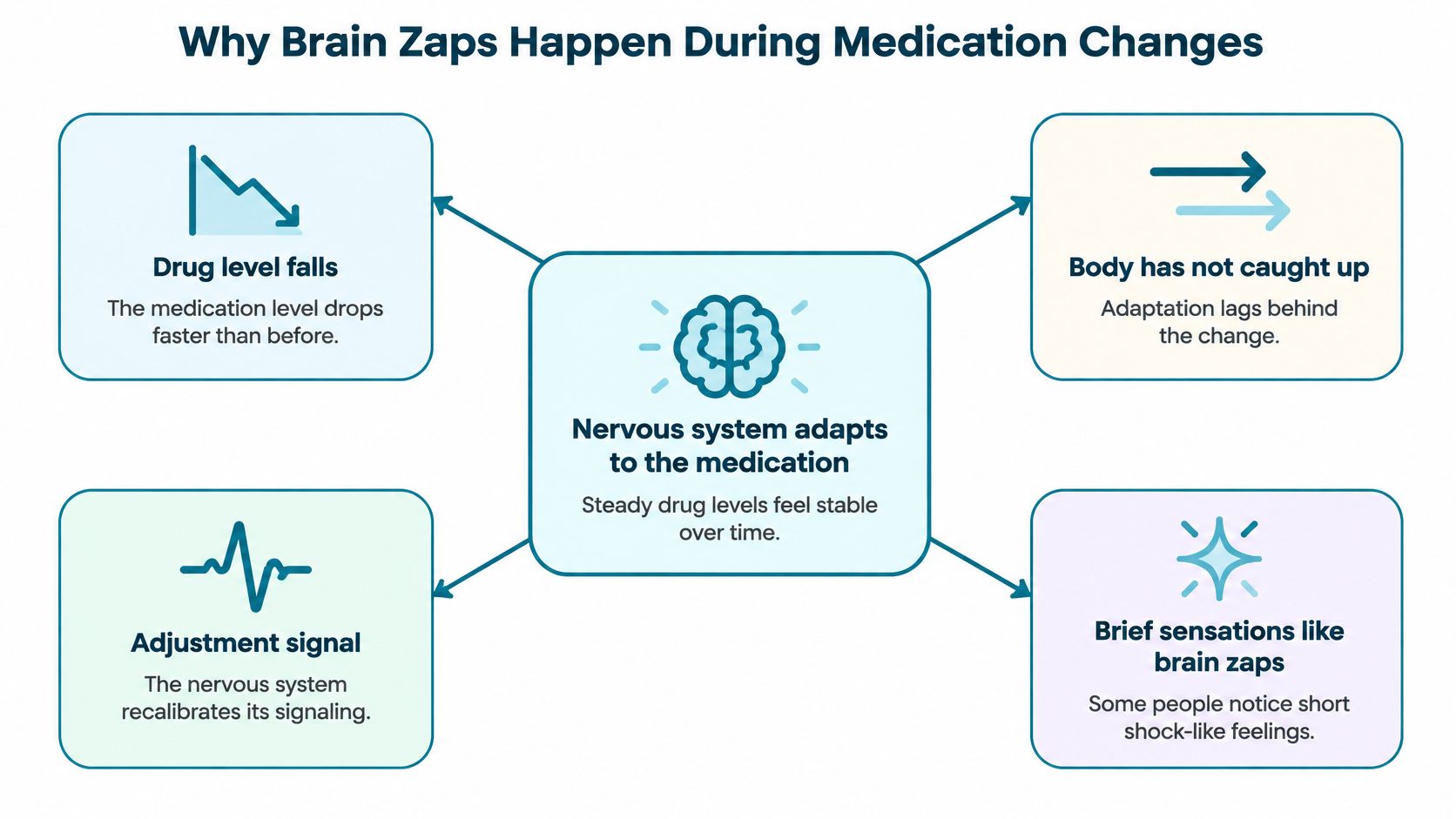
The leading clinical explanation involves nervous-system adaptation. During treatment, the nervous system adjusts to a medication's effects. When exposure falls faster than that system can readjust, discontinuation symptoms may occur.
Illustration, not a literal mechanism: A person walking against a steady water current adjusts their stance to stay balanced. If the current changes abruptly, that stance no longer fits the conditions. Medication-related adaptation is more complex, but the comparison helps explain why symptoms can follow a change rather than appear when treatment begins.
What's known and what remains uncertain
The precise biology of brain zaps remains unresolved. Changes in serotonin-related signaling and temporary nervous-system hyperexcitability, meaning increased responsiveness, are hypotheses rather than proven explanations. The diagram should therefore be read as a conceptual illustration, not an established account of what happens inside the brain.
Cleveland Clinic's clinical discussion of antidepressant discontinuation reports that more than 30% of people reporting brain zaps experienced them during or after a taper. Following a planned reduction therefore doesn't guarantee avoiding symptoms, and experiencing them doesn't mean someone did something wrong.
Patterns linked with discontinuation include:
- Abrupt stopping or missed doses: Medication exposure can fall unexpectedly.
- Dose reduction: Even an intentional reduction may outpace an individual's adaptation.
- Treatment history: Duration of use and previous withdrawal experiences can affect planning.
- Medication characteristics: Formulation and how quickly the medicine leaves the body matter.
A medicine's half-life describes how long it takes for its amount in the body to decrease by half. This is useful background for a prescriber, not a way for patients to calculate their own dosing changes.
Medication review also considers other prescriptions and supplements. The practice's guide to psychiatric drug interactions explains why a complete list matters.
Symptoms during a planned reduction are information for the prescriber, not a reason for self-directed corrections.
Patients shouldn't independently restart, skip, split, or substitute doses to test a theory. A prescriber can review the medication, formulation, treatment history, symptoms, and alternatives without relying on a standard schedule for everyone.
How Common Brain Zaps Are and How Long They Last
How common are brain zaps, and how long do they last? Studies give different estimates because they count different symptoms and examine different groups. The figures below describe study populations, not an individual's chance of having brain zaps.
| Source | Population | Reported figure | Main limitation |
|---|---|---|---|
| Review summarized by the Australian Journal of General Practice | Antidepressant users across reviewed studies | About 50% may experience some withdrawal symptoms | Definitions and study populations differ; this is not a brain-zap-specific estimate |
| Meta-analysis summarized in a peer-reviewed review | People stopping antidepressant or placebo | At least one discontinuation symptom in about 31%, compared with about 17% after placebo | Measures discontinuation symptoms generally, not brain zaps specifically |
| 2020 online survey, described in the Australian Journal of General Practice review | 2,346 people who had taken antidepressants | Nearly 800 reported negative discontinuation symptoms; 42.5% of that subgroup reported brain zaps | Self-selected online sample |
| Analysis of 24 publications, described in the same review | 1,540 usable data points | More than half reported some withdrawal; 40% of those with withdrawal reported symptoms lasting at least six weeks | Studies differed in populations and methods; the duration applies to withdrawal overall |
| 2024 survey by Moncrieff and colleagues, as reported by New Scientist | 1,148 people recruited through online withdrawal support groups | 76.8% reported electric-shock sensations; 43% reported withdrawal lasting at least one year | Volunteers recruited through support groups may not represent all antidepressant users; the duration figure concerns withdrawal overall |
These estimates are not directly comparable. Some count any discontinuation symptom, while others ask specifically about electric-shock sensations. Online surveys may attract people with difficult experiences, while clinical trials may not capture symptoms fully if follow-up is short or symptom reporting is limited. The results therefore do not establish one typical personal risk.
Duration isn't a deadline
General discontinuation guidance describes symptoms beginning after a medication interruption and often resolving over a relatively short period. Other accounts describe symptoms lasting weeks or months. Neither pattern predicts exactly how long an individual's brain zaps will last.
A single jolt may last only briefly, while recurring jolts may continue over a longer stretch. Those are different measures: the length of each sensation is not the same as the total period in which it recurs.
There is no fixed recovery timeline for everyone. Persistent symptoms that affect daily functioning warrant reassessment, particularly if their timing or pattern changes. A timeline can help a clinician judge what may be happening; it is not a deadline by which symptoms must stop.
Questions to Bring to Your Prescriber
A useful appointment starts with an accurate medication history and a plain description of the sensation. At Empire Medical Wellness, medication review visits discuss whether current treatment is helping, side effects, and concerns about the medication plan.
Preparation checklist
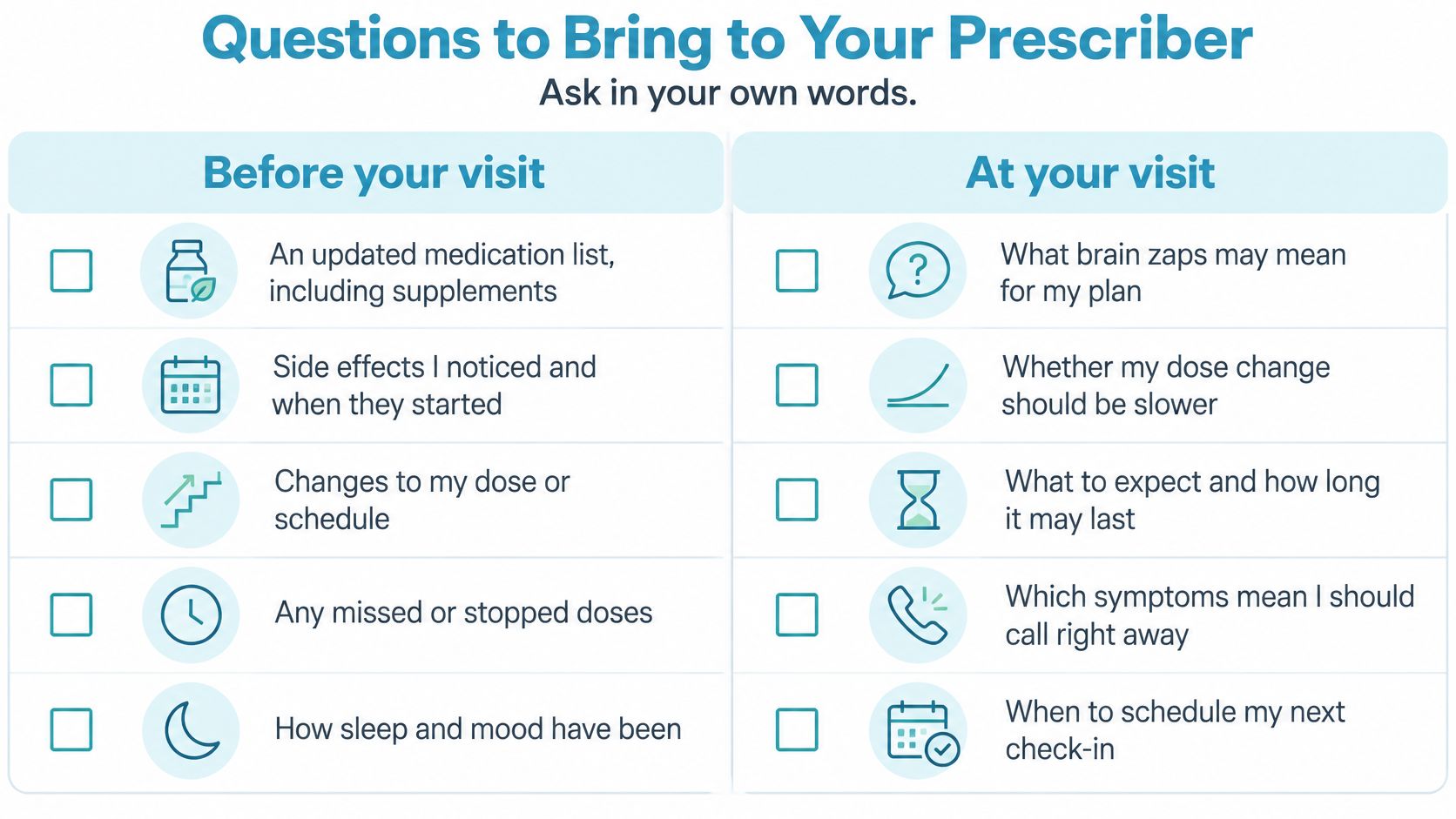
- Medication list: Bring all prescriptions, nonprescription medicines, and supplements, along with any side effects noticed.
- Change dates: Record the most recent dose change, missed dose, or stopped medication.
- Sensation description: Note where the feeling occurs, how often it happens, and whether movement seems to trigger it.
- Separate changes: Record mood, sleep, worry, and energy changes separately from the jolts.
- Treatment benefit: Describe what the medication has helped and which concerns remain.
The psychiatric medication management worksheet can help organize information before the visit. Notes don't need to be elaborate. A clear sequence of events is more useful than an attempt to name the diagnosis.
Questions for the discussion
- Possible explanation: Does the symptom pattern fit discontinuation, relapse, or another cause?
- Medication information: What does the current FDA prescribing information say about discontinuation for this medicine?
- Individual planning: Is a gradual, individualized plan appropriate in this situation?
- Alternatives: What options can be discussed if side effects are a concern?
- Monitoring: Which changes should prompt a call, and when should follow-up occur?
- Uncertainty: Would an examination or another medical evaluation help clarify the symptoms?
When medication is appropriate, follow-up assesses response and tolerability and determines whether treatment needs adjustment. That includes whether the person can function comfortably, not whether a symptom is technically recognized.
Before waiting for an appointment, patients should check whether any emergency features are present. For nonemergency concerns, the practice's mental health medication review page describes a starting point for discussing treatment concerns and ongoing follow-up.
Sources and Editorial Review
This article draws on Royal College of Psychiatrists withdrawal guidance, National Alliance on Mental Illness medication information, a clinical questionnaire summary, Cleveland Clinic's discontinuation discussion, and peer-reviewed reviews of withdrawal evidence.
Survey findings appear separately from general clinical guidance because their recruitment methods limit generalizability.
This article is educational and isn't personal medical advice. It doesn't establish a diagnosis or provide instructions to start, stop, or change medication. Questions about symptoms, side effects, or treatment options belong in a conversation with the prescriber, who can weigh them against the person's history and current medications.
Empire Medical Wellness offers private-pay, physician-led outpatient mental health evaluation, medication review, and ongoing medication management when appropriate. People with nonemergency concerns about antidepressant-related sensations can visit Empire Medical Wellness to learn about arranging an evaluation and discussing next steps.