
Self-medicating means choosing and using a medicine or another substance to treat symptoms you have recognized yourself, without an individualized clinical diagnosis, a prescription, or anyone monitoring the result. The one-line test is whether a clinician diagnosed the problem, wrote the prescription for you, and is checking how it goes.
That test sounds obvious until you apply it. Someone who takes a leftover antibiotic for a sore throat is self-medicating. So is a person who has two drinks every night because sleep comes faster that way, and a person who borrows a coworker's stimulant before a deadline. None of them would describe what they're doing as treating a medical condition.
The behavior is common enough that most clinical practices see it weekly. A systematic review and meta-analysis of university students worldwide estimated that 70.1% had practiced self-medication, while the individual studies inside that analysis ranged from 7.9% to 99% (WHO Eastern Mediterranean Health Journal). The same review put prevalence at 65.0% in high-income countries and 71.8% in middle-income countries, which tells you the behavior tracks access, cost, and health literacy more than it tracks any single personality type.
That spread is the useful part. What counts as self-medication, and how often it happens, depends on who you ask and what you count. It also depends on why the person started.
Table of Contents
- What Self-Medicating Means in Plain Terms
- Substances and Products People Use to Cope
- Why People Turn to Substances to Cope
- How Self-Medication Can Complicate Treatment
- Self-Care, Self-Medication and Medical Treatment Compared
- Signs That Need Routine Review or Urgent Help
- Preparing an Honest Conversation With Your Clinician
- Choose the Right Next Step With a Physician
What Self-Medicating Means in Plain Terms
The term covers more ground than a single pill bottle. It includes using an over-the-counter product exactly as its label directs, but it also includes reusing an old prescription for a new symptom, taking a leftover tablet from a kitchen drawer, sharing medicine with a family member, and buying a prescription drug without professional advice. Pain relievers, cold remedies, antibiotics, and sedatives all land in the same category (WHO policy document on self-medication).
Definitions differ because the range is so wide. A historical WHO document records a narrow, industry-backed version from the World Self-Medication Industry, in which individuals treat their own or their children's ailments with nonprescription medicines that are safe and effective when used as directed. A broader clinical definition puts the emphasis elsewhere, on medicine selection and use without appropriate professional oversight. The question of what is self-medicating gets easier once you see that the term describes a range, not a single act.
Where self-care ends and self-medication begins
Think about a thermostat. Turning the dial a degree or two is a normal adjustment, and you understand what the setting does. Rewiring the furnace because the house feels cold is a different action, taken without knowing whether the problem is the thermostat, a blocked vent, or a failing part. Most self-medication questions are about which of those two things is happening.
The practical boundary is whether the product is used within its label and its safety limits, or whether the person is diagnosing, prescribing, changing, or continuing a treatment alone. Inappropriate use can delay a diagnosis, hide a serious illness, produce side effects or drug interactions, lead to the wrong dose, and add to antibiotic resistance when antibiotics are used unnecessarily or cut short.
The three-question test
Did a clinician diagnose this?
Did a clinician prescribe it for you?
Is a clinician monitoring the result?
Persistent, severe, recurrent, or unexplained symptoms call for evaluation rather than another round of self-treatment.
Substances and Products People Use to Cope
The list below covers common patterns, not a complete inventory, and people often combine several items without thinking of them as related. A nightly drink, a borrowed sedative, and an over-the-counter sleep aid can all be in play at once.
| Substance or product | Symptoms often addressed | Main concerns to raise |
|---|---|---|
| Alcohol | Sleep trouble, nervousness, low mood | Can worsen sleep, mood, and anxiety over time; tolerance and dependence are possible |
| Cannabis | Sleep trouble, anxiety, pain, stress | Effects vary by product and amount; can affect memory and mood; dependence is possible in some people |
| Opioid pain medicine not prescribed to you | Acute or chronic pain | Tolerance and dependence; overdose risk, especially when combined with alcohol or other sedatives |
| Prescription sedatives or tranquilizers taken outside the prescription | Anxiety, sleep trouble | Dependence and withdrawal; sedation risk when combined with alcohol or opioids |
| Prescription stimulants taken outside the prescription | Focus, fatigue, appetite | Sleep disruption, anxiety, heart rate and blood pressure effects, dependence |
| Over-the-counter sleep aids or antihistamines used nightly | Trouble falling or staying asleep | Daytime grogginess; may mask an underlying sleep or mood problem |
| Over-the-counter pain relievers taken beyond the label | Headache, back pain, chronic pain | Stomach bleeding and kidney effects from some products; liver injury from excess acetaminophen; duplicate ingredients across products |
| Antibiotics that are leftover or obtained without a prescription | Presumed infection, cold, sore throat | Often do not treat viral illness; side effects; contributes to antibiotic resistance |
Prescription drug misuse sits inside this picture, and it's more common than many assume. A CDC analysis of substance-use assessments from adults aged 18 to 64 reported prescription-drug misuse in 1,812 assessments, representing 19%. The reported categories were prescription pain medication in 13%, sedatives or tranquilizers in 11%, and stimulants in 9%, and one person could report more than one type. Those figures describe that study's assessed population, so they shouldn't be read as a rate for all U.S. adults.
Two details are easy to miss. First, misuse means taking a medicine in a way the prescriber didn't direct, or using a prescription that wasn't written for you, which is different from taking your own medicine exactly as prescribed. Second, a product used every single night is worth a second look. If someone needs the same sleep aid or the same drink to get through an evening, the more useful conversation is about the sleep, the anxiety, or the pain underneath it. People weighing what's available without a prescription for anxious feelings can read about over-the-counter options for anxiety, though availability and suitability are two different questions.
Why People Turn to Substances to Cope
Self-medicating usually starts with a real need for relief, not an intention to misuse anything. Anxiety that has never been evaluated. Insomnia that has kept someone awake for weeks. Chronic pain that limits work and sleep. Stress from a job, a parent who needs care, or money that doesn't stretch. Trauma-related symptoms that arrive at night. Trouble concentrating that gets handled with a colleague's stimulant.
These patterns show up in ordinary settings, including group therapy and primary care, and they rarely look dramatic from the outside.

The pattern is durable because a substance produces quick, noticeable relief, and that relief reinforces the habit whether or not it touches the cause. The barriers to formal care push in the same direction: cost, a long wait for an appointment, no transportation, a work schedule that doesn't bend, and the reasonable worry that disclosing drug or alcohol use will be written down somewhere and held against you.
Removing the battery from a smoke alarm stops the noise. The fire is still burning.
Relief is not treatment. A substance can lower a symptom for an hour without changing what produced it.
Alcohol is the clearest example. It shortens the time it takes to fall asleep, then fragments sleep later in the night, so the person wakes unrefreshed and reaches for the same remedy again. Alcohol and cannabis are not approved treatments for anxiety, insomnia, or pain, and the evidence on short-term relief is mixed. The picture for sustained use is worse, and the NIAAA guide to alcohol treatment describes alcohol use disorder as a medical condition with effective options, which is a different claim from alcohol being a treatment. Prescription stimulants are approved for specific diagnoses such as ADHD, not for a deadline or a tired afternoon, so a borrowed tablet is unsupervised use of a medicine that wasn't prescribed for that purpose.
What follows from all of this isn't a judgment about character. It's a question about which symptom needs attention. Stress, for instance, responds to stress management approaches that don't borrow against tomorrow's sleep, and a clinician can help sort out which symptom to tackle first.
How Self-Medication Can Complicate Treatment
Relief that arrives fast is hard to argue with, and that's exactly why the complications are easy to miss. The problems rarely announce themselves in the first week. They accumulate in the space where nobody is looking at the whole picture.
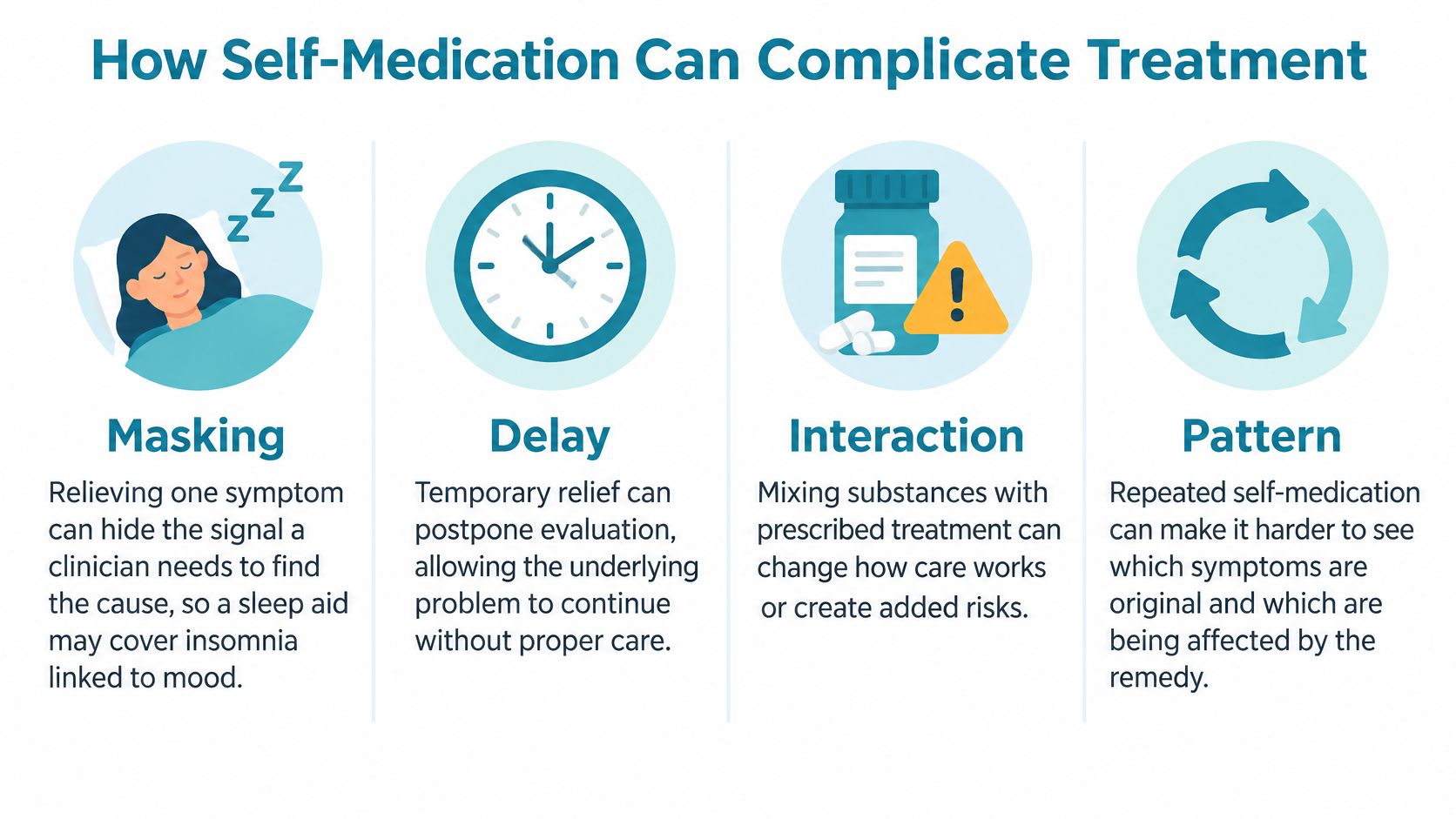
The infographic below maps the four ways self-medication complicates care.
Four mechanisms worth understanding
Masking. Relieving a symptom removes the signal a clinician would use to find the cause. A sleep aid that works can cover insomnia driven by depression, by pain, or by a thyroid problem, and the visit that might have caught it never happens.
Delayed or wrong diagnosis. A person treating a presumed infection or a recurring headache alone may postpone evaluation of something serious. The delay isn't dramatic. It's a series of months where the symptom was managed and the cause wasn't examined.
Dependence and tolerance. The same product may be needed more often for the same effect. Stopping some substances or medicines suddenly can cause withdrawal, which is why any change in use belongs in a conversation with a clinician rather than a decision made alone.
Interactions and duplicate ingredients. Alcohol and other sedatives add to each other's effects. The same active ingredient shows up under different brand names, so a cold remedy and a nighttime pain product can double a dose of acetaminophen.
Where the harm comes from, according to the FDA
The FDA's review of preventable medication-related harm groups the sources into four broad categories: medication errors, unintended exposures, intentional misuse or abuse and self-harm, and drug-quality defects. The agency states that medication errors and unintentional exposures account for the vast majority of preventable harm in the United States. Errors can involve incorrect information, an unsuitable process, or a problem in how a medicine is selected or used.
A product sold without a prescription is not automatically risk-free, and a medicine that suited someone last year may not suit a new health condition, a new medicine, a change in kidney function, or a pregnancy.
That last point matters for anyone taking a psychiatric medicine, because mixing substances or supplements with prescribed treatment can change how the treatment works. The guide to psychiatric drug interactions covers the combinations clinicians watch most closely. Nothing in this article is a reason to start, stop, taper, or switch a medicine without a clinician guiding it.
Self-Care, Self-Medication and Medical Treatment Compared
The three categories differ on four things: who selects the treatment, whether a diagnosis was made, where the medicine came from, and whether anyone monitors the result.
| Decision criterion | Appropriate self-care | Self-medication | Medically supervised treatment |
|---|---|---|---|
| Who selects the treatment | The person, following the product label and common guidance | The person, without clinical input | A clinician, after evaluation and shared decision-making |
| Diagnosis | Mild, common, recognized complaint | The person identifies the condition alone | Clinician reviews history, symptoms, and any needed testing |
| Source of medicine | Nonprescription product used as labeled | Leftover, shared, old, or outside-label products | Prescribed medicine reviewed for risks and interactions |
| Monitoring | Self-observation with clear stop-and-seek-care points | None by a clinician | Scheduled follow-up on response, side effects, and tolerability |
| What happens when symptoms change | Seek evaluation if symptoms persist, worsen, or return | Often continues without reassessment | Plan is reviewed and adjusted based on progress |
One concrete example per column. A nonprescription pain reliever, taken as the label directs for a headache a person recognizes as ordinary tension, is self-care. The same person finding an old bottle of prescription pain medicine and taking one for new back pain is self-medicating. A documented evaluation that produces a plan, a scheduled follow-up, and an adjustment based on how the first weeks went is medically supervised treatment.
A visit doesn't guarantee a particular medicine. At Empire Medical Wellness, medication may be included when clinically appropriate, and treatment decisions follow a review of history, current condition, safety considerations, and goals, so the same symptom can produce different plans in different people.
When a symptom persists, returns, or is tied to substance use that's hard to control, the category that fits is medically supervised treatment. The next section separates the routine situations from the ones that can't wait.
Signs That Need Routine Review or Urgent Help
The table below is general guidance, not an individual assessment. The urgent rows come first because they take priority over any appointment you might schedule.
| Situation | Suggested next step |
|---|---|
| Thoughts of suicide or self-harm | Call or text 988 (the Suicide and Crisis Lifeline) or go to an emergency department now |
| Suspected overdose with slow or stopped breathing, or unresponsiveness | Call 911 now and stay with the person until help arrives |
| Confusion, chest pain, or trouble breathing after taking a medicine or substance | Call 911 or go to the nearest emergency department now |
| Severe allergic reaction or swelling of the face or throat after a medicine | Call 911 now |
| Physical withdrawal that feels unsafe | Seek prompt clinical contact or emergency care now; do not stop or change use alone |
| Poisoning question, including accidental ingestion | Call Poison Control or 911 right away and have the container at hand |
| Symptoms that persist, return, or slowly worsen | Routine clinical evaluation; bring a current medication and product list |
| Using a product more often than intended or unable to cut back | Routine evaluation with a clinician; do not change use alone |
| Antibiotic that has not helped | Contact a clinician for review; do not increase or repeat the course alone |
Antibiotics deserve their own paragraph, because the stakes extend past the individual. A 2025 systematic review and meta-analysis estimated that 43.0% of adults globally have self-medicated with antibiotics, with a 95% confidence interval of 38.0% to 48.1%, while noting that estimates vary by country, population, access to care, and study design (systematic review of antibiotic self-medication).
Antibiotics don't treat viral illnesses such as most uncomplicated colds. Unnecessary exposure can select for resistant organisms, the wrong drug or dose may fail to clear the infection, and stopping early leaves surviving organisms under selective pressure. An antibiotic that hasn't helped needs clinical review, not a bigger dose or another leftover course.
If the pattern behind a symptom is substance use rather than a single product, the DSM-5 criteria for substance use disorder explain how clinicians make that distinction.
Preparing an Honest Conversation With Your Clinician
An honest history helps a clinician evaluate a symptom. It isn't a confession, and it doesn't get scored. What a clinician needs is a clear picture of what you're taking, how much, how often, and what it seems to do, because each of those details changes what gets considered next (WHO guidance on self-medication and clinical oversight).
A general evaluation reviews current symptoms, medical history, prior treatment, and current and past medicines, including supplements and any side effects you've noticed. Risk climbs with prolonged use, several medicines at once, older age, pregnancy, kidney or liver disease, and medicines with dependence potential or a narrow therapeutic margin. None of that is a reason to leave something out. Each one is a reason to bring it up.
What to bring and what to write down
Empire Medical Wellness asks patients to bring an updated medication list to a first visit, including supplements and any side effects they've noticed. Addiction medicine care at the practice begins with a confidential assessment of the current situation, medical risks, previous treatment, medications, and goals, and the initial evaluation includes an explanation of appropriate treatment options and next steps. The intake steps and visit structure are described on the fees and how it works page, which is worth reading before scheduling.
Fill in the table below for every product, including the ones you don't think of as medicine.
| Product or substance (name from label) | How I use it, in my words | Amount and timing as I take it | Last used | What it seems to help | Concerns or side effects |
|---|---|---|---|---|---|
| Item 1 | ___ | ___ | ___ | ___ | ___ |
| Item 2 | ___ | ___ | ___ | ___ | ___ |
| Item 3 | ___ | ___ | ___ | ___ | ___ |
| Item 4 | ___ | ___ | ___ | ___ | ___ |
Five questions worth asking out loud
- What could be causing this symptom? Ask for the differential, meaning the list of conditions the clinician is considering and ruling out.
- What evaluation do I need first? Lab work, a sleep history, and a medication review answer different questions, and the order matters.
- Which of my current products could interact with a medicine you might consider? The supplement list earns its keep here.
- What monitoring would you want, and how often? Ask what a good response looks like and what would prompt a call between visits.
- What should I do if I want to stop or cut back, and what should I avoid doing alone? Get the plan in words before you leave the room.
A few habits lower risk in the meantime. Keep an exact list of medicines and supplements. Check active ingredients rather than brand names. Avoid sharing, saving, or using leftover doses, and stay within the labeled maximum. Disclose every nonprescription product during a visit, including the ones that seem too minor to mention. When you're preparing for a first appointment, the guide to a first addiction medicine visit walks through what the conversation covers.
Choose the Right Next Step With a Physician
When self-treatment isn't easing a symptom, or you cannot tell how a product is affecting you, a scheduled clinical evaluation is the next step. Urgent symptoms come first. If someone is in immediate danger or in crisis, use emergency care or call 911 or 988 without waiting for an appointment.
The visit works best as a fact-finding appointment. You bring a problem, a timeline, and a list of what you have tried. The clinician connects the dots between the symptom you were treating and the broader medical picture.
Empire Medical Wellness is a private-pay, physician-led outpatient practice. Patients can seek addiction medicine on its own without using the practice's other services. Care begins with a confidential assessment of your current situation, medical risks, previous treatment, medications, and goals. From there, the practice explains appropriate treatment options and next steps. Addiction medicine care can include evidence-based medication treatment when clinically appropriate, with monitoring and follow-up, recovery planning, and coordination with outside clinicians or programs when it is useful and authorized. An appointment does not guarantee a prescription. Recommendations are individualized.
Dr. Mohit Chhatpar, DO, DABOM, is the practice's Medical Director and Chief Medical Officer and provides direct patient care.
The addiction medicine service page describes the assessment, and the addiction medicine specialist page covers who provides care.
This article is educational and is not personal medical advice, diagnosis, or a treatment recommendation. It does not replace an evaluation with a qualified clinician. Do not start, stop, taper, or change a medication without clinical guidance.
By Empire Medical Wellness Editorial Team. Published 8 October 2026. Updated 8 October 2026.
Sources. U.S. Food and Drug Administration material on preventable medication-related harm; the CDC Morbidity and Mortality Weekly Report analysis of prescription drug misuse among adults aged 18 to 64; World Health Organization documents on self-medication and clinical oversight; the WHO Eastern Mediterranean Health Journal meta-analysis of self-medication among university students; a 2025 systematic review and meta-analysis of antibiotic self-medication; and the NIAAA guide to alcohol treatment. Each source is linked where it's cited above.
Self-medicating is often a reasonable attempt to feel better when care feels slow or expensive. Empire Medical Wellness is set up to have that conversation without judgment. The practice provides private, physician-led addiction medicine care, with Dr. Chhatpar providing direct patient care. The first visit starts with a confidential assessment and ends with clear, individualized options. Visit Empire Medical Wellness to take the next step.