Ten years of sobriety can mark lasting progress, but it does not set an end date for care. Recovery may still involve support, medication, or medical follow-up. An anniversary is a milestone, not a guarantee about the future.
A decade can deserve recognition while leaving room to review what fits now. The useful question is whether a person's health, relationships, and supports still match their current needs.
Table of Contents
- What 10 Years of Sobriety Means in Clinical Terms
- What Recovery Means Beyond a Day Count
- Maintenance Strategies for a Long Recovery
- A Medical and Life Review After Ten Years
- Updating a Plan When Life Changes
- Marking the Milestone Safely
- When to Revisit Outpatient Medical Care
What 10 Years of Sobriety Means in Clinical Terms
For alcohol use disorder, a decade of sobriety sits well beyond the stable-remission threshold described in the NIAAA alcohol use disorder recovery resource, which presents the following time windows.
NIAAA remission stages by time window
| Remission stage | Time window |
|---|---|
| Initial | At least 3 months |
| Early | 3 months to 1 year |
| Sustained | 1 to 5 years |
| Stable | Longer than 5 years |
These time bands belong to an alcohol use disorder framework. They aren't a universal definition for every substance or every recovery experience.
Remission describes symptoms, not a person's whole life
Remission means that the disorder's symptoms no longer meet the relevant diagnostic criteria. NIAAA's recovery definition combines remission from alcohol use disorder symptoms, excluding craving, with stopping heavy drinking and maintaining those changes over time. Heavy drinking refers to drinking at levels that raise health and safety risks.
The distinction matters because abstinence and remission answer related but different questions. Abstinence describes not using a substance. A clinical assessment considers symptoms, behavior, and health rather than relying on the calendar alone.
The practice's explanation of DSM-5 substance use disorder criteria provides background on how clinicians organize diagnostic symptoms. An anniversary, by itself, isn't a diagnostic assessment.
Clinical perspective: A meaningful milestone can support confidence without requiring the conclusion that future care is unnecessary.
Stable doesn't mean finished
A person may have built a dependable life while still managing occasional cravings, unresolved relationship concerns, or medical conditions. Another person may rarely think about substance use but want support during an unfamiliar transition. Neither experience makes the milestone less meaningful.
The words sober, abstinent, in recovery, and recovered also carry different meanings. Some describe behavior. Others describe identity, community, or a personal understanding of change.
A useful long-term review therefore keeps several questions separate:
- Clinical status: Are symptoms or hazardous behaviors present?
- Daily life: Are health, relationships, and responsibilities manageable?
- Personal meaning: Does the person's preferred language reflect that person's experience?
- Future support: Does the current plan fit foreseeable changes?
The milestone can be recognized while those questions remain open. There's no need to choose between celebrating progress and maintaining appropriate care.
What Recovery Means Beyond a Day Count
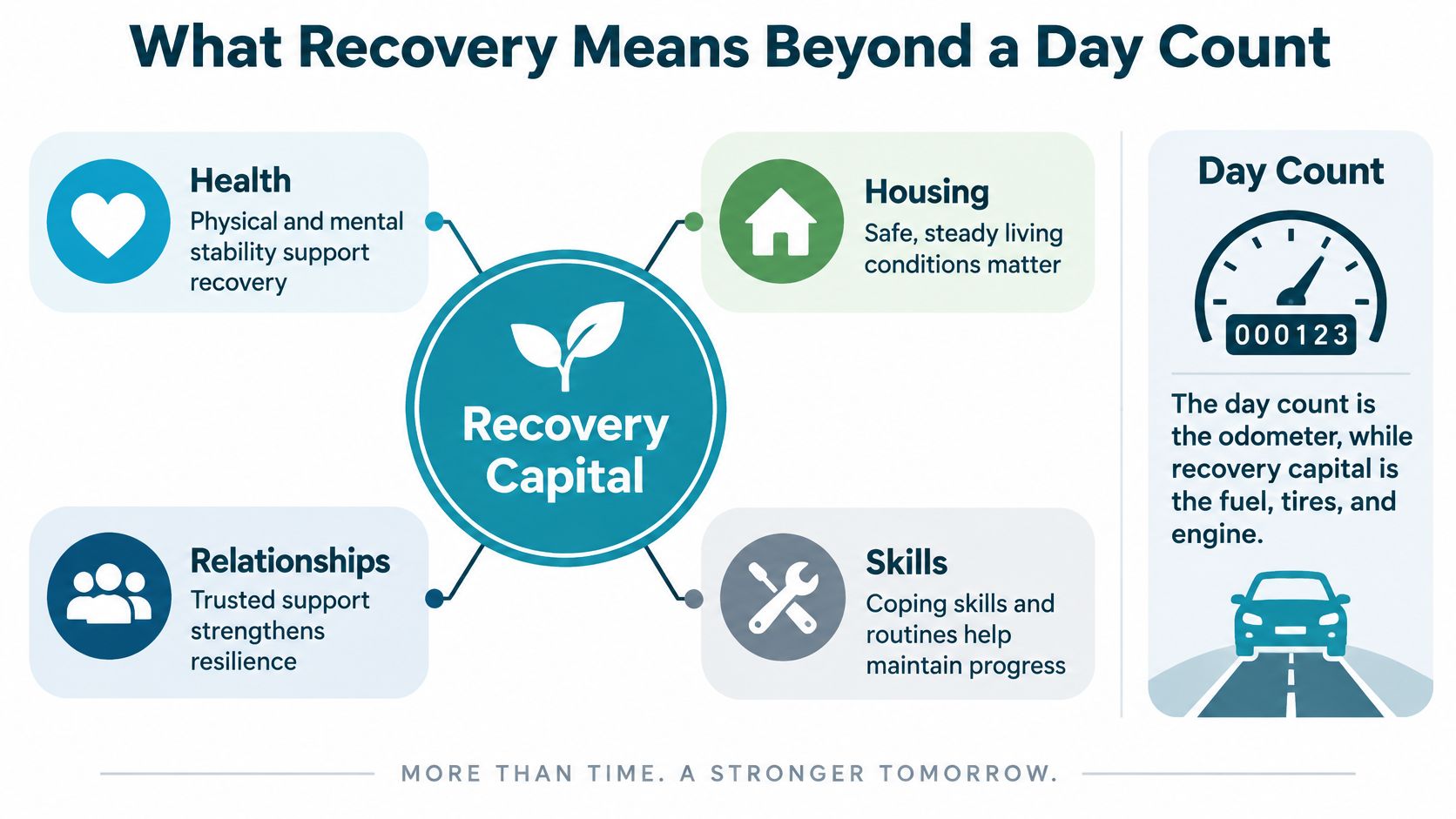
A day count can carry deep personal meaning while leaving much of the clinical picture unspoken. The day count is the odometer, while recovery capital is the fuel, tires, and road conditions.
Recovery capital means the personal, social, and community resources that support change. These can include stable housing, meaningful work, supportive relationships, physical health, coping skills, and a sense of purpose.
Well-being deserves its own attention
The NIAAA FY2024 summary estimated that approximately 15 million U.S. people age 12 and older had alcohol use disorder, and fewer than 10 percent received any treatment. That summary also describes recovery in terms of remission, stopping heavy drinking, and improvements in social, psychological, and physical well-being.
Those population figures don't establish whether a particular reader has alcohol use disorder. They do help explain why recovery discussions should include access to care, not just personal determination.
A quiet review of well-being can include:
- Sleep and mood: Whether rest feels restorative and emotions feel manageable.
- Work or caregiving: Whether responsibilities remain sustainable rather than only completed.
- Friendships: Whether relationships allow honesty and connection.
- Physical health: Whether medical concerns receive attention instead of being postponed.
- Daily routines: Whether meaningful activities remain present or isolation has gradually replaced them.
Someone may be abstinent and still feel lonely, exhausted, or disconnected. Those concerns deserve attention in their own right. They aren't evidence that the person has failed at recovery.
Identity, behavior, and safety aren't interchangeable
The SAMHSA National Survey on Drug Use and Health release reporting 2025 findings reported that 22.3 million adults considered themselves in recovery or recovered from a drug or alcohol problem, representing 73.0 percent of adults who said they had ever experienced such a problem. This is a self-identified measure, not proof that every recovery pathway carries equivalent medical risks or outcomes.
A person may prefer a recovery identity, an abstinence-based description, or no label at all. A clinician can respect that preference while still asking direct questions about current substance use and safety.
| Question | What it helps clarify |
|---|---|
| What language does the person prefer? | Identity and personal meaning |
| What substances are currently being used? | Behavior and possible exposure |
| What health or safety concerns are present? | Clinical assessment needs |
| What has improved in daily life? | Functioning and well-being |
Alcohol-related problems aren't necessarily progressive. Durable improvement is possible, and a difficult period doesn't make every previous gain meaningless.
The practice's addiction medicine information offers context for readers considering medical care. A useful assessment makes room for both the person's goals and an honest discussion of risk.
Maintenance Strategies for a Long Recovery
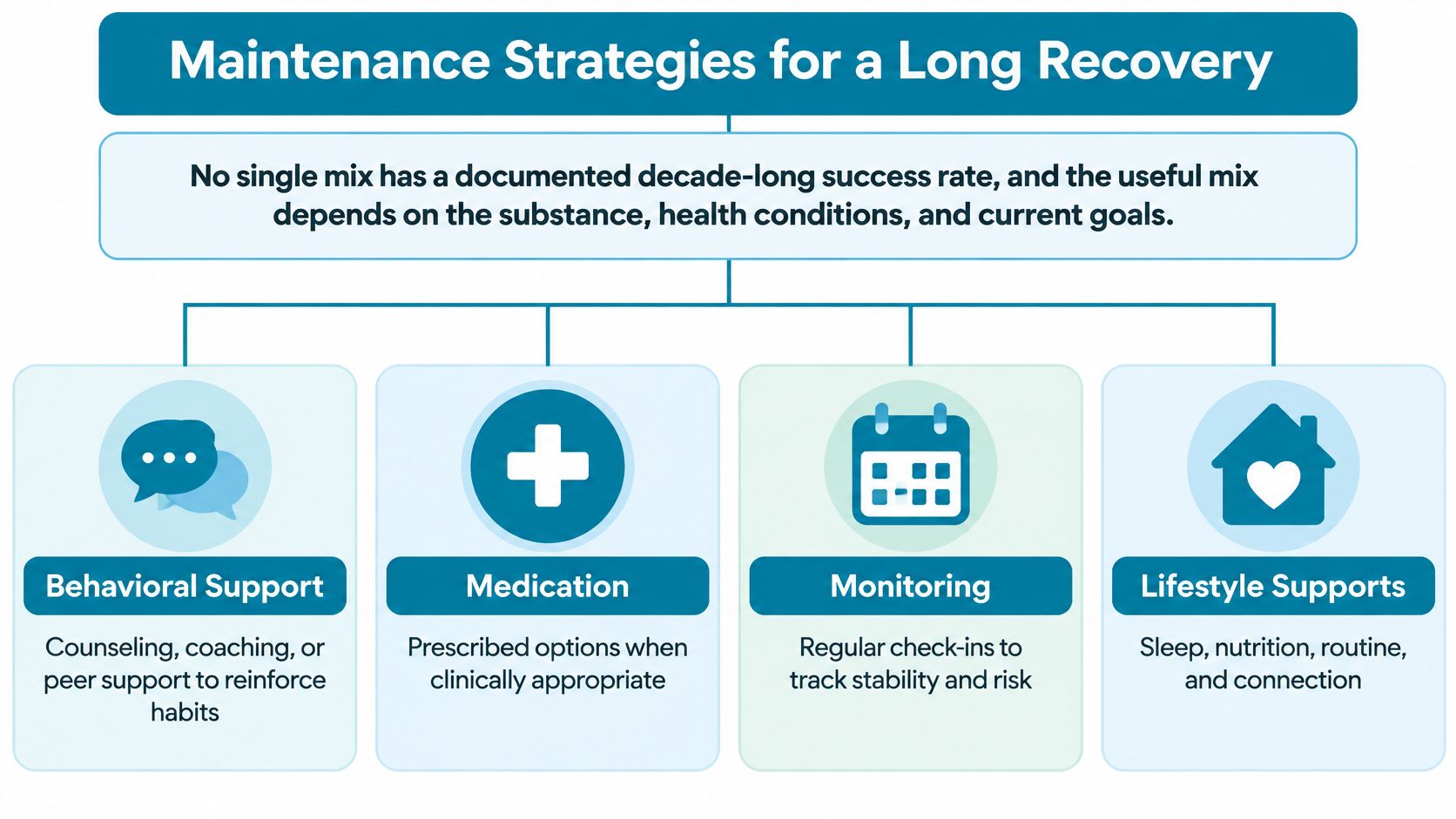
No single mix of supports has a documented decade-long success rate that applies to everyone. The useful combination depends on the substance involved, medical conditions, previous treatment, and current goals.
SAMHSA's substance use treatment overview describes treatment as including medication, counseling, and other supports. These are options to individualize, not an anniversary protocol.
Medication and behavioral treatment serve different purposes
Medication, when clinically appropriate, is a medical treatment rather than a test of commitment. Medicines are used for alcohol use disorder and opioid use disorder, with selection and monitoring based on the condition and the individual.
SAMHSA's treatment options guidance includes medication among treatment approaches; continued medication for opioid use disorder, a condition involving problematic opioid use, is compatible with recovery. A sobriety anniversary isn't an automatic reason to stop treatment.
FDA-approved use means the agency has approved a medication for a particular indication. Off-label use means prescribing an approved medicine for a different indication. Those distinctions, along with benefits, risks, and treatment duration, belong in a conversation with the prescriber, not an anniversary-based decision.
Behavioral treatment addresses different needs. Counseling or structured therapy with an outside clinician may help a person examine habits, manage difficult emotions, or respond to relationship stress. Its role should be clear rather than treated as interchangeable with medication.
Recovery support and ordinary health care remain distinct
| Support type | Main purpose | Useful question |
|---|---|---|
| Medication | Treat the relevant substance use disorder when indicated | Does the current treatment still fit the clinical situation? |
| Behavioral treatment | Address coping, behavior, and emotional challenges | Is there a specific problem that structured therapy could address? |
| Recovery support | Provide connection, practical help, and shared understanding | Which people or communities feel useful and respectful? |
| Ordinary medical care | Address general health and medication safety | Have health conditions or prescriptions changed? |
Recovery support may include mutual-help groups, peer support, family, faith communities, or other meaningful connections. No single pathway is required.
Ordinary medical care creates space to discuss blood pressure, liver health, pain, sleep, mood, and new prescriptions. It shouldn't be replaced by a support group or a sobriety count.
The practice's discussion of what relapse means addresses terminology separately from long-term maintenance. For a maintenance conversation, practical physician questions include:
- Treatment fit: Which parts of the current plan still address an active need?
- Health changes: Have medical conditions or prescriptions changed the balance of benefits and risks?
- Support preferences: Could follow-up better match the person's present goals without removing useful protection?
A Medical and Life Review After Ten Years
A prospective study indexed in PubMed followed 116 adults with co-occurring severe mental illness and alcohol-use disorders for 10 years: 86 percent achieved at least one six-month remission, approximately two-thirds later relapsed, with relapse occurring on average about three years after remission, and one-third did not relapse during follow-up. This specific population doesn't provide a personal forecast for every adult with long-term sobriety.
The study associated entering remission with greater treatment participation, reduced alcohol and drug use, fewer psychiatric symptoms, competitive employment, and greater life satisfaction. These were associations, not a formula that guarantees a particular outcome.
A working review, not a discharge test
The most useful anniversary review focuses on present needs. It doesn't require a rigid milestone calendar or assume that everyone should have reached the same life circumstances.
Long-term recovery review after 10 years
| Review domain | What to reassess | What the anniversary does not decide |
|---|---|---|
| Safety | Cravings, high-risk places, return of use, driving, withdrawal risk | That risk is gone because time has passed |
| Functioning | Work or caregiving, sleep, daily roles, energy | That a stable routine needs no adjustment |
| Relationships | Support, conflict, isolation, changing social circles | That old supports will remain available |
| Health | Chronic illness, pain, mood, new prescriptions | That medical care can be dropped |
| Treatment engagement | Medication including opioid-use-disorder treatment, counseling, recovery support | That medicine or support should stop at ten years |
| Personal goals | What the milestone means and what the next year needs | That one recovery pathway fits everyone |
This table is a conversation aid, not a diagnostic instrument. A concern in a row identifies something to discuss, not a conclusion about the person's recovery.
Preparing for a useful medical conversation
A medication list can make a review more concrete. It should include prescriptions, nonprescription products, and supplements, along with questions about sedation, interactions, or changes in pain treatment.
A brief description of recent life changes is also useful. Grief, disrupted sleep, caregiving demands, or renewed exposure to alcohol or other substances may be more informative than a general statement that life has become stressful.
The purpose of a maintenance visit is to identify what needs attention while preserving what already works.
Medication duration is individualized. A clinician should consider the medication's purpose, current benefits, adverse effects, preferences, and medical context rather than treating elapsed sobriety as the deciding factor.
Someone who feels well may still find a periodic outpatient check-in useful when prescriptions, health, or goals change. There's no universal visit interval or laboratory panel that follows automatically from an anniversary.
Updating a Plan When Life Changes
A long period of stability can make an old plan feel sufficient even after its assumptions have changed. Experience remains valuable, but the available supports may no longer look the same.
NIAAA's guidance on supporting recovery emphasizes recovery capital, including strengths and vulnerabilities in health, relationships, housing, finances, and community connection. A plan refresh can begin with those resources rather than with fear of losing progress.

A practical refresh
Bereavement, divorce, retirement, a move, chronic illness, job loss, or a new pain prescription can justify reconsidering a plan. Renewed contact with drinking or drug use may also change the practical demands of daily life.
The following reflection can help organize a discussion:
- Name current supports. Identify two supports that remain available and one that has faded. A support might be a trusted person, a routine, or access to care.
- Identify changed situations. List circumstances that feel harder now than they did earlier in recovery. The relevant change may be social, physical, financial, or emotional.
- Choose an early signal. Select a personally meaningful change to notice, such as worsening sleep, irritability, or romanticizing past use. None of these signs alone diagnoses a recurrence.
- Identify a contact. Decide which clinician, recovery professional, or trusted person could be contacted before problems become harder to discuss.
- Flag medical concerns. Arrange a medical conversation when withdrawal risk, pregnancy, impaired driving, medication interactions, or significant mental-health symptoms are concerns.
The purpose isn't permanent self-surveillance. It's to reduce uncertainty about what would happen if circumstances became difficult.
Maintenance principle: Updating a plan reflects changed circumstances, not a verdict on past progress.
Progress and renewed risk can coexist
A lapse doesn't erase a decade of learning, repaired relationships, or healthier routines. Renewed hazardous use still deserves confidential assessment rather than reassurance based only on past stability.
A plan can preserve both truths. It can acknowledge the person's history of change while taking current behavior seriously.
Marking the Milestone Safely
A ten-year anniversary can be meaningful without becoming a public declaration or a test of recovery. Some adults mark the date privately, share it with someone they trust, or choose not to use anniversary language at all. The choice belongs to the person.
A clearly hypothetical reflection
A brief note can help someone mark the occasion: what has supported them, what they want to carry into the coming year, or what they hope to make more room for. This is a personal reflection, not a measure of progress or a reason to change treatment, support, or follow-up.
| Marking option | Boundary worth considering |
|---|---|
| A private note | Whether the reflection is for personal use only |
| A meal with supportive people | Whether others will respect substance-related boundaries |
| A donation or service activity | Whether participation feels meaningful rather than obligatory |
| Declining an event | Whether the setting centers on alcohol or other substances |
Privacy is part of the decision
A public post can reveal health information that is difficult to take back. Before sharing, consider who can see it, whether it names anyone else, and whether the wording could sound like one recovery path fits everyone.
A celebration need not involve being around substances. Declining an event can reflect a preference. For adults considering community-based support, the practice's information about Alcoholics Anonymous offers context about that fellowship. Joining a particular group is not required to recognize personal progress.
When to Revisit Outpatient Medical Care
A confidential outpatient visit is reasonable when cravings increase, substance use returns, a new illness changes medical needs, or current medicines no longer seem to fit. A person may also seek a visit to make a more deliberate maintenance plan.
At Empire Medical Wellness, addiction medicine evaluations are confidential outpatient assessments of the person's current situation, medical risks, previous treatment, medications, and goals. The practice's outpatient alcohol treatment information provides additional context for adults considering that setting.
Does continued opioid use disorder medication invalidate recovery?
No. Prescribed treatment and recovery aren't opposing categories. Any review of continued treatment should focus on its clinical purpose and the individual's needs.
Does renewed use mean all progress has been lost?
No. Previous gains remain relevant, but they don't substitute for assessing current safety. Hazardous use calls for a medical conversation rather than judgment or minimization.
Does feeling well mean follow-up should end?
Not by itself. Feeling well is useful information, but decisions about follow-up should also consider health changes, treatment needs, available support, and personal preferences.
For suicidal crisis, call 988. For an emergency, call 911; for treatment referral, the SAMHSA National Helpline is 1-800-662-HELP (4357).
Sources
Primary references include NIAAA's alcohol use disorder recovery resource, its FY2024 summary and recovery-support guidance, SAMHSA's treatment resources and national survey release, and the prospective study of remission and relapse indexed in PubMed. Each is linked at the relevant discussion above.
Empire Medical Wellness offers physician-led outpatient addiction medicine care, including medical evaluation, medication treatment when clinically appropriate, monitoring, recovery planning, and authorized coordination with outside treatment professionals. Adults considering a long-term maintenance review can visit Empire Medical Wellness to learn about the practice's approach. This article is educational and isn't personal medical advice.