
Social anxiety disorder is a persistent fear of scrutiny or humiliation, with avoidance or marked distress and real-life impairment, beyond everyday shyness. About 7.1% of U.S. adults had this pattern in the prior year, and the fear of being judged can itself postpone a first appointment.
An evaluation can stay a low-pressure review of situations, duration, and impairment. It doesn't obligate a medicine. An app isn't a lasting substitute for that conversation.
Ordinary nerves before a speech fade once the moment ends. This fear often arrives weeks early, then keeps someone from a meeting, a class, or a meal they still want. Adults looking at private, physician-led care usually need a clear definition, a way to separate nearby experiences, and a practical picture of what a first visit covers.
Table of Contents
- What Social Anxiety Disorder Is
- How It Differs From Nearby Experiences
- Why People Delay Care
- What an Adult Evaluation Reviews
- CBT and Medicine Options With Evidence
- A Hypothetical Gradual Practice Example
- How Long Digital Programs Last
- Planning a Physician-Led Next Step
What Social Anxiety Disorder Is
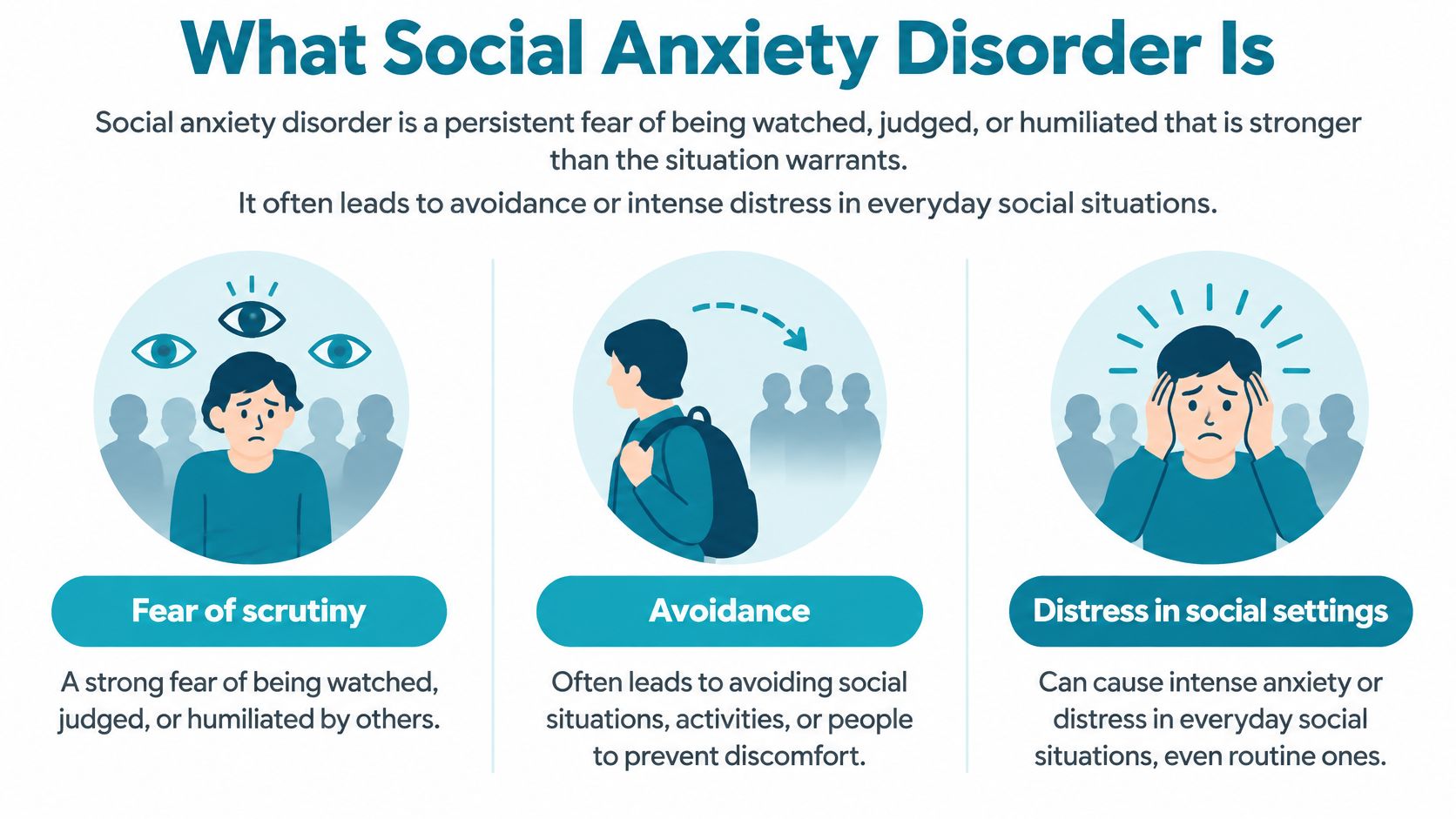
Social anxiety disorder is fear of being watched, judged, or humiliated that is stronger than the situation warrants. People avoid the moment or push through it with intense distress, and work, school, relationships, or daily goals get harder.
Help can start before a typical six-month mark if life is already narrower. Clinicians often use that span as one duration marker. It isn't a waiting period someone has to finish before asking for a review.
The U.S. National Institute of Mental Health analyzed National Comorbidity Survey Replication interviews and estimated that 7.1% of U.S. adults aged 18 or older had social anxiety disorder in the previous 12 months. The same interviews put the rate at 9.1% among adults aged 18–29 and 8.7% among those aged 30–44, with lower levels among older adults. Among U.S. adolescents aged 13–18, an estimated 9.1% had a lifetime history, and 1.3% had severe impairment.
When the pattern usually starts
Those with the disorder often date symptom onset before age 20, and some recall early childhood. Anxiety symptoms commonly begin in childhood or adolescence and may continue into adulthood. That early start helps explain why an adult can sound "just shy" while a job, a degree, or a friendship has already shrunk.
A speech that feels uncomfortable for an hour isn't the same as months of skipped meetings, rehearsed sentences, and goals that stall.
The NIMH publication Social Anxiety Disorder: More Than Just Shyness walks through the difference in plain language. Reading it can't establish a diagnosis. A careful review still has to separate this pattern from other anxiety problems, personality style, medical contributors, and substances. Treatment choices come after that picture, not from a checklist.
How It Differs From Nearby Experiences
Skipping the meeting feels safer today. The feared judgment never gets tested, so the alarm stays set for the next one. That short-term relief is the loop that keeps social anxiety disorder going.
The NCBI Bookshelf clinical review describes persistent fear of scrutiny, negative evaluation, or embarrassment that leads to avoidance or marked distress. Worldwide estimates sit at about 5–10%, with lifetime estimates of about 8.4–15%. Those ranges change with diagnostic criteria and sampling, so they aren't one exact rate.
A side-by-side lookup
| Pattern | Main concern | Behavior and impact | What it suggests |
|---|---|---|---|
| Everyday shyness | Brief discomfort in some social moments | Eases and rarely blocks goals | Not a disorder by itself |
| Introversion | Preference for lower stimulation | Chooses quieter settings without humiliation fear | A personality style |
| Social anxiety disorder | Scrutiny, embarrassment, or negative judgment | Avoidance or marked distress with impairment, often about 6 months | Needs clinical assessment |
| Generalized anxiety | Worry across many domains | Reassurance-seeking or broad tension | A different anxiety focus |
| Panic disorder | Sudden fear of another panic attack | Avoids cues tied to panic rather than mainly to looking foolish | A different anxiety disorder |
| Agoraphobia | Escape or help feeling out of reach | Avoids places for safety rather than for looking foolish | May overlap; mechanism differs |
| Autism-related social difference | Social communication style | The difference isn't driven by fear of humiliation | Needs a separate assessment |
| Trauma-related fear | Reminders of a traumatic event | Avoidance follows trauma cues | Trauma-focused care may fit better |
| Substance- or medicine-related anxiety | Effects of use, withdrawal, or a drug | Timing follows the substance or medicine | Medical contributors to review |
Everyday shyness settles. Introversion is a preference for quieter rooms, not a fear of humiliation. Someone can be introverted and still have social anxiety disorder, or be outgoing in private and frozen when evaluation feels likely.
Generalized anxiety spreads across health, money, family, and work. A focused comparison sits on the practice page for generalized anxiety disorder. Agoraphobia centers on escape or help feeling out of reach. Crowds may be avoided for safety, not for looking foolish, and the two patterns can coexist.
A checklist can't diagnose. Panic attacks, autism-related social differences, trauma cues, and anxiety tied to alcohol, other substances, or a medicine can look similar from the outside. A clinician documents feared situations, anticipatory anxiety, safety behaviors, avoidance, impairment, mood symptoms, and the person's own goals. A scale can track severity. It doesn't replace that evaluation.
Why People Delay Care
Fear of scrutiny can delay care even when work, school, or relationships are already affected. Booking a visit may feel like volunteering for judgment, so the evaluation itself can become part of what a person fears.
A 2025 German analysis of young adults identified difficulty acknowledging a need for help and negative attitudes toward professional care as prominent barriers. Unmet need was more common among people with anxiety or depressive symptoms, lower mental-health-related quality of life, and inadequate health literacy. Women were more than twice as likely as men to report unmet need, while higher subjective social status was associated with lower unmet need.
Some people prefer to manage problems alone, fear losing control over treatment decisions, or worry that seeking help means taking medication. Others may struggle to find a suitable or available provider. These concerns can make an initial conversation feel like a commitment, when an assessment is a chance to review the situation and discuss options.
“Just seek therapy” skips the reason some people stay home: evaluation itself feels like a social test.
Medication is not automatic. Stress that is not mainly about fear of judgment may call for a different kind of care, such as stress management. Apps can offer support, but they are not a lasting substitute for care when symptoms continue to limit daily life.
What an Adult Evaluation Reviews
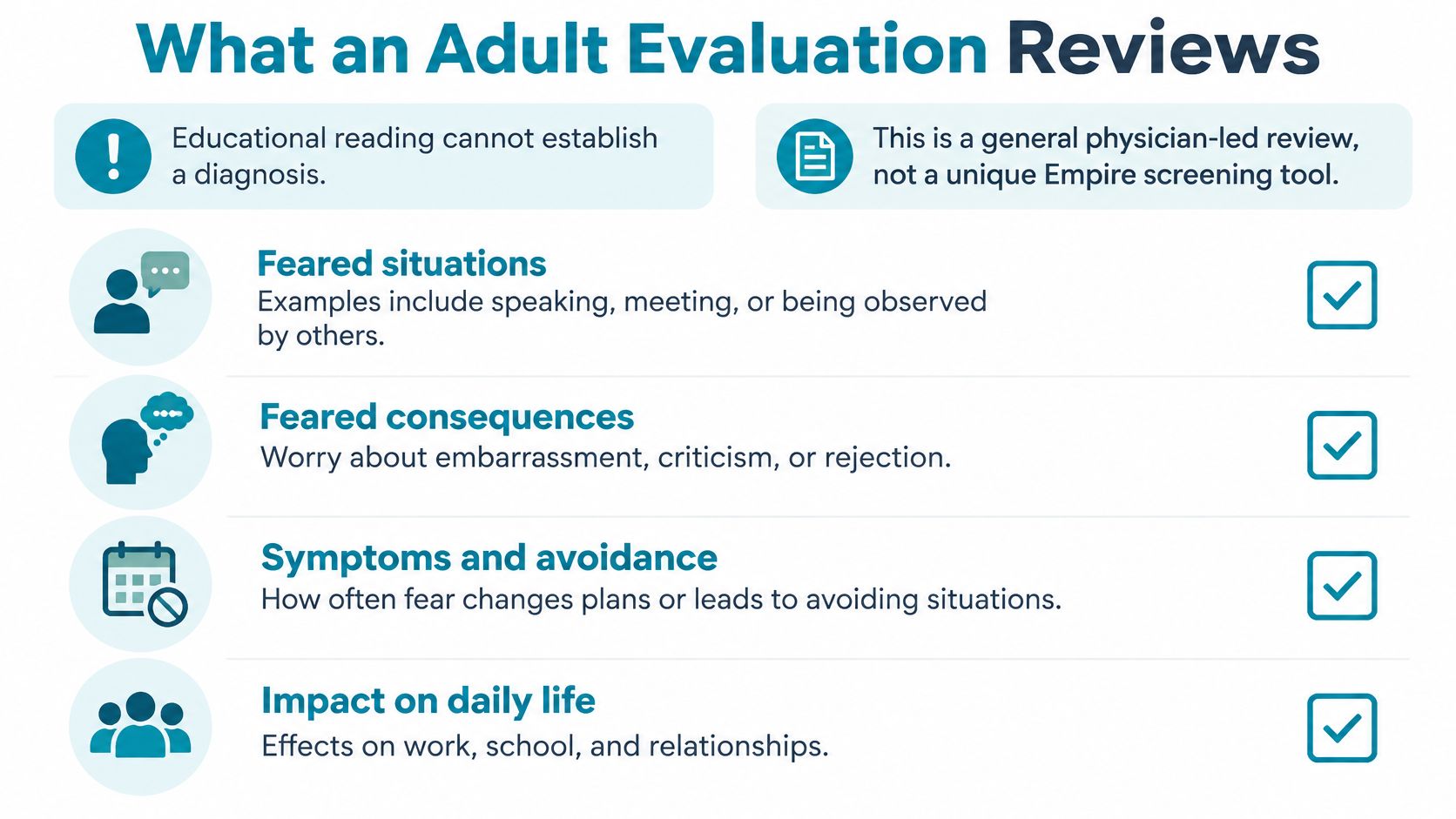
Educational reading can't establish a diagnosis. A physician-led visit is a general review, not a branded screening tool unique to any one practice.
The NICE guideline CG159 separates identification and assessment from later intervention choices. It is U.K. guidance, used here as a recognized framework beside U.S. sources, and it covers adults 18 and older as well as children and adolescents. The useful principle is simple: clarify the problem before selecting a treatment.
What the visit actually covers
The conversation explores feared situations, feared consequences such as humiliation or rejection, avoidance, how long the pattern has lasted, and how it interferes with chosen goals. Medical history, sleep, school or work functioning, past treatment, and current and past medicines belong in that review. Substance use is included when it could mimic or worsen anxiety. Depression and safety, including thoughts of suicide, are part of a careful visit.
At Empire Medical Wellness, mental health care begins with a thorough review of symptoms, medical history, current functioning, previous treatment, and current and past medications. Sleep, substance use, and lifestyle are considered when they affect diagnosis or treatment response.
A structured scale, such as the Liebowitz Social Anxiety Scale, may set a baseline and later show change. It doesn't diagnose on its own.
How to prepare without oversharing
- List two or three situations that are avoided or endured, such as speaking, a meeting, or being observed.
- Name the feared outcome, often humiliation, rejection, or looking incompetent.
- Record roughly how many months the pattern has lasted. An estimate is enough.
- Name one harder goal, such as a meeting, a call, or a meal.
- Bring medicine and substance history, including anything stopped because of side effects.
- Write questions, including whether a medicine is even wanted.
An assessment doesn't obligate treatment. Questions about classes of medicine can wait for a mental health medication review after the pattern is clear. Don't send detailed medical information, Social Security numbers, or card details through a general website form, social message, or ordinary email.
CBT and Medicine Options With Evidence
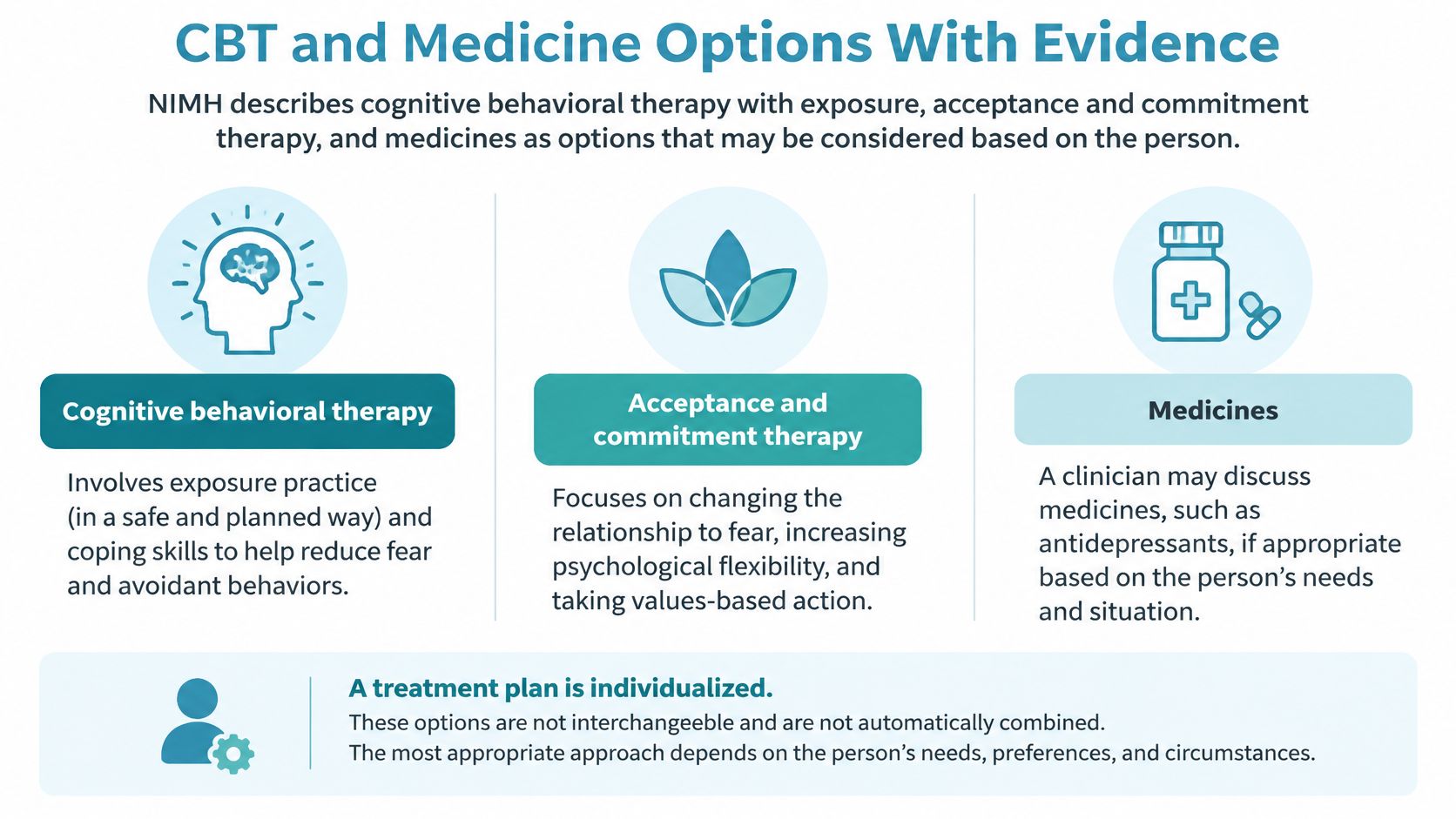
Treatment choices depend on what the person prefers, what is available, and what has been tried. Cognitive behavioral therapy (CBT), acceptance and commitment therapy (ACT), and medication are distinct options. They do not have to be combined.
NIMH describes CBT with exposure, ACT, and medicines that include SSRIs and SNRIs as treatment options. CBT works on patterns of attention, beliefs, and avoidance. Medication may reduce symptoms over time. A clinician can review these approaches without making the evaluation a commitment to treatment.
What published comparisons actually show
| Approach | Main target | Published snapshot | Limit |
|---|---|---|---|
| Individual CBT for social anxiety | Attention, safety behaviors, beliefs, and gradual exposure | SMD about −1.19 vs wait-list in a 101-trial network meta-analysis | Not generic advice to socialize more |
| SSRI such as sertraline or escitalopram in NICE | Ongoing fear and avoidance via serotonin signaling | Published reviews report a modest average benefit over placebo | Not an as-needed cure or a dose for a reader |
| SNRI | Same decision after an individual review | Published reviews report a modest average benefit over placebo | Benefit varies; remission is not guaranteed |
| ACT | Acting on values while anxiety is present | Listed by NIMH among psychological options | Not a diagnosis and not automatically combined with medicine |
A network meta-analysis of 101 trials and 13,164 participants found a large average effect for individual CBT compared with a wait-list control, with a standardized mean difference of −1.19 (95% credible interval −1.56 to −0.81). In that analysis, individual CBT also outperformed psychodynamic therapy (SMD −0.56) and was the only psychological treatment clearly superior to psychological placebo. These are group averages, not a forecast for any one person.
The NICE social anxiety disorder guideline recommends individual CBT designed for social anxiety disorder, using the Clark and Wells model or the Heimberg model. Treatment addresses self-focused attention, safety-seeking behaviors, negative beliefs, and unhelpful thinking before and after social events. Group CBT is not routinely preferred over individual CBT, though preference and access matter.
Medicines, labeling, and follow-up
An SSRI is a prescription medicine that affects serotonin signaling over time. It is not a medicine to take only before a meeting. An SNRI is a related medicine class that may also be discussed after an individual review.
For adults who decline CBT or prefer medication, NICE surveillance of CG159 names escitalopram or sertraline after discussion of why CBT was declined and any concerns about medication. In U.S. labeling, sertraline, paroxetine, and venlafaxine extended-release are FDA-approved for social anxiety disorder. Escitalopram is named by NICE, but prescribing it for this condition in the United States is off-label. These are examples of medicines, not personal recommendations or doses.
Published reviews describe a modest average benefit from medicines over placebo. An average effect cannot predict an individual response. Follow-up can review symptom change, side effects, whether the medication is taken as agreed, interactions, and changes in chosen activities, such as attending a meeting. Timing depends on the person's needs and treatment.
Nothing here is an instruction to start, stop, or change medication. During a secure telehealth visit, a physician assesses whether medication is appropriate and explains options, monitoring, and follow-up. Learn more about anxiety medication management.
A Hypothetical Gradual Practice Example
This example is hypothetical. It isn't an Empire Medical Wellness patient, and it isn't a success story.
Say an adult wants to speak once in a small work meeting. They avoid it and worry about humiliation for weeks beforehand. With a clinician, or with an outside therapist when that is the plan, they pick a step small enough to try and large enough to matter.

One agreed step, with permission to pause
First they might stay in the meeting without speaking. Later they might ask one prepared question. They rate fear before and after, notice safety behaviors such as rehearsing every word, and agree they can pause. The point is learning what happens. It isn't flooding, and it isn't being pushed onstage.
Afterward they write the outcome in a sentence or two instead of replaying the event for hours. If fear stays very high, or a chosen function doesn't change, that information goes to the next visit. It isn't a personal failure.
Exposure in CBT is planned and collaborative. Consent and a pause are part of the step, not a detour from it.
Three questions fit a real visit:
- Which step is small enough to try without flooding?
- Who will help plan it, a therapist, or the person alone between medical visits?
- What function will we track, such as staying in the room, asking one question, or joining the meal?
No timetable and no expected point drop belong in this sketch. The next visit uses what happened, not a promised curve.
How Long Digital Programs Last
A guided program can help while someone is using it. That isn't the same as care that holds after the program ends.
A 2025 systematic review and meta-analysis of 21 randomized trials and 4,196 children, adolescents, and young adults found a small-to-moderate benefit for digital mental-health interventions right after treatment (Hedges' g 0.508, 95% CI 0.308–0.707). Benefits weakened by 3–6 months and were no longer statistically significant at 12 months. Guided, CBT-based programs with social-anxiety-specific elements did better than unguided or less targeted ones.
Three checks before relying on an app
- Guided, not fully unguided. A person or structured coach is part of the program.
- Built for social anxiety, not a generic wellness library.
- A reassessment is planned if fear, avoidance, or a chosen function such as a meeting, call, or meal hasn't changed.
This evidence is in younger people. It doesn't prove that every adult app works, or that gains continue after use stops. Persistent impairment is a reason to discuss clinician-led care, not a verdict that technology failed.
Planning a Physician-Led Next Step
Fear of being judged can make reaching out for care feel like another social test. An evaluation can instead be a structured conversation about symptoms, daily functioning, and treatment history. It does not obligate you to take medication.
For adults, Empire Medical Wellness offers physician-led outpatient mental health evaluation and medication management. The physician reviews symptoms, medical history, current functioning, previous treatment, and current and past medications. Sleep and substance use are considered when they may affect diagnosis or treatment response. Patients can discuss treatment history, medication response, and side effects, then review possible next steps.
Anxiety medication management takes place in a secure telehealth visit. The physician assesses whether medication is appropriate and explains options, monitoring, and follow-up. Learn more about how to get anxiety medication. A visit is a chance to review options, not a promise that medication will be recommended.
The standard initial evaluation is 50 minutes and costs $350. A standard follow-up is 25 minutes and costs $225. Empire does not bill insurance directly. An itemized receipt is available through the patient portal.
If you want psychotherapy, it can be arranged with a qualified therapist outside the practice. The practice does not provide in-house psychotherapy. If you or someone else is in immediate danger, call 911 or the 988 Suicide and Crisis Lifeline. Do not wait for a routine appointment.
Empire Medical Wellness Editorial Team
Published April 2026. Updated April 2026.
This article is educational, not personal medical advice or a diagnosis, and it is not an instruction to start, stop, or change medication.