
A person who has tried to lose weight, regained it, and now wants medical guidance usually faces two obvious choices: a primary care physician or an obesity-medicine physician. For most adults, either can be a sensible starting point. The better question is: which clinician can evaluate the medical factors involved, explain appropriate options, monitor treatment, and plan for long-term maintenance?
Weight can be affected by medications, sleep, stress, mental health, hormones, metabolic conditions, eating patterns, physical activity, and life circumstances. Appearance alone doesn't establish a diagnosis or determine which professional is appropriate. This guide compares the main roles, shows what a thorough first evaluation should cover, and gives adults practical questions to ask before choosing physician-led care. General background on medical weight management is also available through this weight-loss service resource.
Table of Contents
- Starting With the Right Clinician
- Who Does What in Weight Care
- What a Good First Evaluation Should Cover
- When an Obesity Medicine Physician Is the Next Step
- Questions to Ask at the First Visit
- Monitoring, Regain, and Long-Term Continuity
- Rethinking Common Assumptions About Weight Care
- Practical Next Steps and Common Questions
Starting With the Right Clinician
The best first call for most adults
A primary care physician, such as a family-medicine or internal-medicine doctor, is an appropriate first contact for many adults beginning a weight-loss evaluation. That visit can review weight history, current and past medications, sleep, mental health, nutrition, physical activity, blood pressure, glucose, and other conditions that could affect treatment choices. The National Institute of Diabetes and Digestive and Kidney Diseases explains that a healthcare professional may refer a patient to a specialist or team trained in weight management when a more individualized program is needed (NIDDK guidance).
An obesity-medicine physician may be the more direct choice when prior efforts haven't produced lasting results, a medical condition or medication may be influencing weight, or prescription treatment is being considered. Obesity medicine is a focused clinical discipline built on a foundational specialty. It doesn't replace primary care.
The right clinician should assess the broader medical picture instead of offering a short-term diet or a medication without follow-up. Respectful, person-first language should be standard. A thoughtful evaluation treats weight as one part of health, not as a judgment about character.
What the choice should reveal
A useful first call should answer whether the clinician:
- Reviews causes and contributing factors rather than appearance alone.
- Explains which professionals may be involved and why.
- Offers follow-up based on response, tolerability, and changing health needs.
- Coordinates with existing clinicians when the patient authorizes it.
- Discusses costs and access clearly before care begins.
The comparison below provides a practical starting point. The credential questions later in the article help distinguish a clinician who can provide ongoing care from one who offers only a brief consultation.
Who Does What in Weight Care
If you are trying to decide who to call, stop focusing on the title alone. The better question is who can evaluate the medical picture, monitor treatment, and stay involved long enough to adjust the plan when life, health, or weight changes.
Weight care often works best as shared care, but shared care does not mean collecting specialists. It means each clinician has a defined job, and you know who is responsible for diagnosis, prescribing, monitoring, nutrition counseling, and referral when a specific condition is suspected.
| Professional | Typical Training | Common Role in a Weight Plan | When Most Relevant |
|---|---|---|---|
| Primary care physician | Medical degree with family-medicine or internal-medicine training | Reviews overall health, medications, sleep, mental health, metabolic risk, and weight history. Starts care or coordinates referrals | A practical first contact for many adults, especially when several health concerns need to be considered together |
| Obesity-medicine physician | Medical degree with a foundational specialty plus focused obesity-medicine training or certification | Performs medical and metabolic assessment, develops an individualized plan, evaluates medication when appropriate, monitors response, and plans maintenance | Prior efforts have not lasted, weight-related conditions are present, or specialized physician-led care is wanted |
| Registered dietitian | Accredited nutrition education and supervised practice, with scope governed by professional credentials and state rules | Provides individualized nutrition counseling, meal-planning support, behavior strategies, and nutrition monitoring | Nutrition support is a meaningful part of the plan, particularly when coordinated with medical care |
| Endocrinologist | Medical degree with internal-medicine training and endocrine subspecialty training | Evaluates and manages specific hormonal or metabolic disorders | Thyroid disease, Cushing syndrome, complex diabetes, or another endocrine condition is suspected or requires specialist management |
| Bariatric surgeon | Medical degree followed by surgical training and appropriate bariatric-surgery practice | Evaluates and performs metabolic and bariatric surgery within a multidisciplinary process | Surgery may be clinically appropriate after individualized medical and surgical evaluation |
Use the table to judge function, not prestige. A primary care physician may be the right starting point, but not always the right long-term lead. An obesity-medicine physician is often the better fit when the key need is a physician who can assess causes, prescribe when appropriate, track response, and manage maintenance over time. A registered dietitian has a different role. Nutrition counseling, meal structure, and behavior support often sit with the dietitian, while diagnosis, prescription decisions, and medical monitoring remain with the physician or other prescribing clinician. Ask the practice to tell you plainly who handles each part.
A simple example makes this easier. An adult books a visit after repeated weight-loss efforts keep fading out. The first physician reviews medications, sleep, blood pressure, glucose, and related conditions. If the picture suggests the need for more focused physician-led care, that patient may be referred for an obesity-medicine service. A dietitian may then help with nutrition goals. An endocrinologist enters the picture only when the history, exam, or testing points to a specific hormonal problem.
No single title wins by default. Choose the clinician who can assess the full picture, explain their role clearly, and offer follow-up that matches the level of care you need.
What a Good First Evaluation Should Cover
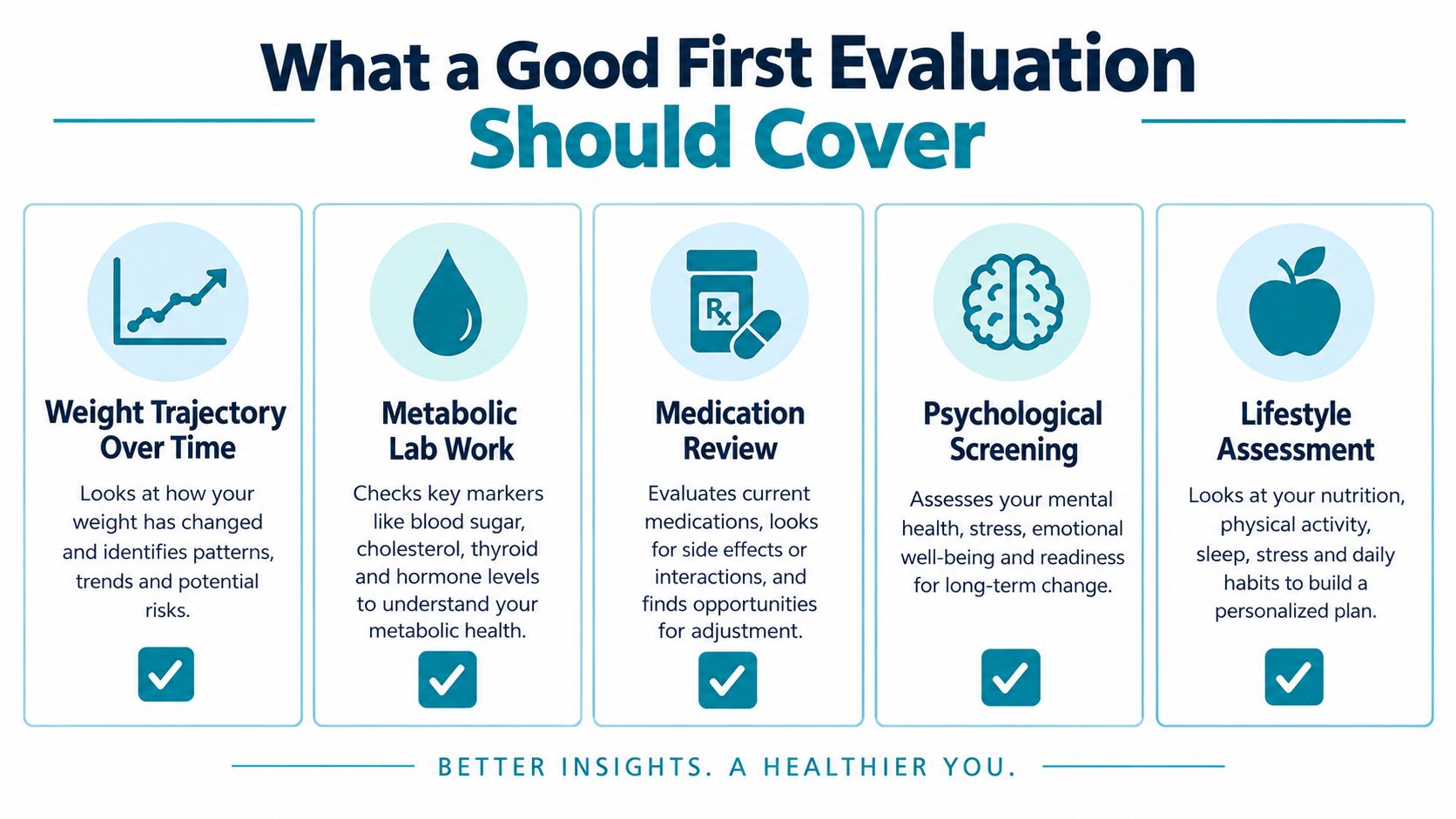
A first evaluation that records only weight misses the factors that decide whether treatment will work for more than a few weeks. The visit should sort out what has changed over time, what is pushing weight up or making loss harder, what health risks are already present, and who can monitor the plan over time.
A physician-led assessment usually covers several parts at once:
- Weight trajectory: Changes over time, prior attempts, periods of regain, and what seemed to trigger those shifts.
- Medication review: Prescription drugs, over-the-counter products, and supplements that may affect weight or limit treatment options.
- Nutrition and activity: Eating patterns, physical activity, work schedule, mobility, and day-to-day barriers.
- Sleep and stress: Sleep quality, possible sleep disorders, stress load, and routines that interfere with recovery.
- Mental health and eating-related concerns: Mood, anxiety, emotional eating, disordered eating concerns, and other issues that may affect safe treatment.
- Medical risk: Blood pressure, glucose, lipids, and obesity-related conditions.
That is the standard to expect.
The U.S. Preventive Services Task Force recommends screening all adults for obesity. For adults with a body mass index of 30 or higher, it recommends offering or referring them to intensive, multicomponent behavioral interventions that combine nutrition and activity counseling, goal setting, self-monitoring, problem-solving, and strategies for maintaining change (USPSTF recommendation). In practice, that means a good first visit should lead to an actual plan for follow-up, not a vague instruction to try harder.
Respect matters just as much as the checklist. The right clinician does not judge by appearance or assume every case is the same. A careful visit separates medication-related weight change from metabolic disease, sleep problems, hormonal conditions, eating-related concerns, food access, stress, and other barriers. That is how you figure out which clinician can evaluate, monitor, and adjust care over the long term.
If lab and metabolic questions come up, Longwelle biomarker testing offers general educational background. It does not replace a clinician's interpretation of symptoms, history, examination, and prior records.
By the end of the first visit, you should know what has been assessed, what is still uncertain, and what happens next. If a practice cannot explain that clearly, keep looking. For a practical example of what physician-led intake may include, this overview of a first obesity-medicine appointment is useful.
When an Obesity Medicine Physician Is the Next Step
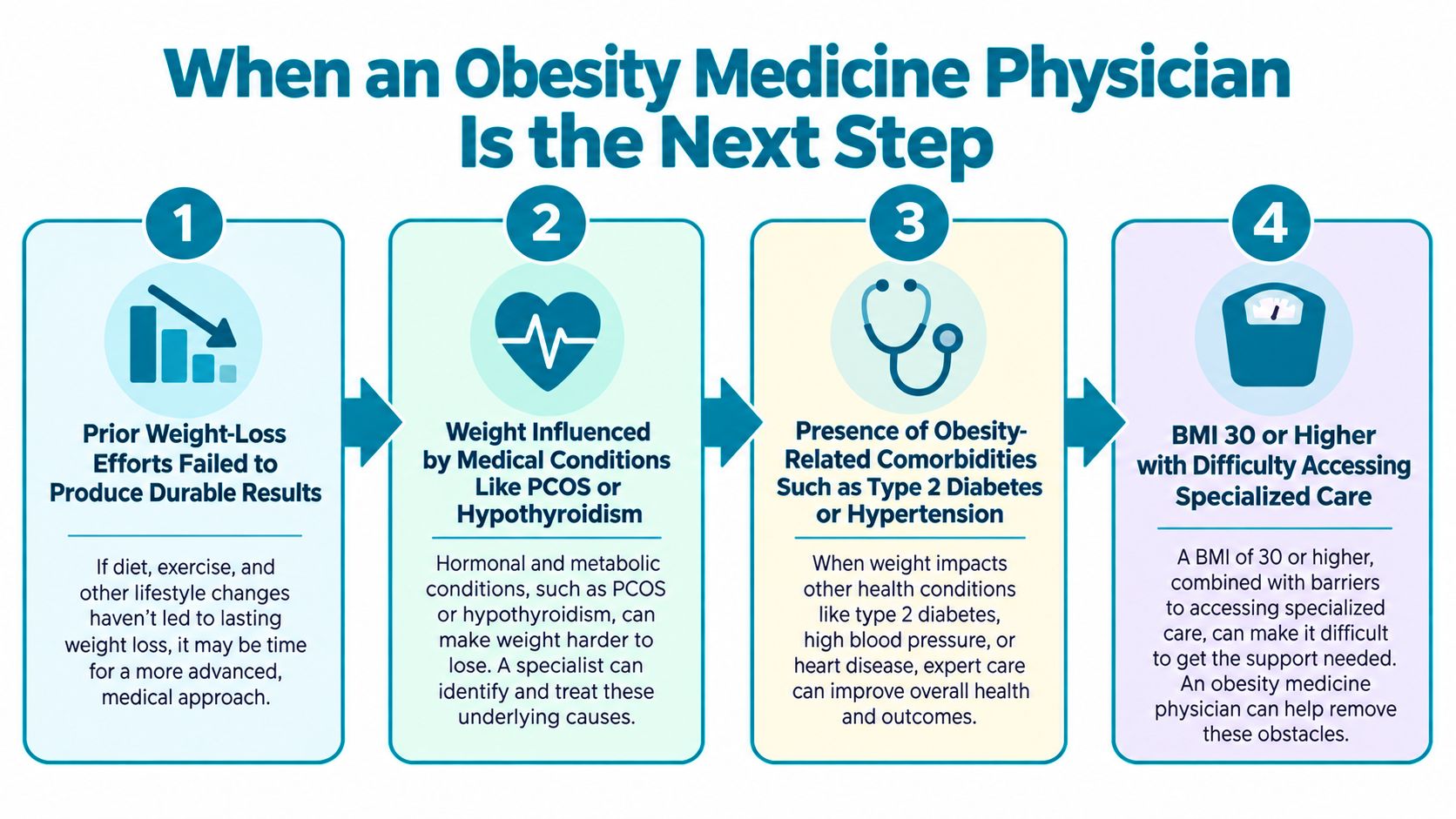
You do not need a fancier title. You need a clinician who can sort out why weight has been hard to change, decide whether prescription treatment makes sense, and stay involved long enough to adjust the plan when real life interferes.
That is usually the point where an obesity-medicine physician makes sense. Consider that next step when repeated dieting has led to regain, when weight change may be tied to another condition or a current medication, or when you want a serious discussion about anti-obesity medication rather than a quick yes or no.
Focused training still has a foundation
Obesity medicine sits on top of another medical specialty, often family medicine, internal medicine, endocrinology, or pediatrics. What matters to patients is not the clinic label. Check the physician's base specialty, whether obesity-medicine board certification is current, and whether the practice provides evaluation, prescribing when appropriate, follow-up, and long-term management.
A general resource on obesity health guidance can help with basic terms, but it cannot tell you whether your pattern points to sleep apnea, medication-related gain, binge-eating symptoms, menopause-related changes, insulin resistance, or something else that needs medical review.
Medication eligibility is only the starting point
Prescription treatment has clear eligibility thresholds in obesity care, and FDA labeling for chronic weight management commonly uses BMI cutoffs such as 30 kg/m², or 27 kg/m² with related conditions including hypertension, dyslipidemia, type 2 diabetes, obstructive sleep apnea, and cardiovascular disease (FDA prescribing information). Eligibility does not answer the harder question, which is whether a specific medication fits your history, risks, goals, and ability to stick with follow-up.
That decision takes an actual review of contraindications, drug interactions, pregnancy considerations, psychiatric and cardiovascular history, kidney or liver issues, expected side effects, and cost. Adults who want a plain-language overview of prescription options can review this GLP-1 treatment overview before the visit.
Good obesity care also includes monitoring after the prescription is written. The Endocrine Society guideline supports continuing medication when a patient reaches at least 5% weight loss after three months on an effective, tolerated regimen. That is why a one-time prescription is weak care. The right clinician tracks response, side effects, dose changes, and what to do if progress stalls or weight returns.
Questions to Ask at the First Visit
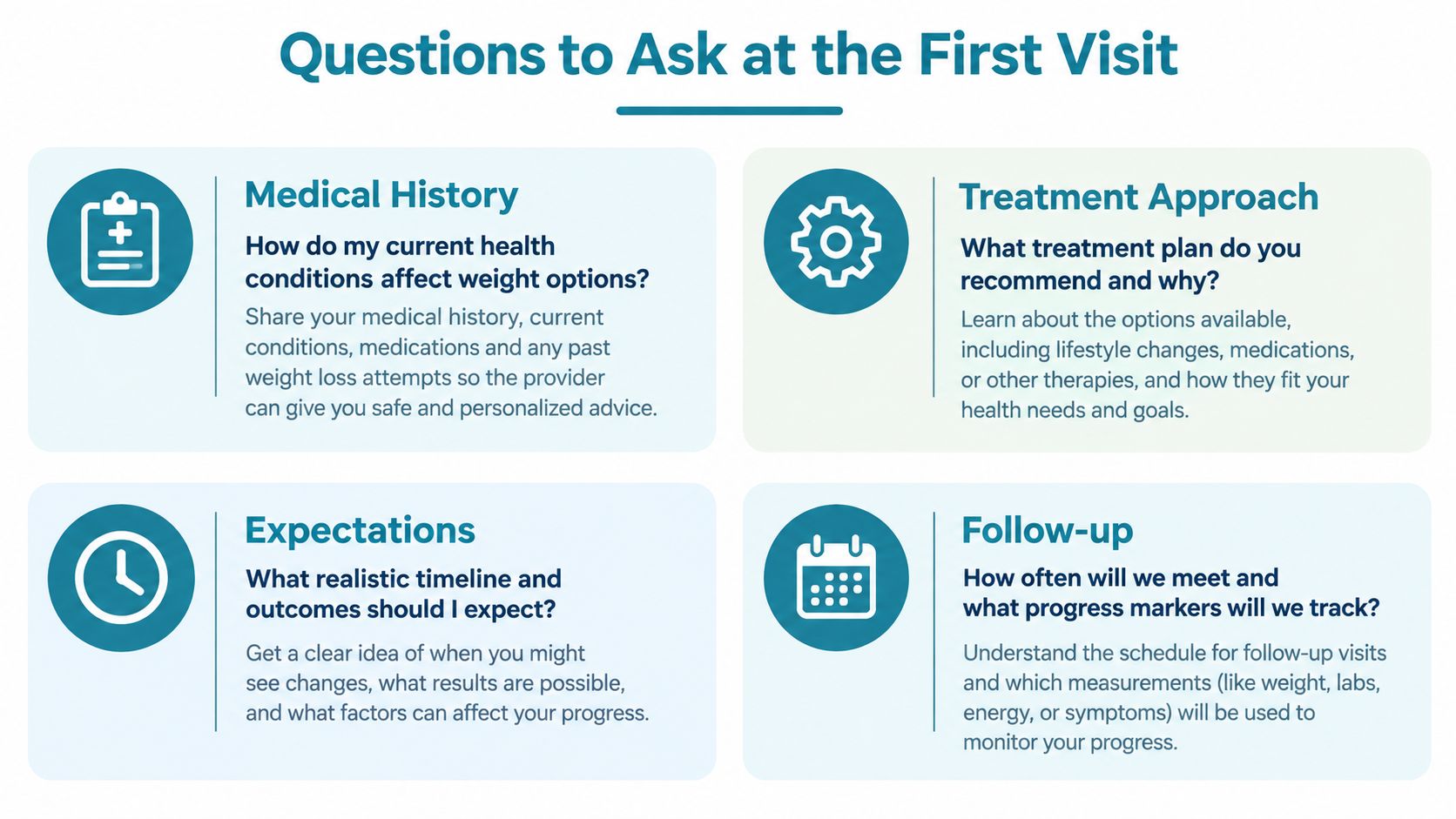
A patient doesn't need to interrogate a clinician. A short set of reasonable questions can show whether the practice provides the kind of care the patient needs.
Credentials and scope
- What is the physician's foundational specialty? The answer should identify family medicine, internal medicine, endocrinology, or another recognized specialty.
- What obesity-medicine training or board certification does the physician hold? Patients can ask which credentialing organization issued it and whether it is current.
- What does the evaluation include? A medical and metabolic assessment should extend beyond body weight and appearance.
- Who provides nutrition support? The practice should clarify whether nutrition counseling is provided by the physician, coordinated with an authorized registered dietitian, or handled through another arrangement.
- Are prescription options evaluated only when appropriate? A responsible clinician should explain that medication isn't necessary or suitable for every patient.
Follow-up and coordination
- How are response and side effects monitored?
- How are dose decisions or access problems handled between visits?
- What symptoms require same-day contact or urgent medical attention?
- How does the physician coordinate with primary care, specialists, or a therapist when the patient authorizes communication?
- What happens if progress stalls or weight returns?
A clinician who becomes defensive about these questions isn't offering a reassuring sign. Good care should make the treatment logic, monitoring plan, and limits of the service understandable.
Cost and access
The practice should state visit length, fees, billing procedures, and whether an itemized receipt is available for patients seeking possible out-of-network reimbursement. Adults considering private-pay care can review how fees and the care model work before scheduling.

Monitoring, Regain, and Long-Term Continuity
The first appointment matters, but the follow-up model matters more. A clinician who offers a prescription without explaining how response, adverse effects, medical changes, and maintenance will be handled is leaving out a central part of treatment.
FDA labeling for medicines such as tirzepatide states that chronic weight-management treatment is used with a reduced-calorie diet and increased physical activity (FDA prescribing information). NIDDK likewise explains that prescription medication should be discussed with a healthcare professional after considering likely benefits, possible side effects, current health problems, other medicines, family history, and cost (NIDDK prescription medication guidance).
Regain needs assessment, not blame
Weight regain isn't automatically evidence of nonadherence or personal failure. It can reflect the biology of weight regulation, treatment interruption, medication effects, stress, sleep changes, or new health circumstances.
A sound maintenance plan should include:
- Periodic review of medications and health conditions.
- Monitoring of relevant metabolic risk markers.
- Discussion of nutrition, activity, sleep, and stress.
- A plan for stalled or reversed progress.
- Clear instructions for reporting adverse effects, urgent symptoms, pregnancy-related concerns, or changes in other care.
CDC reporting from 2025 emphasized evidence-based, multicomponent treatment that can include obesity medication alongside health-behavior and lifestyle support, primarily in the adolescent context (CDC report). The broader adult-care implication is straightforward: ongoing assessment and coordinated support are more responsible than treating medication as a complete solution.
Practical rule: The clinician who can monitor treatment after the initial decision is usually more valuable than the clinician who simply offers the fastest prescription.
The original question therefore needs a slight rewrite. Instead of asking only which title to choose, an adult should ask which qualified clinician can evaluate the causes, discuss appropriate options, monitor safely, coordinate care, and plan for the long term.
Rethinking Common Assumptions About Weight Care
One diet isn't universally best
A high-quality behavioral intervention doesn't depend on one fashionable diet. The USPSTF describes intensive, multicomponent care that may combine nutrition counseling, activity counseling, goal setting, self-monitoring, problem-solving, and maintenance strategies (USPSTF recommendation). That structure gives the clinician room to account for health conditions, preferences, daily routines, food access, and previous experience.
Medication isn't the whole treatment
Prescription medicines may help some adults, but FDA labeling and NIDDK guidance place them within a broader plan involving reduced-calorie intake and increased physical activity. Eligibility thresholds don't guarantee that a particular medicine is appropriate. A physician must still review risks, interactions, medical history, pregnancy considerations, expected benefits, side effects, and affordability.
Willpower isn't the main clinical variable
Weight is influenced by medications, sleep, stress, hormones, metabolic conditions, eating-related concerns, and the biology of weight regulation. Framing the issue as a willpower test can delay evaluation of treatable contributors and discourage people from seeking respectful care.
An endocrinologist isn't the default choice
An endocrinologist is particularly useful when a specific endocrine disorder, such as thyroid disease or Cushing syndrome, is suspected or requires specialist management. A primary care or obesity-medicine physician often coordinates the overall weight-management plan, with referral based on the findings rather than on a universal rule.
The central standard remains consistent: the right clinician is the one who can evaluate the broader picture, monitor treatment, and plan for durable care.
Practical Next Steps and Common Questions
Is an endocrinologist right for every adult seeking weight care?
No. An endocrinologist is most useful when a specific hormonal or metabolic disorder is suspected or needs specialist management. Primary care or obesity medicine is usually a more practical starting point for an overall evaluation.
Can a registered dietitian prescribe weight-loss medication?
No. A registered dietitian isn't a physician, and scope of practice varies by jurisdiction and professional role. Dietitians can still provide valuable nutrition support as part of coordinated care, while a physician handles medical assessment and prescribing decisions.
When might bariatric surgery enter the discussion?
A bariatric surgeon becomes relevant when metabolic and bariatric surgery may be appropriate. Evaluation is individualized and typically involves a multidisciplinary team rather than a surgical decision based on weight alone.
How should private-pay cost be considered?
Visit fees, billing practices, and possible out-of-network reimbursement vary. Patients should ask whether the practice provides an itemized receipt and review its cost information for weight-management care before scheduling.
Empire Medical Wellness offers physician-led obesity-medicine evaluation for adults who want medical assessment, appropriate treatment planning, monitoring, and long-term maintenance planning. Adults can review the obesity-medicine service and schedule an appointment if the practice's model fits their needs. This article is educational and isn't personal medical advice or a substitute for individualized care.
Adults seeking a careful answer to “what type of doctor should I see for weight loss?” can visit Empire Medical Wellness to review its physician-led obesity-medicine care. The practice can evaluate weight history and relevant health factors, discuss treatment options when clinically appropriate, and establish follow-up focused on response and long-term planning.
Byline: Empire Medical Wellness Editorial Team
Published: October 10, 2026
Updated: October 10, 2026
Sources
- U.S. Preventive Services Task Force recommendation on adult obesity screening and counseling
- NIDDK treatment guidance for adult overweight and obesity
- Endocrine Society pharmacological management guideline
- American Board of Obesity Medicine examination results
- FDA prescribing information for chronic weight management