Byline: Empire Medical Wellness Editorial Team
Published: September 20, 2026
Updated: September 20, 2026
A certified addiction professional is not one universal credential. In the United States, addiction counseling is spread across 216 addiction counselor credentials across all 50 states and the District of Columbia, and that is separate from physician board certification in addiction medicine or addiction psychiatry.
Most online advice makes this sound simpler than it is. It often treats “certified addiction professional” as if it names one national license with one training path and one scope of practice. That's not how the field works.
For adults looking for private, physician-led addiction care, that difference matters. A counselor may be highly qualified to provide counseling, recovery planning, case management, and psychoeducation. A physician may be the right choice when you need medical evaluation, medication decisions, withdrawal risk assessment, or coordination with other medical conditions. Before you choose care, verify the issuer, active status, discipline, and permitted services of the credential you're seeing.
Table of Contents
- What Certified Addiction Professional Means Today
- How Addiction Counseling Credentials Became Standardized
- How Counseling Credentials Differ From Physician Board Certification
- Typical Training Pathways and Requirements to Earn Certification
- How to Verify Any Addiction Credential Before You Choose Care
- When to Seek Physician Led Addiction Care Versus Counseling Only
- Access Options Telemedicine and FAQs About Certified Addiction Professionals
- A practical way to sort the options
- Quick credential check before you book
- FAQ
- Is Certified Addiction Professional a national license
- Does a CAP title mean the person provides medical addiction treatment
- Can a counselor and a physician both be part of good addiction care
- What should I verify first
- Are telemedicine addiction visits available everywhere
- Sources
What Certified Addiction Professional Means Today
“Certified addiction professional” sounds like a single national badge. It is not. The phrase often works more like a family name for different credentials issued by different bodies, with different rules, in different states.
That is why the safest first question is not “Is this person a CAP?” It is “Who issued this credential, and what does it legally allow this person to do?”
A title can signal training in addiction-related care. By itself, it does not tell you whether the person is licensed by a state, certified by a private board, supervised by another clinician, or permitted to diagnose, prescribe, or manage medical risk.
Why the phrase causes so much confusion
Three terms are often blended together even though they answer different questions:
- Certification asks: did a credentialing body verify education, supervised experience, an exam, ethics standards, and renewal?
- Licensure asks: did a state grant legal permission to practice a profession?
- Scope of practice asks: what services can this person provide under state law and under that credential?
A simple analogy helps. Your job title, driver's license, and car insurance card are all real credentials, but they do different things. Addiction credentials work the same way. One document may show training. Another may grant legal authority. A third source may define the exact services the person can offer.
A broad regulatory review found that addiction counseling is regulated through many separate credentials rather than one national profession-wide license, including a large mix of licenses, certifications, registrations, and state board credentials across the United States (global regulatory review). That is the core idea to keep in mind. “Certified addiction professional” is often a category label, not a complete description.
A CAP in one state is not automatically a CAP everywhere
Some states use Certified Addiction Professional, or CAP, as a specific credential title. Florida is a good example. The Florida Certification Board describes CAP as a credential for professionals who provide direct addiction counseling and related recovery services, including screening, assessment, treatment planning, counseling, case management, referral, and psychoeducation (Florida Certification Board CAP overview).
That tells you something useful, but not everything.
It tells you the credential issuer, the general practice area, and the kinds of services the board associates with that credential. It does not make CAP a universal national license. It also does not mean every person using addiction-related titles has the same authority in another state or discipline.
Use a verification-first approach
For an adult choosing care, title recognition is less helpful than credential verification. Start with the issuer, then confirm active status, then check what type of professional the person is.
| What to verify | Why it matters | Where to check |
|---|---|---|
| Credential issuer | Tells you whether the title comes from a state board, certification board, or medical specialty board | Credential certificate, clinician bio, state board profile |
| Professional discipline | Distinguishes counselor, social worker, psychologist, physician, or psychiatrist | State licensure board, employer profile |
| Active status | Confirms the credential or license is current and not expired | State board lookup or issuing board directory |
| Medical specialty board certification | Helps confirm physician-level addiction specialization | ABPM for Addiction Medicine, ABPN for Addiction Psychiatry |
| Treatment setting fit | Clarifies whether you need counseling only or medical evaluation too | SAMHSA treatment locator, clinic intake process |
This framework lowers the chance of choosing care based on a title that sounds familiar but means something different in practice.
If you are comparing counseling-only services with medical addiction treatment, review the scope of a physician evaluation before deciding. Empire's physician-led addiction care services outline medical assessment, treatment planning, monitoring, and coordination with other care when appropriate.
How Addiction Counseling Credentials Became Standardized
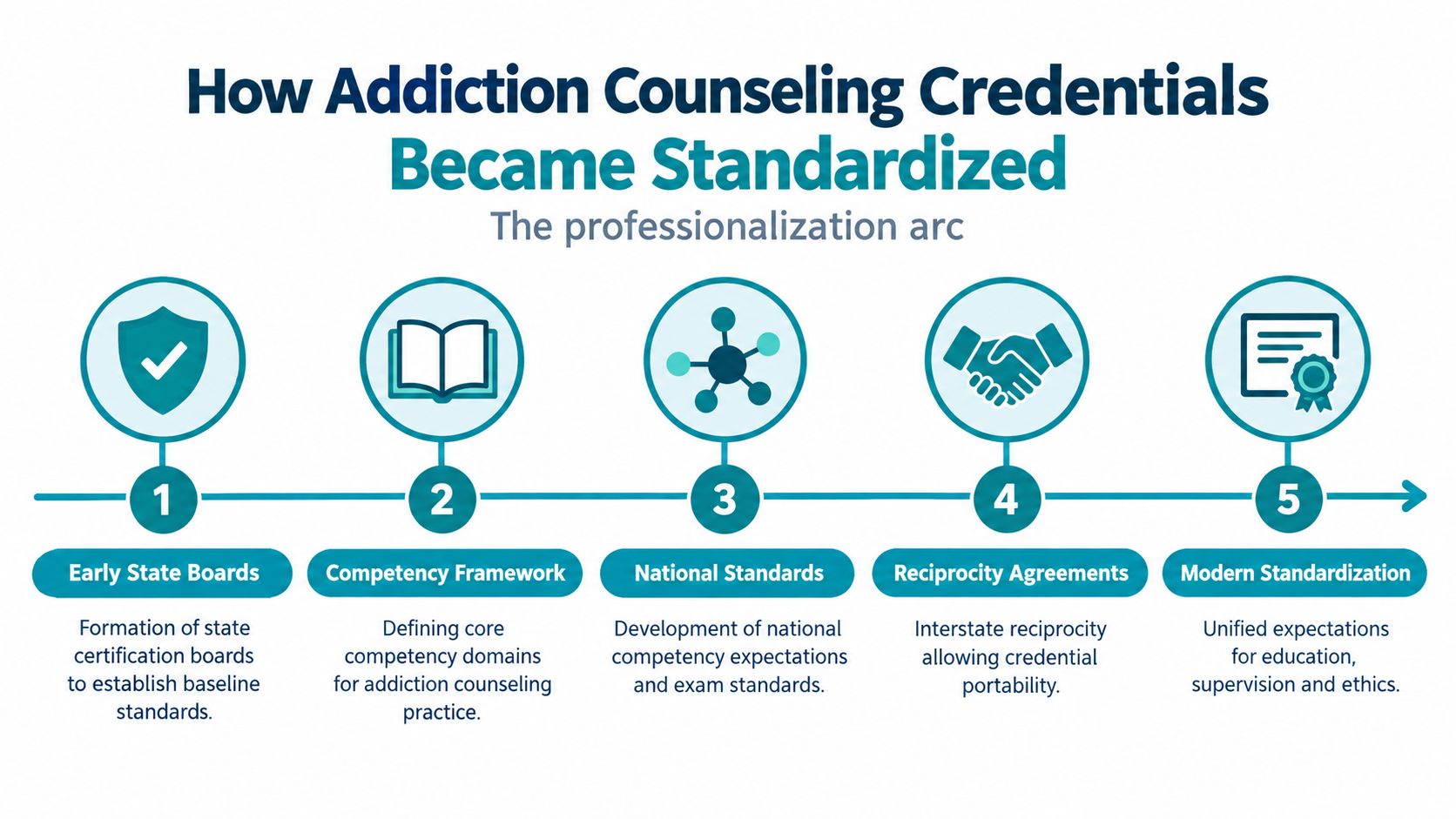
“Certified Addiction Professional” sounds like one settled national title. The history points in a different direction. Addiction counseling grew through many state and private certifying systems that gradually borrowed common parts from one another, without becoming one universal license.
A useful way to picture the process is to compare it to roads built by different counties that later agreed on lane widths and traffic signs. Travel became easier, but the roads still had different owners, rules, and names. Addiction counseling credentials developed in much the same way.
A clear early example comes from Pennsylvania. The state began building a formal certification pathway in 1976, incorporated the Pennsylvania Drug and Alcohol Counselor Certification Board in 1979, and introduced its first Certified Addiction Counselor (CAC) credential that same year. By 1983, it had joined the National Certification Reciprocity Consortium, which showed an early push toward recognition beyond a single state (Pennsylvania Certification Board history).
Why formal standards replaced informal training
Early addiction treatment often depended on local practice habits, apprenticeship, peer recovery experience, or a general counseling background. That approach created a predictable problem. Patients, employers, and referral sources could not easily tell who had addiction-specific training and who did not.
Standardization answered practical questions. What coursework should a counselor complete? How much supervised experience should count? Should there be an exam? What ethics rules apply? How does someone keep the credential active over time?
The result was a more structured model built around education, supervised experience, exams, ethics requirements, and continuing education. Pennsylvania's board history shows that these systems also kept evolving, including the addition of Associate Addiction Counselor levels in 1986 and later revisions by the same board.
Why standardization still produced a patchwork
This is the part that often confuses readers. Standardization improved consistency inside many credentialing systems, but it did not merge those systems into one national framework. State agencies, independent certification boards, and professional organizations each continued to define titles, scopes, and requirements in their own way.
That helps explain why the same-sounding title can mean different things depending on the issuer.
A recent review of addiction treatment occupations described a large number of credentials across the United States and concluded that overlapping structures can make it difficult for applicants and employers to tell what a credential allows someone to do (review of addiction treatment occupations).
The practical takeaway is simple. Standardization gave the field more rules. It did not create one national meaning for every addiction credential. That is why a verification-first approach matters so much: first identify who issued the credential, then determine whether it is a state license, a private certification, or a medical board certification, and then confirm active status with the appropriate board or directory.
How Counseling Credentials Differ From Physician Board Certification
Here is the part many readers get backward. A title that sounds more specialized does not always mean a higher or broader level of medical authority.
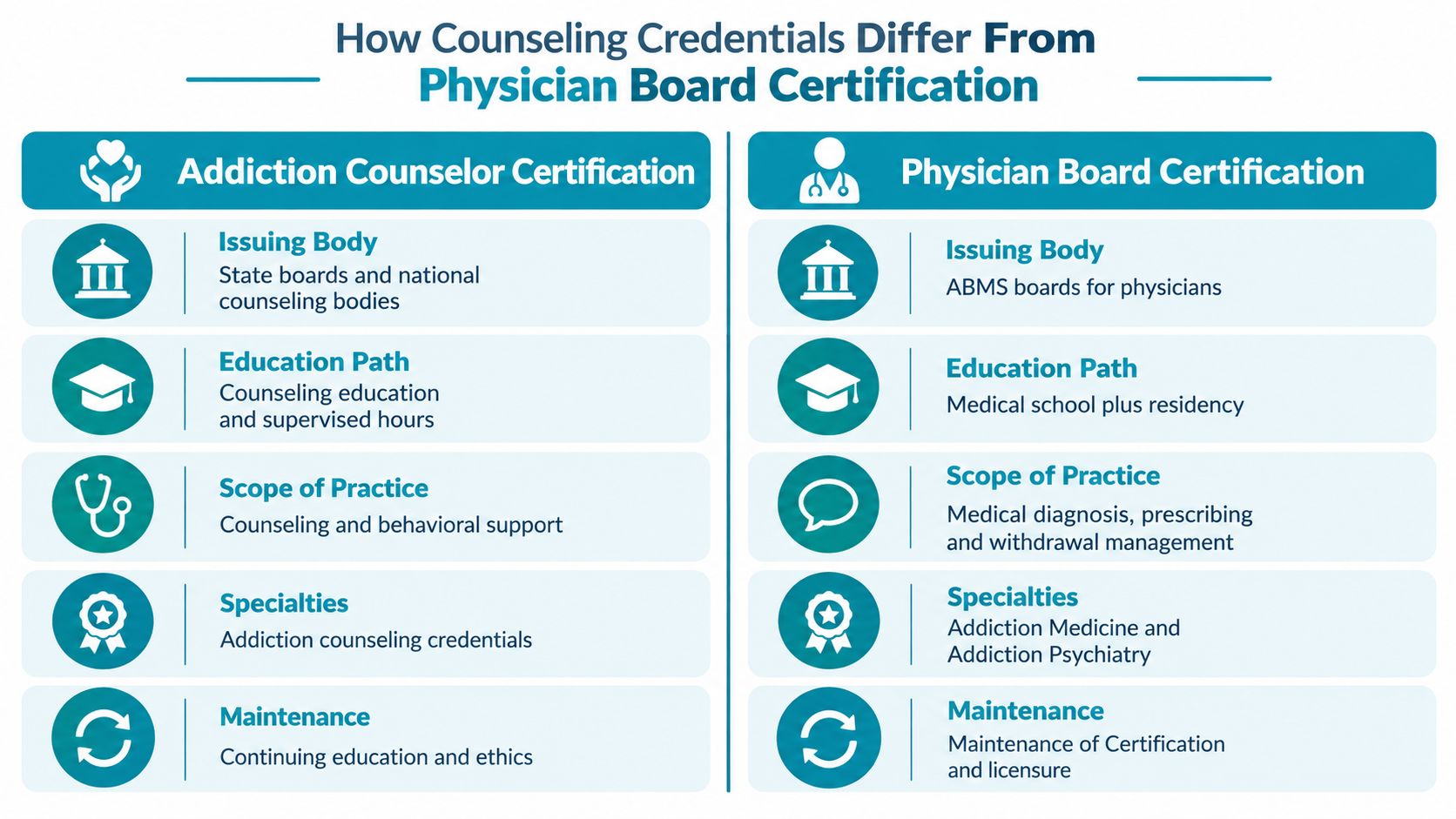
Counseling credentials and physician board certification sit in different systems. One usually confirms preparation for counseling and recovery-support services. The other confirms added specialty training after a physician has already completed medical education, residency, and state medical licensure. If you remember only one point, remember this: a Certified Addiction Professional title is usually part of the counseling credential family, not the physician board-certification family.
Two systems that sound similar but answer different questions
A counseling credential answers a question like: Has this person met the education, supervision, exam, and ethics requirements to provide addiction-related counseling services under the rules of that credential?
A physician board certification answers a different question: Has this licensed physician completed specialty training and met board standards in a medical field related to addiction care?
That distinction matters because addiction treatment can involve both behavior and biology. Counseling addresses coping, motivation, recovery planning, and structured therapeutic support. Medical care adds diagnosis, medication decisions, physical assessment, and management of withdrawal or other health risks.
A practical comparison helps. Counseling credentials work like a profession-specific practice authorization inside a behavioral health track. Physician board certification works like an added specialty layer on top of a medical license.
What physician board certification usually refers to in addiction care
For physicians, addiction-related board certification is not a generic CAP title. It is usually tied to recognized medical specialty routes, such as addiction medicine or addiction psychiatry, with verification through the appropriate medical board or certifying body. That is why a verification-first approach matters. You are not just checking whether someone "has a credential." You are checking which credential family they belong to.
For readers who are still sorting out clinician roles, this is similar to learning how to pick a therapist or psychiatrist. Both may help with mental health concerns. Their training, legal scope, and medical authority are different.
What each path usually allows in practice
Counseling credentials may support work such as:
- Individual or group counseling
- Recovery planning and psychoeducation
- Intake, screening, documentation, and care coordination within the rules of the setting and credential
- Behavioral support as part of a larger treatment team
Physician-led addiction care becomes important when the situation may involve:
- Diagnosis of substance use disorders and co-occurring medical or psychiatric conditions
- Prescribing medications
- Assessment of withdrawal risk, medication interactions, or other physical safety concerns
- Deciding whether outpatient care is appropriate or whether a higher level of care is safer
Only a licensed physician can practice medicine within that medical scope. A counseling credential, even a respected addiction credential, does not grant prescribing authority or convert a counseling role into medical practice.
A simple verification table
Use this quick check before you assume two addiction credentials mean the same thing:
| If the title comes from | What it usually represents | What to verify |
|---|---|---|
| State counseling board or state certification body | A counseling license or certification governed by state rules | Active status, scope, discipline history, and whether independent practice is allowed |
| Private or nonprofit addiction credentialing organization | A professional certification that may or may not be tied to state licensure | Issuer, renewal status, exam requirements, and whether the credential is recognized by your state or employer |
| ABPM or ABPN | Physician specialty board certification | Board status, physician license, specialty area, and whether the physician is currently in good standing |
| SAMHSA treatment directory or program listing | A treatment program listing, not a personal license by itself | Program services, staffing model, and whether physician evaluation is available |
If your main question includes, "Could this be withdrawal, a medication issue, or a medical problem?" start by checking whether physician evaluation is available. For a factual example of that care model, see addiction medicine specialist care.
A strong treatment plan often includes both lanes. Counseling helps with behavior change and recovery support. Physician-led care covers the medical side when diagnosis, medications, or safety risks are part of the picture.
Typical Training Pathways and Requirements to Earn Certification
The training path for a certified addiction professional works less like one national ladder and more like a set of roads that share a few common signs. Two people can both work in addiction care, both hold legitimate credentials, and still have very different education, supervision, and practice limits. That is why the safest question is not "Is this person certified?" but "Which certification, issued by whom, and what does it allow?"
The state-by-state credential review cited in Sources describes this patchwork clearly. Titles overlap. Requirements vary. Scope can change from one state line to the next. For an applicant, that can feel confusing. For a patient or family member trying to choose care, it means the title alone rarely answers the practical question: what can this person do?
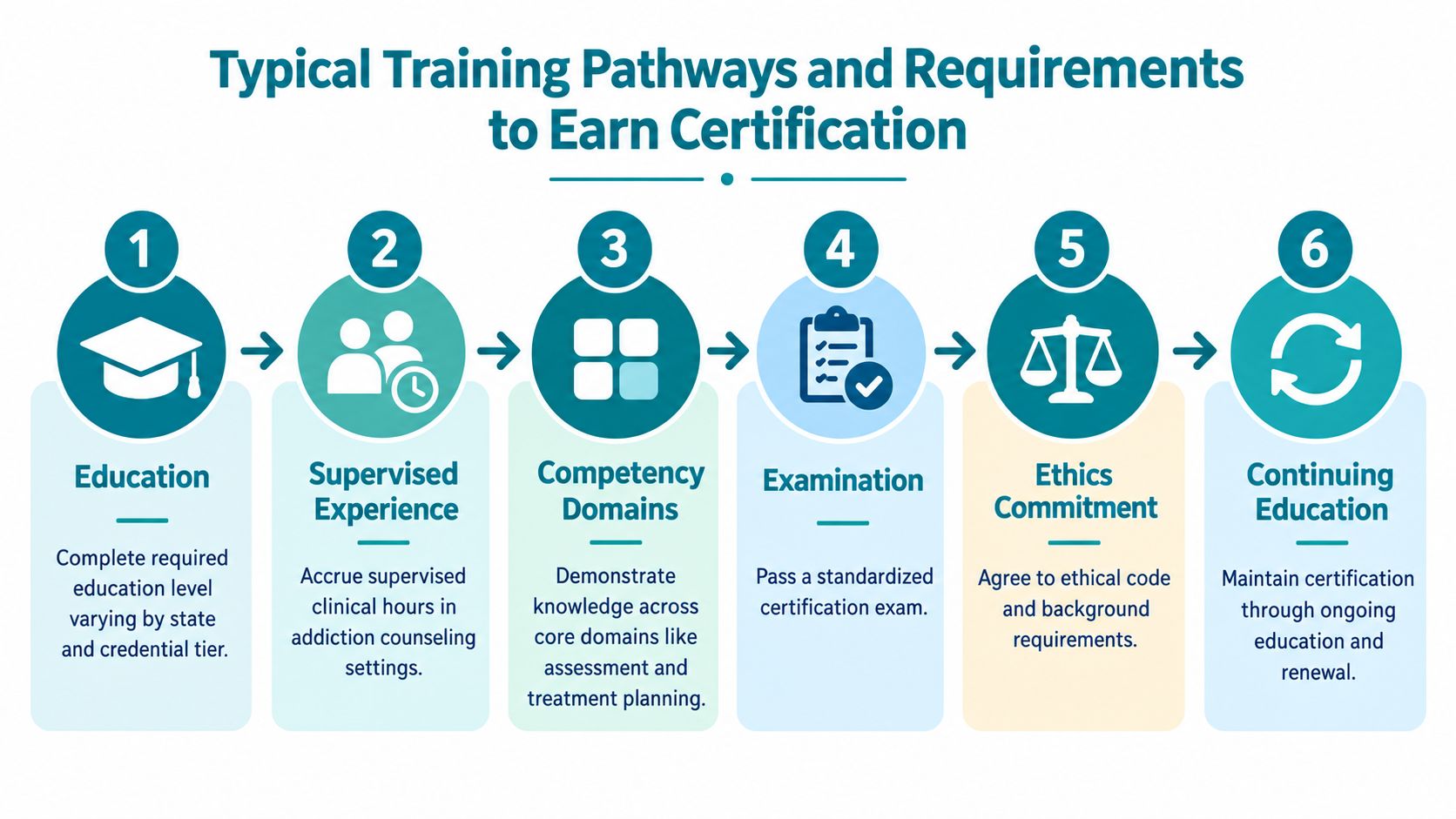
Common building blocks across many counseling certifications
Despite the variation, many addiction counseling credentials are built from the same core parts.
Education
Entry requirements differ by state and by credential tier. Some pathways begin with high school level or associate level prerequisites plus approved training hours. Others expect a bachelor's degree or graduate education. The title may sound similar even when the academic floor is very different.Supervised experience
Nearly every pathway requires documented practice under supervision. This is the apprenticeship part of the process. A trainee may be allowed to provide services, but only within the limits set by the credential and the supervisor.Core training areas
Programs usually cover screening, assessment, treatment planning, counseling methods, ethics, recordkeeping, and relapse prevention. Those topics are the frame of the house. Different states may arrange the rooms differently, but the basic structure is familiar.
A short explainer can help orient readers to the overall sequence:
Examination
Many credentials require a standardized exam or state-approved test. Passing an exam shows baseline knowledge. It does not, by itself, answer whether the person can practice independently, diagnose a mental health condition, or prescribe medication.Ethics review
Applicants are often asked to sign a code of ethics and disclose conduct issues, disciplinary history, or relevant legal history.Renewal and continuing education
Certification is usually time-limited. Ongoing education keeps the credential active and may be tied to ethics, clinical updates, or specialty topics.
Parallel tracks create confusion
Applicants often expect one clean progression from trainee to independent clinician. In practice, addiction credentials are often split across separate tracks. A state may have one path for addiction counselors, another for licensed mental health professionals who add substance use training, and another for peer support roles.
Those roles can work together well, but they are not interchangeable. A counselor certification may focus on therapy and treatment planning. A peer role may focus on lived-experience support, recovery coaching, and engagement. A physician board certification through ABPM or ABPN belongs to a different professional category entirely, with medical training, medical licensure, and a different scope of practice.
More anxious readers often get tripped up. More initials after a name can reflect more training, a different profession, or a different issuing body. The letters do not sort themselves into one universal hierarchy.
The addiction workforce also has real structural strain. The HHS ASPE workforce report, cited in Sources, describes barriers such as inconsistent state standards, reimbursement problems, and limits on independent practice pathways. Those pressures help explain why states have built multiple entry points into the field, even if the result is harder for the public to interpret.
A good example is the difference between counseling and recovery support. These peer recovery specialist insights are helpful because they show how peer roles can add value without replacing counseling, psychiatric care, or physician-led addiction treatment.
A credential tells you part of the story. The missing part is scope. Before you rely on the title, verify who issued it, what training path it represents, and what services it legally permits.
How to Verify Any Addiction Credential Before You Choose Care
A long title can create false confidence. Verification works better than impression.
“Certified Addiction Professional” is not one master credential with one national meaning. It is a family of titles issued by different boards, in different states, for different roles. That is why the safest question is not “Is this person certified?” It is “What exactly is this credential, who issued it, and what does it allow this person to do?”
Verification is a lot like checking both a driver's license and the type of vehicle someone is allowed to operate. A person may be fully qualified for one role and not qualified for another. The title alone does not answer that.
A verification-first workflow
Start with the issuer, not the bio page.
First, identify the person's underlying profession. Are you looking at a physician, counselor, social worker, psychologist, nurse, peer specialist, or facility? Then confirm the active license or credential through the primary source that governs that profession.
After that, check four things in order:
- Issuing body. Was the credential issued by a state board, a national physician board, a state certification body, or an employer or training program?
- Current status. Is it active, expired, suspended, or missing from the official directory?
- Scope. What can this person legally do under that credential in that state?
- Discipline or facility status. Are there public disciplinary actions, sanctions, or accreditation problems?
If you are sorting through alcohol-related options and are unsure whether the question is mainly medical, counseling-based, or both, this plain-language page on alcohol use questions and treatment basics can help you frame the next call.
Credential Verification Table for Addiction Professionals and Facilities
| Role | What to verify first | Where to check | What the result usually tells you | What still needs a follow-up question |
|---|---|---|---|---|
| Physician | State medical license, plus any addiction board certification | State medical board. ABPM or ABPN directory | Whether the physician is licensed to practice medicine, and whether a physician board has certified added expertise in addiction medicine or addiction psychiatry | Whether this clinician treats your condition directly, offers medication treatment, and handles co-occurring psychiatric or medical issues |
| Counselor | State license or state addiction counseling credential | State counseling board or state certification board | Whether the person is authorized for counseling services under state rules | Whether they provide only therapy, can diagnose within their license type, or coordinate with medical care when needed |
| Social worker, psychologist, nurse, or other clinician | Professional license, plus any addiction-specific credential | Relevant state licensing board and any listed certifying body | The base profession and whether the person has an added addiction-focused credential | Whether the addiction credential changes actual scope, or only documents added training |
| Peer or recovery support role | Peer certification, recovery coach credential, or program-based approval | State peer credentialing body, employer, or sponsoring program | Whether the person holds a recognized support role | Whether the role is nonclinical, whether supervision is in place, and when referral to licensed or medical care occurs |
| Facility or program | Facility license, certification, and any claimed accreditation | State agency, SAMHSA treatment locator, and the accrediting organization named by the program | Whether the program is listed and what level of care it says it provides | Whether the current services, staffing, complaints process, and accreditation status match the marketing language |
The pattern matters. A physician board directory answers a different question than a state counseling board. A facility listing answers a different question than an individual license lookup. Looking in the wrong place is one reason people end up more confused after “verifying” a credential.
Questions worth asking before you book
Bring the title down to plain language:
- What is your primary professional license or credential?
- Who issued your addiction credential, if you have one?
- Can I verify both of those online?
- What services do you personally provide, and what do you refer out?
- Do you prescribe or manage medications?
- If withdrawal, overdose risk, or psychiatric symptoms come up, who handles that?
- Is the facility licensed or accredited for the level of care it advertises?
Clear answers are a good sign. Vague answers are useful information too.
If you remember one point from this section, let it be this: verify the base license, then the addiction credential, then the real-world scope. That three-step check is usually more useful than comparing letters after a name.
When to Seek Physician Led Addiction Care Versus Counseling Only
“Certified addiction professional” can sound as if one credential answers every addiction-related need. In practice, it does not. A counseling credential may signal skill in therapy, recovery planning, and behavior change. A physician's addiction board certification points to medical training, diagnosis, medication management, and assessment of physical risk. The safest choice starts with matching the person's scope to the problem in front of you.
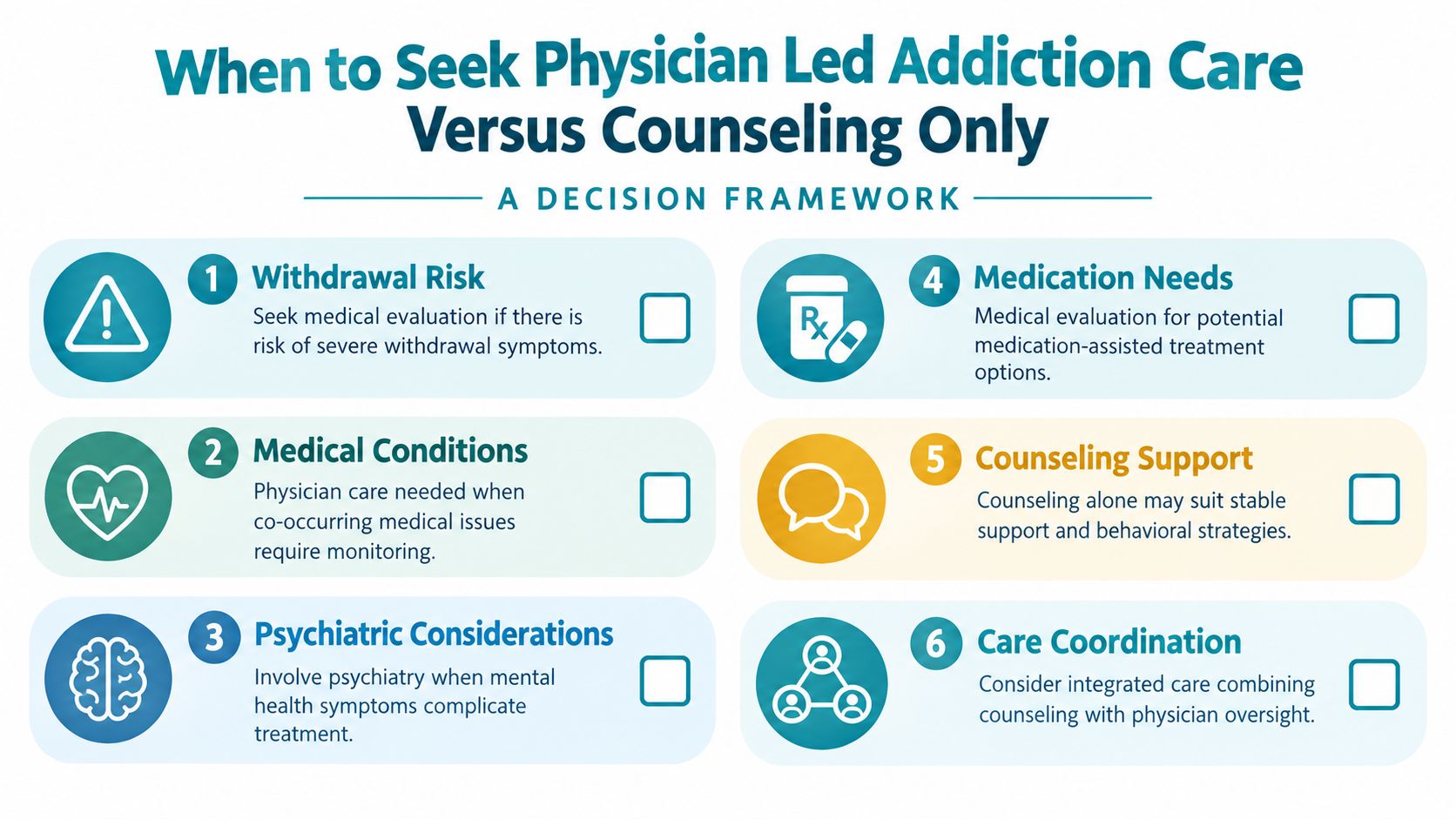
A simple way to sort this out is to ask one question first: is the main issue support, or safety?
Counseling-focused care may fit when the immediate need is motivation, coping skills, relapse-prevention work, family or relationship support, or help building a recovery plan, and there is no sign of urgent medical risk. In that setting, a counselor's training may be exactly what helps most.
Physician-led addiction care matters more when the situation could change medically, not just emotionally. Addiction medicine works a bit like the difference between a driving instructor and a mechanic. Both can help with the same car owner's problem, but they solve different parts of it. Counseling helps with patterns, triggers, and day-to-day decisions. Medical care evaluates the body, the brain, medications, and the risk of something dangerous happening soon.
A physician-led evaluation is more appropriate when any of these are present:
- Possible withdrawal from alcohol, benzodiazepines, opioids, or other substances
- A recent overdose, severe sedation, fainting, or breathing problems
- Questions about medication treatment or interactions with current prescriptions
- Pregnancy, chronic pain, liver disease, heart disease, or other health conditions that could affect treatment
- Confusion, agitation, severe anxiety, depression, suicidal thoughts, hallucinations, or other symptoms that may need medical or psychiatric assessment
Confidentiality worries often delay care. Earlier in this article, the federal privacy rules for substance use treatment records were reviewed by name. Those rules matter, but they do not change the basic triage question. If medical instability is possible, privacy concerns should not delay an urgent evaluation.
Counseling and physician care also do not compete. They often work best together. A counselor may provide the steady weekly structure, while a physician handles diagnosis, withdrawal risk, lab review, medication decisions, and coordination with other medical or psychiatric clinicians.
For adults who are specifically trying to understand medication-based outpatient care, this overview of Suboxone treatment for opioid use disorder can help clarify what kind of physician-led service is being discussed before booking.
Seek urgent medical help now if someone is hard to wake, is struggling to breathe, has chest pain, has a seizure, becomes severely confused, or may be in dangerous withdrawal. Routine counseling is not the right first stop for those symptoms.
Access Options Telemedicine and FAQs About Certified Addiction Professionals
A search result for "certified addiction professional" can create a false sense of certainty. The title sounds singular, almost like one nationwide stamp of approval. In practice, CAP often belongs to a patchwork of state and organization-based credentials. The safer approach is verification first, then booking.
Access to care depends on two separate questions. First, what kind of credential does this person hold. Second, can that clinician legally and safely provide the service you need, whether by telemedicine or in person. A counseling credential, a physician medical license, and a physician board certification answer different questions. They are related, but they are not interchangeable.
Telemedicine can widen access for adults who need an initial medical discussion, follow-up, or medication management, but only if the clinician's license, scope, and your location line up. Counseling may also be available remotely, depending on state rules and the provider's license. If the title on a website is unclear, pause there. Verification is the first screening step.
A practical way to sort the options
A common situation looks like this. An adult wants help quickly, searches for a "certified addiction professional," and lands on a website that sounds medical. A closer check shows a counseling certification rather than physician board certification in addiction medicine or addiction psychiatry.
That finding does not tell you whether the clinician is good or bad. It tells you what question to ask next. Is your main need structured counseling and recovery support, or do you also need medical assessment, diagnosis, medication review, and a physician's treatment plan.
A useful comparison is urgent car trouble. If the issue is learning better driving habits, coaching helps. If the brakes may be failing, you need a mechanic. Addiction care works the same way. Counseling addresses many important parts of recovery. Medical addiction care addresses the body, medications, withdrawal risk, and coexisting health conditions.
For adults comparing physician-led medication care with counseling-only services, this overview of buprenorphine treatment for opioid use disorder explains the type of outpatient medical visit being discussed.
Quick credential check before you book
| If the website lists this | What it usually means | What to verify first |
|---|---|---|
| Certified Addiction Professional or similar counseling title | A state or organization-based counseling credential | Issuing body, active status, and what services the credential permits |
| MD or DO | A physician license | Active state medical license and whether addiction treatment is part of the physician's practice |
| Board certified in Addiction Medicine | Physician specialty certification pathway | Confirm the certifying board and active physician licensure |
| Board certified in Addiction Psychiatry | Psychiatrist with subspecialty certification | Confirm psychiatry licensure, subspecialty certification, and whether the practice offers the service you need |
FAQ
Is Certified Addiction Professional a national license
No. It usually refers to one credential within a broader family of addiction counseling credentials. The exact meaning depends on the issuing organization and the state where the person practices.
Does a CAP title mean the person provides medical addiction treatment
Not by itself. A CAP title commonly points to counseling training and scope. Medical addiction treatment requires the appropriate professional license, and for physicians, some patients also want to confirm board certification in addiction medicine or addiction psychiatry.
Can a counselor and a physician both be part of good addiction care
Yes. Many adults use both. The counselor may provide regular therapeutic support and recovery planning. The physician may handle diagnosis, medical history, medication decisions, and coordination with other clinicians.
What should I verify first
Start with the exact credential name, the issuing body, and whether the credential is active. Then check the clinician's license type, your state, and whether the service you want is counseling, physician evaluation, medication treatment, or a combination.
Are telemedicine addiction visits available everywhere
Availability depends on state licensure rules, the clinician's scope, and the type of care being offered. Telemedicine is a delivery method, not a credential. It does not change what a clinician is legally allowed to do.
Empire Medical Wellness offers private-pay, physician-led outpatient addiction medicine for adults, including confidential medical assessment and treatment when clinically appropriate.
Sources
- Global regulatory review of addiction counselling professions
- Pennsylvania Certification Board history
- Florida Certification Board Certified Addiction Professional overview
- Review of addiction treatment occupations and credential variation
- HHS ASPE workforce report on the addiction treatment workforce
- SAMHSA statutes, regulations, and guidelines for substance use treatment
- HHS fact sheet on 42 CFR Part 2
- SAMHSA FAQ on applying confidentiality regulations to health information exchange
This article is for education only and isn't personal medical advice.
Empire Medical Wellness offers private-pay, physician-led outpatient addiction medicine for adults, including confidential medical assessment, treatment when clinically appropriate, monitoring, recovery planning, and coordination with outside clinicians or programs when authorized. If you're trying to sort out whether you need counseling support, physician-led medical care, or both, visit Empire Medical Wellness to review the practice's addiction medicine services and appointment model.