
You may be doing everything right on paper. You're eating better, walking more, and trying again after every stalled week, yet the scale still doesn't behave the way you hoped. That experience is common, and it does not mean you've failed, it means weight loss is often a medical problem that deserves more than self-directed effort alone.
Table of Contents
- The Common Experience with Weight Loss
- Why Lasting Weight Loss Can Be a Medical Challenge
- A Modern Medical Approach to Weight Management
- When to Seek Care from an Obesity Medicine Physician
- What to Expect from Your Medical Evaluation
- Building a Plan for Long-Term Maintenance
- Your Health Is a Priority
The Common Experience with Weight Loss
A lot of adults recognize this pattern. You start with real motivation, tighten up meals, add exercise, and see some early progress. Then life gets busy, hunger creeps back, or the plan becomes too hard to sustain, and the weight returns.
That cycle is common enough to show up in national data. In a nationally representative analysis, nearly half of U.S. adolescents and adults reported trying to lose weight in the prior year, but fewer than one-third of those trying achieved clinically significant weight loss, which shows how often well-intended efforts stall without structured support (NHANES analysis). When repeated attempts don't lead to lasting change, the answer usually isn't more self-criticism. It's a more complete medical plan.

Practical rule: If you've had several honest attempts and the result keeps fading, you're not alone. That's a strong reason to look at obesity medicine instead of starting another generic diet.
For many people, the question isn't whether they care enough. It's whether the method matches the biology. Obesity medicine treats weight regulation as a health issue with many moving parts, including appetite, sleep, medications, stress, and long-term follow-up. That approach can feel very different from commercial dieting, because it starts with the body, not blame.
Empire Medical Wellness weight loss care uses a physician-led model for adults who want that kind of support. The focus is on health, not appearance, and on finding a plan that can be lived with over time.
Why Lasting Weight Loss Can Be a Medical Challenge
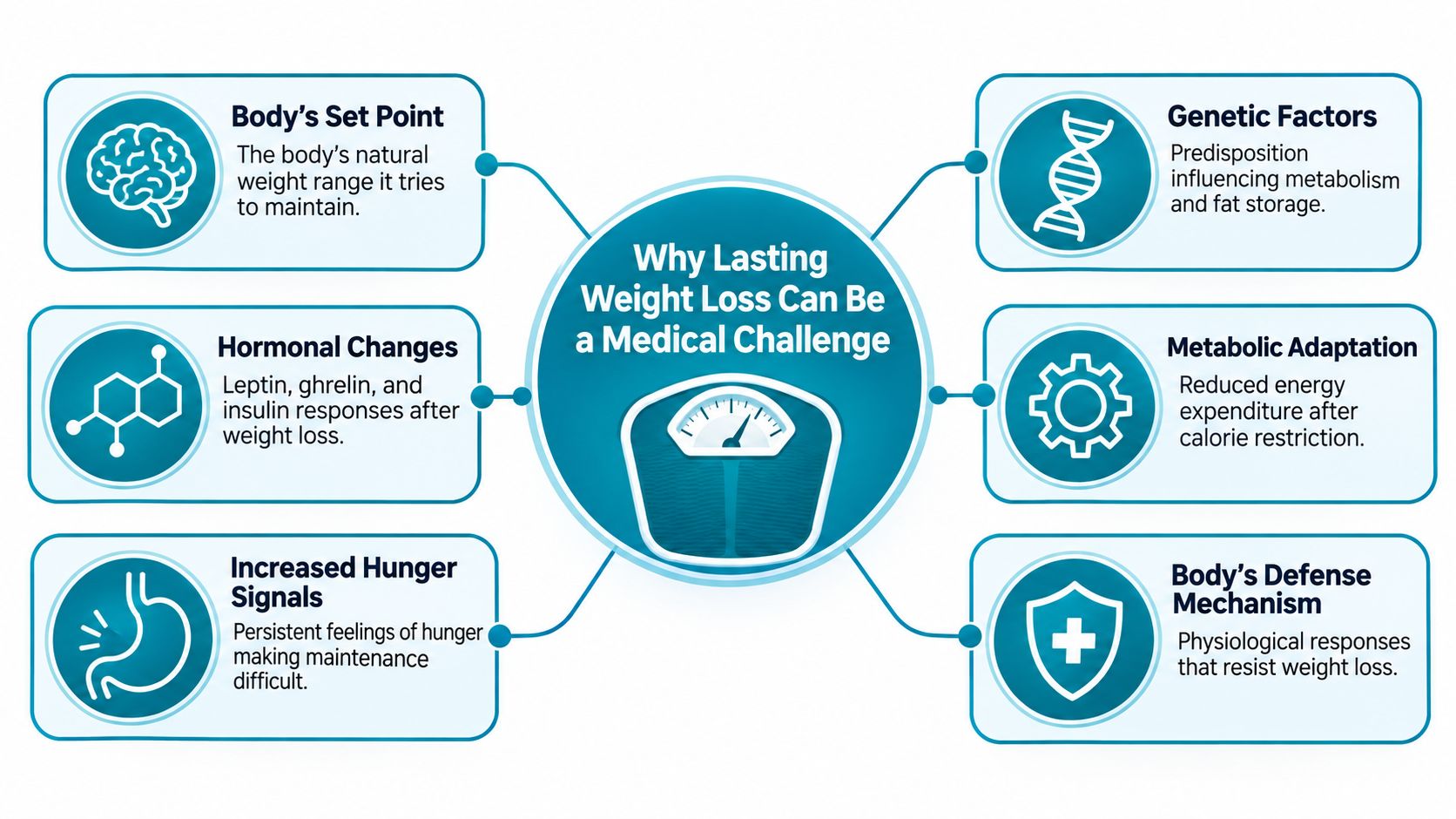
The body is not passive during weight loss. As weight drops, the body often tries to defend the higher weight it previously maintained. That's one reason people can feel hungrier, more tired, and less able to keep losing at the same pace.
Metabolic adaptation in plain language
Metabolic adaptation means your body burns fewer calories than expected after weight loss. A simple way to think about it is a thermostat. If you lower the temperature in a room, the system can push back toward the old setting. The body behaves a bit like that, except the “setting” involves hunger, energy use, and hormonal signals.
A review of weight-loss maintenance describes this as an adaptive response to negative energy balance, with coupled changes in energy intake, energy expenditure, and neuroendocrine signaling (maintenance physiology review). In practical terms, that means it gets harder to keep losing weight, and easier to regain it, unless maintenance is planned from the start.
Why biology matters more than motivation
A common misconception arises when people assume that if weight came off once, keeping it off should be simple. But evidence shows the opposite. In a meta-analysis of 29 long-term weight-loss studies, more than half of lost weight was regained within 2 years, and over 80% was regained by 5 years (long-term maintenance meta-analysis). That's not a moral failure. It's a predictable biological challenge.
If you've ever wondered whether hormones are part of the picture, a clinician may sometimes consider whether additional testing is useful in context. A resource like get tested for leptin can help explain one hormone that plays a role in appetite regulation, but it's only one piece of a much larger system.
Can Benadryl make you gain weight? is another example of how medication review matters, because not every barrier to weight change is about food choices. Some prescription and over-the-counter drugs can affect appetite, energy, or weight trajectory, so a careful review is part of good obesity care.
The body protects its prior balance point. A good treatment plan works with that biology instead of pretending it isn't there.
A Modern Medical Approach to Weight Management
A modern obesity care visit usually starts by sorting the problem into three parts. Behavior matters, medical assessment matters, and medication can matter when it is clinically appropriate. Each part has a role, and none of them should be treated like a shortcut that replaces the others.
Behavior that can be maintained
The CDC describes successful weight management as a process that includes nutrition, physical activity, stress management, and sleep. It also notes that people who lose weight gradually, at about 1 to 2 pounds per week, are more likely to keep it off long-term (CDC guidance). That does not mean faster change is always wrong. It means the plan has to fit real life if it is going to hold up.
A useful way to see this is through meal structure. One person may do better with a steady breakfast and a planned lunch, while another may need simpler dinners, more protein at certain meals, or a grocery routine that takes less effort. A plan works best when it can be repeated on ordinary weeks, not only during a burst of motivation. Small choices that are easy to keep doing often matter more than a perfect day that cannot be repeated.
Medical assessment changes the plan
A physician-led visit looks at the full picture of weight change. That includes weight history, current medicines, blood pressure or blood sugar concerns, sleep, mood, and prior attempts. In real practice, that matters because two people can have the same weight and still need very different support.
The medication discussion is part of that same evaluation. GLP-1 vs phentermine at Empire Medical Wellness is a useful way to compare medication classes, because some treatments reduce appetite through newer hormone pathways while others work differently. The right option depends on a person's health history, tolerance, and goals, not just on what is most familiar or most talked about.
Medication as one tool, not the whole plan
Anti-obesity medications can be helpful tools, but they are not stand-alone solutions. They are used alongside nutrition, activity, and follow-up. The clinical goal is to support the biology that makes maintenance hard, while still building habits that can continue after the initial loss phase.
Medicine works best as part of a larger plan, the way glasses help vision but do not change the eye itself. The prescription can reduce one barrier, yet the day-to-day structure still matters. If medication is used without attention to eating patterns, movement, sleep, and monitoring, the plan is more likely to stall when treatment changes.
A program also has to match the person, which is why a comparison such as GLP-1 vs phentermine at Empire Medical Wellness can help clarify how different options fit different medical situations. The point is not to replace behavior with medication. It is to use the right tools together so the plan is more durable than a short-term diet.
When to Seek Care from an Obesity Medicine Physician
A common pattern starts with good effort and rising frustration. You try a plan on your own, get some short-term progress, then watch the same weight return once the structure fades. That is often the point where physician-led care becomes useful, because the problem is no longer just effort, it is the biology and context that keep pulling weight back.
You do not need to wait until things feel severe before asking for help. If weight is affecting your health, your energy, or your ability to trust your current approach, a specialist can help you sort out what is happening and what to do next.
Repeated unsuccessful attempts are one clear sign. So are weight-related concerns such as high blood pressure, prediabetes, sleep problems, or joint pain. Feeling stuck matters too. If you have been moving through diets, losing some weight, and regaining it, obesity medicine may fit better than another generic program that assumes the same advice works for every person.
Commercial weight loss and medical obesity care are not the same. A physician can look for health conditions that affect weight, review medications that may contribute to gain, and decide whether prescription treatment is appropriate. That matters because weight is rarely shaped by one factor alone. It is more like a set of overlapping levers, and the right plan depends on which ones are driving the problem.
Medication review is often part of that process, including a mental health medication review when a person is taking treatments that may affect appetite, sleep, or energy. Even when weight is the main concern, the full medication list can reveal important clues about why progress has been difficult.
Practical rule: If your current approach keeps failing in the same way, do not assume the answer is more discipline. Consider a different level of care.
Physician-led treatment is especially useful when you want structure, accountability, and a plan that changes with your response. It is more like ongoing coaching than a one-time recommendation. Obesity medicine starts with assessment, continues with follow-up, and adjusts the plan as your body, habits, and treatment response evolve.
What to Expect from Your Medical Evaluation
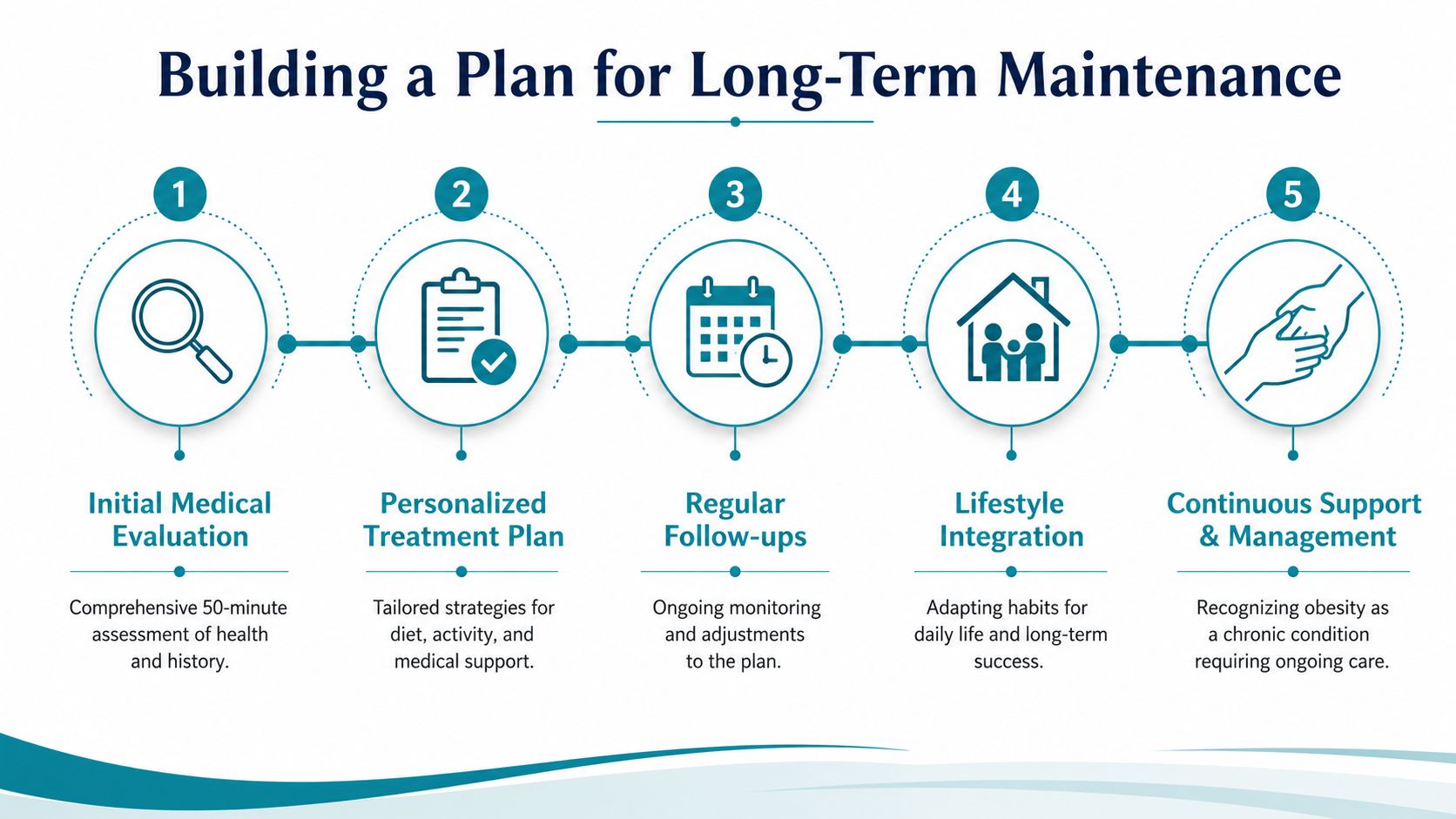
At Empire Medical Wellness, the first obesity medicine visit is a 50-minute initial evaluation. The appointment is designed to gather your weight history, relevant medical history, current medications, eating patterns, activity level, sleep, stressors, and what you've tried before. The purpose is to build a plan that makes medical sense for you, not to judge past attempts.

During that first visit, the physician is also looking for clues about what might be getting in the way. That could include medication effects, emotional eating patterns, poor sleep, or a health condition that needs attention. The conversation is collaborative. You're not handing over control, you're building a clearer map.
A follow-up visit is typically 25 minutes. That time is used to review progress, discuss side effects if medication is being used, revisit habits that are working or not working, and adjust the plan based on your response. For many patients, that regular check-in is what turns an effort into a process.
The practice's model is private-pay, and the current workflow supports telemedicine for adults physically located in New York, New Jersey, Connecticut, Pennsylvania, or Virginia. If mental health medication review is part of the broader picture, the physician can consider that too, because weight and medication choices often interact.
After the first evaluation, the clinical goal is clarity. You should leave knowing what the next step is, why it was chosen, and how progress will be monitored.
A short video can also help demystify the kind of conversation that happens in a visit like this.
Building a Plan for Long-Term Maintenance
A patient leaves the first phase of weight treatment feeling encouraged, then the sustained effort begins. The early result matters, but long-term maintenance is where medical care earns its place. The body resists change, daily routines shift, and the plan has to account for both.
Maintenance starts early
Weight regain after initial loss is common, and the pattern has been described in long-term studies of weight treatment. That is why maintenance should be discussed before the first goal is reached, not after the scale has already started to drift back upward.
In a medical practice, the maintenance phase shifts the focus from short-term loss to durability. The clinician looks at which eating patterns are realistic, which routines can survive a busy week, and whether medication should be continued, adjusted, or reassessed based on the response so far. The goal is not a perfect number on the scale. It is a steadier pattern that can be carried into ordinary life.
Support has to match real life
Real life rarely cooperates with a strict plan. Work schedules change, budgets tighten, travel comes up, and family obligations stack up. A useful maintenance plan has to work on a difficult week, not only on a week when everything goes right.
For some patients, simple low carb meal ideas can make that easier by giving structure without demanding constant decision-making. In a medical setting, tools like that are most useful when they support consistency and fit the person's actual routine.
Long-term success also depends on tracking trends instead of reacting to one weigh-in. A stable routine, regular follow-up, and honest discussion about side effects or setbacks all matter. If medication is part of care, the plan often needs to be revisited over time rather than left unchanged out of habit.
Empire Medical Wellness's balanced diet and weight loss page reflects this maintenance mindset, because lasting improvement usually depends on more than one behavior. The right plan is one that can hold up during normal life, not just during a burst of motivation.
Key takeaway: Long-term maintenance is not a sign that treatment failed. It is the part of treatment that protects the progress you already made.
Your Health Is a Priority
Weight regulation is complex, and the evidence is clear that lasting change is hard to achieve without long-term support. That's why physician-led obesity medicine exists. It gives you a structured place to evaluate the biology, the habits, and the medications that may be relevant to your situation.
If you've been stuck in the cycle of trying hard, losing some ground, and starting over, that doesn't mean the effort was wasted. It means the approach probably needs more medical support, more follow-up, and a longer maintenance plan. If you want a calm, physician-led conversation about obesity medicine, visit the practice's obesity care page and see whether this model fits your goals. For readers who like to plan ahead, a smarter macro plan for sustainable results can also be a useful companion to a broader medical strategy.
Empire Medical Wellness offers physician-led obesity medicine with careful evaluation, individualized planning, medication management when appropriate, and long-term follow-up. If you're looking for a structured, respectful approach to weight loss that puts health first, visit Empire Medical Wellness to learn more.
This article is for educational purposes only and isn't personal medical advice.