
Tirzepatide starts at 2.5 mg once weekly for 4 weeks, then increases by 2.5 mg no faster than every 4 weeks. Labeled maintenance doses are 5 mg, 10 mg, or 15 mg weekly, with a 15 mg weekly maximum, and only a prescriber determines treatment changes.
Could the right question be less about reaching the highest number and more about finding the dose that balances response, tolerability, and long-term maintenance? A dose chart can show the available steps, but it can't determine which product, indication, formulation, or treatment plan is appropriate for a particular adult.
This guide focuses on FDA-labeled tirzepatide doses for adults researching physician-led obesity care. It explains how titration works, why Mounjaro and Zepbound shouldn't be treated as interchangeable prescriptions, what the clinical trial evidence shows, and which symptoms need routine follow-up versus prompt medical attention. It isn't a personal dosing plan, and only a licensed prescriber should start, pause, delay, increase, reduce, or otherwise change treatment.
Table of Contents
- What Tirzepatide Doses Are and How They Work
- Mounjaro and Zepbound Are Not Interchangeable Doses
- Starting Dose and Stepwise Titration Schedule
- Maintenance Doses and What Evidence Shows by Dose
- Side Effects Monitoring and When Dose Adjustments Are Considered
- Missed Doses Red Flags and Common Versus Urgent Symptoms
- Talking With Your Prescriber About the Right Maintenance Dose
What Tirzepatide Doses Are and How They Work
What does a tirzepatide dose describe? It identifies the amount of medication given at one time, while the schedule explains how that amount changes over treatment. Tirzepatide is a dual GIP/GLP-1 receptor agonist, meaning it acts on two incretin hormone pathways involved in glucose regulation and appetite signaling. FDA-approved products are given as a once-weekly subcutaneous injection, under the skin rather than as a daily tablet. Current labels describe an initiation dose of 2.5 mg once weekly, followed by stepwise increases, with maintenance options of 5 mg, 10 mg, or 15 mg weekly and a maximum of 15 mg weekly (FDA Mounjaro prescribing information, FDA Zepbound prescribing information).
Three terms clarify the dosing map:
- Initiation dose: the amount used to introduce the medication. 2.5 mg is an initiation dose, not a labeled long-term maintenance dose for obesity treatment.
- Titration: planned, stepwise dose adjustment. Tirzepatide increases by 2.5 mg, with changes no faster than every 4 weeks.
- Maintenance dose: the dose continued after escalation is complete or paused. For obesity treatment, labeled choices are 5 mg, 10 mg, or 15 mg weekly.
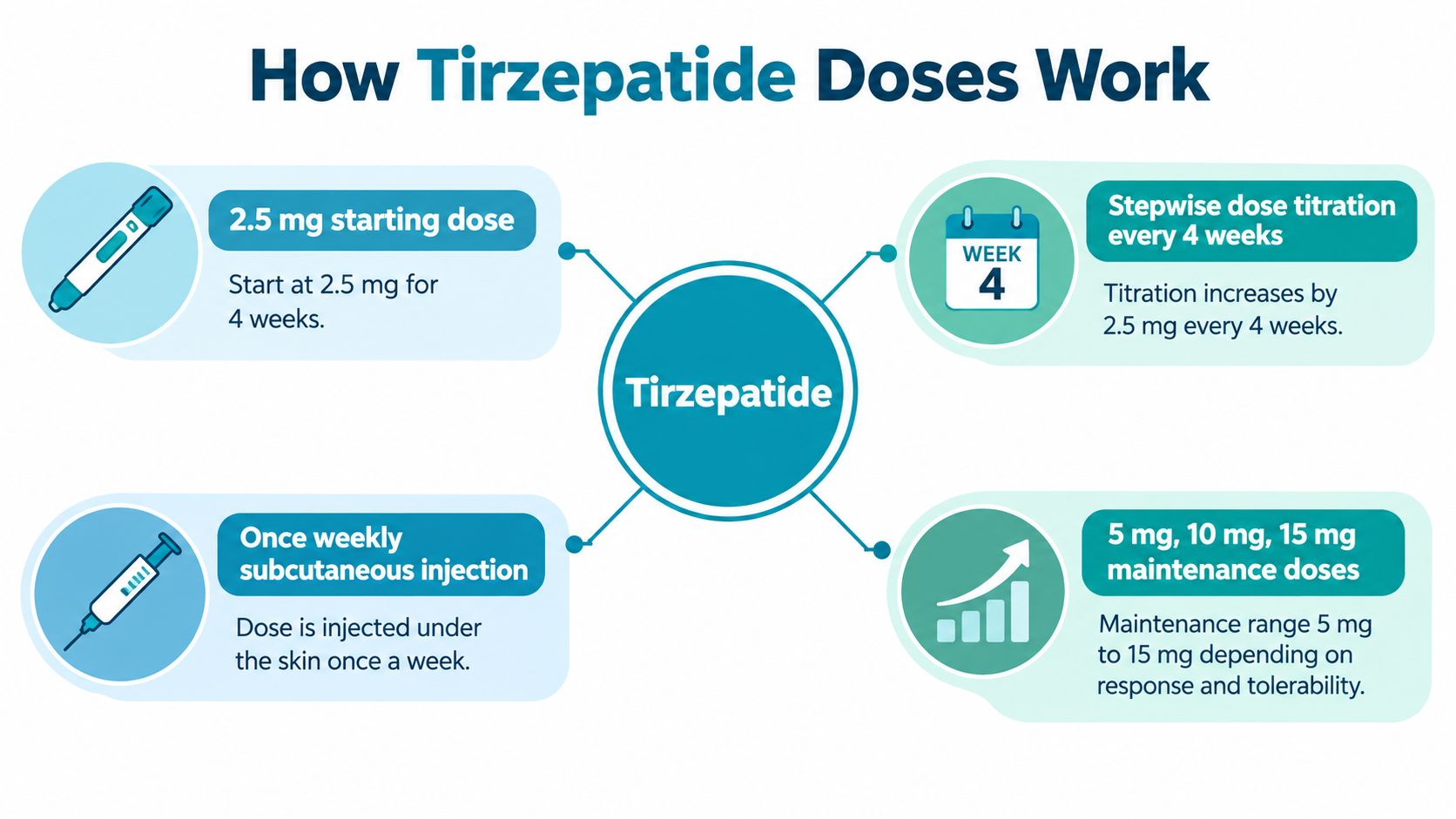
Gradual escalation gives the body time to adjust. FDA labeling describes this structure as supporting tolerability, particularly by reducing gastrointestinal intolerance while the prescriber assesses response (FDA tirzepatide labeling). Research may show a stronger average response at higher doses, but the highest labeled dose is not automatically the best maintenance choice for every adult.
Mounjaro and Zepbound share tirzepatide, yet the product, indication, and individual medical history still guide prescribing. For general background, read what to know about GLP-1 drugs, or review Empire Medical Wellness's information about tirzepatide treatment. Educational material can explain the options, but a licensed prescriber must decide whether to start, delay, increase, reduce, or otherwise change treatment.
Mounjaro and Zepbound Are Not Interchangeable Doses
How can two products containing the same medicine have different dosing instructions? The answer is that active ingredient, product, formulation, and FDA-approved indication all matter.
Mounjaro and Zepbound both contain tirzepatide. Mounjaro is labeled for adults with type 2 diabetes. Zepbound is labeled for chronic weight management in appropriate adults and for certain adults with obesity-related obstructive sleep apnea. Each product has its own prescribing information, so the indication helps determine eligibility, treatment goals, monitoring, and labeled use.
| Product and active ingredient | FDA-approved indication | Formulation and schedule | Labeled doses |
|---|---|---|---|
| Mounjaro, tirzepatide | Adults with type 2 diabetes | Subcutaneous injection, once weekly | Starts at 2.5 mg; increases by 2.5 mg steps no faster than every 4 weeks; labeled doses extend to 15 mg once weekly (FDA Mounjaro label) |
| Zepbound, tirzepatide | Chronic weight management in appropriate adults, and certain adults with obesity-related obstructive sleep apnea | Subcutaneous injection, once weekly | Starts at 2.5 mg; labeled maintenance doses are 5 mg, 10 mg, or 15 mg weekly; maximum 15 mg weekly (FDA Zepbound label) |
Use the table as a product-and-indication reference, not as a conversion chart. A prescriber needs to confirm the exact product, formulation, contraindications, other glucose-lowering or incretin medicines, pregnancy plans, and procedure timing before deciding whether treatment is appropriate.
Semaglutide creates a separate source of confusion. It is a different incretin medicine, so semaglutide and tirzepatide aren't dose equivalents. A semaglutide dose should not be translated into a tirzepatide dose without prescriber direction.
Do not use another person's pen or assume that a pharmacy instruction for one product applies to the other. Information about Zepbound care can provide general context, but current product labeling and a clinician's assessment determine how the treatment should be prescribed.
Starting Dose and Stepwise Titration Schedule
How does the labeled tirzepatide schedule move from an introduction dose to a maintenance choice? It begins with 2.5 mg once weekly for 4 weeks. If the prescriber considers escalation appropriate, the dose can increase in 2.5 mg steps no faster than every 4 weeks. This interval gives the body time to adjust and may reduce gastrointestinal intolerance. It is a safety interval, not a deadline for reaching the highest dose, as described in the FDA Zepbound prescribing information.
The sequence can be read like a staircase:
2.5 mg → 5 mg → 7.5 mg → 10 mg → 12.5 mg → 15 mg, once weekly
The intermediate steps, 7.5 mg and 12.5 mg, support gradual escalation. For obesity treatment, the labeled maintenance choices are 5 mg, 10 mg, and 15 mg. A step used during titration is therefore different from a maintenance dose selected for ongoing treatment.
The FDA describes reaching a target dose over 4 to 20 weeks, depending on the treatment pathway and target selected (FDA announcement on Zepbound). The prescriber still determines whether the next increase is appropriate. Significant or persistent symptoms can lead to delaying escalation. Patients should not create custom doses, change injection timing, or alter the step size independently.
Why 2.5 mg is an initiation dose
The 2.5 mg dose introduces tirzepatide but is not a labeled maintenance dose for obesity management. Staying at that dose temporarily, delaying an increase, or moving to a maintenance option depends on tolerability, treatment response, medical history, and prescriber review.
A weekly schedule also needs missed-dose planning. Current labeling states that a missed dose should be taken within 4 days, or 96 hours, or skipped according to the product instructions (FDA tirzepatide labeling). Do not double doses or create a replacement schedule.
Readers preparing for a clinician discussion can review the practice's Mounjaro dosing information for general context. The current prescribing information and clinical assessment remain the basis for treatment decisions.
Maintenance Doses and What Evidence Shows by Dose
What makes one maintenance dose more suitable than another? Once titration reaches a labeled option, the decision is no longer about reaching the highest dose. It involves weighing expected response, side effects, medical context, and the goal of maintaining benefit over time.
| Labeled product | Indication | Formulation | Labeled maintenance doses |
|---|---|---|---|
| Mounjaro | Type 2 diabetes | Tirzepatide injection | 5 mg, 10 mg, or 15 mg once weekly |
| Zepbound | Chronic weight management | Tirzepatide injection | 5 mg, 10 mg, or 15 mg once weekly |
In the obesity trial published in the New England Journal of Medicine, tirzepatide was studied at 5 mg, 10 mg, and 15 mg weekly. At least 5% weight reduction occurred in 85% of participants receiving 5 mg, 89% receiving 10 mg, and 91% receiving 15 mg, compared with 35% receiving placebo (NEJM obesity trial). The 15 mg dose was associated with the greatest average weight reduction, showing a dose-related pattern among the studied maintenance doses.
These findings describe groups, not individual guarantees. A higher dose may produce a greater average response while creating side effects that make continued treatment harder for a particular person. The practical question is whether a given dose provides enough benefit to justify its tolerability and monitoring requirements.
How to interpret each option
- 5 mg can be a meaningful maintenance dose. In the obesity study, it was an active maintenance dose rather than only a temporary transition.
- 10 mg may offer additional average response. It remains one of the labeled maintenance options, with the same need for clinical review.
- 15 mg is the highest listed maintenance option. Its higher average result does not mean it is appropriate for every patient.
- 2.5 mg serves a different purpose. It is the labeled initiation dose, not a labeled obesity maintenance target.
Dose selection should follow the labeled product and indication. Mounjaro and Zepbound should not be treated as interchangeable prescriptions, and tirzepatide should not be switched with semaglutide without prescriber guidance. For context, review this comparison of semaglutide and tirzepatide.
Side Effects Monitoring and When Dose Adjustments Are Considered
Could side effects affect whether a planned dose increase continues? Yes. Titration is also a tolerability strategy. Nausea, diarrhea, vomiting, constipation, and abdominal discomfort can influence the next treatment decision. The FDA prescribing information describes gradual increases to help reduce gastrointestinal intolerance, although side effects can still occur.
Before changing the next step, a prescriber may review:
- Symptoms and severity: whether symptoms are mild, persistent, worsening, or interfering with hydration and daily activities.
- Timing: whether they began after an increase, continue between doses, or point to another medical cause.
- Other therapies: whether other glucose-lowering or incretin medicines could affect safety or tolerability.
- Pregnancy plans: whether pregnancy is current or planned, because this changes the medication discussion.
- Procedures: whether an upcoming procedure requires medication planning.
- Product details: whether the prescription and formulation match the FDA-labeled product and indication.
These details help separate a manageable adjustment from a situation needing prompt assessment. Only a prescriber should decide whether to continue, delay, reduce, or otherwise change tirzepatide treatment.
Appetite changes can also make regular eating more difficult. A general GLP-1 protein snacks guide may provide practical food ideas, but it does not replace medical assessment or individualized nutrition guidance.
A clearly labeled composite example
Hypothetical composite example: An adult reports nausea after an escalation. The prescriber checks the exact product, symptom severity, hydration, possible alternative causes, other medicines, and the current FDA labeling. The next step may be to hold or delay escalation while tolerability is evaluated, rather than assuming the highest dose is the right goal.
This is not an Empire Medical Wellness patient story and does not predict care for a specific reader. Individual circumstances determine the appropriate response. Severe or persistent symptoms should not be managed by guessing from an online dose chart. For general background, see this tirzepatide side effects overview, while remembering that educational material is not a substitute for urgent care when red flags appear.
Missed Doses Red Flags and Common Versus Urgent Symptoms
What should you do after missing a weekly tirzepatide dose? The FDA-labeled rule is practical: take the missed dose within 4 days, or 96 hours. If more time has passed, skip it and resume the regular weekly schedule. Do not double the dose or create a new schedule without speaking with the prescriber. This timing rule applies according to the labeled product and indication, so the FDA tirzepatide labeling should remain the reference.
Symptoms also need triage. Mild gastrointestinal effects may call for routine contact with the prescribing office, while certain patterns require prompt or emergency care. The FDA Zepbound Medication Guide provides product-specific safety information.
| Symptom pattern | What it may mean for next steps |
|---|---|
| Nausea, diarrhea, constipation, or mild vomiting that remains manageable | Arrange routine follow-up, especially if symptoms persist or began after an escalation. Do not change the dose independently. |
| Persistent vomiting or diarrhea, inability to maintain hydration, or worsening weakness | Seek prompt medical guidance. A clinician may assess dehydration, tolerability, and other possible causes. |
| Severe or persistent abdominal pain, especially with vomiting or pain extending to the back | Seek urgent medical evaluation instead of assuming the symptom is routine. |
| Symptoms of a serious allergic reaction, such as facial or throat swelling, trouble breathing, or a widespread severe rash | Seek emergency medical care immediately. |
| Severe low-blood-sugar symptoms while using other glucose-lowering treatment | Seek prompt medical guidance. Confusion, fainting, or inability to respond requires urgent attention. |
This table cannot diagnose a complication. It separates questions suitable for routine follow-up from symptoms that should not wait for a scheduled appointment. If the situation is unclear, use the product's Medication Guide, contact the prescriber, or seek emergency care for severe symptoms.
Talking With Your Prescriber About the Right Maintenance Dose
How do you and your prescriber decide which maintenance dose fits your treatment goals? The answer depends on more than choosing the highest available number. Bring the exact product name, indication, formulation, current dose, injection schedule, symptom pattern, other medicines, pregnancy plans, and upcoming procedures. Together, these details help clarify whether the decision concerns treatment response, tolerability, safety, or longer-term planning.
A useful appointment can start with four questions:
- Response: Is the current dose meeting the treatment goal, or has progress reached a clinically meaningful plateau?
- Tolerability: Are gastrointestinal or other symptoms mild and improving, or do they make escalation inappropriate?
- Maintenance: If the current dose is effective and tolerated, is remaining there consistent with the product label and the person's clinical circumstances?
- Long-term planning: What monitoring and follow-up will help maintain treatment benefit over time?
The label separates initiation from maintenance. For obesity treatment, 2.5 mg isn't a labeled long-term maintenance dose, while 5 mg, 10 mg, and 15 mg are labeled maintenance options. Trial results showed greater average reduction at higher doses, but that finding does not establish one dose as right for every person. A prescriber weighs the expected benefit against symptoms, medical history, other medicines, and whether the current dose is already meeting its purpose.
Long-term treatment may be considered when it remains effective and helps address the risk of weight regain. That does not mean every person needs the highest dose or indefinite treatment. Maintenance is better understood as a review process: assess the goal, check how the dose is tolerated, confirm the product and indication, and revisit the plan as circumstances change.
Frequently asked questions
Is 15 mg required for tirzepatide to work?
No. The obesity trial found clinically meaningful responses at 5 mg, 10 mg, and 15 mg, and the labeled maintenance options include all three. A prescriber decides whether remaining at a lower maintenance dose is reasonable or whether escalation should be considered.
Is semaglutide dosed the same way?
No. Semaglutide and tirzepatide are different medicines with product-specific FDA labels. Their brands, formulations, indications, contraindications, and dose schedules are not interchangeable.
Can a person create a custom tirzepatide dose?
A person should not create, measure, or change a dose independently. A pause, delay, reduction, escalation, or product change requires review by a licensed prescriber who can consider the current label and the individual's clinical context.
What should someone ask after missing several doses?
Contact the prescribing clinician before restarting or changing the schedule. The labeled missed-dose rule addresses a dose missed within or beyond the 4-day, 96-hour window, while a longer interruption may require product-specific clinical review rather than guesswork.
Adults considering physician-led obesity care can visit Empire Medical Wellness to learn about evaluation, medication discussions when clinically appropriate, monitoring, and longer-term weight-management planning. The practice provides private-pay outpatient care, with availability and treatment decisions based on clinical assessment.
This article was published on September 18, 2026, and provides educational information, not personal medical advice. It does not diagnose conditions or tell any reader to start, stop, or change medication.
Byline: Empire Medical Wellness Editorial Team