
A practical way to calculate a calorie deficit is to estimate daily energy needs, then set intake about 500 to 750 kcal below total daily energy expenditure, a commonly used starting range for gradual weight loss. Recheck that estimate against two to three weeks of real weight trends, because formulas predict energy needs but don't guarantee how your body will respond.
You may be comparing calculator results late at night, wondering why one tool gives you a different maintenance target than another. The confusion is understandable. Calculating calorie deficit involves useful math, but the math is only a starting point. Food portions, daily movement, sleep, medications, medical conditions, and changes in energy expenditure can all affect the result.
A clinician-led approach treats the calculation as a feedback loop. First estimate resting needs, convert that estimate into total daily needs, choose a tolerable reduction, and then adjust based on intake records, hunger, strength, adherence, and the trend in body weight.
Table of Contents
- What a Calorie Deficit Actually Is
- Estimating BMR with Mifflin-St Jeor
- Turning BMR into TDEE with Activity Multipliers
- Choosing a Safe Deficit and a Worked Example
- Why the 3,500-Calorie Rule Overstates Results
- Tracking Weekly and Recalibrating the Deficit
- Common Pitfalls and When to Seek Medical Supervision
What a Calorie Deficit Actually Is
Suppose your calculated maintenance intake is 2,400 kcal, but your food log averages 1,900. That gap is a starting estimate, not a guaranteed rate of weight loss. A calorie deficit exists when energy use exceeds energy from food and drinks, and the difference must persist long enough to evaluate the resulting weight trend.
The working relationship is:
Daily calorie target = estimated TDEE − chosen deficit
Total daily energy expenditure, or TDEE, includes resting metabolism, planned exercise, routine movement, and the energy used to digest food. Basal metabolic rate, or BMR, represents the resting component. A typical calculation estimates BMR first, then applies an activity multiplier to approximate TDEE.
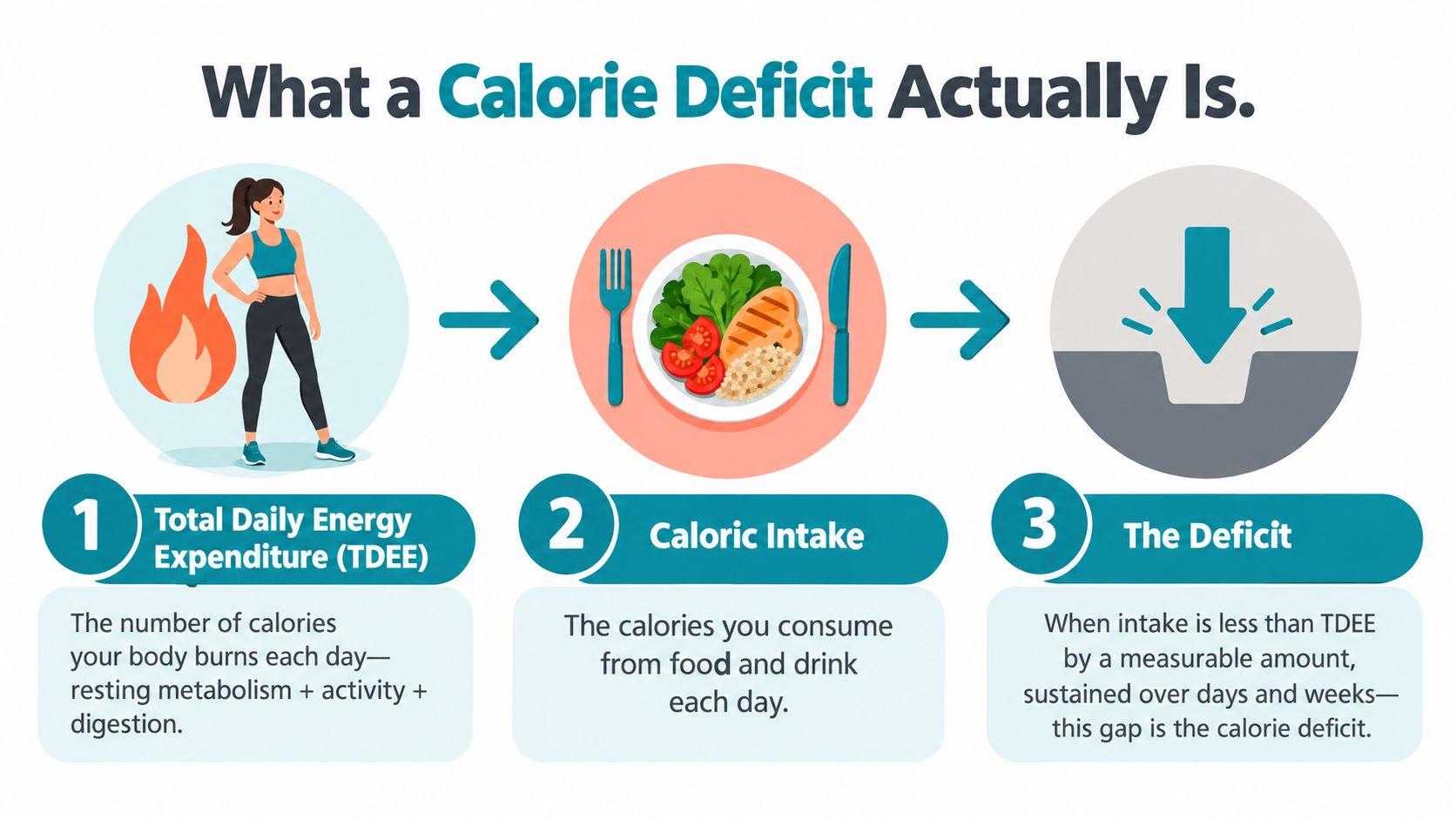
The four-part method
- Estimate BMR. Use a validated equation as an initial input, or use the NIDDK Body Weight Planner to model calorie and activity plans for reaching and maintaining a goal weight.
- Estimate TDEE. Multiply BMR by an activity category. Treat the result as a working estimate because activity categories do not measure every movement or day-to-day change.
- Select a deficit. A common starting strategy is 500 to 750 kcal per day. The appropriate choice depends on available intake, hunger, training demands, health conditions, and how well the person can sustain it. An NIH evidence summary identifies this range as a common starting approach for weight loss.
- Recheck the trend. Compare the food record with consistent weight data over two to three weeks. Review portion estimates, unlogged drinks, restaurant meals, weekend intake, and changes in activity before changing the target.
Formulas can miss differences in lean mass, non-exercise activity, digestion, and metabolic adaptation. A proven plan for reducing body fat may provide additional body-fat context, but it does not replace medical assessment when weight management is complicated.
For calculation details, see Empire Medical Wellness's calorie-deficit guide. Use the TDEE-minus-deficit formula to set the first target, then judge it against the next two to three weeks of measured intake and weight trends.
Estimating BMR with Mifflin-St Jeor
A 38-year-old woman weighing 70 kilograms at 165 centimeters may calculate a BMR near 1,380 kcal per day. That figure can start the discussion, but it does not prescribe her intake or predict the scale precisely.
BMR estimates the energy the body uses at rest. The Mifflin-St Jeor equation is commonly used when indirect calorimetry, which measures energy expenditure through gas exchange, is unavailable. Current clinical guidance describes it as a useful estimator, while emphasizing that the result needs clinical interpretation and adjustment (2025 VA/DoD obesity guideline).
The equation is:
- Male: BMR = 10 × weight in kilograms + 6.25 × height in centimeters − 5 × age + 5
- Female: BMR = 10 × weight in kilograms + 6.25 × height in centimeters − 5 × age − 161
The sex terms are statistical inputs used by the equation. They do not diagnose anything or fully describe an individual's physiology. Body composition, medical conditions, medications, treatment history, and changes in activity can make a standard estimate less representative.
Hypothetical worked example
| Variable | Value | Multiplied term |
|---|---|---|
| Weight | 70 kg | 10 × 70 = 700 |
| Height | 165 cm | 6.25 × 165 = 1,031.25 |
| Age | 38 years | −5 × 38 = −190 |
| Female constant | Not a measured value | −161 |
| Estimated BMR | Starting estimate | 700 + 1,031.25 − 190 − 161 = 1,380.25 kcal/day |
Rounded to the nearest calorie, the result is approximately 1,380 kcal per day. It is a starting estimate, not a guaranteed requirement. Errors in weight, height, or age inputs change the result, and the equation cannot capture every factor affecting energy expenditure.
Use the NIDDK Body Weight Planner when a person needs a tool that models both weight loss and later maintenance. Indirect calorimetry may provide more individualized information in selected clinical settings, although availability and interpretation vary.
Clinician checklist: verify the inputs, review body composition and medical factors, then compare the calculated target with food records and weekly weight trends before making a larger adjustment.
Clinical perspective: A calculated BMR is one assessment input, not a calorie prescription.
Turning BMR into TDEE with Activity Multipliers
To estimate TDEE, BMR is multiplied by an activity factor. The categories below are conventional planning tools. They don't directly measure how many calories a particular person burns, and the biggest source of uncertainty is often how activity is classified.
Using the hypothetical BMR of approximately 1,380 kcal per day, the estimates look like this:
| Activity level | Multiplier | Estimated TDEE |
|---|---|---|
| Sedentary | 1.2 | 1,656 kcal/day |
| Lightly active | 1.375 | 1,898 kcal/day |
| Moderately active | 1.55 | 2,139 kcal/day |
| Very active | 1.725 | 2,381 kcal/day |
| Extra active | 1.9 | 2,623 kcal/day |
These figures are rounded estimates based on the worked example above. A person may exercise regularly yet spend much of the remaining day seated. Another person may not have formal workouts but may walk, stand, and move frequently. Those patterns can produce different TDEE estimates even when the activity label sounds similar.
Wearable devices add another layer of uncertainty. They can be useful for tracking activity patterns, but calorie-burn readings shouldn't automatically be “eaten back” as if they were laboratory measurements. A better use is to compare changes in movement with changes in weight and appetite.
How exercise fits the calculation
Exercise can support health, fitness, and weight maintenance, but it shouldn't be used to justify aggressive restriction. Strength training can be relevant when the broader goal includes preserving physical function and lean tissue. The strength and exercise guidance for weight loss provides a separate framework for considering movement alongside nutrition.
Start with a conservative activity category when uncertain. If the weight trend is falling faster than intended, energy is poor, or strength is declining, review the target rather than assuming that more restriction is the answer.
Choosing a Safe Deficit and a Worked Example
A calorie target should be tested against real-world response, not treated as a prescription. In the example below, the estimated TDEE is 2,205 kcal per day. The practical question is whether the chosen intake supports adequate nutrition, activity, and adherence while producing a sustainable weekly trend. General guidance favors gradual loss rather than the largest possible deficit, as outlined in NIDDK educational material.
Hypothetical example
Suppose a hypothetical 35-year-old woman, 5 feet 7 inches tall and 165 pounds, is classified as moderately active. The Mifflin-St Jeor estimate places her BMR near 1,470 kcal per day, and a 1.5 activity multiplier produces an estimated TDEE of about 2,205 kcal per day.
| Deficit size | Daily intake | Projected loss | Clinical notes |
|---|---|---|---|
| 500 kcal/day | 1,705 kcal/day | About 1 lb/week | Reasonable starting point if hunger, nutrition, and activity remain manageable |
| 750 kcal/day | 1,455 kcal/day | About 1.5 lb/week | More restrictive, so monitor hunger, strength, recovery, and adherence |
| 1,000 kcal/day | 1,205 kcal/day | About 2 lb/week | Leaves little room for protein, fiber, and micronutrients without careful planning |
These projected losses are arithmetic translations of the estimated deficit, not guarantees. Intake can be underreported, portions can be misjudged, and the activity multiplier can overestimate expenditure. A clinician should ask whether the person can accurately describe meals, maintain strength, meet protein and fiber needs, and sustain the plan without escalating hunger or preoccupation with food.
At 1,205 kcal per day, the example reaches a level that deserves closer review rather than automatic adoption. The CDC calorie guidance supports using energy reduction as part of weight management, but the calculation does not determine whether a specific intake is nutritionally adequate or medically appropriate. Pregnancy, diabetes, eating-disorder symptoms, recent bariatric surgery, or significant medical conditions warrant professional supervision before an aggressive deficit is attempted.
Use the chosen target as a starting estimate, then compare it with the average weight trend across several weeks. If weight is falling faster than intended, fatigue or declining strength appears, or adherence repeatedly breaks down, raise intake or reassess the assumptions. If the trend is unchanged, check portions, liquid calories, weekend intake, and actual activity before cutting further. Guidance on calorie-deficit diets can help organize intake targets, while high-energy plant-based meal ideas may support meal planning when a plant-forward pattern is preferred.
Why the 3,500-Calorie Rule Overstates Results
A person may follow a calculated deficit and still lose less weight than the arithmetic predicts. The 3,500-calorie-per-pound rule remains useful for a rough estimate, but it is not a precise physiologic law. The result depends on the size and duration of the deficit, along with changes in body weight, energy expenditure, movement, food intake, and the tissues lost. A NIH-hosted review describes the rule as an oversimplification and explains why dynamic models better reflect these changes.
The gap also reflects measurement error. Food logs may miss portions, drinks, cooking fats, or irregular eating, while activity estimates can overstate energy use. As weight falls, resting needs and spontaneous movement may decline, so the original TDEE estimate may no longer fit.
What the evidence means in practice
An evidence review summarized a randomized follow-up in which reported deficits predicted more loss than participants achieved over 12 weeks. In the intensive restriction group, predicted loss was 8.2 ± 3.9 kg, compared with actual loss of 6.5 ± 4.8 kg. In the conventional restriction group, predicted loss was 6.7 ± 2.3 kg, compared with 4.7 ± 3.5 kg (NIH evidence review).
| Comparison | Predicted loss | Actual loss |
|---|---|---|
| Intensive calorie restriction | 8.2 ± 3.9 kg | 6.5 ± 4.8 kg |
| Conventional calorie restriction | 6.7 ± 2.3 kg | 4.7 ± 3.5 kg |
Use the rule to set an initial estimate, not a promise. After consistent tracking, a clinician should review the weekly weight trend, food-log completeness, hunger, strength, symptoms, and adherence before changing intake. If the trend differs from the plan, reassess those inputs rather than automatically making the deficit larger.
Tracking Weekly and Recalibrating the Deficit
A calorie target becomes useful only when paired with a monitoring plan. The target is a starting estimate, not a precise prescription. The practical question is whether intake produces a tolerable weekly trend while preserving nutrition, function, and quality of life.
Track consistently for at least two to three weeks before making a small adjustment, unless symptoms or safety concerns call for earlier review. As noted in the earlier evidence summary, predicted loss can exceed observed loss, so the worksheet relies on trend data rather than the calculator alone.
Weekly trend worksheet
| Measure | What to record |
|---|---|
| Calories | Daily intake and weekly average |
| Protein | Daily amount or a consistent meal-based proxy |
| Fiber | Daily intake and major sources |
| Hunger | A 1 to 10 rating, recorded consistently |
| Strength | Completed sessions, performance, and recovery |
| Adherence | Planned days followed, plus barriers |
| Weight | Consistent morning measurements and the weekly trend |
| Health context | Sleep, medications, symptoms, and relevant medical markers reviewed with a clinician |
Record morning weights under similar conditions and assess the weekly pattern. Glycogen, water, sodium, bowel contents, and menstrual-cycle timing can move the scale without reflecting the same change in body fat. One reading should not determine the next calorie target.
Decision rules for adjustment
| Weekly loss | Adherence | Hunger or strength signal | Action |
|---|---|---|---|
| 0.5% to 1.0% of body weight | Consistent | Hunger manageable, strength stable | Hold the current plan |
| Below 0.5% for two weeks | Records reasonably complete | Function stable | Review hidden intake and consider trimming 100 to 200 kcal/day with clinical guidance |
| Above 1.5% | Consistent or uncertain | Hunger, mood, or strength worsening | Review promptly and consider increasing intake by 100 to 200 kcal/day with a clinician |
| Little or no change for four or more weeks | Adherence appears consistent | Any concerning symptoms | Escalate for medical review rather than repeatedly cutting calories |
These thresholds are monitoring prompts, not universal prescriptions. A clinician should interpret them alongside starting weight, medical history, medications, nutritional adequacy, and the quality of the records.
Exercise logs and wearable data add context. They can show changes in steps, workouts, and routine, but device calorie estimates should not override the weight trend or be treated as verified expenditure.
Before changing intake, review the full picture: food-log completeness, hunger, strength, sleep, medications, activity, symptoms, and relevant cardiometabolic markers. Adults seeking help organizing meals, records, and follow-up can review Empire Medical Wellness nutrition care.
Common Pitfalls and When to Seek Medical Supervision
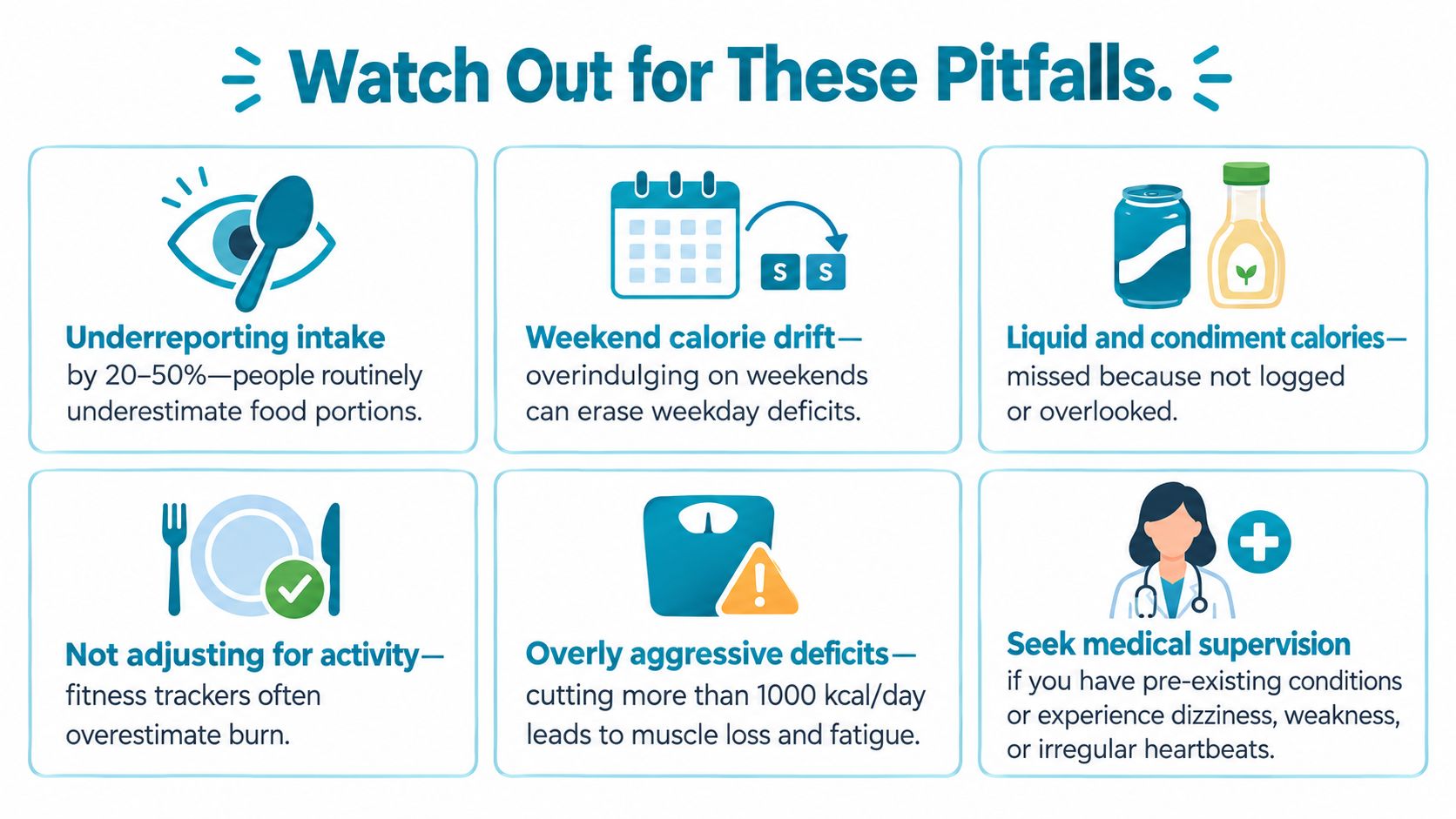
The most common calculation error isn't the equation. It's the input. Dietary self-report tends to underestimate actual energy intake, and reviews describe underreporting across food records, recalls, and diet histories. One landmark adult example found underreporting of about 47%, while reviews describe a range of roughly 11% to 47%, depending on the method (dietary assessment review).
That doesn't mean people are dishonest. Portions are hard to estimate, and many logs omit cooking fats, beverages, condiments, bites, and weekend changes. Treat the log as relative data, then compare it with the weight trend.
A practical safety checklist
- Audit hidden calories: Include drinks, oils, sauces, tasting, and unplanned bites. A photo-based log can help identify omissions without requiring perfect weighing.
- Check weekend drift: Compare the entire week, not only weekday intake. Pre-planning meals can reveal whether a weekday deficit disappears during social or restaurant meals.
- Review activity estimates: Use wearable data to observe movement patterns, not as permission to consume every reported exercise calorie.
- Protect food quality: Build meals around vegetables, fruit, minimally processed carbohydrates, protein, and unsaturated fats. Dietary patterns should preserve protein, fiber, and micronutrient intake.
- Stop escalating restriction: A lower target isn't automatically a better target. Dizziness, weakness, fainting, irregular heartbeats, worsening mood, or declining strength warrant medical attention.
- Review contraindications: Pregnancy, a history of eating-disorder symptoms, type 1 diabetes, recent bariatric surgery, rapid unintentional weight loss, or a BMI below 18.5 are reasons to seek individualized medical guidance before pursuing weight loss.
The BMI threshold is a screening convention, not a diagnosis. A stalled plateau lasting four to six weeks despite credible adherence also deserves clinical review, particularly when medications or medical conditions may affect weight.
For a broader physician-led weight-management assessment, see Empire Medical Wellness weight-loss care. Dr. Chhatpar or another qualified clinician can help determine whether the issue is the estimate, the tracking method, the meal pattern, a medication, a medical condition, or an overly restrictive target.
If calorie tracking is triggering eating-disorder symptoms or severe emotional distress, contact a qualified mental-health professional. For immediate emotional crisis support in the United States, call or text 988. The National Eating Disorders Association support resources can provide eating-disorder information and referral guidance. If someone is in immediate physical danger, call 911 or go to the nearest emergency department.
Empire Medical Wellness provides private-pay, physician-led obesity medicine that may include medical assessment, individualized weight-management planning, appropriate monitoring, and long-term maintenance planning. Visit Empire Medical Wellness to learn about the care model and request an evaluation if you want help interpreting calorie-deficit estimates in the context of your health.
Byline: Empire Medical Wellness Editorial Team
Published: September 16, 2026
Updated: September 16, 2026
Sources
- NIDDK Body Weight Planner
- VA/DoD Clinical Practice Guideline for the Management of Overweight and Obesity
- NIH evidence summary on obesity-guideline calorie deficits
- NIDDK calorie-balance educational material
- NIH-hosted review of the 3,500-calorie rule
This article is educational and isn't personal medical advice.