
BMI is weight in kilograms divided by height in meters squared. For adults, the screening categories are under 18.5, 18.5 to less than 25, 25 to less than 30, and 30 or greater, but BMI is a screening range, not a diagnosis.
What does your BMI tell you, and what might it miss? The calculation is simple, yet the answer can be misleading when height or weight is measured inconsistently, when units are mixed, or when the result is treated as a complete assessment of health.
This guide explains how to calculate BMI accurately at home, how to avoid common math errors, and how a physician may interpret the number alongside waist measurement, blood pressure, laboratory results, medicines, body composition, weight history, and physical function. The examples are hypothetical and aren't a diagnosis of any reader.
Table of Contents
- What BMI Means and How You Calculate It
- How to Measure Height and Weight Accurately at Home
- Metric and Imperial Formulas With Worked Examples
- Understanding Your BMI Category and What It Does Not Mean
- Common Mistakes and What BMI Misses Checklist
- When to Talk With Dr Chhatpar and Next Steps for Personalized Assessment
What BMI Means and How You Calculate It
What can a BMI number tell you, and where can it mislead you? Body mass index, or BMI, compares weight with height using a standard calculation:
BMI = weight in kilograms ÷ height in meters²
The squared term means multiplying height in meters by itself before dividing the weight. A person who is 1.70 meters tall, for example, would use 1.70 × 1.70 as the height portion of the formula. The next section covers measurement technique and unit conversions, while this section establishes how to interpret the result.
BMI gives clinicians and public health teams a consistent screening measure for adults. It works like a first sorting tool, not a complete health examination. BMI does not directly measure body fat, muscle mass, metabolic health, or where fat is stored. The CDC adult BMI categories provide the standard adult ranges and obesity classes.
Screening identifies people who may benefit from closer assessment. It does not diagnose disease, show precisely how much body fat someone carries, or explain a change in weight. A clinician may therefore consider BMI alongside waist measurement, blood pressure, laboratory results, medicines, body composition, weight history, and physical function.
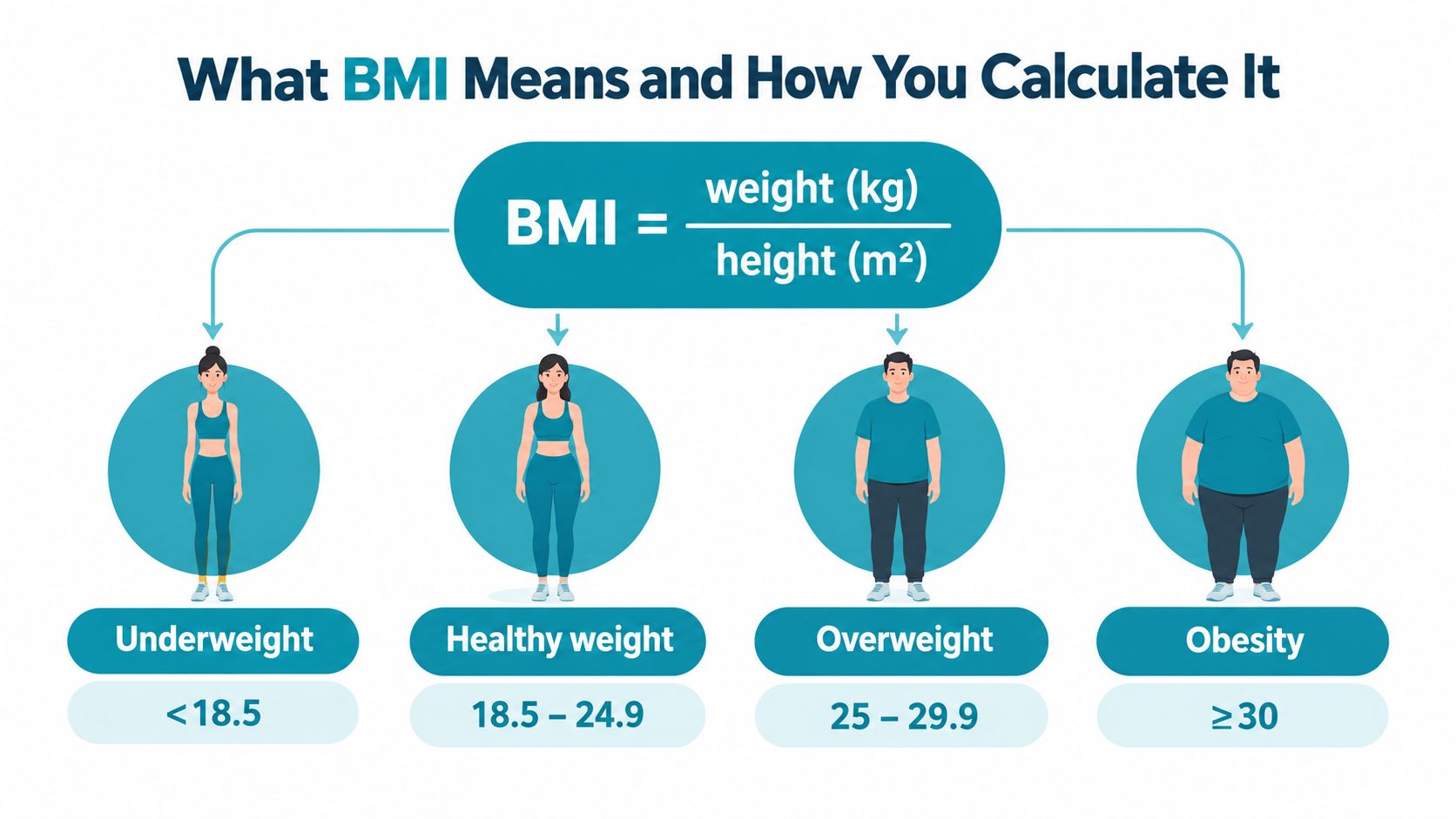
The adult screening ranges
For adults, the categories are:
| BMI result | Adult screening category |
|---|---|
| Below 18.5 | Underweight |
| 18.5 to less than 25 | Healthy weight |
| 25 to less than 30 | Overweight |
| 30 or greater | Obesity |
The obesity category has additional classes. Class 1 is 30 to less than 35, class 2 is 35 to less than 40, and class 3, also called severe obesity, is 40 or greater. A BMI of 27.5 falls in the overweight range, 32 in class 1 obesity, and 41 in class 3 obesity. These labels describe screening categories, not a person's character, appearance, fitness, or complete medical condition.
Because height appears twice in the formula, even a modest height error can change the result. For a convenient online BMI calculator, enter a recent height and weight using matching units. Children and teens require age- and sex-specific growth-chart interpretation rather than fixed adult cut points, as explained in the CDC's pediatric BMI guidance.
How to Measure Height and Weight Accurately at Home
Could a small measurement error change your BMI enough to affect its category? It can, especially when height is recorded incorrectly. A reliable calculation starts with a reasonably accurate height, a consistent weight reading, and clear documentation of the units.
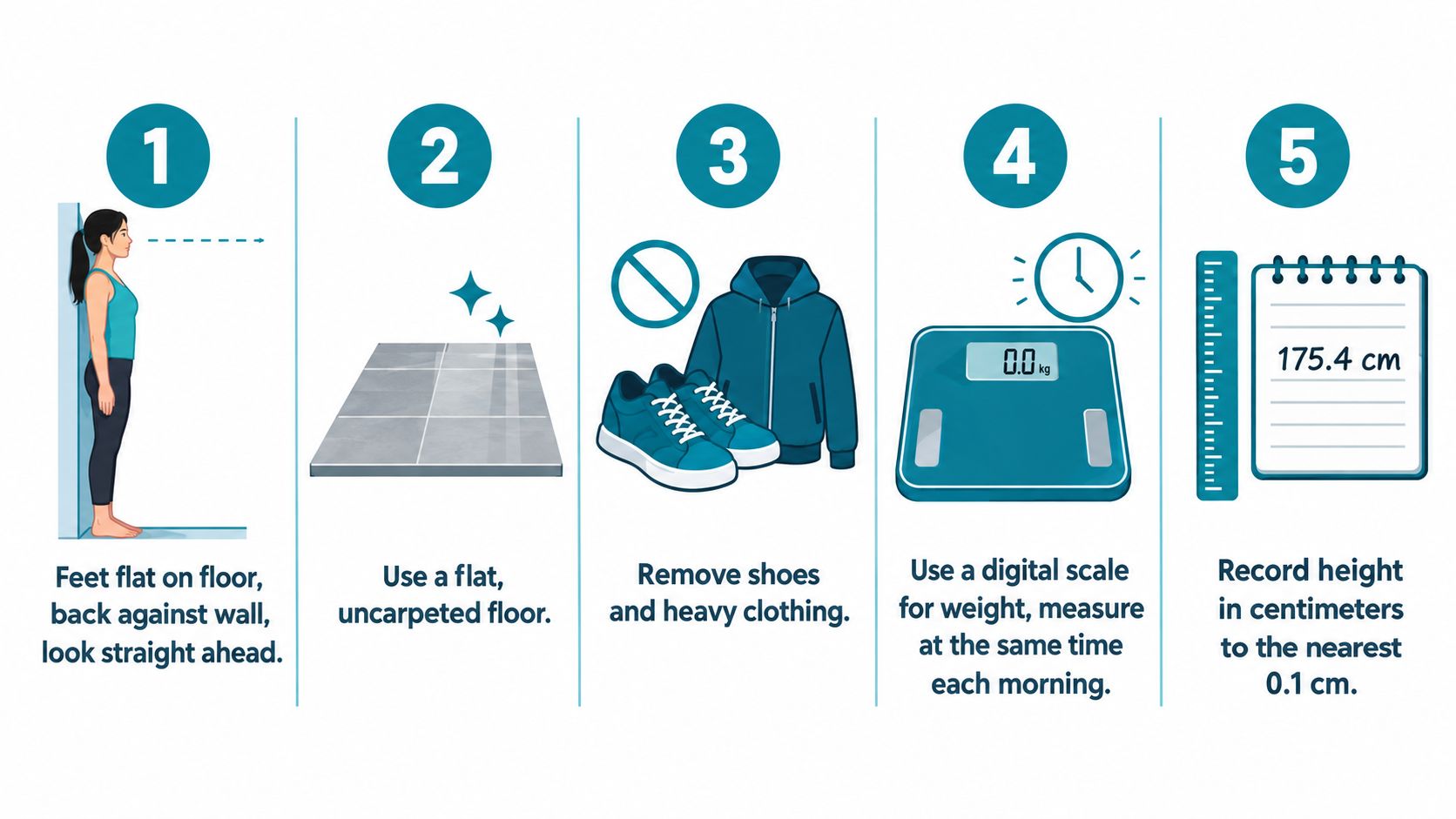
For height, stand on a flat, uncarpeted surface with your heels together if comfortable, feet flat, and back against a wall. Remove shoes and bulky hair accessories. Look straight ahead without raising or lowering your chin. Place a flat object against the wall and the top of your head, mark the wall, then measure from the floor to that mark. Keep the same method each time so later readings are easier to compare.
Use a digital scale on a hard, level floor. Measure in light clothing and under similar conditions when comparing weights, because shoes and heavy clothing can change the reading. Confirm that the scale is set to zero before stepping on it. If a result seems unusual, repeat the measurement rather than assuming it is accurate.
Keep the units together
Choose one formula and convert every input before calculating. Mixing pounds with meters, or kilograms with inches, produces a misleading result.
- Metric: Record weight in kilograms and height in meters.
- Centimeter form: Use kilograms and centimeters with
weight (kg) ÷ height (cm) ÷ height (cm) × 10,000. - U.S. customary: Use weight in pounds and height in inches with
weight (lb) ÷ height (in)² × 703.
Feet and inches must become total inches before you use the imperial formula. A height written as feet and inches is not ready for the equation until you convert the feet and add the remaining inches. Keeping a written record of the unit system can prevent this common mistake.
Rounding without creating confusion
Keep extra precision during the calculation, then round the final BMI. Avoid aggressively rounding each input first. Record height consistently, such as to the nearest 0.1 centimeter when using centimeters, and write the scale reading as displayed. A result near a category boundary deserves careful interpretation, because a tiny numerical difference may not represent a meaningful clinical change.
Record the date, height, weight, units, and BMI. Consistent conditions make a trend easier to review, but the trend still requires context. A physician may compare it with weight history, waist measurement, blood pressure, laboratory findings, and physical function. Empire's home monitoring resources offer related practical material, while online tracking does not replace clinical assessment.
Metric and Imperial Formulas With Worked Examples
There are two common ways to calculate BMI. The metric equation uses kilograms and meters. The U.S. customary equation uses pounds and inches, with a conversion factor of 703, as described by StatPearls at NCBI.
| Unit system | Formula | Example input |
|---|---|---|
| Metric | BMI = weight in kg ÷ height in m² | 80 kg and 1.75 m |
| Metric with centimeters | BMI = weight in kg ÷ height in cm ÷ height in cm × 10,000 | 80 kg and 175 cm |
| U.S. customary | BMI = weight in lb ÷ height in in² × 703 | 176 lb and 69 in |
Hypothetical metric example
Suppose a hypothetical adult records a weight of 80 kilograms and a height of 1.75 meters.
- Square the height: 1.75 × 1.75 = 3.0625.
- Divide the weight by the squared height: 80 ÷ 3.0625 = approximately 26.1.
- The resulting BMI is approximately 26.1.
The calculation places this hypothetical result within the adult overweight screening range. It doesn't establish excess body fat or a health diagnosis. A clinician would interpret it alongside the person's overall history and other measurements.
The centimeter version gives the same result:
80 ÷ 175 ÷ 175 × 10,000 = approximately 26.1
That second method can reduce conversion mistakes when a height is already recorded in centimeters.
Hypothetical imperial example
Now suppose a hypothetical adult weighs 176 pounds and is 69 inches tall.
- Square the height: 69 × 69 = 4,761.
- Multiply the weight by 703: 176 × 703 = 123,728.
- Divide: 123,728 ÷ 4,761 = approximately 26.0.
The imperial calculation produces a BMI of approximately 26.0. The result is close to the metric example because the inputs represent similar body proportions, not because the equations are interchangeable without their unit-specific factors.
A common error is to use height in meters with weight in pounds, or height in feet with the imperial equation. Another is to apply 703 after already converting all measurements to metric. Use either the metric formula or the imperial formula, not a mixture of both. Empire's BMI calculator can handle the arithmetic, but the measurement and interpretation remain your responsibility and, when needed, your clinician's.
Understanding Your BMI Category and What It Does Not Mean
What does your BMI category tell you? It places a height-and-weight calculation into a screening range, much like a traffic light that signals whether closer review may be useful. It does not diagnose a condition or describe your entire health profile. The National Heart, Lung, and Blood Institute BMI table uses the same adult thresholds as the CDC.
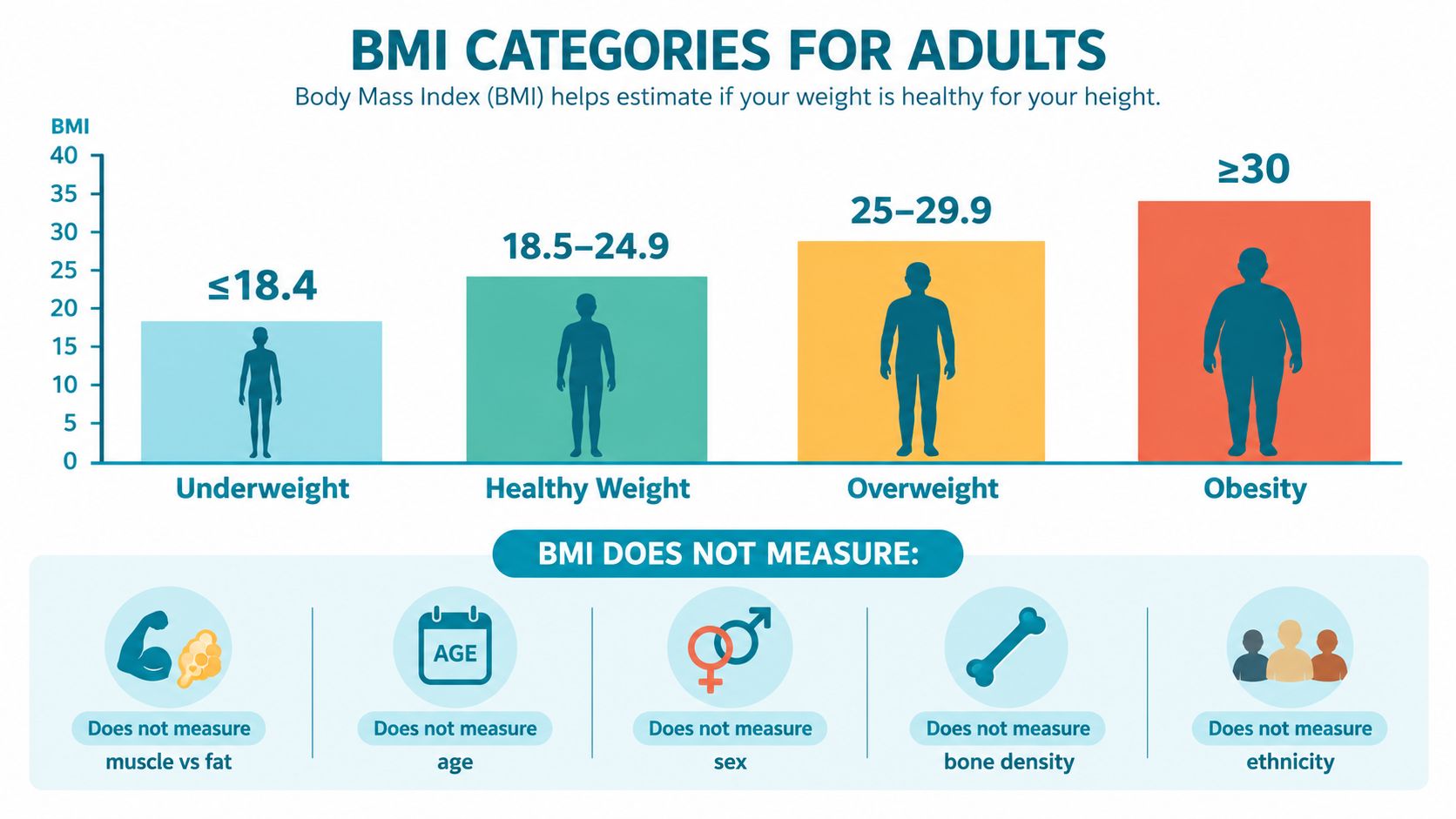
| Adult BMI | Screening category | What the range can signal |
|---|---|---|
| Below 18.5 | Underweight | A reason to review nutrition, weight history, and health context |
| 18.5 to 24.9 | Healthy weight | A screening range, not proof that all health measures are healthy |
| 25.0 to 29.9 | Overweight | A reason to consider body composition, waist measurement, and cardiometabolic factors |
| 30.0 to less than 35 | Class 1 obesity | A screening category that may warrant structured clinical assessment |
| 35.0 to less than 40 | Class 2 obesity | A higher screening category requiring individualized context |
| 40.0 or greater | Class 3 obesity, also called severe obesity | A screening category that merits thoughtful medical review |
For another visual reference, review this obesity index chart. The categories are useful labels for starting a conversation, not a diagnostic checklist. A BMI of 27.5 falls in the overweight screening range, yet it cannot show muscle mass, fat distribution, blood pressure, glucose status, medicines, or functional health. A BMI of 32 falls in class 1 obesity, while 41 falls in class 3 obesity. The appropriate interpretation still depends on the person's complete clinical picture.
What a physician adds to the number
BMI can identify a reason for closer assessment. A physician may then review:
- Waist measurement, which adds information about body shape and central adiposity.
- Blood pressure, because cardiovascular risk cannot be interpreted from BMI alone.
- Laboratory results, such as glucose or lipid findings when clinically relevant.
- Medicines and medical history, including treatments or conditions that may affect weight.
- Weight trajectory and function, including changes over time, mobility, sleep, and daily activities.
A result in the healthy-weight range does not guarantee that every health measure is reassuring. A higher result does not identify its cause or dictate one treatment. BMI is a starting point for informed questions, while diagnosis and next steps require the broader clinical context.
Common Mistakes and What BMI Misses Checklist
People often blame the calculator when the problem is an input or a unit. The most frequent errors are easy to prevent.
- Mixing unit systems: Don't divide pounds by meters or kilograms by inches. Convert first, then use the matching equation.
- Using feet as inches: Convert the entire height to inches before squaring it. A height written as feet and inches can't be entered directly into the imperial formula.
- Squaring the wrong value: Square height, not weight. In the metric formula, square height in meters. In the centimeter formula, use height in centimeters twice.
- Measuring with shoes: Shoes can increase height and alter the result. Measure without them.
- Estimating height: A remembered height may be outdated. Measure again on a flat surface.
- Rounding too soon: Keep the calculator's precision through the steps and round the final result. A borderline value deserves careful interpretation rather than a dramatic conclusion.
BMI also has biological blind spots. The CDC explanation of BMI limitations states that BMI doesn't distinguish fat from muscle or bone mass, and it doesn't show the location or type of fat.
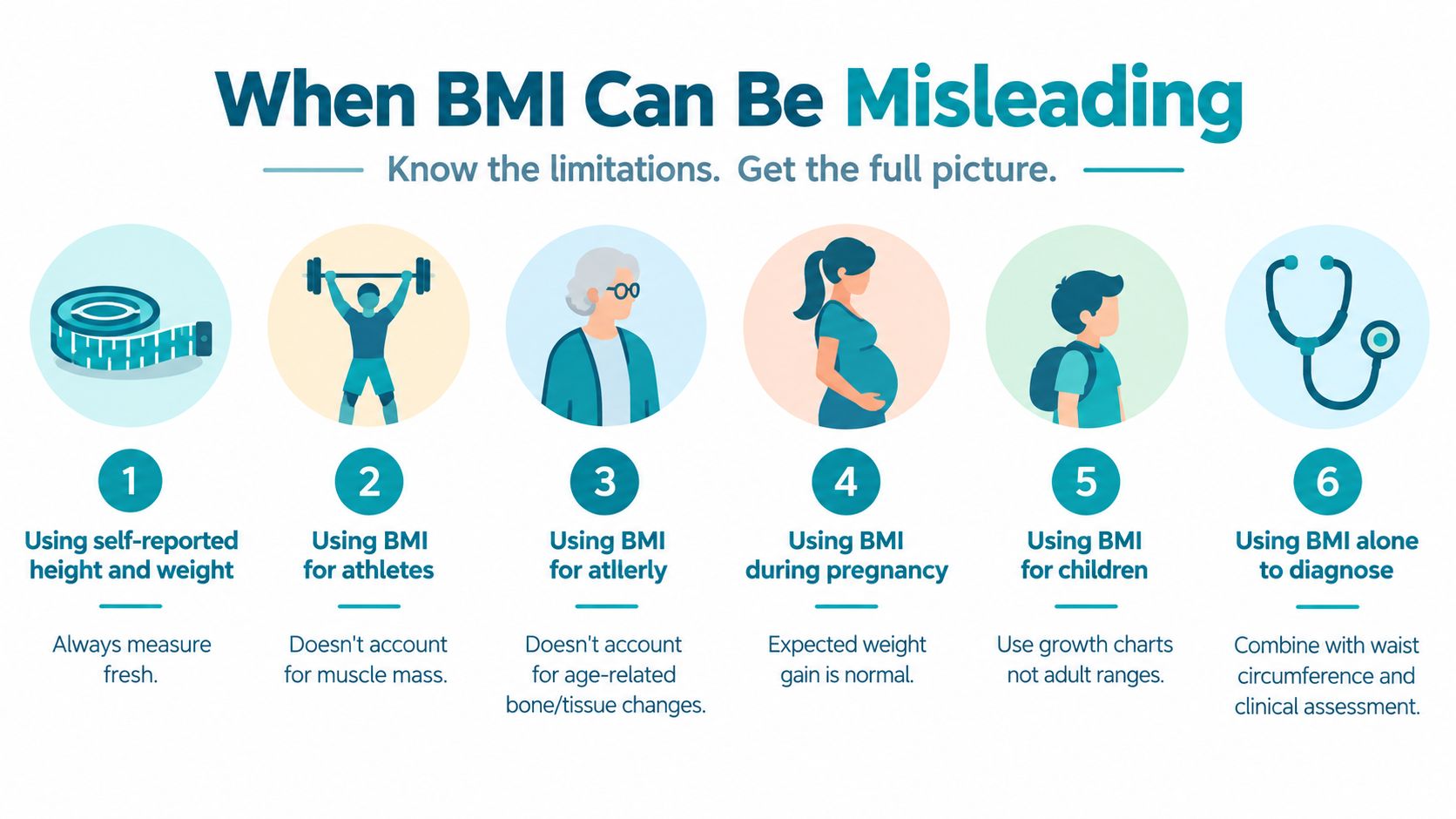
What BMI misses checklist
Use this checklist to decide whether the result needs more context:
- Muscle mass: A muscular adult may have a higher BMI because lean tissue contributes to weight.
- Fat distribution: BMI doesn't show whether fat is concentrated around the abdomen or distributed elsewhere.
- Edema: Fluid retention can raise body weight without representing the same change in body fat.
- Sarcopenia: An older adult can lose muscle while retaining or gaining fat, making BMI less informative by itself.
- Age-related changes: Body composition and function can change even when BMI appears stable.
- Pregnancy and pediatric status: Adult BMI categories aren't designed for pregnancy, and children and teens use age- and sex-specific percentiles rather than adult thresholds.
A clearly labeled composite comparison
Hypothetical composite, not a patient story: An athletic adult and a sedentary adult could share the same BMI while having different muscle mass, waist measurements, blood pressure, laboratory findings, weight histories, and physical function. Their BMI category would be the same, but a clinician's risk discussion could differ substantially.
That comparison doesn't make BMI useless. It shows why the calculation should be paired with assessment. Appearance alone can't confirm a diagnosis, and a single BMI reading can't capture every factor that affects health.
When to Talk With Dr Chhatpar and Next Steps for Personalized Assessment
The useful question after calculating BMI isn't only, “What category am I in?” It's also, “Does this number reflect my body composition and health risk accurately enough to guide a conversation?”
A physician visit may be reasonable when your result is near a category boundary, when your weight has changed noticeably over time, or when you have health factors that deserve review. It can also help when your body composition makes BMI difficult to interpret, such as substantial muscle mass, possible fluid retention, or age-related muscle loss.
Clinician decision checklist
Bring the following information to a private obesity-medicine assessment:
- Measurement record: Height, weight, units, dates, and the conditions under which you measured.
- Weight history: Major changes, previous efforts, and whether weight has been difficult to maintain.
- Health information: Blood pressure readings, available laboratory results, sleep concerns, and relevant symptoms.
- Medication list: Current medicines and supplements, including treatments that may affect weight or appetite.
- Function and goals: Mobility, energy, daily activities, and what you want medical care to address.
A clinician may use BMI as one screening measure, then consider waist-based measures, body composition, metabolic findings, and function. The 2025 VA/DoD obesity guideline advises using BMI as a screening tool rather than using it alone to diagnose obesity, as stated in the VA/DoD clinical practice guideline.
Empire Medical Wellness provides private-pay, physician-led obesity medicine for adults. The practice describes care that may include medical and metabolic assessment, review of weight history and relevant health factors, individualized weight-management planning, medication when clinically appropriate, monitoring, and long-term maintenance planning. Visit the obesity medicine service page to review whether that type of evaluation fits your needs.
Empire Medical Wellness can help adults place a BMI result in the context of weight history, health factors, measurements, and ongoing goals through physician-led obesity medicine. Visit Empire Medical Wellness to learn about the practice and request information about an evaluation. This article is educational and isn't personal medical advice.