
Agoraphobia is an anxiety disorder marked by intense fear or avoidance of at least two situations where escape may be difficult or help may be unavailable. The pattern typically lasts six months or more and causes significant distress or disruption in daily life.
The key concern isn't just disliking crowds or open spaces. It's what a person fears might happen if panic-like or other incapacitating symptoms occur and they can't leave or get help. A careful evaluation looks at the situations involved, what the person avoids or endures, and how the pattern affects everyday life.
Table of Contents
- What Counts as Agoraphobia Under DSM-5-TR
- How Common Agoraphobia Is and Who It Affects
- How Agoraphobia and Panic Disorder Overlap
- Preparing for a Clinical Evaluation and Ruling Out Other Causes
- Treatment Options and What the Evidence Shows
- Digital Tools, Virtual Reality and Telehealth Access
- Plan a Supported First Step and Request an Evaluation
What Counts as Agoraphobia Under DSM-5-TR
Two people may avoid the same crowded train for different reasons. One dislikes noise and close quarters; another fears having panic-like symptoms and being unable to leave or get help. A clinician asks what the person expects will happen, then checks whether the pattern fits the DSM-5-TR diagnostic criteria for agoraphobia.
| Criterion | What DSM-5-TR Requires | Example |
|---|---|---|
| Situation groups | Marked fear or anxiety in at least two of five groups: public transportation, open spaces, enclosed spaces, standing in line or in a crowd, and being outside the home alone | Fear of buses and store checkout lines |
| Response to situations | The situations almost always provoke anxiety and are avoided, endured with intense distress, or require a companion | Leaving home only with another person present |
| Fear in context | Fear is out of proportion to the actual danger and cultural context | Fear persists in a setting with little objective risk |
| Duration | The pattern typically lasts at least six months | An ongoing pattern rather than one frightening day |
| Impact | The fear causes significant distress or interferes with daily life | Missed work, skipped medical visits, or limited errands |
| Other explanations | Another mental disorder, medical condition, or substance use or withdrawal does not better explain the symptoms | A clinician checks for other possible causes |
The five groups describe different settings: buses and trains, open areas such as parking lots, enclosed places such as stores, crowds or lines, and being outside the home alone. A person does not need to fear every group. The diagnostic threshold is two or more.
The key question is what makes a situation feel threatening. A dislike of crowds or a preference for quiet places, on its own, does not establish agoraphobia. A clinician may ask whether the concern is getting out quickly, finding help if symptoms become overwhelming, or something else. They also ask how long the fear has been present and how it affects ordinary routines.
A list can help prepare for an appointment. Write down the situations that feel difficult, what you fear might happen, and how the pattern affects your life. This can guide a clinical conversation, but it cannot confirm a diagnosis.
How Common Agoraphobia Is and Who It Affects
Population percentages work like a weather forecast for a whole country: they describe the climate across millions of people, not whether rain will fall on your street. With that in mind, the National Institute of Mental Health reports, based on diagnostic interviews from the National Comorbidity Survey Replication, that 0.9% of U.S. adults met criteria for agoraphobia in the past year and 1.3% have met them at some point in their lives.
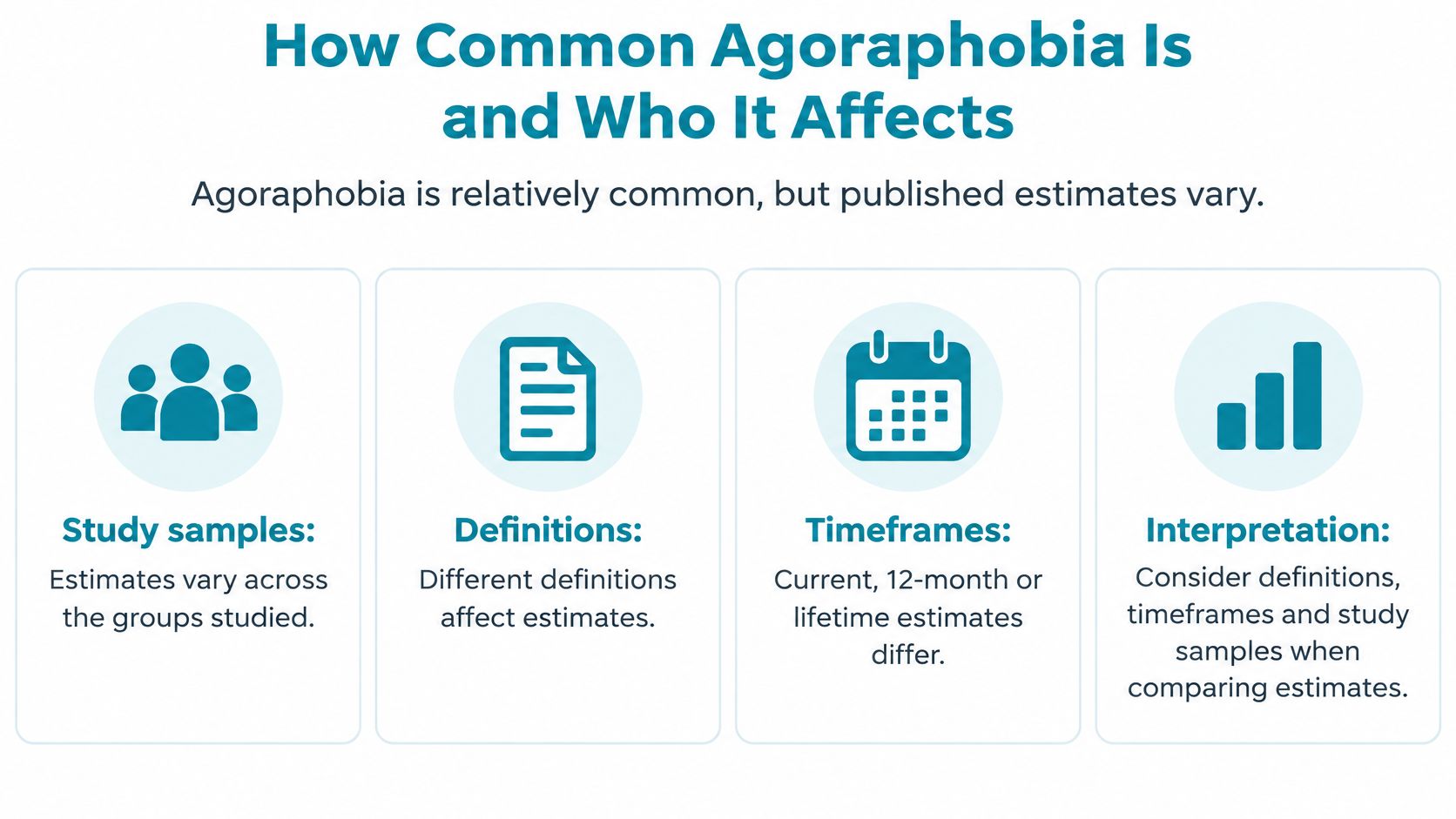
The same survey breaks the past-year figure down by sex: 0.9% among females and 0.8% among males. Two points in those numbers can confuse readers. First, the overall estimate comes from the full sample, so it is not an average of the two sex-specific figures and can land at the same value as one of them. Second, a gap of one-tenth of a percentage point is small enough to sit within the survey's sampling error. The practical reading is that this survey found similar past-year rates for women and men.
The Johns Hopkins Psychiatry Guide, updated in 2025, describes a different pattern, with agoraphobia about twice as likely in women as in men. These findings do not have to match, because they answer different questions. A national survey counts people in a defined community sample during a fixed window, while a clinical guide summarizes the wider diagnostic literature across studies, settings, and timeframes, where the gap between women and men is larger.
| Source | What it measures | Estimate |
|---|---|---|
| NIMH, National Comorbidity Survey Replication | Past year, U.S. adults | 0.9% |
| NIMH, National Comorbidity Survey Replication | Past year, by sex | 0.9% females, 0.8% males |
| NIMH, National Comorbidity Survey Replication | Lifetime, U.S. adults | 1.3% |
| Johns Hopkins Psychiatry Guide, 2025 update | Sex comparison in the broader literature | About twice as likely in women as in men |
A final caution applies to all of these figures. The surveys behind them count people whose fear centers on being unable to escape a situation or get help, leading to avoidance or enduring the situation with intense distress. They do not count everyone who dislikes crowds or prefers staying home. A percentage can never confirm or rule out agoraphobia in one person.
If you want to discuss how your own pattern fits these definitions, the adult mental health services at Empire Medical Wellness offer a starting point for that conversation.
How Agoraphobia and Panic Disorder Overlap
Agoraphobia and panic disorder are separate diagnoses. A person may have agoraphobia, panic disorder, both, or neither. The DSM-5 separated agoraphobia from panic disorder, so agoraphobia can occur without a history of panic attacks.
| Feature | Agoraphobia | Panic disorder |
|---|---|---|
| Core concern | Situations where escape or help may be hard to get | Recurrent, unexpected panic attacks and persistent worry about future attacks |
| Panic attacks required | No, it can occur without a history of panic attacks | Yes, recurrent unexpected attacks are central |
| Typical behavior | Avoiding or enduring specific situations, sometimes requiring a companion | Avoiding places linked to past attacks, with the focus on the attacks |
The distinction matters because similar behavior can have different underlying concerns. Someone might avoid a train because they fear being unable to leave if severe symptoms begin. Someone else might avoid it because they worry another unexpected panic attack will occur. A clinician considers the pattern, triggers, duration, and effect on daily life rather than relying on one moment of fear.
That distinction also helps shape treatment planning. When sudden attacks are central, care may focus on the attacks and the person's persistent worry about them. When situation-based avoidance is central, the clinician may also track which settings are difficult and how avoidance affects daily activities.
A practical question to bring to an appointment is: Do the hardest moments come from sudden surges of fear, or from avoiding places because leaving or getting help might be difficult? A single panic attack doesn't answer that question. A preference for staying home, on its own, isn't a diagnosis either. Readers seeking information specifically about panic disorder should ask a clinician to assess that concern separately.
Preparing for a Clinical Evaluation and Ruling Out Other Causes
A clinician may ask: Which situations feel difficult to escape or get help in? What do you avoid, or endure with major distress? How does it affect work, errands, relationships, and independence? These general questions help clarify the pattern without assuming that a person has agoraphobia or panic disorder.
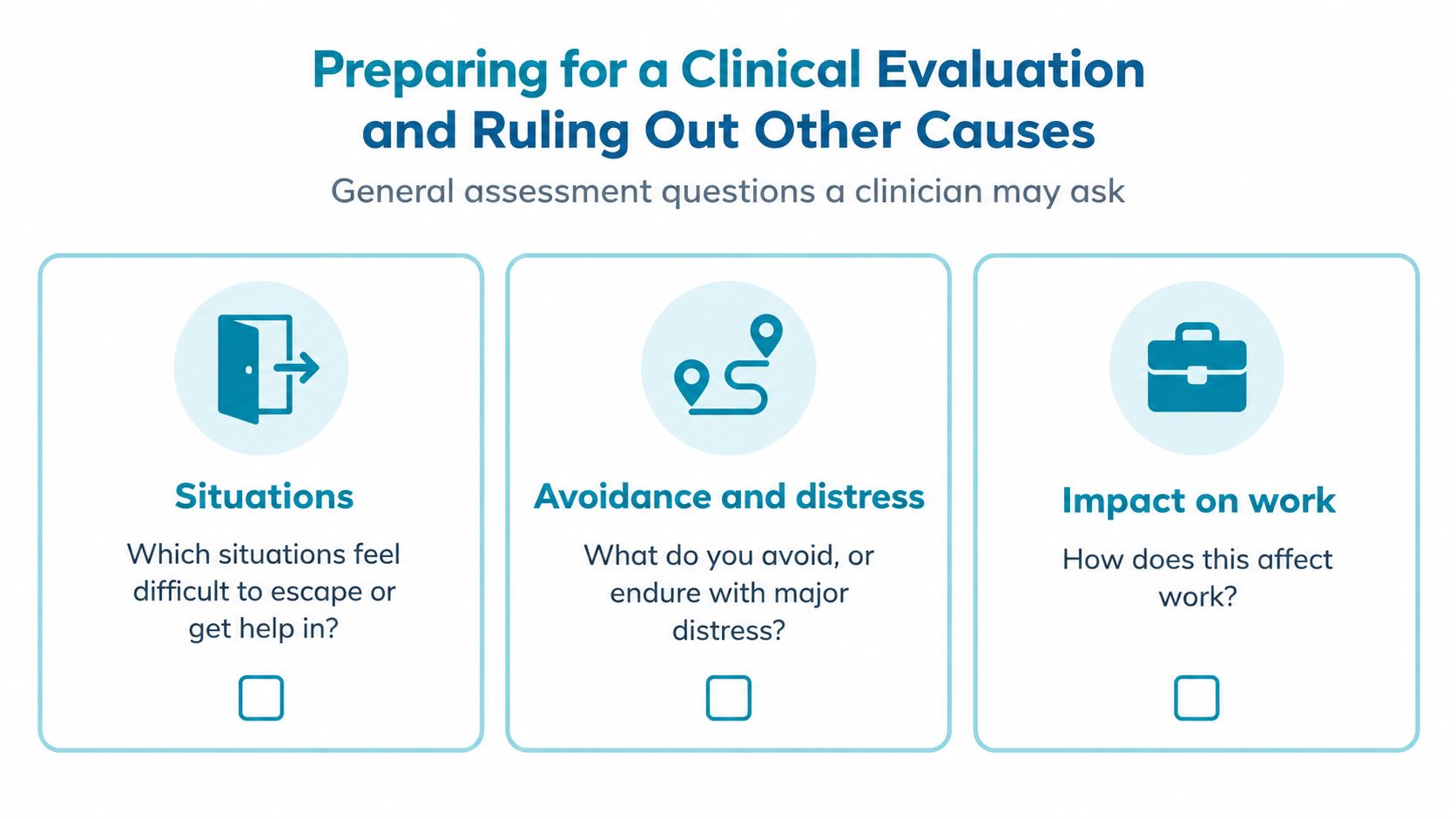
Agoraphobia can involve transportation, crowds, or leaving home, and it can occur without panic attacks. A person may restrict travel, avoid going out alone, or feel unable to manage an errand without a companion. The DSM-5-TR criteria and clinical description focus on the relationship between fear, avoidance, and functional impact, not just on discomfort in public.
A short preparation checklist
Before an appointment, a person may find it helpful to bring:
- A situation list: Note settings that are avoided or endured with major distress, and add a distress rating from 0 to 10.
- A rough timeline: Record when the pattern began and whether it has changed.
- A medication and substance list: Include medicines, supplements, alcohol, cannabis, and other substance use. Honest details help the clinician assess possible effects or withdrawal.
- Relevant health information: Note medical history, sleep concerns, and caffeine intake.
- Companion needs: Record whether another person is needed in public and, if so, in which situations.
- Questions: Write down what remains unclear about diagnosis, assessment, and possible next steps.
The visit may include a conversation about symptoms and history, a review of medicines and substance use, and questions about medical or mental health conditions that could explain the symptoms. The clinician uses the timeline and situation list to decide whether the pattern fits agoraphobia, panic disorder, both, or another condition. A person can bring a companion or written notes if that makes the visit easier. The clinician should explain the reasoning before discussing treatment decisions. For questions about medication review, see mental health medication review information.
New severe chest pain, trouble breathing, fainting, sudden weakness, or speech changes require urgent evaluation. Call 911 or the local emergency number. These symptoms shouldn't be assumed to be anxiety.
Treatment Options and What the Evidence Shows
Treatment for agoraphobia targets the fear of being unable to escape or get help, not the places themselves. That distinction shapes every option below. The goal is to restore access to the situations a person has been avoiding, whether or not panic attacks are part of the picture.
The choice among the options is rarely either-or.
| Option | What the evidence shows | Notes for U.S. readers |
|---|---|---|
| Cognitive behavioral therapy with graded exposure | Recommended in clinical guidelines as a first-line psychological treatment; supported by a long history of controlled studies of exposure-based methods | Delivered by a licensed mental health professional; exposure is planned step by step, with the person consenting to each stage |
| Antidepressants such as SSRIs or SNRIs | Supported by clinical trials for panic disorder and related anxiety conditions; prescribing for agoraphobia on its own may fall outside the FDA-approved label | Ask the prescriber to explain the current label and how it applies |
| Benzodiazepines | Can reduce acute anxiety quickly, but guidelines advise against routine or long-term use because benefits fade while risks accumulate | Dependence and withdrawal are documented risks; use only under clinician direction, for the shortest reasonable course |
| Breathing and relaxation skills | Useful as coping tools within a larger plan; not studied as stand-alone treatment for agoraphobia | Support assessment and treatment; cannot substitute for either |
A clinician weighs these options through a handful of practical questions. First, are panic attacks present? When panic disorder coexists with the avoidance, an SSRI or SNRI may be added because reducing the attacks can lower the fuel driving the avoidance. Second, how severe is the restriction? Graded exposure works only if the person can practice it, so when avoidance is strong enough to block travel to a clinic, treatment may start with medication or remote sessions to lower fear enough for exposure work to begin. Third, what does the person's medical history allow? Other conditions, current medicines, and past responses to treatment all shape the choice. Fourth, what will the person realistically continue? A plan someone can sustain beats a theoretically ideal plan they abandon.
Off-label means a medicine is prescribed for a use that isn't listed in its FDA-approved labeling. Because some antidepressants carry approved indications for panic disorder but not for agoraphobia alone, the prescriber should explain which applies. For an overview of how these medicines are used, see anxiety medication options.
Benzodiazepines deserve one added caution. Because they work within minutes, they can feel like the obvious answer, yet regular use produces tolerance, and stopping can bring withdrawal symptoms that resemble the original anxiety. A clinician who prescribes one will define a time limit in advance.
App-based programs and virtual reality approaches are examined separately below.
Digital Tools, Virtual Reality and Telehealth Access
A crowded supermarket can feel uncomfortable for many reasons. Agoraphobia concerns a more specific question: if fear, dizziness, or panic rose sharply, would escape feel hard or help feel out of reach? Digital care is useful only when it keeps that distinction in view rather than treating every dislike of lines, traffic, or open space as the same problem.
As noted earlier, recent randomized trials of self-guided exposure apps and virtual-reality CBT report improvement for some participants, while leaving limits around recruitment, missing data, clinician involvement, and how well gains carry into daily travel, queues, stores, and unfamiliar places. An app can rehearse a feared situation; it cannot by itself confirm diagnosis, review medicines, or decide when a symptom needs medical assessment.
Virtual reality means a headset or screen recreates situations such as elevators or busy streets. It works like a flight simulator: controlled practice can build familiarity, yet turbulence outside the simulator still differs. The same caution applies to telehealth, which is care delivered by secure video or phone. Practical questions to ask include:
- Fit: Does the program target fear of losing escape or help, including any panic attacks that overlap with panic disorder?
- Guidance: Who selects the next step, and how is distress measured from 0 to 10?
- Safety: What happens if symptoms intensify, medication changes, or another condition needs review?
- Transfer: How will practice move from a screen to a real driveway, bus stop, pharmacy, or waiting room?
Remote care can remove the hurdle of traveling to an office, but it still needs privacy, a stable connection, and a plan for steps that cannot be checked online. A person can ask about eligibility, follow-up, and telehealth and appointment locations before assuming remote visits fit every need.
Plan a Supported First Step and Request an Evaluation
What happens at a first appointment, and what can you do beforehand to make it useful? A physician-led evaluation is the most productive starting point. Any first step in daily life works best when it is planned with a clinician rather than attempted alone as a self-directed exposure exercise.
One detail is worth preparing ahead of time. Clinicians listen for the difference between "I dislike crowds" and "I fear being unable to escape or get help if something goes wrong." The second description points toward agoraphobia. Expect questions about what you believe would happen in a feared situation, whether panic attacks occur and where, and which places you have stopped going entirely. Writing your answers down before the visit helps the clinician separate agoraphobia from an ordinary preference for quiet, and from panic disorder, which can overlap with it as noted earlier.
Hypothetical example: An adult who has stopped going to the pharmacy alone discusses one modest, personally meaningful goal with a clinician, such as walking to the end of the driveway with a companion. The clinician and patient review whether the goal is appropriate before anything is tried. This example illustrates a goal-setting conversation, not a report of a real patient or a promised result.
A goal review might record a distress rating from 0 to 10 before and after the situation, what made it feel more manageable, what felt unmanageable, and what the clinician suggests changing. The purpose is to understand the person's experience and adjust the plan with professional guidance. Nobody should be pressured into a step that feels unsafe or has not been discussed with a clinician. Progress can be gradual and uneven, and no outcome is guaranteed.
For the appointment, bring a list of avoided situations, a medication list, and questions such as:
- Which situations will the evaluation cover?
- Which medical or mental health conditions will be considered?
- Which treatment options fit my situation, and what do FDA labeling and off-label use mean?
- Is psychotherapy available through the practice, or would I need a referral?
Waiting for an appointment can be stressful on its own. General information on stress management strategies may help in the meantime, and Empire Medical Wellness' adult mental health page can be checked for current services and availability.
Byline: Empire Medical Wellness Editorial Team
Published: 2026-10-03
Updated: 2026-10-03
This article is educational and isn't personal medical advice.
Empire Medical Wellness offers adult mental health evaluation, diagnostic clarification, medication review, and ongoing medication management. Adults researching agoraphobia can visit Empire Medical Wellness to review current services and availability.