
The most confident claim about antipsychotics for anxiety is also the least supported: that a small dose of quetiapine is a gentle fix for worry and broken sleep, too modest to cause trouble. The trial record points the other way. In generalized anxiety disorder, where the evidence is strongest, pooled trials found quetiapine produced a 26% greater likelihood of treatment response than placebo (AHRQ summary of the pooled findings), while people taking it were 30% more likely to stop treatment for any reason (meta-analysis of quetiapine trials in GAD).
Read those numbers together and a trade-off emerges: real symptom relief for some patients, enough side effects and dropout to end treatment for others. That is a narrower result than casual prescribing implies. It also undercuts the small-dose assumption directly, because low doses still produced measurable metabolic effects, which is why even a modest prescription earns monitoring rather than a pass.
Table of Contents
- Where Antipsychotics Fit for Anxiety
- First-Line Care Versus an Off-Label Option
- What Quetiapine Trials Show in GAD
- Metabolic Risk Even at Low Doses
- Older Labels With Strict Time Limits
- Questions That Can Justify a Discussion
- When to Seek Care and What a Visit Can Do
Where Antipsychotics Fit for Anxiety
Antipsychotics sit at the edge of the anxiety conversation. They are not routine first-line medication for anxiety, and most second-generation use for an anxiety disorder falls outside what the FDA approved.
That position reflects the evidence rather than reflexive caution. A review of controlled trials found moderately strong evidence that some atypical antipsychotics can reduce anxiety symptoms, whether used alone or added to another treatment. The same review concluded that the adverse-effect burden generally outweighs the benefit for most patients, and it noted a regulatory gap that surprises people: at the time of publication, no atypical antipsychotic carried FDA-approved labeling for an anxiety disorder, though older labels existed for the first-generation drug trifluoperazine and for an amitriptyline-perphenazine combination (review of controlled trials in anxiety disorders).
| Medicine | Studied role | Regulatory status | Main limit |
|---|---|---|---|
| Quetiapine | GAD monotherapy, often extended-release in trials | Off-label; quetiapine XR was not FDA-approved for GAD | Strongest evidence, but tolerability and discontinuation limit use |
| Olanzapine | Selected anxiety analyses only | Off-label for anxiety disorders | Evidence too limited and mixed to pool |
| Risperidone | Limited placebo-controlled anxiety trials | Off-label for anxiety disorders | Too little evidence for a firm conclusion |
| Ziprasidone | Sparse anxiety trials | Off-label for anxiety disorders | Mixed results and not poolable |
| Trifluoperazine | Short-term generalized nonpsychotic anxiety | FDA-labeled, but not the first drug for most patients | Label limits nonpsychotic anxiety because of tardive dyskinesia risk |
| Amitriptyline-perphenazine | Historical nonpsychotic anxiety labeling | Older combination labeling | Not a reason to start combination antipsychotic treatment routinely |
The pooled research is thin in a specific way. An AHRQ evidence review identified 14 placebo-controlled trials of atypical antipsychotics in anxiety-related conditions, yet only the quetiapine monotherapy trials in generalized anxiety disorder were similar enough to combine statistically; that pooled set covered four randomized trials in 1,383 adults, while evidence for olanzapine, risperidone, and ziprasidone stayed too limited and mixed to pool (AHRQ evidence review results). In that analysis, quetiapine outperformed placebo on treatment response, defined as at least a 50% improvement on the clinician-rated Hamilton Anxiety Scale, while also producing higher rates of discontinuation (AHRQ summary of the pooled findings).
An advantage over placebo compares two groups. It is not a promise for one person, and it does not establish that quetiapine is preferable to an SSRI or SNRI. Evidence for one drug in one diagnosis also does not transfer to panic disorder, social anxiety, or ordinary worry; the NIMH overview of mental health medications is a plain-language place to start on how drug classes differ.
The practical translation: a medicine can have real trial support in one anxiety diagnosis and still be a poor routine choice, because the decision turns on tolerability, monitoring, and what has already been tried.
Later synthesis did not strengthen the case. A 2025 umbrella review of antipsychotic use in anxiety found that most of the underlying reviews were methodologically weak, that antipsychotic monotherapy lacked sufficient evidence against established first-line treatments, and that usable evidence beyond quetiapine in generalized anxiety disorder and olanzapine in selected analyses remained limited. The honest state of the field is a handful of drugs with modest short-term signals, wrapped in a much larger volume of weak reviews. A low dose shrinks the exposure; it does not shrink the need for monitoring.
First-Line Care Versus an Off-Label Option
Picture a familiar sequence. Someone has worried most days for eight months, sleeps badly, and has read that an antipsychotic helped a stranger on a forum. The clinician's first job isn't to discuss that drug. It's to confirm the diagnosis, rule out look-alikes, and start with what has the strongest safety record.
Antipsychotics were developed mainly to treat psychotic disorders such as schizophrenia, and some are also used for bipolar disorder or as add-ons in depression. Anxiety was never their original assignment, which is why the framing matters.
Off-label means a clinician prescribes an FDA-approved medicine for a purpose, dose, or population the label doesn't list. It's legal, it's common in psychiatry, and it isn't a hidden approval. It also doesn't make the use standard care, and it doesn't shift the monitoring burden onto the patient alone.
Here is how a careful prescriber narrows the field, in order.
- Confirm what is being treated. Anxiety can be the primary problem, or a feature of depression, post-traumatic stress, substance use, a thyroid condition, or a sleep disorder. Each answer changes the plan.
- Check whether first-line care had a fair trial. That usually means psychotherapy such as cognitive behavioral therapy, and when medication is appropriate, an SSRI or SNRI at an adequate dose and duration, or a documented reason those options didn't fit.
- Name the drug, the target, and the review date. A specific medicine, a specific symptom it's meant to improve, and a scheduled point to judge whether it did.
The evidence is uneven across drugs, which is the single most useful thing to understand before any appointment. The Cochrane review of second-generation antipsychotics for anxiety disorders is the most efficient place to see how concentrated the findings are in one medication and one diagnosis rather than spread across the class.
For a wider view of how anxiety medication decisions are sequenced, this overview of anxiety medication options covers the first-line choices and where the discussion goes when they fall short.
What Quetiapine Trials Show in GAD
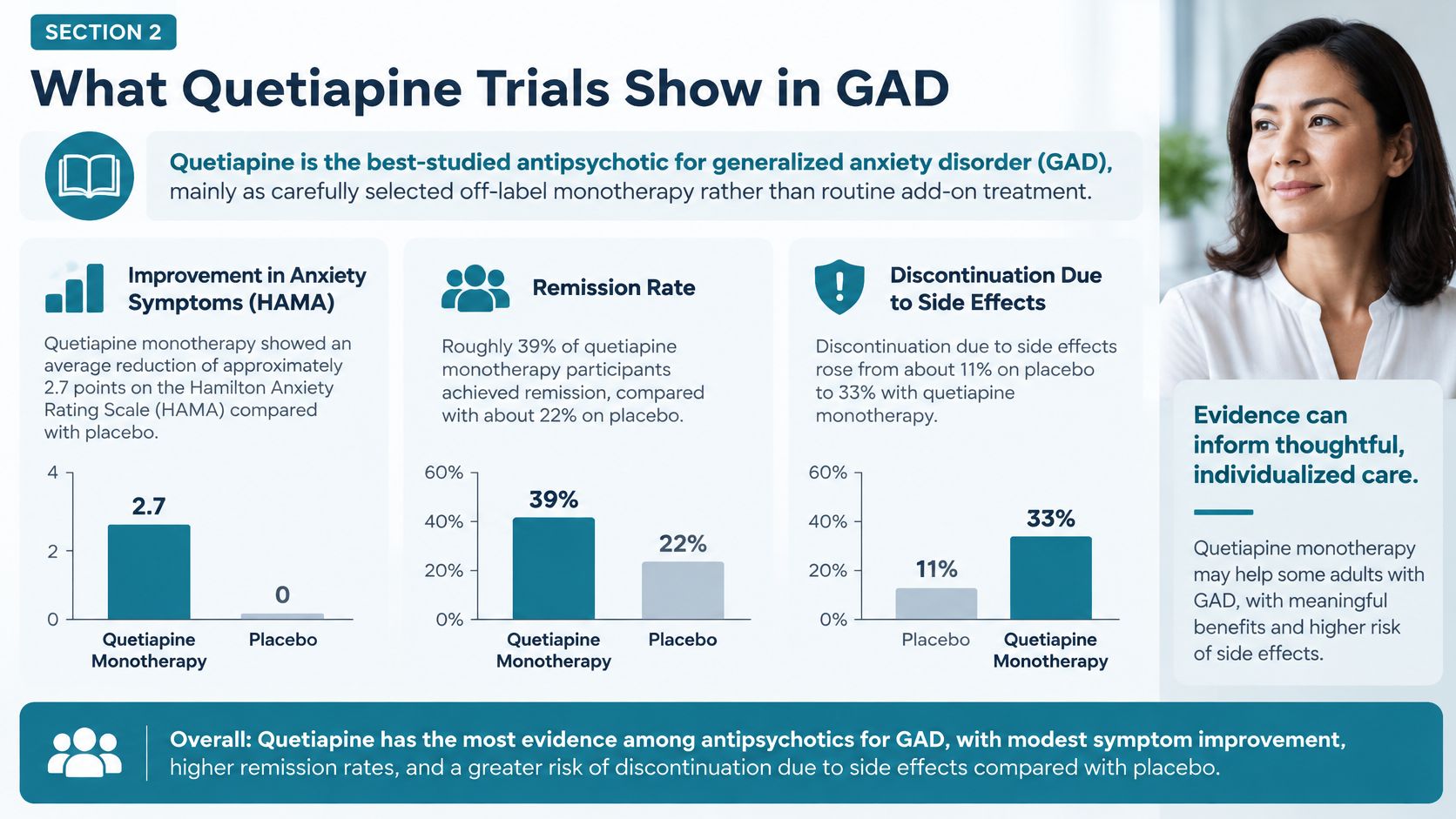
Quetiapine is the best-studied antipsychotic in generalized anxiety disorder, and the fair description of its role is a carefully selected off-label monotherapy option rather than a routine add-on. The results below read best if you keep two questions separate: did the drug beat placebo on symptoms, and did people stay on it long enough to benefit.
| Finding | Result | Comparison | Caveat |
|---|---|---|---|
| Monotherapy response | Risk ratio 1.31 (95% CI 1.20 to 1.44); NNT about 7 | Placebo | Four trials, 1,383 adults |
| Monotherapy remission | Risk ratio 1.44 (95% CI 1.23 to 1.68) | Placebo | Same meta-analysis |
| HAM-A change | Extra 3.66-point reduction | Placebo | Not proof it beats every first-line medicine |
| Summarized response rates | 62.4% quetiapine vs 60.0% SSRIs | SSRI group in a summarized analysis | Not a single head-to-head superiority trial |
| Eight-week remission | 42.6% quetiapine XR 150 mg vs 38.8% paroxetine | Paroxetine | One trial; dose is study information only |
| Augmentation (add-on) | No consistent benefit; more people stopped treatment | Placebo | Pooled trials in treatment-resistant GAD |
The core meta-analysis pooled four randomized trials involving 1,383 adults. Quetiapine improved clinical response versus placebo (risk ratio 1.31; 95% CI, 1.20 to 1.44), improved remission (RR 1.44; 95% CI, 1.23 to 1.68), and reduced Hamilton Anxiety Rating Scale scores by an additional 3.66 points (95% CI, minus 5.13 to minus 2.19), with a number needed to treat for response of about 7 (meta-analysis of quetiapine trials in GAD). The dose studied most consistently was 150 mg per day, often as extended-release. That is a trial detail rather than a dose to copy, because dose selection belongs to the prescriber who knows the full history.
Why monotherapy evidence isn't a first-line endorsement
The same analysis showed all-cause discontinuation was higher with quetiapine (RR 1.30; 95% CI, 1.09 to 1.54). Symptom benefit and tolerability pull in opposite directions, and the second number is the one that decides whether a plan survives past a few weeks. A drug can win on the rating scale and still lose at the pharmacy refill.
Comparisons with standard treatment are less dramatic than the risk ratios suggest. A summarized analysis reported response, defined as at least a 50% reduction in Hamilton Anxiety Rating Scale score, in 62.4% of quetiapine-treated participants versus 60.0% for SSRIs, and an eight-week trial found remission, defined as a HAM-A score of 7 or lower, in 42.6% of people on quetiapine XR 150 mg versus 38.8% on paroxetine (review of quetiapine evidence in anxiety). Those are single-digit gaps. Close, not commanding.
The augmentation story is weaker still. When quetiapine was layered on top of existing treatment in adults whose anxiety had partly or not responded, pooled results did not show a reliable advantage over placebo on response or remission, and people taking it stopped treatment more often. Some individual studies reported higher numerical response rates with quetiapine, yet the differences did not reach statistical significance. That pattern is worth remembering, because a favorable-looking percentage in a small sample is not the same as a proven effect.
A risk ratio of 1.31 is a pooled average across trials, not a verdict that quetiapine outranks an SSRI. The comparison against standard medication was never tested directly enough to draw that conclusion.
None of these figures is a reason to request a prescription by name. They are a reason to ask sharper questions, starting with whether the diagnosis matches the population studied. This explanation of generalized anxiety disorder shows how clinicians distinguish it from other anxiety conditions before medication enters the discussion.
Metabolic Risk Even at Low Doses
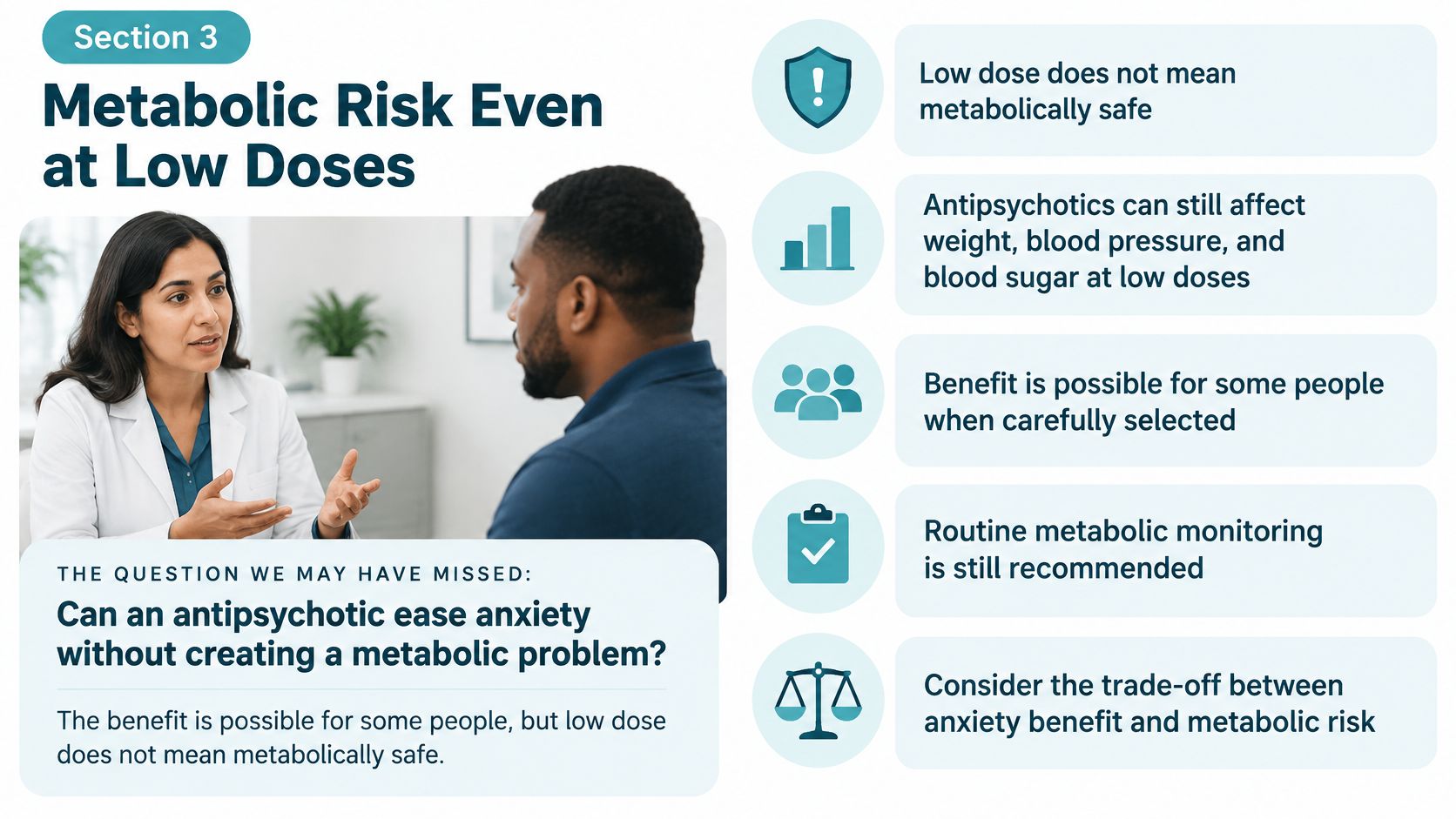
Doses at or below 100 mg a day sound gentle next to the amounts used for psychosis, and that instinct drives many off-label quetiapine prescriptions for anxiety. It is also where the reasoning slips. A low dose lowers exposure, but it does not make the drug metabolically negligible.
A 2025 systematic review and meta-analysis of low-dose quetiapine found a mean weight increase of 0.58 kg, an HDL-cholesterol decrease of 1.25 mg/dL, and a 2.12 times greater likelihood of gaining at least 7% of baseline body weight (meta-analysis of low-dose quetiapine effects). Earlier pooled evidence in generalized anxiety disorder pointed the same direction, with average weight gain, higher triglycerides, and lower HDL cholesterol.
Why low dose isn't a safety category
Quetiapine trials and regulatory reviews identified weight gain, increased cholesterol, and hyperglycemia, with reported weight-gain incidence ranging from about 3% to 23% and cholesterol increases from 7% to 18%, effects that can appear even at 100 mg per day or less (quetiapine prescribing information summary). A milligram count describes the intensity of exposure, not the presence or absence of risk.
Sedation matters as more than inconvenience. Daytime drowsiness, orthostatic dizziness on standing, and possible cardiac conduction effects change the calculation for people who drive, work with machinery, drink alcohol, take other sedatives, or carry cardiovascular risk factors. A patient who feels calmer because they are mildly sedated has received a different kind of relief than the trials were designed to measure.
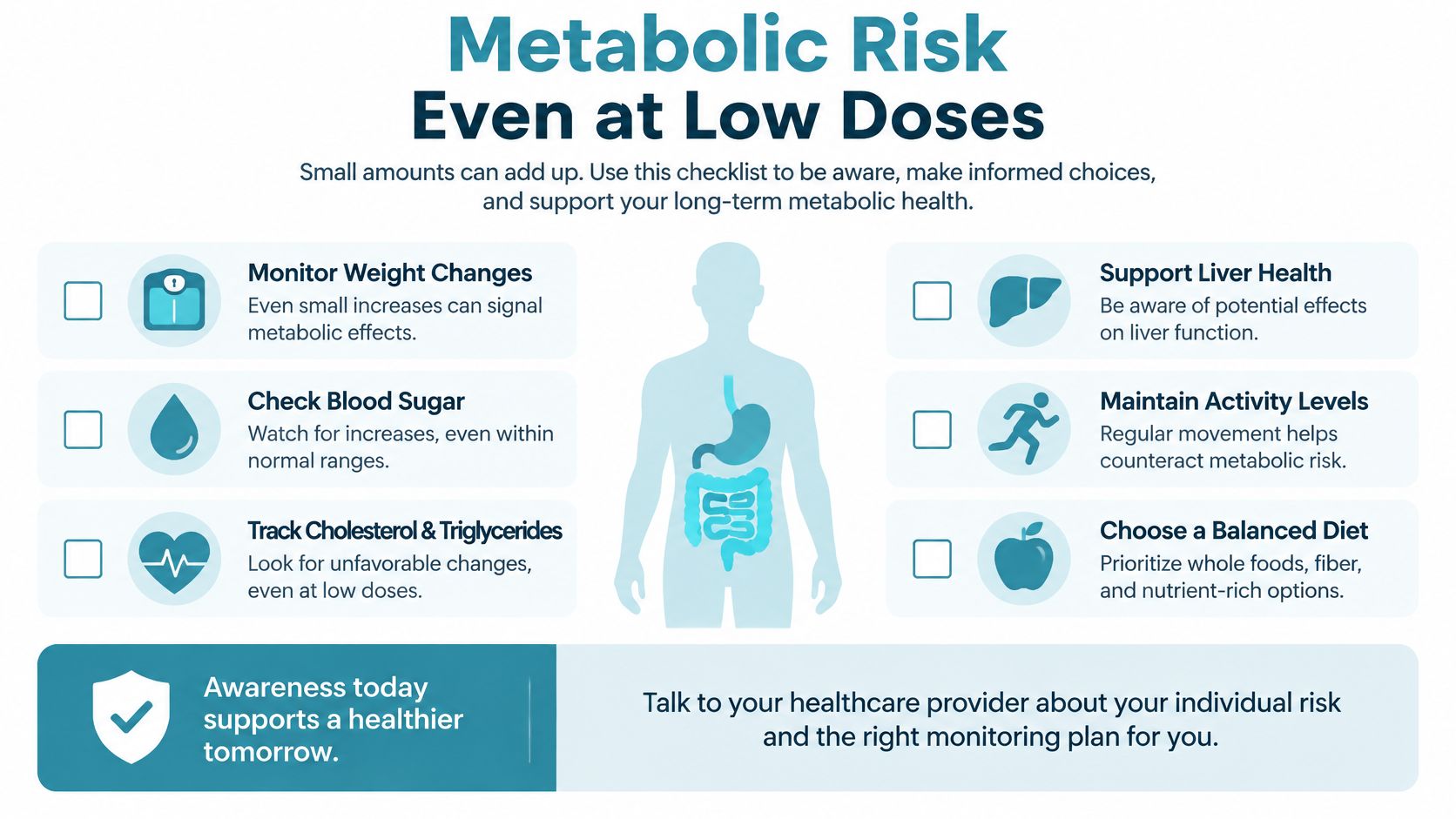
A monitoring set you can actually complete
| Check | Before treatment | Why it matters | Follow-up focus |
|---|---|---|---|
| Weight or BMI | Record baseline | Low-dose mean gain 0.58 kg; 2.12 times odds of 7% gain | Repeat early and track trajectory |
| Waist circumference | Measure when appropriate | Central gain can be missed by weight alone | Recheck if weight changes |
| Blood pressure | Measure baseline | Orthostasis and cardiovascular risk | Recheck with symptoms or dose changes |
| Glucose or HbA1c | Fasting glucose or HbA1c | Hyperglycemia reported with quetiapine | Repeat by risk and duration |
| Lipids | Full lipid profile | Cholesterol rises about 7% to 18%; HDL may fall | Repeat by risk and duration |
| Alertness and other sedatives | Ask about driving, alcohol, and sedating medicines | Sedation raises discontinuation and injury risk | Reassess if daytime sedation appears |
Weight gain is not unique to quetiapine. It is a documented effect across several psychiatric drug classes, which is why understanding how psychiatric medications can lead to weight gain is useful context before any prescription begins. The AHRQ review found strong evidence linking atypical antipsychotics with significant weight gain and sedation, and identified increased mortality risk among elderly patients as a major concern, while the VA/DoD PTSD guideline notes that these medicines can worsen existing medical conditions or contribute to new ones through metabolic effects.
For the visit: ask who will track weight and labs, on what schedule, and what result would stop the plan. A treatment without a defined stopping point is an open-ended exposure.
The decision question that gets skipped is whether sedation-related short-term relief is worth a long-term metabolic cost, especially for someone with obesity, diabetes risk, abnormal lipids, sleep-related breathing concerns, or earlier medication-associated weight gain. The answer is rarely that antipsychotics are never appropriate. It is that benefit, alternatives, duration, and monitoring need to be discussed explicitly, because the metabolic effects above do not wait for high doses to begin.
Older Labels With Strict Time Limits
FDA labeling shows that even an antipsychotic with an actual anxiety indication can carry hard boundaries. Trifluoperazine is labeled for short-term treatment of generalized nonpsychotic anxiety, yet the label says it is not the first drug for most patients, because its risks aren't shared by common alternatives (FDA labeling for trifluoperazine).
It then does something unusual: it caps the use. For nonpsychotic anxiety, treatment should not exceed 6 mg per day or 12 weeks, because higher doses or longer use may cause persistent tardive dyskinesia, an involuntary-movement disorder that can be irreversible.
Three lessons follow, and they generalize well beyond one old drug.
- Indication is narrow. Short-term, generalized, nonpsychotic anxiety is not the same as every anxious patient who walks in.
- Duration is part of safety. A ceiling on weeks exists because the risk grows with exposure, not because the drug stops working.
- Population changes the warning. The same label carries a boxed warning about increased mortality in elderly patients with dementia-related psychosis. That warning describes a different population and does not create an anxiety indication for dementia.
That last point confuses readers often. A boxed warning on a label is not a license to use the drug for whatever symptom is on the patient's list, and it is not evidence the drug helps anxiety in that group. It's a mortality signal, and it applies to a specific clinical situation.
The comparison worth holding in mind is between a labeled-but-restricted drug and an unlabeled second-generation option. The labeled one comes with a dose ceiling and a time limit printed on it. The unlabeled one comes with no ceiling, no duration, and no anxiety-specific approval at all, which is exactly why it deserves a defined target and a review date rather than indefinite refills.
Labels also change. Before treating any package insert as current, check the FDA drug label database or MedlinePlus, and bring the question to the prescriber rather than resolving it alone.
Some symptoms don't wait for a scheduled visit. New involuntary movements of the tongue, face, or limbs, extreme restlessness or an inability to sit still, fainting, a severe rash, or new confusion warrant urgent clinical contact. These are not "mention it next month" problems.
Questions That Can Justify a Discussion
A conversation about antipsychotics for anxiety can be reasonable. It can also be a plan that should never start. The difference is usually paperwork: target, alternatives, monitoring, stop date.
The guideline position is blunt. The NICE anxiety disorders guidance states that antipsychotics should not be prescribed routinely for anxiety disorders and specifically advises against offering them for generalized anxiety disorder in primary care. Trial evidence for quetiapine points the other way on one narrow point: some patients score better than placebo on anxiety symptoms. That tension is the whole decision. A modest symptom gain has to be weighed against sedation, weight and lipid changes, extrapyramidal symptoms, QT-related concerns, and tardive dyskinesia risk. Low dose lowers exposure; it does not make the metabolic ledger disappear.
A useful way to frame the visit is a preflight checklist. Pilots do not ask whether the plane feels ready; they check named items before takeoff.
- Is generalized anxiety disorder the working diagnosis, or is another condition driving the symptoms?
- Were psychotherapy and an SSRI or SNRI tried at an adequate dose and duration, or were they unsuitable for a recorded reason?
- Is the proposal one named medicine, alone or as an add-on, with a defined review point?
- Which symptom would count as benefit, and by what date should the clinician expect to see it?
- Which changes trigger reassessment: weight, waist or BMI trend, sedation, movement symptoms, glucose, lipids, or blood pressure?
- Do other medicines, alcohol use, sleep loss, or driving and safety-sensitive work change the risk?
- Is there dementia-related psychosis, a heart-rhythm or QT concern, diabetes, high cholesterol, or earlier medication-related weight gain?
- What is the stop plan if benefit stays unclear, including how the dose would be reduced?
A justified plan names the target symptom, records why standard options were skipped, and sets monitoring before the prescription is written. A weak plan treats the word anxiety as enough.
Before the appointment: write the eight questions down and bring an updated list of prescriptions, supplements, and side effects. Memory is a poor filing system for medication history.
The same items fit naturally into a psychiatric medication management review before the visit. Leaving with treatment unchanged is also a legitimate result when the record does not support adding risk.
When to Seek Care and What a Visit Can Do
Urgent problems come before scheduling. Work through the three tiers in order.
- Call emergency services now for severe allergic symptoms such as facial or throat swelling or trouble breathing, chest pain, fainting, or rapidly worsening movement problems or confusion.
- Call or text 988, the Suicide and Crisis Lifeline, for suicidal thoughts or a mental health crisis.
- Book a scheduled visit for non-urgent questions about whether current anxiety treatment is working, side effects that are tolerable but persistent, or a plan that hasn't been reviewed in a year.
Empire Medical Wellness is a private-pay, physician-led outpatient practice offering mental health evaluation and medication management. Anxiety medication management happens during a secure telehealth visit in which the physician assesses whether medication is appropriate and explains options, monitoring, and follow-up. The first mental health appointment runs 50 minutes and focuses on symptoms, medical and treatment history, current medications, daily functioning, and goals, with an explanation of the clinical assessment, treatment options, and recommended follow-up. For a first visit, bring an updated medication list, including supplements and any side effects you've noticed.
Current standard appointments are a 50-minute initial evaluation for $350 and a 25-minute follow-up for $225; insurance isn't billed directly, and an itemized receipt is available through the patient portal (fees and how it works). A visit doesn't guarantee a prescription, and recommendation depends on the individual evaluation.
If the practical question is how to start, this guide to getting anxiety medication walks through the steps, and the mental health medication management page covers ongoing care. Appointments can be scheduled online.
Byline: Empire Medical Wellness Editorial Team
Published: October 8, 2026
Updated: October 8, 2026
Sources: Cochrane review of second-generation antipsychotics for anxiety disorders; NIMH Mental Health Medications; FDA prescribing information for trifluoperazine and quetiapine; AHRQ evidence review of off-label atypical antipsychotics; NICE anxiety disorders guidance; VA/DoD PTSD clinical practice guideline; peer-reviewed meta-analyses of quetiapine in generalized anxiety disorder and of low-dose quetiapine metabolic effects.
This article is educational and is not personal medical advice. Clinical review of this article is documented separately from the byline.
Empire Medical Wellness provides private-pay, physician-led mental health evaluation and medication management for adults who want a careful review of what has already been tried for anxiety and what the evidence supports next, with clear monitoring and follow-up rather than open-ended refills. Appointments are available by secure telehealth for adults physically located in New York, New Jersey, Connecticut, Pennsylvania, or Virginia. Visit Empire Medical Wellness to see how an evaluation works.